Blog
Project Based Software Engineering Degree: Learn by Building Real Projects
SHARE THIS:


For many students researching software engineering degrees, one question comes up early: “Will I actually know how to build software when I graduate?” This concern is common, especially among students comparing traditional programs with more applied options like CLaaS2SaaS Software Engineering, which emphasizes learning through real projects rather than theory alone.
Traditional degrees often promise strong foundations, but many graduates still struggle to apply what they learned to real-world problems. They understand concepts, yet lack confidence working with real codebases, professional tools, and collaborative teams. This gap is one reason students begin exploring CLaaS2SaaS Bachelor’s Degree pathways that progress is measured by what students can actually build.
Software engineering, however, is not a purely academic discipline. Engineers are hired to design, build, maintain, and improve real systems, often under real constraints such as deadlines, bugs, performance issues, and changing requirements. Success in this field depends as much on hands-on experience as it does on conceptual understanding.
That is why interest in a project based software engineering degree continues to grow. Students want to learn software engineering the same way engineers actually work, by building, testing, iterating, and solving real problems.
Why Project Based Learning Matters in Software Engineering
Modern software development is hands-on by nature. Engineers spend most of their time writing code, reviewing changes, fixing issues, and improving existing systems rather than studying theory.
This reality is reflected in the GitHub Octoverse Report, which tracks real-world developer activity globally. The report shows continuous growth in collaborative coding, open-source contributions, and practical software development across industries, reinforcing that hands-on experience is central to modern engineering work.
McKinsey research on the future of learning and work highlights that digital upskilling and hands-on experience are increasingly crucial in preparing the next generation of knowledge workers. Digital skill-building is no longer optional, it’s essential for career readiness in tech roles, suggesting that education models must evolve to include active, applied learning experiences.
Project-based learning exposes students to complexity early and repeatedly, helping them develop confidence and technical judgment, exactly the skills employers look for when hiring software engineers.
Rather than asking, “Do I understand this concept?” students learn to ask, “Can I build something that works with this?”, a practical mindset that bridges education and employment.
What Is a Project Based Software Engineering Degree?
A project based software engineering degree organizes learning around real software projects rather than isolated lectures.
Students still learn core concepts, but each concept is immediately applied. Instead of studying programming, databases, or system design in isolation, students use them to build actual software.
This approach helps students:
- Learn faster through application
- Retain knowledge longer
- Build confidence through results
- Create a portfolio of real work
How a Project Based Software Engineering Degree Works
Project-based degrees follow a different rhythm from traditional programs.
Instead of long semesters dominated by lectures and exams, learning happens in cycles. Students learn a concept, apply it in a project, receive feedback, and improve their work.
This cycle repeats across the program, increasing in complexity over time.
Learning Software Engineering Through Real Projects
Projects are not side activities. They are the core learning method.
Students build applications, systems, or features that reflect real engineering tasks. These projects may involve creating user interfaces, writing backend logic, fixing bugs, or improving performance.
Early projects focus on fundamentals. Later projects simulate professional-level challenges, including teamwork and system integration.
From Theory to Application: How Projects Reinforce Skills
Theory still matters, but it serves a clear purpose.
Students learn concepts such as algorithms or system logic and immediately use them. This prevents knowledge from staying abstract and reduces the “why do we need this?” problem common in traditional degrees.
Over time, students naturally think in terms of application, not memorization.
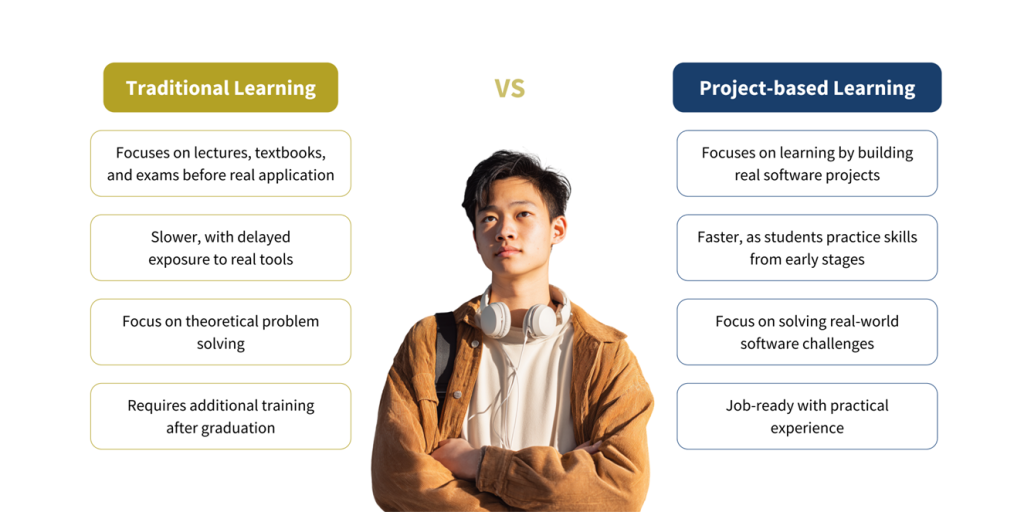
Hands-On Software Engineering Program vs Traditional Degree
Not all software engineering degrees prepare students in the same way.
Traditional Theory-Heavy Software Engineering Programs
Traditional programs often delay hands-on work.
Students spend much of the early years studying theory before applying it meaningfully. Practical exposure may be limited to a final-year project or short internship.
As a result, graduates may understand concepts but feel unprepared to work on real codebases or collaborate in engineering teams.
Hands-On, Project Driven Software Engineering Programs
A hands-on software engineering program integrates projects throughout the learning journey.
Students practice applying knowledge continuously. They gain experience with tools, workflows, and collaboration early rather than at the end.
This approach reduces the gap between graduation and employment and helps students feel job-ready sooner.
Practical Software Engineering Degree: What Students Actually Learn
A practical software engineering degree focuses on usable skills rather than exam performance alone.
Assessment often includes project outcomes, code quality, teamwork, and problem-solving ability.
Technical Skills Built Through Projects
Through repeated project work, students develop:
- Programming and debugging skills
- Experience with development tools
- Understanding of testing and version control
- Familiarity with real development workflows
Professional Skills Developed Through Team-Based Work
Real software engineering is rarely a solo activity.
Project-based programs emphasize collaboration. Students learn to communicate ideas, manage tasks, handle feedback, and work within teams.
These professional skills are critical in real engineering roles and often underdeveloped in theory-heavy programs.
Why Employers Prefer Graduates From Project Based Programs
Employers hire based on capability.
A graduate from a project-based program can show:
- Real projects they have built
- Problems they have solved
- Tools and technologies they have used
- How they work in teams
Between 2020 and 2025, employers increasingly valued portfolios and project experience when hiring junior engineers. Candidates who can demonstrate applied skills often adapt faster and require less onboarding.
Projects act as proof, not promises.
How CLaaS2SaaS Delivers a Project Based Software Engineering Degree
CLaaS2SaaS Software Engineering is designed around hands-on, project-driven learning from the very beginning.
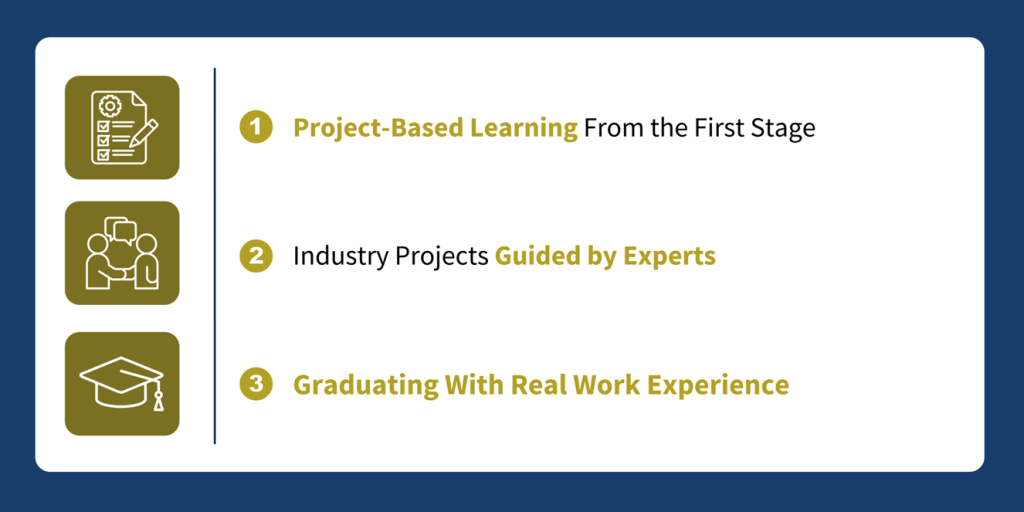
Project-Based Learning From the First Stage
Students begin applying concepts early, even while learning fundamentals. Rather than waiting until advanced semesters, they work on small but meaningful projects alongside core topics such as programming logic, databases, and system design.
This early exposure helps students understand why concepts matter. By building simple applications from the start, students develop confidence and avoid the common gap between “knowing the theory” and “knowing how to use it.”
Industry Projects Guided by Experts
Projects reflect real industry challenges.
As students progress, projects evolve into industry-aligned assignments that reflect real software engineering challenges. These are not hypothetical case studies, but practical problems inspired by how software teams operate in real companies.
Students receive guidance from experienced professionals who have worked in modern engineering environments. Feedback focuses on code quality, problem-solving approach, documentation, and collaboration, mirroring how work is reviewed in professional teams rather than graded like a traditional exam.
Capstone Project: Building a Real Software Solution End-to-End
In the final stage, students complete a capstone project that brings together everything they have learned. This project simulates a real-world software development cycle, from problem definition to deployment.
For example, a capstone project may involve:
By the time students complete the capstone, they have experienced what it means to work like a software engineer, not just study software engineering. - Designing and building a full-stack application to solve a real user or business problem
- Working in teams using version control, issue tracking, and agile-style workflows
- Developing features, fixing bugs, and iterating based on feedback
- Presenting the final product with technical documentation and a working demo
Technical Skills Built Through Projects
Through repeated project work, students develop:
- Programming and debugging skills
- Experience with development tools
- Understanding of testing and version control
- Familiarity with real development workflows
Professional Skills Developed Through Team-Based Work
Real software engineering is rarely a solo activity.
Project-based programs emphasize collaboration. Students learn to communicate ideas, manage tasks, handle feedback, and work within teams.
These professional skills are critical in real engineering roles and often underdeveloped in theory-heavy programs.
Technical Skills Built Through Projects
Through repeated project work, students develop:
- Programming and debugging skills
- Experience with development tools
- Understanding of testing and version control
- Familiarity with real development workflows
Professional Skills Developed Through Team-Based Work
Real software engineering is rarely a solo activity.
Project-based programs emphasize collaboration. Students learn to communicate ideas, manage tasks, handle feedback, and work within teams.
These professional skills are critical in real engineering roles and often underdeveloped in theory-heavy programs.
Graduating With Real Work Experience
The CLaaS2SaaS Bachelor’s Degree in Software Engineering integrates apprenticeship-style learning.
Students can graduate with up to 12 months of real work experience, gaining exposure to professional environments before entering the job market.
Learn more here.
Technical Skills Built Through Projects
Through repeated project work, students develop:
- Programming and debugging skills
- Experience with development tools
- Understanding of testing and version control
- Familiarity with real development workflows
Professional Skills Developed Through Team-Based Work
Real software engineering is rarely a solo activity.
Project-based programs emphasize collaboration. Students learn to communicate ideas, manage tasks, handle feedback, and work within teams.
These professional skills are critical in real engineering roles and often underdeveloped in theory-heavy programs.
Technical Skills Built Through Projects
Through repeated project work, students develop:
- Programming and debugging skills
- Experience with development tools
- Understanding of testing and version control
- Familiarity with real development workflows
Professional Skills Developed Through Team-Based Work
Real software engineering is rarely a solo activity.
Project-based programs emphasize collaboration. Students learn to communicate ideas, manage tasks, handle feedback, and work within teams.
These professional skills are critical in real engineering roles and often underdeveloped in theory-heavy programs.
Project Based Software Engineering Degree vs Bootcamps
Bootcamps are often compared to project-based degrees.
Bootcamps move fast and focus on specific tools. They may help students learn quickly, but they often lack depth, structure, and recognized academic credentials.
A project based software engineering degree combines:
- Structured, progressive learning
- Academic recognition
- Long-term skill development
- Sustained project experience
This balance makes it suitable for students seeking both credibility and real capability.
Common Misconceptions About Project Based Degrees
Some students worry that project-based learning means “less theory.”
In reality, theory still exists. It is simply taught with context and purpose, making it easier to understand and apply.
Others assume project-based programs are only for advanced learners. In fact, many are designed to support beginners through structured progression and guidance.
Project-based does not mean unstructured. It means applied.
Who Should Choose a Project Based Software Engineering Degree?
This pathway suits students who prefer learning by doing.
It works well for learners who enjoy building, experimenting, and solving problems rather than memorizing concepts. It also suits students who want a clear connection between what they study and the careers they pursue.
Parents often value this approach because it focuses on employability, confidence, and real outcomes alongside academic recognition.
Is a Project Based Software Engineering Degree Worth It?
A project based software engineering degree is worth it when it delivers real capability.
By graduation, students have:
- Built multiple real projects
- Used professional tools
- Worked in teams
- Gained real-world exposure
This reduces uncertainty and improves confidence when entering the workforce.
Learning by building creates stronger engineers.
Course

Start Building Your Software Engineering Career With CLaaS2SaaS
Software engineering is learned through practice.
With the CLaaS2SaaS Bachelor’s Degree in Software Engineering, students:
- Learn through real projects
- Develop job-ready skills early
- Graduate with real work experience