Blog
Step-by-Step Guide to Data Scientist Career Transition Course

SHARE THIS:


Data roles are among the most sought-after in the modern workforce, but many professionals find themselves unsure of how to break into them. Organizations across finance, healthcare, retail, logistics, and technology are investing heavily in analytics and AI to guide smarter decisions, automate processes, and stay competitive. As a result, roles like Data Analyst, Business Intelligence Analyst, and Junior Data Scientist have moved from “nice-to-have” positions to core business functions.
Yet despite this growing demand, the path into data careers often feels unclear.
For many working adults, going back to university for another degree isn’t realistic. Self-learning through scattered online tutorials can feel overwhelming and unstructured. And without hands-on experience, even motivated learners struggle to prove their capabilities to employers. This gap between learning and employability is exactly why so many career switchers feel stuck — interested in data science, but unsure how to make the leap.
A data scientist career transition course offers a more practical alternative. Instead of years of theory-heavy study, these programs focus on targeted, job-relevant skills delivered in a structured and accelerated format. Learners build competence step by step — from data preparation and analysis to visualization, AI integration, and real-world problem solving — so they can contribute meaningfully to the workplace from day one.
More importantly, this approach emphasizes application over memorization. Rather than simply understanding concepts, learners practice solving realistic business problems, working with messy datasets, and presenting insights that drive decisions. The result isn’t just knowledge — it’s confidence and demonstrable ability.
This guide walks you through exactly how a structured, project-based pathway works, why applied analytics matters more than ever, and how a focused transition framework can help you move from your current role into a future-ready Data & AI career faster and more effectively.
Why a Data Scientist Career Transition Matters Now

Across industries, organizations increasingly rely on data to make decisions. Data analytics and AI drive product innovation, optimize operations, and inform strategic planning. Research shows that demand for AI-complementary skills — such as digital literacy, teamwork, and analytical problem-solving — is growing significantly, even as automation reshapes the labor market.
This means companies are not just automating tasks. They are demanding human skills that work with AI — like contextualizing data analysis and applying insights to business decisions.
However, industry leaders consistently report a gap between employer expectations and available talent. A survey of online job postings, for example, highlights mismatch between the skills taught by many educational programs and those required in the data job market, creating a persistent skills shortage.
This gap creates a strategic opportunity: for learners willing to build applied skills, the demand for analytics professionals remains strong.
What Is a Data Scientist Career Transition Course?
A data scientist career transition course is designed to help professionals move into data roles without spending years in traditional education.
Unlike standard degrees, these programs focus on:
- practical analytics and AI tools
- solving business problems with data
- building real, portfolio-ready projects
- frameworks that mirror industry tasks
Rather than emphasizing abstract theory, career transition pathways concentrate on the actionable skills employers seek — including data cleaning, model building, interpretation, and data storytelling.
Studies tracking graduate outcomes show that combining foundational education with targeted upskilling (e.g., industry certifications or applied projects) significantly enhances employability — especially roles in analytics and machine learning.
Learning by Doing
Instead of passively absorbing lectures, learners tackle industry-relevant projects that mirror the challenges organizations face today. These projects are designed to:
- Simulate workplace dynamics by requiring collaboration, problem-solving, and decision-making.
- Low-code development, AI automation, and data analytics into cohesive solutions.
- Deliver tangible outcomes that can be showcased in a professional portfolio.
Traditional Learning vs CLaaS2SaaS’ Applied Work-Integrated Pathway

Traditional Academic or Self-Study Route
Many professionals begin with:
While these can provide useful information, they often lack direct links to real industry tasks, and students may struggle to apply concepts to actual business problems. This disconnect between acquired knowledge and workplace expectations is a recurring theme in research examining curriculum readiness in data science education, that’s according to the Frontiers research report. - self-paced online courses
- university degrees
- ad-hoc tutorials
CLaaS2SaaS’ Skills-First Career Transition Model
By contrast, CLaaS2SaaS’ framework brings learners through progressively realistic challenges, helping them build:
By contrast, CLaaS2SaaS’ framework brings learners through progressively realistic challenges, helping them build:
- applied analytics capability
- real project outcomes
- dashboard and model deliverables
- professional portfolios that clearly document their work
How a 4-Month Career Transition Framework Works
Structured career‑transition pathways usually follow a progressive, step‑by‑step sequence that builds capability layer by layer. The journey typically looks like this:- Foundations: statistics, data literacy, core tools (Excel, SQL)
- Intermediate: Python/R, data manipulation, visualization
- Applied Analytics: insights, BI tools, decision frameworks
- AI & ML: predictions, model evaluation, automation
- Capstone Projects: final projects designed to reflect real industry problems
What You Actually Learn (Not Just Theory)
A strong transition course prioritizes real outcomes over abstract lectures. Learners typically build skills in:
- data cleaning and preprocessing
- business problem formulation
- exploration and analysis of real datasets
- dashboard design (e.g., Power BI, Tableau)
- basic machine learning implementation
- results interpretation and communication
This approach mirrors how data professionals contribute to decisions within companies — assessing messy data, crafting insights, and aligning outcomes with business needs.
It also aligns with what employers list as core needs in job descriptions — including analytics frameworks, tool proficiency, and decision support skills.
Project Based Data Science Training That Builds Real Confidence
The most effective transition programs use project-based data science training — where learners repeatedly practice end-to-end analytics workflows using real or realistic business cases.
This trains learners to:
This iterative, immersive practice builds confidence much more effectively than passive study alone. Research in education has found project-based learning significantly improves knowledge integration and problem-solving skills compared with traditional modalities. - read and frame business questions
- prepare and transform data
- analyze and model insights
- visualize and communicate results
- recommend actions
Career Outcomes That Justify the Switch
Graduates with applied data experience are prepared for roles like:
- Data Analyst
- Business Intelligence Analyst
- Junior Data Scientist
- AI/ML Associate Analyst
- Reporting Analyst
These positions are in demand across multiple sectors — from finance and healthcare to technology and consulting. Job market analyses report that data science and analytics positions remain among the fastest-growing technical job categories.
Even when overall tech hiring slows, demand for AI and data capabilities continues to show resilience. In a recent labor market analysis, job postings referencing AI skills rose even as broader tech hiring declined, underscoring the ongoing prioritization of analytical competencies.
Why Employers Prefer Practically Trained Data Professionals
Employers increasingly adopt skill-based hiring — placing greater emphasis on what candidates can do rather than where they learned it. A large analysis of job postings found that the demand for AI and analytics skills outpaced the emphasis on formal degree requirements, with employers prioritizing portfolios, projects, and demonstrated competencies.
This trend reflects the reality that data work is less about memorizing content and more about solving concrete problems in business contexts.
Addressing Common Misconceptions
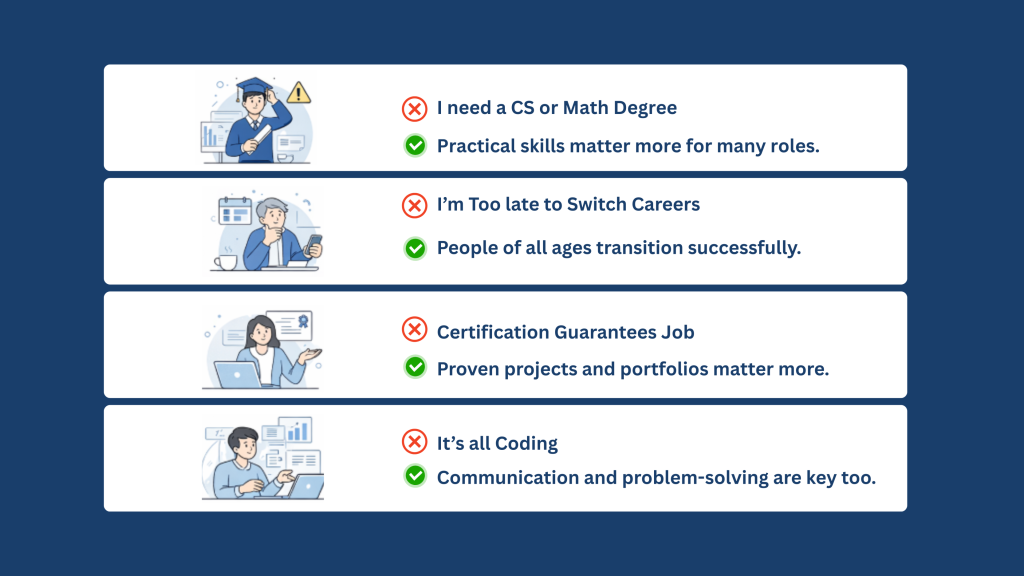
Despite the growing popularity of analytics careers, many capable professionals hesitate to start because of common myths about data science.
“I need a computer science or math degree first.”
Not necessarily. While advanced research roles may require deep technical backgrounds, many entry-level and applied analytics roles focus more on practical thinking — cleaning data, spotting trends, and communicating insights clearly. With structured guidance and the right tools, these skills are highly learnable.
“I’m too late to switch careers.”
Career transitions into data are happening at every age. In fact, professionals with prior work experience often perform better because they already understand business processes and stakeholder needs. Combining domain knowledge with analytics skills can make you even more valuable than someone starting from scratch.
“Certification alone guarantees a job.”
Certificates help, but employers increasingly look for proof of real work. Portfolios, dashboards, and completed projects carry more weight because they demonstrate applied capability. That’s why project-based training is so critical — it gives you evidence, not just credentials.
“Data science is all coding.”
Coding is just one piece of the puzzle. A large part of the job involves asking the right questions, interpreting results, and explaining insights to non-technical stakeholders. Communication and problem-solving are just as important as technical tools.
When these misconceptions are removed, the path becomes far less intimidating — and far more achievable.
Who Should Choose This Path?
A structured transition pathway is especially valuable for learners who want clarity, momentum, and tangible results.
This route is ideal for:
- Working professionals seeking a more future-proof career
- Data analysts ready to level up into AI or data science roles
- Career switchers from marketing, finance, operations, or engineering
- Fresh graduates who want practical skills beyond theory
- Professionals returning to the workforce after a break
- Anyone who prefers hands-on, guided learning over self-study
If you’ve ever felt stuck watching endless tutorials without knowing how everything connects, a structured program can provide the direction you’re missing. Instead of guessing what to learn next, you follow a roadmap designed around real workplace expectations.
For many learners, that structure alone dramatically shortens the time it takes to become job ready.
Is This Path Right for You?
If your goals include:
…then this is not just an alternative — it’s a strategically effective one. - tangible, demonstrable outcomes
- real, portfolio-ready experience
- alignment with employer expectations
- confidence working with real business problems
Course

Start Your Data & AI Career Journey Now
The barrier to entry into data roles has shifted from credentials to capability.
With the right project-based, applied learning pathway, you can accelerate your career transition — translating data into insights and impact, not just concepts.