Software Engineering Degree vs Bootcamp: Which Is Better for Long-Term Career Growth?
SHARE THIS:


Choosing how to enter the tech industry is no longer just an education decision. It is a career strategy decision that can shape professional mobility, earning potential, and long-term relevance in a rapidly evolving field. The debate around software engineering degree vs bootcamp continues to grow as more learners search for faster and more affordable ways to access technology roles, especially working adults and career switchers who cannot pause their income for years. The pathway someone chooses today can influence not only how quickly they get hired, but also how far they can progress later.
At first glance, the decision seems straightforward. Bootcamps promise speed, hands-on projects, and job-ready skills. Degree programs promise structured learning, deeper technical foundations, and globally recognized credentials. Both pathways appear to offer a solution, but they are built around different assumptions about how careers develop. One prioritizes immediate execution, while the other emphasizes long-term knowledge frameworks and formal recognition.
The technology job market has also evolved. Employers are no longer hiring solely for familiarity with tools or programming languages. They are looking for professionals who understand systems, can collaborate across teams, adapt to new technologies, and grow into more complex responsibilities over time. This shift means the real question is not just how fast you can secure your first role, but how well your learning pathway prepares you for sustained growth and changing demands.
When the goal is long-term career growth, the choice becomes more complex. A pathway focused only on short-term skills may help with entry but can limit progression into senior engineering, architecture, or leadership roles. A pathway focused mainly on theory may provide depth but delay the practical exposure employers expect early on. Learners often feel forced to choose between speed and credibility, practice and recognition, or income and education.
This is why hybrid, work-integrated learning models are gaining attention. Instead of treating education and employment as separate phases, they combine skill development, industry experience, and academic progression in parallel. A model like CLaaS2SaaS is designed around how modern careers actually unfold, not in isolated stages but as continuous cycles of learning, application, and advancement. This article explores what each pathway offers, where each one falls short, and why an integrated approach can support both immediate employability and sustainable career progression.
What Is a Bootcamp and What Does It Offer?
Coding bootcamps are short, intensive programs built to help learners gain technical skills quickly. Most run from a few weeks to several months and focus heavily on applied development skills.
Common bootcamp features include:
- Project-based coding Learners build functional applications and systems, allowing them to apply concepts in practical scenarios similar to real development work.
- Real-world simulations Training activities mirror workplace environments, helping learners practice problem-solving, collaboration, and technical decision-making under realistic conditions.
- Portfolio building Students graduate with tangible projects that demonstrate their technical ability and approach to solving problems, which employers can directly evaluate.
- Interview preparation Programs provide structured guidance on technical interviews, coding challenges, and communication skills needed to perform confidently during hiring processes.
- Career coaching Learners receive support in career planning, job search strategy, and professional development to help them transition into and grow within the tech industry.
Bootcamps excel at helping learners enter the job market fast. They are often structured around current industry tools and stacks, such as web development frameworks, JavaScript ecosystems, or Python environments.
However, bootcamps usually concentrate on how to build, not always why systems work the way they do. According to CourseCompare, bootcamps are skills-focused, while degrees provide deeper theoretical grounding that supports adaptability over time.
Bootcamps are a strong starting point, but they may not provide the academic recognition or conceptual depth required for long-term progression into architecture, leadership, or specialized technical fields.
What Is a Software Engineering Degree and Why It Matters
A software engineering or computer science degree provides structured learning across both practical and theoretical areas. Beyond coding, students learn:
This deeper foundation helps graduates adapt as technologies evolve. Frameworks change, but core computing principles remain relevant. - Algorithms and data structuresLearners understand how to organize data efficiently and design logical processes that improve performance, scalability, and problem-solving effectiveness.
- System design and architectureStudents learn how complex software systems are structured, enabling them to design reliable, maintainable, and scalable applications.
- Databases and operating systems This area builds knowledge of how data is stored, managed, and retrieved, as well as how software interacts with the core systems that run applications.
- Security principlesLearners gain awareness of how to protect systems, data, and users by understanding vulnerabilities, risk management, and secure development practices.
- Computational problem solvingStudents develop structured thinking skills to break down complex challenges into logical steps that can be solved efficiently using technology.
According to BestColleges, degree programs often prepare learners for a broader range of long-term career options, including advanced technical roles and management pathways.
Degrees also carry formal academic recognition, which many employers consider when evaluating candidates for promotions or specialized roles.
Software Engineering Degree vs Bootcamp: Comparing Career Outcomes
Understanding fast track vs bootcamp outcomes requires looking beyond the first job.
Time to Employment
- Bootcamps: Faster entry into junior roles
- Degrees: Longer study period before first job
Depth of Knowledge
- Bootcamps: Focus on tools and frameworks
- Degrees: Cover tools plus foundational theory
Recognition and Credibility
- Bootcamps: Certificate credentials
- Degrees: Academic qualification
Long-Term Career Growth
- Bootcamps: Strong early career entry
- Degrees: Greater mobility into senior, specialized, or leadership roles
Years 0–2: Entry and Execution
Bootcamp graduates often enter junior developer roles faster, focusing on feature implementation using tools like React, Node.js, REST APIs, Git, and basic cloud services. Degree-based learners may take slightly longer to enter the workforce but begin with broader exposure to system design, databases, algorithms, and software development lifecycles, helping them understand how individual components fit into larger systems.
Years 3–5: System Ownership and Depth
As expectations increase, many bootcamp graduates need additional upskilling to move beyond execution-focused roles. Engineers at this stage are expected to work with scalable architectures, backend services, cloud platforms (AWS, Azure, GCP), CI/CD pipelines, and automated testing. Degree holders more commonly progress into mid-level roles with responsibility for system design, performance optimization, security considerations, and DevOps practices.
Years 6–10: Architecture and Leadership
Senior roles increasingly involve architecting distributed systems, leading teams, and making complex technical decisions across cloud-native platforms, microservices, security, and enterprise systems. These positions often favor candidates with strong foundations and recognized academic qualifications, particularly in enterprise, regulated, or international environments, where long-term technical credibility matters.
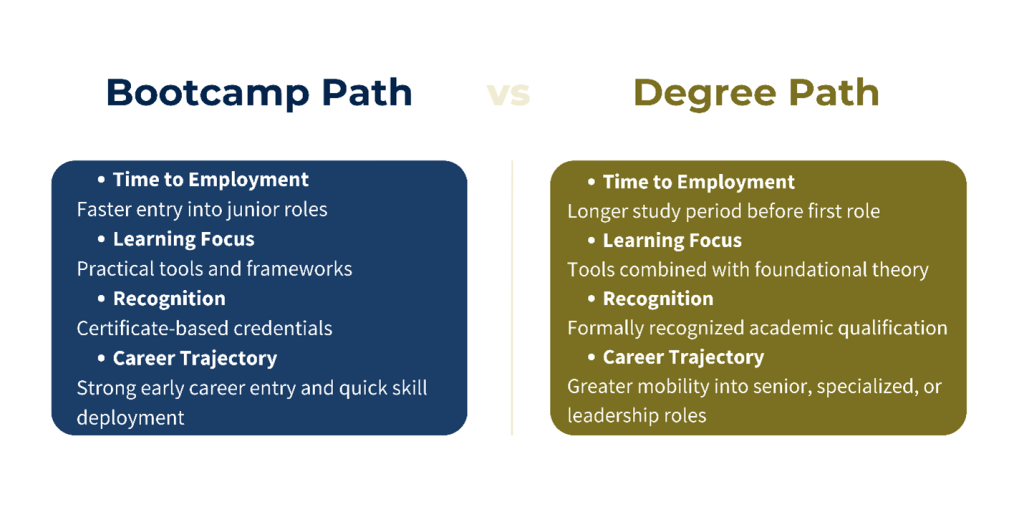
If speed to employment is the priority, then bootcamps clearly win because they help learners gain practical skills quickly. If broader knowledge that transfers across technologies and deeper recognition in corporate, government, or international roles is the goal, then formal degrees typically provide stronger long-term value. According to CourseCompare, degree graduates often enjoy greater flexibility as their careers progress, especially when moving into complex or cross-functional roles.
Limitations Facing Each Pathway
Bootcamp Limitations
- Limited academic recognition
Bootcamp credentials may not carry the same weight as formal degrees in some organizations, particularly for senior roles or international opportunities. - Narrow focus on specific tools
Training often centers on current technologies, which can limit exposure to broader computing principles needed for long-term adaptability. - May require further formal study later
Some learners pursue additional academic qualifications later in their careers to meet advancement or employer requirements.
Traditional Degree Limitations
- Longer time to complete
Traditional degree programs typically require several years of study before learners can fully enter the workforce, which can delay income and practical exposure. - Higher upfront cost
Degree pathways often involve significant tuition and related expenses that must be paid before career returns are realized. - Often limited integration with real work experience
Many traditional programs separate classroom learning from industry practice, leaving students with less hands-on exposure before graduation.
This creates a trade-off between speed and depth, which is especially challenging for working adults.
CLaaS2SaaS: A Hybrid Pathway That Combines Both
Instead of choosing one side in the software engineering degree vs bootcamp debate, CLaaS2SaaS is built to integrate the strengths of both pathways while minimizing their limitations.
CLaaS2SaaS stands for Competency Learning as a Service to Software as a Service, a model designed around how modern tech careers actually develop. Rather than separating education and employment into different stages, this approach allows learners to build skills, gain experience, and progress academically in parallel., this approach allows learners to build skills, gain experience, and progress academically in parallel.
Their work-study programs reduce risk by allowing learners to enter the workforce quickly without closing the door on academic recognition, senior roles, or international mobility. Instead of revisiting education later at higher cost, learners build credentials progressively as their career expands.
It combines:
- Applied, project-based learning
Learners develop technical capability by working on structured projects that reflect real development tasks, strengthening both confidence and job readiness. - Industry experience during study
Work exposure is integrated into the learning journey, allowing students to understand professional workflows, collaboration, and delivery standards while still studying. - Pathways toward a recognized Bachelor of Science degree
Learners are not limited to short-term certifications and can progress toward a formal academic qualification that supports long-term career mobility. - Flexible scheduling for working learners
The structure is designed to accommodate professionals balancing work, family, and education, reducing the need for career interruption - Personalized mentoring
Guidance is aligned with individual career goals, helping learners make informed decisions about specialization, progression, and professional development.
How CLaaS2SaaS Works in Practice
A typical CLaaS2SaaS pathway includes:
This approach improves fast track vs bootcamp outcomes because learners graduate with both experience and academic credentials. Fast-track outcomes are strongest when speed does not replace foundation, but compresses timelines without removing progression. - Applied Technical Training
Learners develop job-ready skills through guided project work. - Industry Integration
Students gain real experience while learning, building portfolios grounded in real use cases. - Academic Progression
Learners can progress toward a Bachelor’s degree, adding formal recognition. - Career Mentorship
Support focuses on long-term career direction, not just first-job placement.
Why Employers Prefer Lower-Risk, Work-Integrated Learning Models
In markets like Singapore, Philippines, Malaysia, Indonesia, where employers often balance skills-first hiring with formal qualification screening (especially in enterprise, finance, and government-linked sectors) academic recognition continues to influence promotion and mobility decisions. This makes long-term credential strategy particularly important for learners planning regional or global careers.
Employers increasingly look for professionals who combine:
- Practical experience
The ability to apply knowledge in real scenarios shows that a candidate can deliver outcomes, work within deadlines, and handle the complexities of real development environments. - Theoretical understanding
A strong foundation helps professionals make informed technical decisions, troubleshoot unfamiliar problems, and design solutions that scale beyond immediate tasks. - Adaptability
Technology evolves quickly, so employers value individuals who can learn new tools, shift between projects, and adjust to changing business or technical requirements. - Professional collaboration skills
Modern software development is team-based, requiring clear communication, cross-functional coordination, and the ability to contribute effectively within structured workflows.
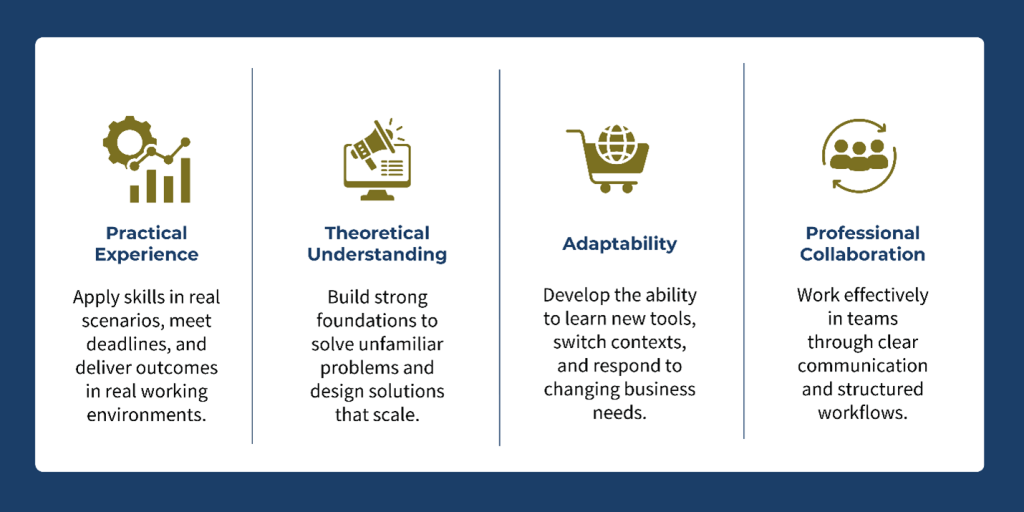
Graduates of integrated models can demonstrate both real-world application and structured learning. That balance supports stronger long-term career growth compared to single-track pathways.
Who Should Choose Which Path?
Bootcamp may be right if:
- You need immediate entry into the workforce
- You already hold a degree
- You plan to self-direct further learning
A work-integrated degree pathway is better if:
- You want recognized credentials
- You aim for senior or specialized roles
- You want balanced skill depth and practical experience
- You are planning for long-term mobility
Addressing Common Misconceptions
“Bootcamps are always cheaper”
They may appear more affordable at the start, but future education needs, credential upgrades, or specialized training can increase the total long-term investment.
“Degrees are too slow”
Modern work-integrated learning models allow learners to gain industry experience while studying, reducing the gap between education and employment.
“Employers only care about skills”
Skills matter for entry-level hiring, but long-term progression often depends on foundational knowledge, credibility, and recognized qualifications.
“You can learn everything online for free”
While free resources are valuable, structured programs provide guided progression, feedback, accountability, and recognized outcomes that self-study often lacks.
“Bootcamps guarantee jobs”
No learning pathway can guarantee employment, as career success depends on performance, adaptability, and market conditions.
Course

Conclusion
The software engineering degree vs bootcamp choice is not about which is easier. It is about which supports your career across decades.
Bootcamps help you enter. Degrees help you grow. A hybrid pathway like CLaaS2SaaS helps you do both at the same time.
Compare Learning Pathways
Explore how different learning routes compare in recognition, employability, and career progression and see how CLaaS2SaaS blends practical training with academic advancement for sustainable success.