Software Engineering Degree with AI & Secure Development
SHARE THIS:


The software industry is evolving at a pace that makes static skill sets obsolete. Artificial intelligence is now embedded into everyday development workflows, while security risks continue to grow in scale and complexity. For mid-career professionals, this creates a real challenge. How do you advance, pivot, or move into leadership roles without stepping away from your career or restarting from scratch?
A software engineering professional certificate with AI is no longer just an academic credential. It is a strategic investment for professionals who want to remain relevant, increase their earning potential, and future-proof their careers.
This article is written for experienced professionals who are navigating career plateaus, planning a mid-career switch, or aiming for senior and leadership roles. We will explore why AI and secure development skills are now essential, where traditional education falls short, and how a modern, work-integrated pathway offers a better alternative.
Why Software Engineering Careers Are Being Redefined by AI and Security
Software development today looks very different from even five years ago. AI-assisted coding, automation, and intelligent systems are becoming standard across industries. According to McKinsey, AI adoption has more than doubled in recent years, with organizations integrating AI across engineering, operations, and product development.
At the same time, software security has become a board-level concern. IBM reports that the average cost of a data breach now exceeds USD 4 million, making secure development a business-critical capability rather than a technical afterthought.
For mid-career professionals, this means one thing. Staying competitive requires deeper engineering capability, not just surface-level tools or short-term certifications.
What Makes a Software Engineering Degree with AI Relevant Today
A modern software engineering applied master’s with AI goes far beyond traditional programming education. It combines engineering fundamentals with applied artificial intelligence and secure system design.
Key differences compared to traditional programs
- AI integration across the software lifecycle, not isolated machine learning modules
- Secure-by-design development principles embedded from day one
- Real-world application through industry-aligned projects
- Focus on scalability, maintainability, and risk management
Why Secure Development Skills Are Now Non-Negotiable
Security vulnerabilities are no longer rare edge cases. They are a daily operational risk. The Open Web Application Security Project consistently highlights how common software flaws such as insecure authentication and poor access control remain among the top causes of breaches
A secure software development graduate diploma prepares professionals to think defensively while building systems. This includes understanding how design decisions impact data protection, compliance, and long-term system stability.
Secure development competencies employers value
- Secure coding and vulnerability prevention
- Authentication and authorization architecture
- Encryption and data integrity principles
- Secure APIs and backend systems
- Risk-aware testing and validation
AI, Engineering, and Leadership Progression
Many mid-career professionals aim to move beyond individual contributor roles. However, leadership roles in software today demand more than people management.
A recognized software development manager qualification increasingly depends on technical credibility. Leaders must be able to evaluate AI-driven solutions, balance innovation with risk, and guide teams through complex architectural decisions.
According to Gartner, organizations expect technology leaders to combine engineering depth with business and risk awareness, especially as AI becomes embedded across enterprise systems.
An AI-focused engineering education equips professionals to step into these responsibilities with confidence.
Why Traditional Degrees Often Do Not Work for Mid-Career Professionals
Many professionals consider returning to university, only to discover major obstacles.
Common limitations of traditional degrees
For experienced professionals, education must deliver practical outcomes quickly and credibly. - Full-time schedules that disrupt income and career momentum
- Heavy emphasis on theory over applied capability
- Limited coverage of AI-driven engineering practices
- Minimal exposure to real-world secure development challenges
How the CLaaS2SaaS Pathway Addresses These Challenges
The CLaaS2SaaS software engineering pathway is designed specifically for professionals who need measurable career impact without career interruption.
Work-integrated learning
Learners work on real, industry-aligned projects that mirror modern enterprise environments. This bridges the gap between learning and application.
Stackable credentials
Professional certificates build into diplomas and can progress toward an applied master’s degree. This allows learners to advance in stages while managing risk and time.
AI and security embedded throughout
AI application development and secure engineering are core components, not optional add-ons.
Flexible, part-time structure
Designed for working professionals, the pathway fits around existing commitments.
This model aligns closely with how employers evaluate readiness and capability.
What You Learn in an AI-Driven Software Engineering Pathway
A future-ready program balances depth with applicability.
Core learning areas include 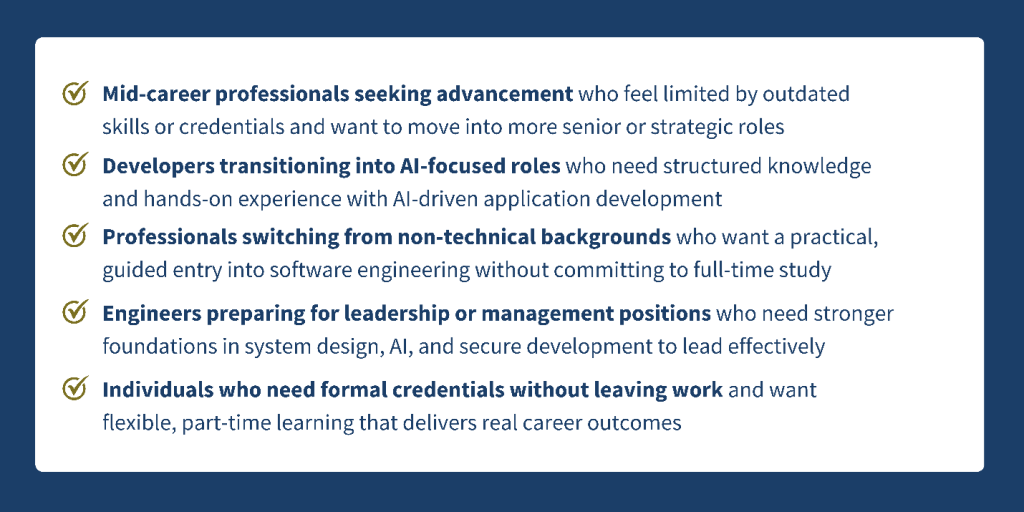
Each module focuses on real-world problem-solving, not isolated academic theory.
Who Is Best Suited For This Type of Degree
This pathway is well suited for professionals who want to grow without restarting their careers, including:- Mid-career professionals seeking advancement who feel limited by outdated skills or credentials and want to move into more senior or strategic roles
- Developers transitioning into AI-focused roles who need structured knowledge and hands-on experience with AI-driven application development
- Professionals switching from non-technical backgrounds who want a practical, guided entry into software engineering without committing to full-time study
- Engineers preparing for leadership or management positions who need stronger foundations in system design, AI, and secure development to lead effectively
- Individuals who need formal credentials without leaving work and want flexible, part-time learning that delivers real career outcomes
Traditional Education vs Modern Work-Integrated Engineering
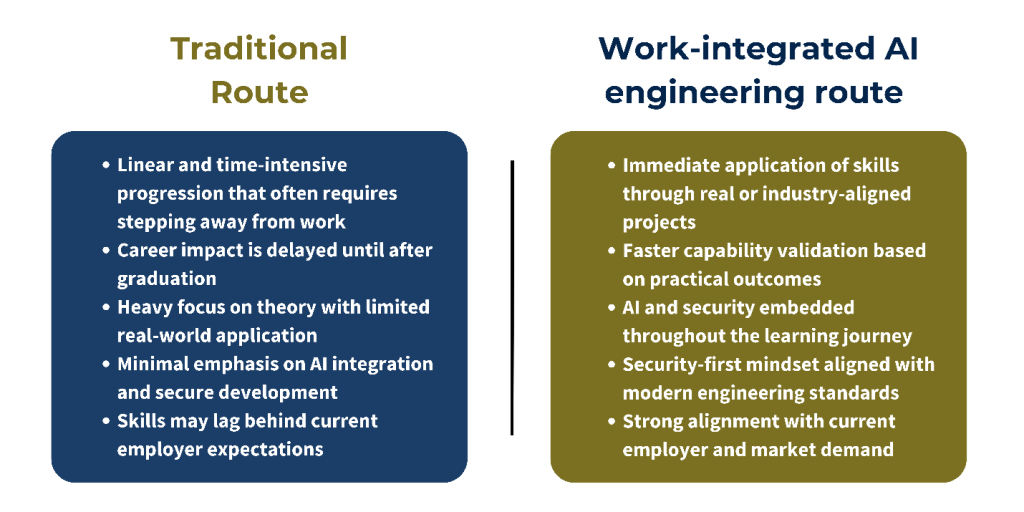
Traditional route
- Linear and time-intensive progression that often requires stepping away from work
- Career impact is delayed until after graduation
- Heavy focus on theory with limited real-world application
- Minimal emphasis on AI integration and secure development
- Skills may lag behind current employer expectations
Work-integrated AI engineering route
- Immediate application of skills through real or industry-aligned projects
- Faster capability validation based on practical outcomes
- AI and security embedded throughout the learning journey
- Security-first mindset aligned with modern engineering standards
- Strong alignment with current employer and market demand
For mid-career professionals, the work-integrated approach offers a stronger return on time and effort while supporting continuous career progression.
Conclusion: A Smarter Way to Advance in Software Engineering
Career growth in technology now depends on depth, adaptability, and credibility. A modern software engineering degree with AI enables mid-career professionals to move beyond stagnation, qualify for leadership roles, and transition into future-ready positions without sacrificing their current careers.By combining AI-driven development, secure engineering principles, and work-integrated learning, this pathway aligns education with real-world demands. It is not about learning more tools. It is about building capability that lasts.
Ready to Future-Proof Your Engineering Career?
If you are serious about advancing your career, now is the right time to act.The CLaaS2SaaS software engineering pathway is designed for professionals who want practical outcomes, industry relevance, and flexible progression. Through applied projects, stackable credentials, and AI-focused learning, you can build skills that employers actively seek.
Whether your goal is leadership, specialization, or a strategic career switch, this pathway provides a clear and realistic route forward.
Course

Frequently Asked Questions (FAQ)
What is a software engineering degree with AI?
A software engineering degree with AI combines core software engineering principles with applied artificial intelligence and secure development practices. Instead of learning AI only as theory, students apply it directly in real-world software systems, including intelligent automation, data-driven applications, and secure system design.
Is a software engineering degree with AI suitable for mid-career professionals?
Yes. A software engineering degree with AI is especially valuable for mid-career professionals who already have work experience and want to advance, pivot, or future-proof their careers. Unlike entry-level degrees, modern AI-focused programs are designed to build on existing professional knowledge while introducing applied AI, secure development, and real-world engineering practices that employers now expect.
How does this differ from a traditional software engineering degree?
Traditional degrees often emphasize theory and full-time study. A modern software engineering degree with AI focuses on applied learning, real-world projects, and current industry tools. It integrates AI and security throughout the curriculum and is typically delivered in a flexible, part-time format that allows professionals to continue working while studying.
Can this degree help me move into a leadership or management role?
Yes. Many professionals use this pathway to qualify for senior and leadership positions. The combination of AI, secure engineering, and applied project experience supports progression toward roles that require a software development manager qualification, such as technical lead, engineering manager, or solutions architect. These roles require both technical depth and decision-making capability.
Is this degree relevant outside of pure tech companies?
Absolutely. AI-driven and secure software systems are now essential across industries including finance, healthcare, logistics, education, and manufacturing. A software engineering degree with AI prepares professionals to work across sectors where digital systems are central to business operations.