Enterprise Transformation
Corporate Learning Transformation in the AI Era
Corporate Learning Transformation in the AI Era
Content
Content
Corporate learning is at a crossroads.
Over the past decade, enterprises have poured billions into digital platforms, e-learning libraries, and corporate academies. Yet despite this investment, workforce capability gaps continue to widen. According to the World Economic Forum’s Future of Jobs Report 2023, 39% of workers’ core skills are expected to change by 2030, driven by AI adoption, automation, and evolving industry demands.
The problem is not a shortage of training resources. The problem is a growing disconnect between how enterprises learn, how work is actually performed, and how quickly workforce capability must now adapt in the AI economy.
If your organization is still running annual training calendars, static LMS (Learning Management System) platforms, and role-agnostic e-learning modules, this article is for you. Enterprises across ASEAN recognizes exactly this challenge, and the pattern is consistent: the problem is never a lack of content. It is always a lack of integration between learning and work.
Explore how enterprises are reimagining L&D for the AI era
The Real Problem with Corporate Learning Today
Most enterprises today operate in what can be called a “content abundance trap.”
Thousands of courses, certifications, and micro-credentials are available at the click of a button. Yet employees struggle to identify what is actually relevant to their roles. L&D teams face the constant burden of curating, updating, and validating materials in a landscape that evolves faster than content cycles can keep up with.
This creates a compounding problem. Skill lifecycles are shrinking. Digital, AI, and professional competencies now evolve so rapidly that learning content can become outdated almost as soon as it is deployed. According to McKinsey & Company, 87% of executives report experiencing skill gaps in their workforce now or expecting them within the next few years, yet most organizations lack the infrastructure to respond fast enough.
Compounding this further is the fragmentation of learning ecosystems. Learning Management Systems, HR platforms, content providers, and operational systems operate in silos. Data is collected but rarely synthesized into actionable intelligence. Most LMS platforms function as administrative record systems, tracking enrolments and completions without generating the adaptive, predictive, or performance-driven intelligence enterprises now require.
Most critically of all: learning remains separated from the flow of work.
Employees step away from daily responsibilities to complete training, only to return to environments where new knowledge is never reinforced. Without integration into operational workflows, knowledge decays. And measurable business impact remains elusive.
Why the Current Approach Is No Longer Enough
The corporate learning challenge is structural, not cosmetic. More content will not fix a broken model. Organizations that have moved to Stage 2, what can be called “Contextualized Learning,” have made meaningful progress by mapping programs to job roles and competency frameworks. This is a genuine improvement. Role-based pathways improve relevance and move organizations closer to competency-based development.
But this model breaks under scale. As enterprises grow, the number of job roles, business units, and regional variations multiplies exponentially. Each role requires defined skills, proficiency levels, assessments, and progression pathways. What begins as structured alignment quickly becomes a complex matrix of modules, certifications, and role transitions that demands constant manual oversight.
Cost escalates with customization. Continuous revision cycles drive higher R&D expenditure, additional instructional design workload, and extended approval processes. Skill volatility then accelerates this further: digital and AI-related competencies evolve faster than manual redesign and deployment cycles can keep pace with.
The result? Learning teams operate reactively, correcting gaps after performance issues appear instead of preventing them. According to Deloitte’s Global Human Capital Trends, only 17% of organizations say their people have the skills needed to adapt to the future of work, even among those with established L&D functions.
This is the gap that defines the challenge facing every enterprise leader today.
Understanding the 3 Stages of Learning Maturity
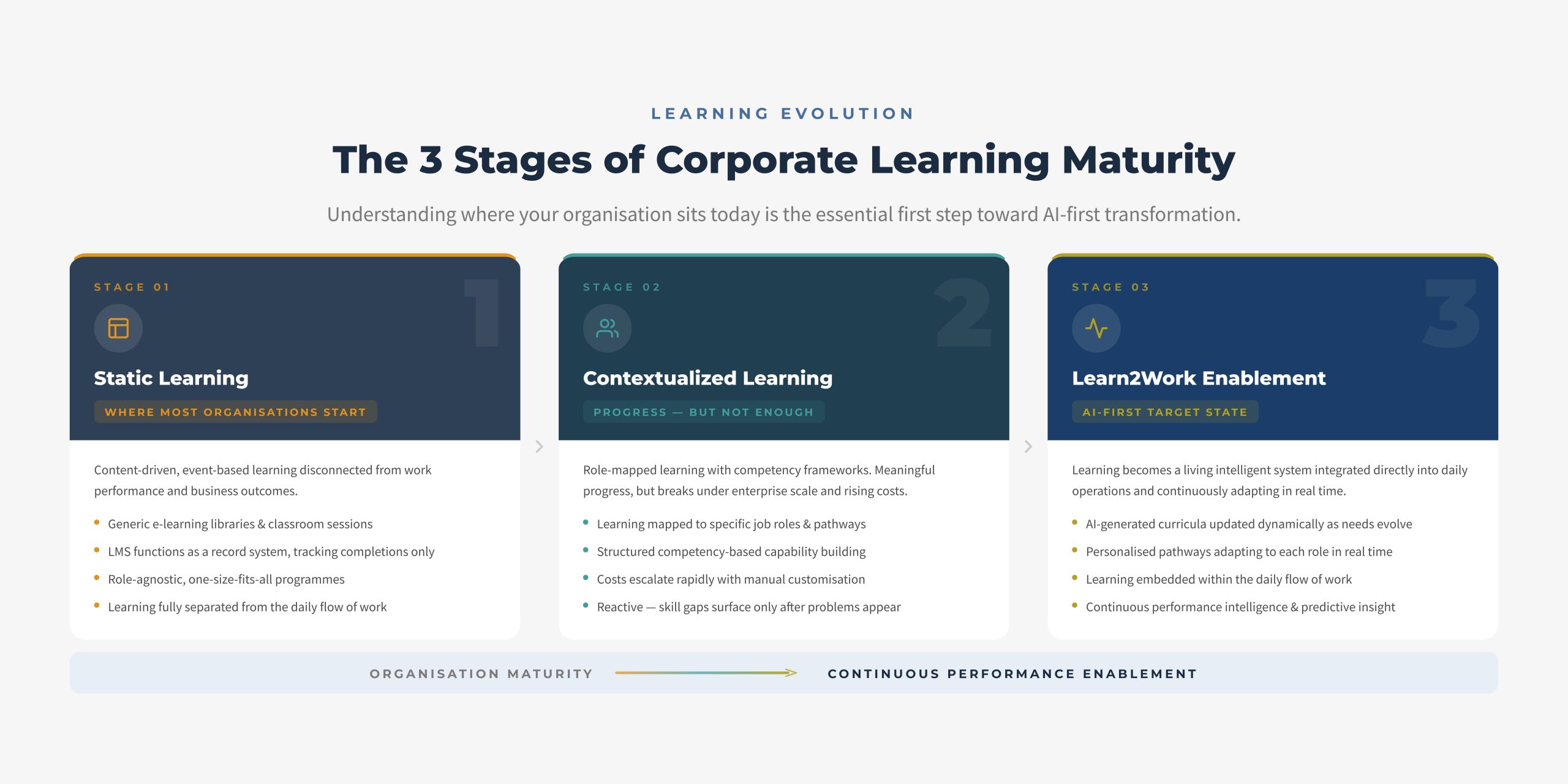
Corporate learning evolves through three distinct stages. Understanding where your organization sits is the first step toward transformation.
Stage 1: Static Learning
Stage 1: Static Learning is content-driven and event-based. Organizations rely on classroom sessions, generic e-learning libraries, or external platforms. Learning is largely role-agnostic and disconnected from actual work execution. LMS platforms function as systems of record, tracking completions but not driving performance. The result is learning activity without enterprise capability transformation.
Stage 2: Contextualized Learning
Stage 2: Contextualized Learning is an improvement. Organizations map learning to specific job roles and competency frameworks, design structured pathways, and shift from general training to role-based capability building. But as explored above, this model strains under scale, rising costs, and the accelerating pace of skill change.
Stage 3: Learn2Work Enablement
Stage 3: Learn2Work Enablement represents the AI-first transformation. Here, learning is no longer managed as static programs. It becomes a living, intelligent system integrated directly into daily operations. Skills are dynamically profiled and continuously reassessed. AI agents generate and update curriculum in days, not months. Personalized pathways adapt automatically as roles and priorities shift.
Learning moves from episodic consumption to continuous performance enablement. This is the model CLaaS2SaaS architected through its Adaptive CLaaS® platform, a Skills-First Adaptive Learning LLM (Large Language Model) that orchestrates workforce capability across every stage of the learner and employee lifecycle.
The shift from Stage 1 to Stage 3 is not incremental. It is transformational because it changes learning from a support function into an operating capability directly tied to workforce performance and business execution.
The Learn2Work Enablement Model: A New Framework for Enterprise L&D
The concept of Learn2Work Enablement fundamentally redefines what corporate learning is supposed to do.
Rather than managing static catalogues of courses, organizations manage dynamic workforce capability aligned to operational priorities. Skills intelligence, real-time gap analysis, and adaptive pathways continuously evolve as roles, technologies, workflows, and business demands change.
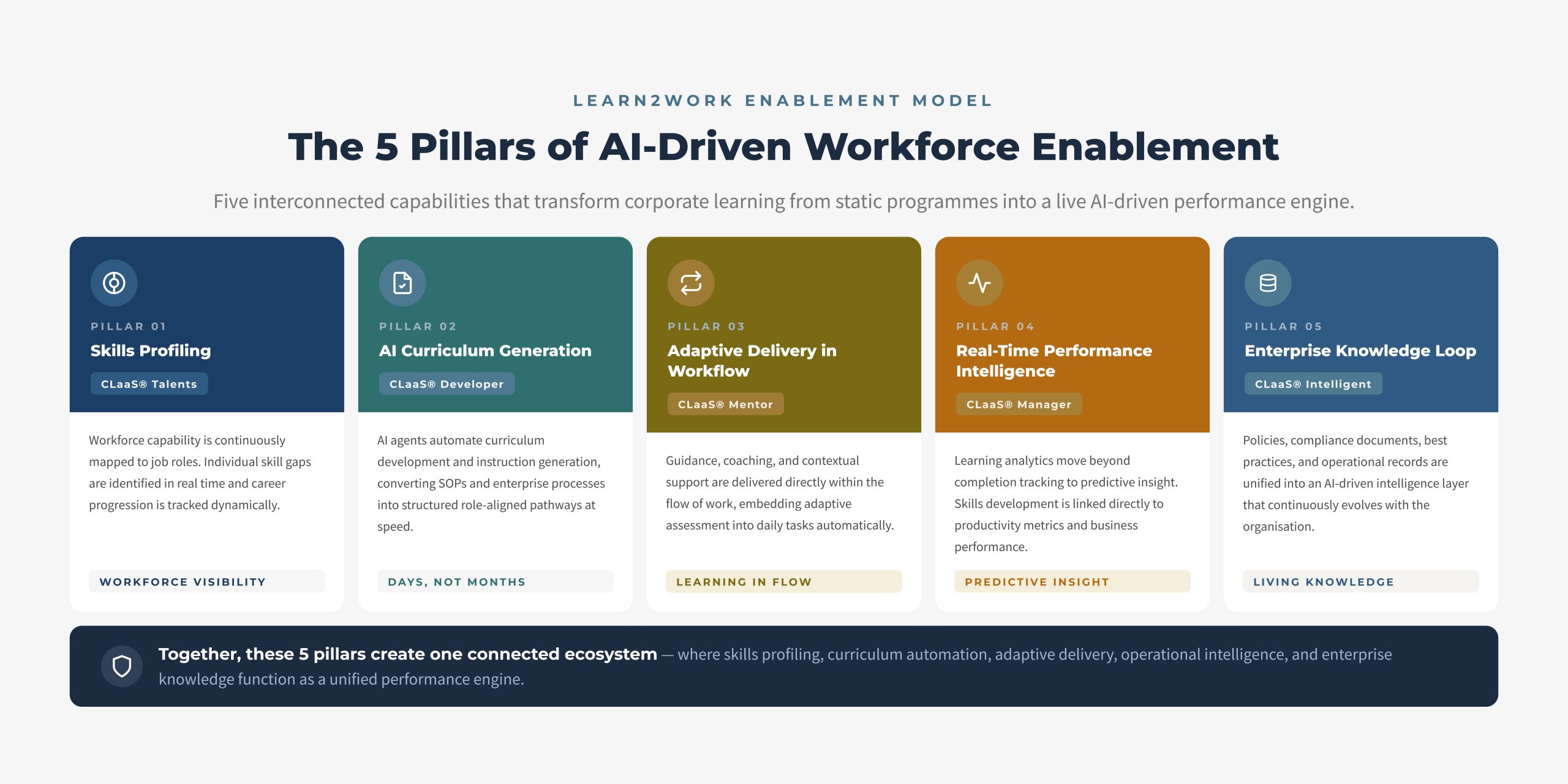
There are five interconnected pillars that drive this shift:
1. Skills Profiling
Skills Profiling – Workforce capability is continuously mapped to job roles. Individual skill gaps are identified in real time, and career progression is tracked dynamically. L&D leaders gain clear visibility into workforce readiness rather than discovering gaps after problems emerge. Within the CLaaS2SaaS Adaptive platform, this is powered by CLaaS® Talents, which continuously profiles employees, identifies skill gaps, and aligns workforce capability to business demand.
2. AI Curriculum Generation
AI Curriculum Generation – Instead of relying on lengthy design cycles, AI agents automate curriculum development and instruction generation. Standard operating procedures and enterprise processes are converted into structured learning pathways. Development cycle time drops significantly, lowering R&D costs while accelerating time-to-competency. CLaaS® Developer operationalizes this by converting SOPs and enterprise processes into structured, role-aligned pathways at speed.
3. Adaptive Delivery in Workflow
Adaptive Delivery in Workflow – Learning is no longer a separate event. Guidance, coaching, and contextual support are delivered directly within the flow of work. Managers and employees receive real-time recommendations aligned to live tasks. A closed loop forms between execution and capability development. CLaaS® Mentor makes this possible by embedding adaptive coaching and automated assessment directly into daily tasks.
4. Real-Time Performance Intelligence
Real-Time Performance Intelligence – Learning analytics move beyond completion tracking to predictive insight and intervention. Skills development is linked directly to productivity metrics, risk reduction, and business performance. CLaaS® Manager orchestrates this by aligning learning data with operational metrics and providing leadership dashboards for real-time capability oversight.
5. Enterprise Knowledge Loop
Enterprise Knowledge Loop – Structured and unstructured enterprise knowledge, including policies, compliance documents, operational records, and best practices, are unified into an AI-driven intelligence layer that continuously evolves with the organization. CLaaS® Intelligent serves as this agentic intelligence layer, transforming transactional systems into predictive, decision-driven engines connected to enterprise knowledge.
Together, these pillars create a fully integrated system where skills profiling, curriculum automation, adaptive delivery, operational intelligence, and enterprise knowledge function as one connected ecosystem.
See how one platform for digital and workforce transformation brings all five pillars together.
Learn how the Adaptive Learning Platform maps to each stage of workforce enablement
Explore the Adaptive CLaaS® Enterprise Platform ➜
The Strategic Impact for Enterprise Leaders
The implications of this transformation extend beyond L&D teams. They reshape how enterprise leaders think about competitive advantage, operational resilience, and workforce strategy.
For enterprise leaders, the significance of Learn2Work enablement is not simply better training delivery. It is the ability to build, refresh, and deploy workforce capability at the speed of business change.
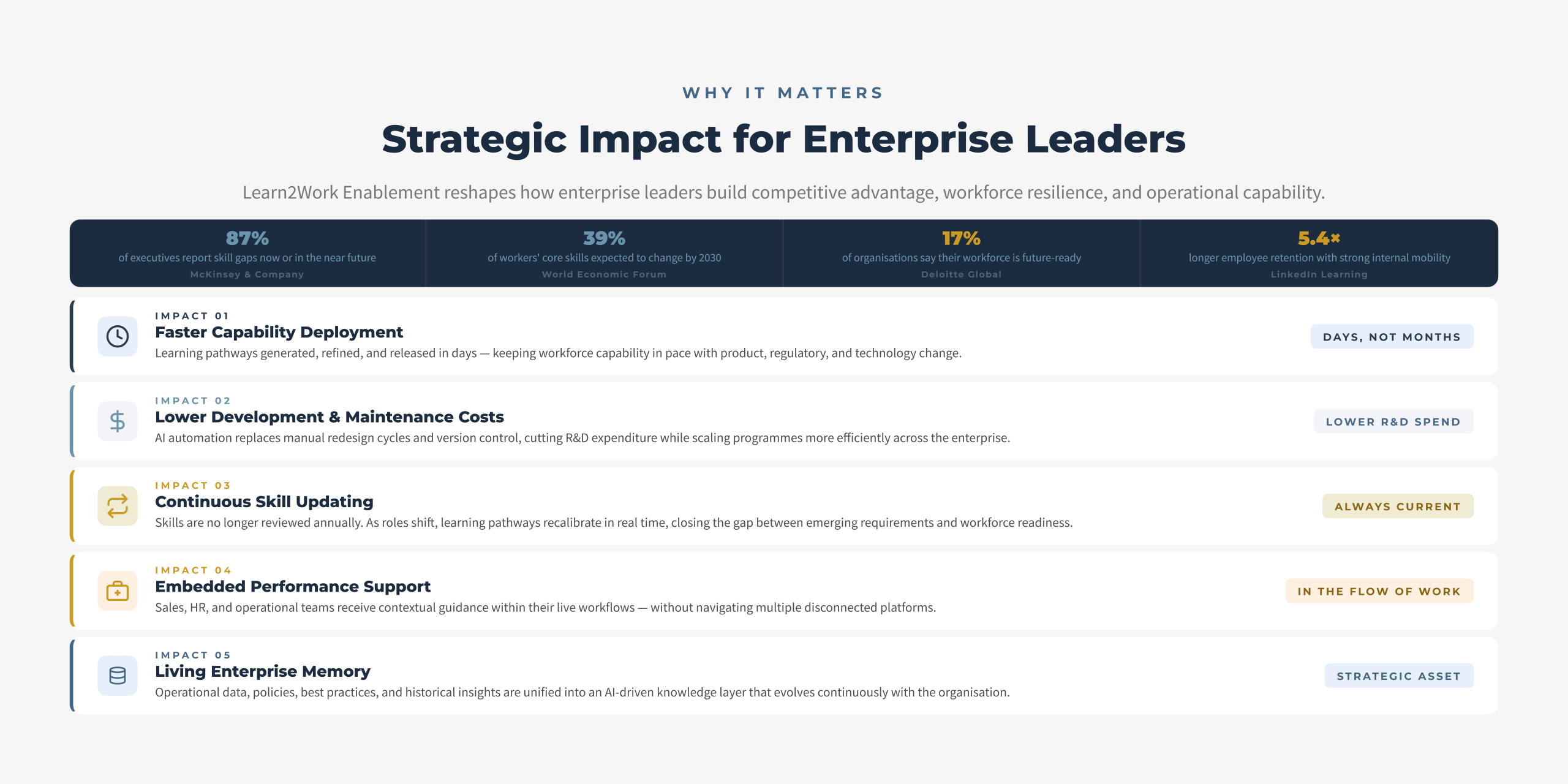
Faster capability deployment.
Instead of relying on lengthy approval cycles, learning pathways can be generated, refined, and released in days. As products evolve, regulations change, or new technologies emerge, updates are applied continuously. Workforce capability keeps pace with business transformation rather than lagging behind it.
Lower development and maintenance costs.
Traditional contextualized learning models require ongoing manual redesign and version control. An intelligent operational layer automates reporting, monitors compliance, and optimizes resource allocation, controlling R&D expenditure while scaling learning more efficiently.
Continuous skill updating.
Skills are no longer reviewed annually. As job roles shift, learning pathways recalibrate in real time. This continuous alignment shortens the gap between emerging skill requirements and workforce readiness.
Embedded performance support.
Sales teams receive contextual guidance within opportunity workflows. HR knowledge, including policies, onboarding processes, and compliance procedures, becomes instantly accessible. Employees gain timely coaching without navigating multiple disconnected platforms.
Living enterprise memory.
Operational data, policies, feedback, best practices, and historical insights are unified into an AI-driven knowledge layer that evolves with the organization. Learning becomes part of everyday execution. Knowledge becomes a strategic asset rather than a static repository. CLaaS2SaaS delivers this through its Pan-ASEAN Digital Acceleration Platform, currently deployed across more than 100 education institutions and connected to over 10,000 enterprises across Asia, providing a proven, scalable foundation for exactly this kind of transformation.
According to LinkedIn’s 2023 Workplace Learning Report, companies that excel at internal mobility retain employees for an average of 5.4 years, nearly twice as long as companies that struggle with it. Workforce capability, built through integrated, adaptive learning, is increasingly a retention and growth driver, not just a compliance activity. Here is how to build an AI-ready workforce that keeps pace with business change.
What This Means for L&D Leaders, CHROs, and Business Executives
The way enterprises think about learning must evolve alongside the technology transforming every other function.
For L&D leaders, this means moving from program administration to performance intelligence. The role expands from managing content libraries to orchestrating adaptive capability ecosystems aligned to real business objectives.
For CHROs, this means workforce strategy becomes inseparable from technology strategy. Talent development is no longer a support function. In an AI-driven economy, it is a source of competitive differentiation.
For business executives, this means recognizing that the return on learning investment is no longer measured in completion rates. It is measured in productivity, time-to-competency, decision quality, and innovation velocity.
The organizations that will lead in the next decade are those that build the capacity to learn faster than disruption occurs. That is not an aspiration. It is the defining capability of an AI-first enterprise.
Conclusion: The Window for Action Is Now
Corporate learning has reached a structural turning point.
The tools exist. The frameworks are proven. The cost of inaction, measured in widening skill gaps, stalled AI adoption, and declining workforce agility, grows more significant with every passing quarter.
The question for enterprise leaders is no longer whether to transform corporate learning. The question is how quickly your organization can move from episodic training to continuous, AI-driven workforce enablement. CLaaS2SaaS is here to make that journey structured, measurable, and achievable, without disrupting the operations your business depends on today.
In an AI-first economy, competitive advantage belongs to organizations that can build capability faster than their competitors. Moving from static learning to unified Learn2Work Enablement is not optional. It is foundational.
Ready to move beyond static training and build a workforce built for the AI era?
Explore the full Adaptive CLaaS® Enterprise Transformation Platform ➜
or learn more about Agentic Intelligence Hub and Workforce Upskilling Solutions
Share


Want to check if this career is for you?