Equipping AI Conductors for Smarter Enterprise Operations
Equipping AI Conductors for Smarter Enterprise Operations
Content
Content
The Shift That Enterprises Can No Longer Ignore
Enterprises are entering a new phase of competition—one defined not by access to technology, but by the ability to execute it. Artificial Intelligence (AI) is no longer a distant concept as it actively reshapes how daily operations are managed, how strategic decisions are made, and how value is created for the customer. Larger organizations are already embedding AI into their core workflows to gain speed and efficiency.
Research shows that AI adoption continues to accelerate across industries, with organizations increasingly integrating AI into core business functions improve efficiency and strengthen decision-making. As adoption grows, the focus is shifting from whether businesses should use AI to how AI creates measurable value across enterprise operations.
These benefits are already visible in practice, particularly among enterprises, where AI is delivering gains in productivity, customer engagement, cost optimization, and revenue growth.
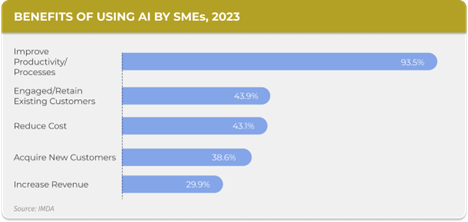
These outcomes make one point clear: the value of AI is no longer theoretical. It is already improving enterprise operations in tangible ways. Yet realizing these benefits consistently and at scale requires more than adopting AI tools. It requires the capabilities to operationalize them effectively. See what Service-as-Software means for SMEs looking to put AI into daily operations.
For many enterprises, the challenge is not a lack of ambition or willingness to modernize. It is a lack of access to the right tools, the right transformation strategies, and most critically, the right internal capabilities. Closing that gap means unifying digital and workforce transformation rather than treating tools and skills as separate efforts. Closing that gap starts with building an AI-ready workforce.
At the same time, businesses across sectors are shifting toward AI-first operating models where intelligent systems, workflows, and teams operate through connected orchestration rather than isolated digitization. Adopting AI tools alone is no longer enough. The real advantage lies in having people who can integrate, manage, and maximize these tools across entire workflows.
This shift gives rise to a new role: the AI Conductor.
AI Conductors are professionals who orchestrate people, intelligent systems, automation, and operational workflows into scalable AI-first enterprise execution. They employ more than just AI. They scale with it, manage through it, and design with it.
However, recognizing this shift is one thing. Executing it effectively is where many enterprises struggle.
Explore how AI can be practically applied to your business
Why Many Enterprises Are Falling Behind
For growth-focused enterprises navigating increasing complexity, this transition is critical. Organizations are under pressure to reduce manual workloads, improve agility, and do more with limited resources. Yet many continue to treat AI as a productivity add-on rather than a core operational capability.
As a result, even with rising investments in digital transformation, the expected business impact often falls short.
The challenge is not the technology itself, but the gap between having access to AI tools and being able to translate them into real operational transformation.
In practice, this gap shows up in three critical ways:
1. The Training-to-Application Gap
Many organizations invest in AI and digital upskilling, yet what employees learn rarely translates into day-to-day execution.
Workshops on prompt engineering, automation tools, or generative AI platforms build awareness, but without integration into real workflows, these skills remain theoretical.
This leads to a common pattern:
- Teams learn AI concepts
- Productivity remains largely unchanged
- Workflows stay manual
- Automation opportunities remain untapped
Closing this gap requires a shift from knowledge transfer to applied capability, where learning is directly embedded into how work gets done.
2. The Capability-Design Gap
Another issue arises even after teams start utilizing AI tools. They are proficient with the tools, but they lack the ability to create workflows that make use of them.
This distinction is crucial.
Redesigning a lead qualification pipeline, customer service workflow, or finance approval process with AI integrated throughout is far different from using a chatbot for specific tasks.
Without this change, AI will continue to be limited to certain activities rather than transforming workflows from start to finish, and as a result, organizations see incremental improvements instead of meaningful operational change.
3. The Productivity-Realization Gap
Lastly, and perhaps, the biggest gap is turning AI adoption into measurable productivity gains.
Many organizations launch AI pilots, yet struggle to realize meaningful outcomes such as:
- Lower operating costs
- Faster execution cycles
- Reduced manual effort
- Improved process consistency
- Scalable efficiency
Understand how to bridge these gaps to enhance business operations
Bridging the Gaps by Leading as an AI Conductor
Adopting AI technologies is not enough to close these gaps; active AI leadership is needed instead of passive use. The modern businesses are developing the capacity to coordinate AI across teams, workflows, and systems rather than just implementing it.
This is where the concept of the AI Conductor emerges, not as a standalone role, but as a new operating capability for the enterprise. It represents the ability to orchestrate people, automation, data, and AI tools in ways that strengthen execution across the business.
Rather than merely interacting with AI platforms, AI Conductors shape how AI delivers operational value through automation standardization, process integration, and the conversion of isolated tools into scalable systems. In practice, this moves organizations beyond disconnected use cases toward coordinated, intelligent operations where AI supports how work is designed, managed, and continuously improved.
How AI Conductors Drive Enterprise Execution
AI Conductors help enterprises move from fragmented processes to connected, scalable operations by combining workflow design, automation thinking, and performance visibility. This capability is often built through three interconnected areas of execution:
AI Conductors help enterprises move from fragmented processes to connected, scalable operations by combining workflow design, automation thinking, and performance visibility. This capability is often built through three interconnected areas of execution:
Designing Better Prompts for Better Outputs
Using tools like Claude and other generative AI platforms, AI Conductors develop structured prompting approaches that improve both output quality and operational reliability.
Strong prompting supports higher-quality outputs, greater accuracy, and better decision support. more repeatable results, and improved task efficiency.
In this context, prompting becomes more than a user’s skill; it becomes a workflow design capability. Well-structured prompts help standardize execution, improve consistency, and increase the value AI can deliver across business functions.
Building Simple AI Agents for Repetitive Work
AI Conductors also identify routine, repetitive work that can be delegated to lightweight AI agents including:
- Drafting routine communications
- Summarizing reports and documents
- Routing information automatically
- Supporting finance reconciliations
- Managing recurring administrative workflows
Individually, these may appear like small processes, but collectively they can unlock meaningful productivity gains by reducing manual effort and freeing teams for higher-value work.
Creating AI-Powered Workflows with Performance Visibility
AI Conductors develop systems that can be tracked, improved, and expanded; they don’t stop at automation.
They monitor metrics like these through dashboards and performance reporting such as:
- Time saved
- Process bottlenecks
- Workflow efficiency
- Automation performance
- Business impact metrics
This transforms AI adoption from individual experimentation into structured execution. Rather than deploying tools without oversight, organizations gain visibility into what is working, where value is being created, and how workflows can continuously improve over time. That is the distinction between simply using AI and conducting it.
Applying AI Across Core Business Functions
When AI is handled in this manner, its effects go much beyond minor increases in productivity. It turns into a comprehensive operating capacity that may be used across multiple business functions within the enterprise.
When AI is handled in this manner, its effects go much beyond minor increases in productivity. It turns into a comprehensive operating capacity that may be used across multiple business functions within the enterprise.
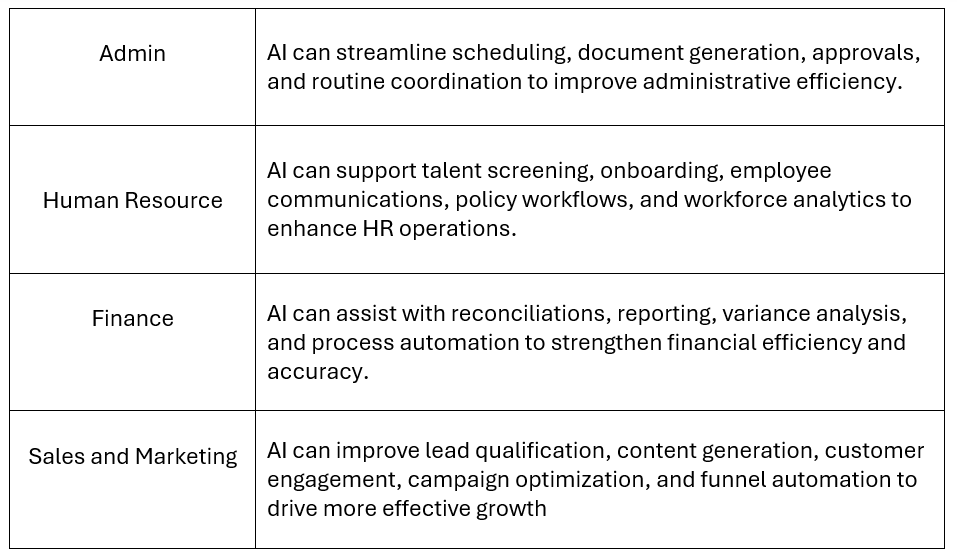
Across functions, the objective remains the same: reduce manual workload while improving execution.
However, sustaining this level of cross-functional impact requires more than embedding AI into existing workflows. It depends on whether organizations are also adopting AI-adaptive learning approaches where capability building evolves alongside AI use.
Without this, AI remains fragmented across departments instead of becoming an integrated operating system for work.
See the enterprise-wide execution that equips your team to lead as AI Conductors
AI-Adaptive Learning for Building AI Conductors
Accordingly, companies must stop viewing AI as a one-time application and instead integrate it into a continuous process that changes as tools, workflows, and business requirements do. Therefore, becoming an AI-driven firm is an organized procedure based on ongoing adaptation.
A practical model for this transition begins with 60 hours of focused AI training designed to teach professionals to radically rethink how work is done.
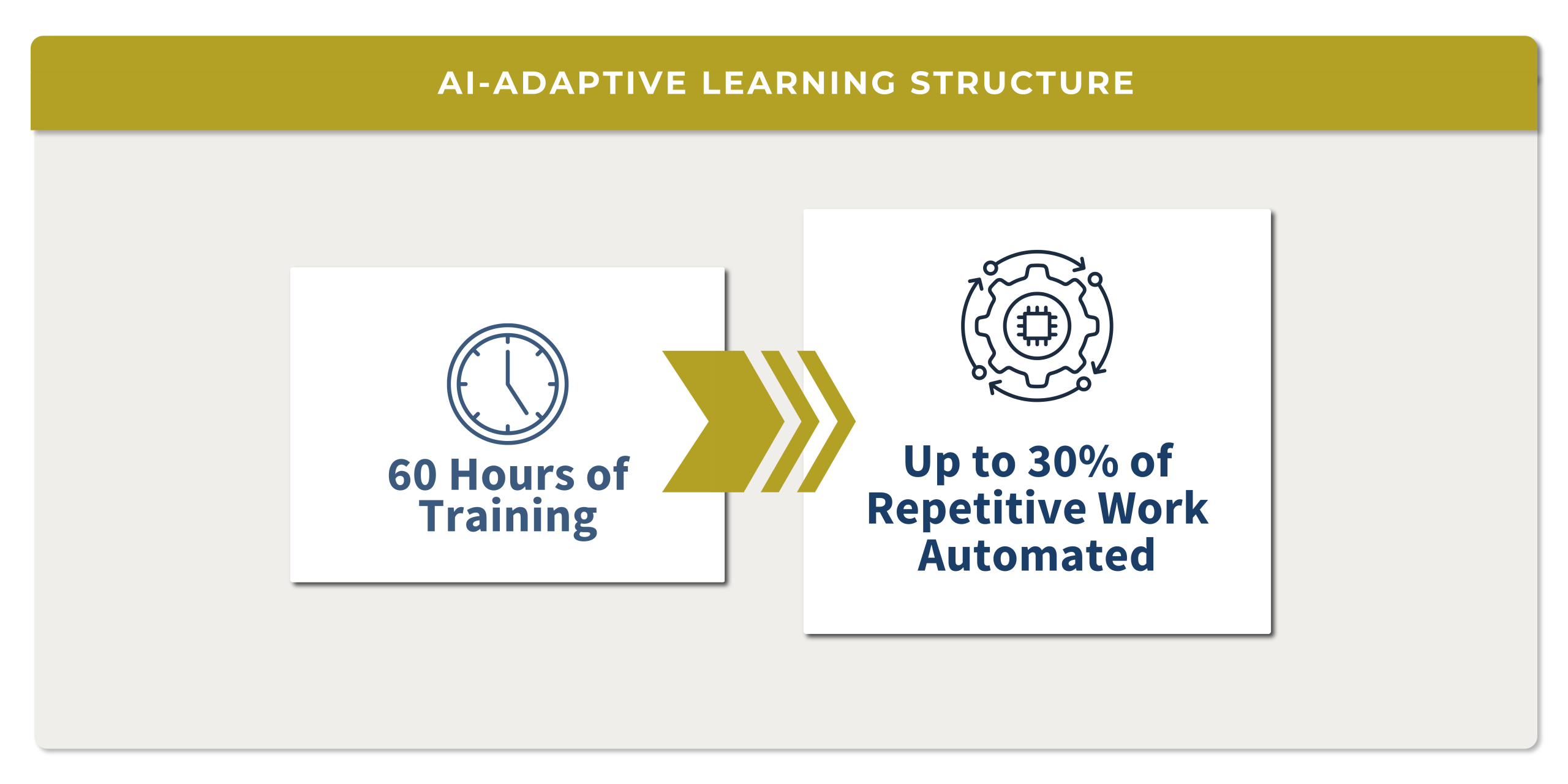
Within this model, one of the earliest measurable outcomes is the ability to automate up to 30% of repetitive work through well-designed AI workflows. Routine activities such as data processing, document drafting, reporting, and administrative coordination can be streamlined, freeing teams to focus on higher-value analysis, decision-making, and innovation.
The impact creates enterprise-wide gains in:
- Productivity
- Cost efficiency
- Response speed
- Workforce capacity
- Growth readiness
This transformation unfolds through four progressive stages of work, with each stage moving employees closer to operating as AI Conductors.
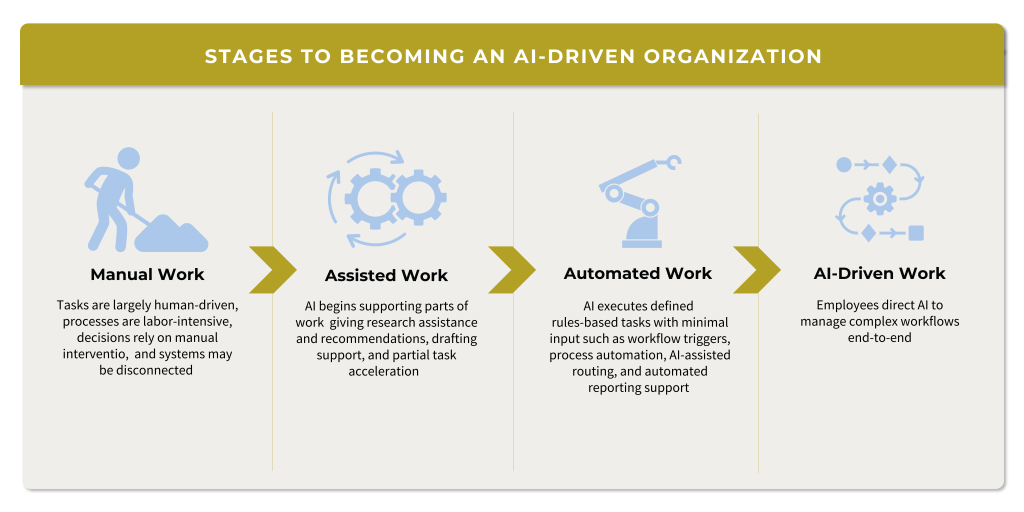
- Manual Work
In the beginning, tasks are done entirely by humans, often involving hours of repetitive data entry or document processing. - Assisted Work
AI begins to support parts of the task; such as drafting content; summarizing long reports or identifying leads, while the human remains the primary driver. - Automated Work
AI executes specific, rules-based tasks with minimal input, allowing the employee to focus on reviewing the quality of the output. - AI-Driven Work
Employees direct AI to manage complex workflows end-to-end; moving from “doing the work” to “managing the system”
Together, these four stages provide a realistic transformation route where training has an operational impact.
Organizations develop the internal capacity to integrate AI throughout workflows at scale, as opposed to using AI as discrete technologies. Businesses can attain quantifiable performance gains by the end of the 60-hour journey, such as quicker turnaround times, more reliable output, and noticeably higher operational efficiency.
For enterprises, this means integrating ongoing learning into actual company operations while managing growing complexity and volume without drastically increasing manpower.
Discover the path to becoming an AI-driven enterprise and empower your team
Learn More to Work Less and Become an AI Conductor
The path to achieving these operational gains lies in a fundamental shift in how professionals acquire new skills. Real enterprise transformation does not come from tools alone; it comes from how people learn to apply, integrate, and scale those tools in real work environments.
This is the core focus of the CLaaS2SaaS AI-Powered Adaptive Learning Approach.
Unlike traditional training, which separates learning from execution, our approach embeds the learning process directly into actual workflows.
Designed as a modular, hybrid, and outcome-focused learning journey, the programme combines structured learning with practical implementation to help professionals integrate AI into real business operations. Within approximately 60 hours over 4–6 weeks, participants develop applied AI capabilities that reduce manual effort and enable teams to scale work more efficiently.
Through this approach are equipped to:
- Design workflows with AI embedded
- Execute tasks with reduced manual effort
- Integrate systems for smoother operations
- Scale processes with consistency and speed
Equipping Generative AI
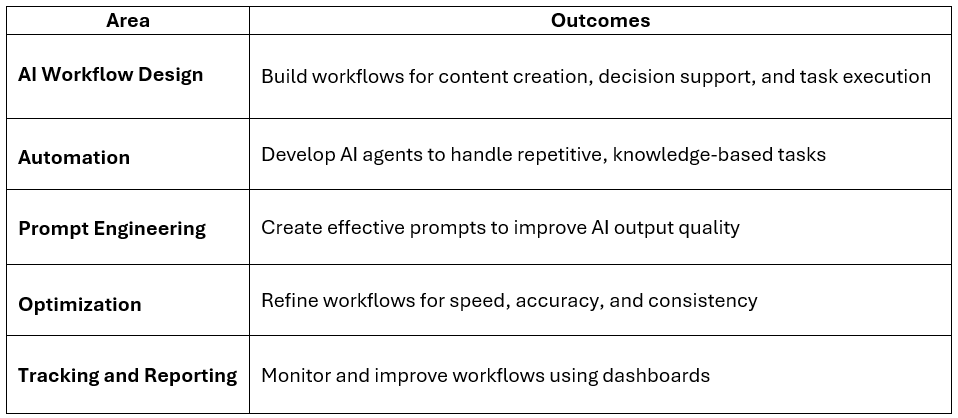
At the core of the programme is the Generative AI Module, which focuses on helping professionals move beyond basic AI usage into workflow orchestration and operational execution. Instead of treating AI as a standalone tool, the module trains participants to embed AI into actual business processes across functions such as Admin, HR, Finance, Customer Support, Operations, and Sales & Marketing.
Participants can choose between a Claude-focused or Microsoft Copilot-focused learning pathway depending on their organisational environment and operational needs. Throughout the module, learners apply generative AI tools directly to real workplace scenarios, enabling immediate implementation and measurable outcomes.
The module covers several key capability areas:
Rather than separating learning from execution, the programme embeds AI directly into real work environments. Participants apply concepts immediately within their own operational context, allowing teams to build practical capabilities while solving actual business challenges.
As organizations adopt a structured framework for AI implementation, workflows become more streamlined, scalable, and less dependent on manual coordination. Teams can automate repetitive work, improve consistency, accelerate execution, and operate more effectively without proportionally increasing resources.
Ultimately, the programme equips professionals to become AI Conductors.
As these capabilities scale across departments and functions, organisations strengthen three core enterprise priorities:
As this capability develops, it directly supports three core enterprise priorities:
-
Optimize
Workflows are redesigned to reduce friction, improve handoffs, and increase execution speed and consistency. - Automate
Structured processes allow automation to remove repetitive tasks and reduce manual effort. - Scale
With optimized and automated workflows, organizations can grow capacity, improve service delivery, and scale operations without proportional increases in overhead.
The result is a future-ready workforce capable of delivering more with less by redesigning how work itself is executed through AI-powered workflows and adaptive learning.
Learn more to bridge the gap between AI adoption and measurable business impact
Share


Want to check if this career is for you?