Home Blog Enterprise Transformation AI-First Digitalization for SMEs
Enterprise Transformation

AI First Future of Business

AI-First Digitalization for SMEs: Bridging the Digital Divide in Asia’s Growing Economies

AI First Future of Business

AI-First Digitalization for SMEs: Bridging the Digital Divide in Asia’s Growing Economies

A header banner with text ‘AI-First Digitalization for SMEs: Bridging the Digital Divide in Asia’s Growing Economies’
Small and medium-sized enterprises (SMEs) are the true economic engines of Asia. Representing up to 99% of businesses in many Southeast Asian countries, SMEs are integral to the region’s employment, innovation, and GDP growth. Yet, despite their vast contributions, many SMEs face significant barriers in capitalizing on the opportunities of the AI-first digital economy. Artificial intelligence (AI), automation, and digital technologies are reshaping industries, but SMEs often lack the resources, digital talent, and infrastructure to compete effectively in this landscape.
SMEs must overcome substantial hurdles in this rapidly evolving environment, including financial constraints, fragmented technology ecosystems, and a lack of AI literacy to remain competitive. By empowering small businesses with accessible, scalable digital tools, AI-powered automation, and skills training, SMEs can embrace new efficiencies, enhance productivity, and position themselves for growth.
In this article, we explore the barriers SMEs face, share our perspective on AI-first self-service solutions, and outline how SMEs in Asia can navigate these challenges to thrive in an increasingly digital world.


The Rising Importance of SMEs in Asia’s Digital Economy

Asia is home to a vast and diverse SME landscape, where businesses across sectors, from manufacturing to retail and technology services, contribute a major portion to economic output. According to the Asian Development Bank, SMEs account for 96% of all Asian businesses in the region, and they provide over 60% of employment in many countries.
In an increasingly competitive environment, digital adoption and AI integration have become crucial enablers of business efficiency, customer engagement, and innovation. But many SMEs are stuck in traditional, manual processes, which limit their ability to scale and adapt to market changes.
A key driver of this rapid growth, as we see it, is the expanding digital landscape, fuelled by e-commerce, fintech, and digital services. With initiatives like the ASEAN Digital Economy Framework Agreement (DEFA), which aims to integrate and regulate the region’s digital markets, the digital economy in Southeast Asia is expected to reach $1 trillion by 2030, potentially doubling to $2 trillion if DEFA’s full implementation succeeds. This creates a significant opportunity for SMEs to tap into the digital economy. However, despite these promising prospects, many SMEs are hindered by various barriers that prevent them from fully embracing emerging technologies and digital transformation.
As the region’s digital economy continues to grow, there’s a clear gap between opportunity and readiness. From a shortage of digital skills to fragmented technology ecosystems, the path to digitalization is not straightforward. DEFA is expected to streamline digital regulations, making it easier for SMEs to access cross-border digital markets and integrate into regional value chains. This creates a massive opportunity for SMEs to embrace digital transformation, yet many remain at a disadvantage due to the barriers preventing them from effectively leveraging these emerging technologies. With the right digital tools and support systems, SMEs can overcome these barriers and position themselves to thrive in the digital economy.
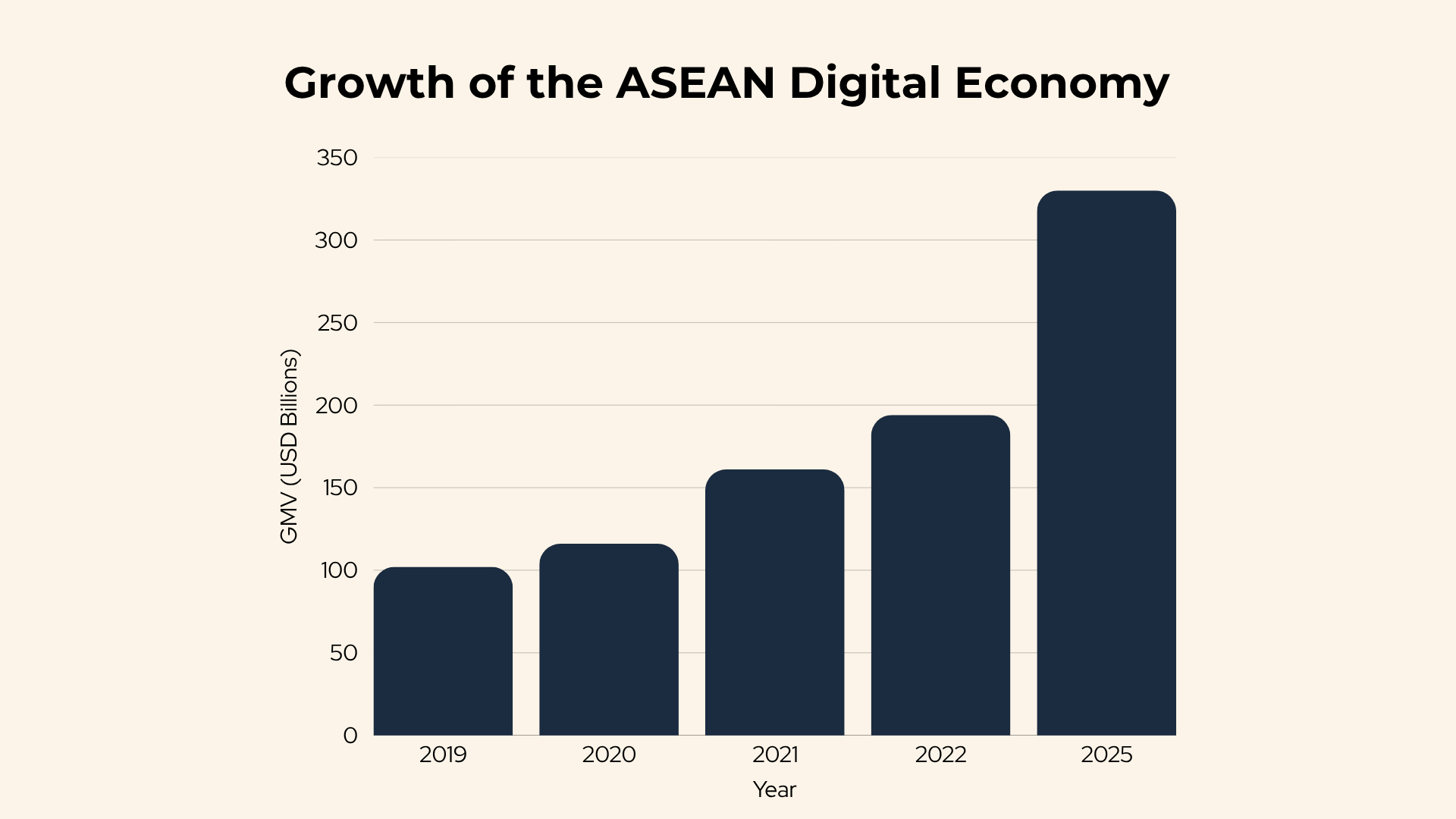
Growth of the ASEAN Digital Economy

Source: https://sponsored.bloomberg.com/article/sc/banking-on-asean-s-digital-economy#_ftn8
Walk through the full AI-First Digital Transformation for SMEs roadmap by downloading the brochure

The Key Barriers Hindering SME Digitalization in Asia

Across Asia, digital skills gaps remain a significant barrier to SME growth. This shortage of AI professionals disproportionately impacting SMEs, which often lack the resources to recruit top-tier talent, unlike larger enterprises.
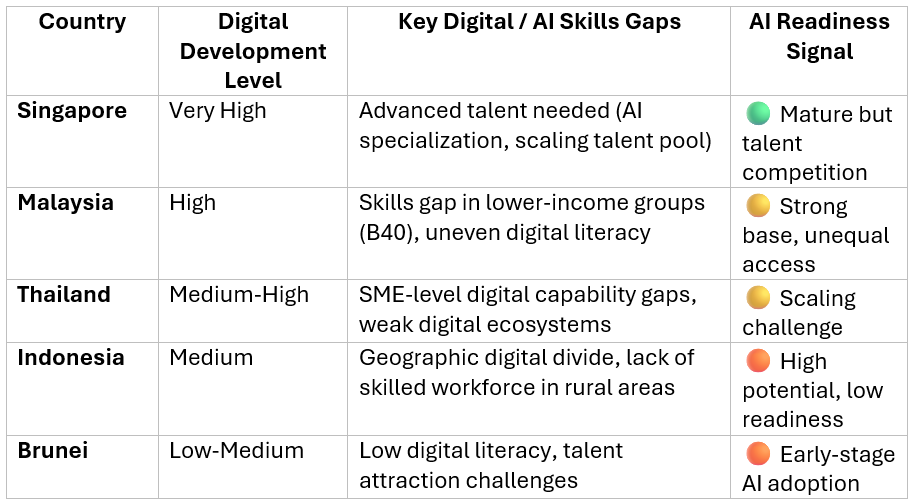
Source: https://open-research-europe.ec.europa.eu/articles/5-2/pdf
Moreover, while traditional IT roles remain essential, SMEs now require a different kind of workforce, one that is digitally literate, can manage AI-powered tools, and is capable of developing automation solutions. Citizen developers, or employees trained to build and manage digital tools, are becoming a critical asset. We believe SMEs can empower their workforce with AI skills training, thus creating an agile team capable of integrating AI and automation within their day-to-day business operations.
The cost of digital transformation can be daunting for SMEs, particularly when considering the up-front investment needed for enterprise-level AI and digital infrastructure. Many SMEs in India and Southeast Asia face challenges in justifying large-scale investments in AI and automation tools that require significant capital outlay. According to a report by McKinsey, 70% of digital transformation efforts fail due to cost overruns, lack of ROI, and organizational resistance.
This lack of investment poses a particular challenge to SMEs, where profit margins are often thin and digital capabilities are sometimes perceived as a luxury rather than a necessity. We see strong potential in modular, low-cost, AI-driven self-service solutions, which can significantly reduce the financial burden of transformation, allowing SMEs to start small and scale incrementally.
For many SMEs, the lack of integration between digital tools is a major roadblock. Many businesses still rely on a patchwork of software systems, spreadsheets, and manual processes that don’t communicate with one another. In our experience, this fragmentation creates inefficiencies and slows down decision-making, making it difficult for companies to gain actionable insights from their data.
SMEs report that disconnected systems and a lack of data integration slow down decision-making and hinder growth. The absence of cohesive, integrated platforms that link everything from finance and inventory to customer service and marketing hinders SMEs from unlocking the potential of AI-driven automation.
We see AI-first solutions as a way to overcome this barrier by offering integrated systems that automate workflows and allow businesses to leverage real-time data across operations. CLaaS2SaaS represents this new operating model in practice, integrating citizen developer skilling, AI agents, and agentic SaaS into a unified digital acceleration system for SMEs.
Explore the full AI-First Digital Transformation for SMEs framework by downloading the brochure

AI-First Self-Service Digitalization: A Game-Changer for SMEs

AI-first self-service digitalization is a shift away from traditional reliance on large, complex IT implementations. Instead, it enables SMEs to adopt AI tools and automation technologies without heavy reliance on external consultants or large IT teams. This model allows businesses to start small and scale gradually, adapting AI solutions based on evolving needs and capabilities.
AI agents can handle a wide range of tasks, such as customer service automation, inventory management, and even predictive analytics for sales and marketing efforts. These agents can be easily integrated into existing systems, reducing the need for complete overhauls of legacy technologies. Through low-code/no-code platforms, SMEs can develop their own AI-powered workflows and automate business functions without needing advanced coding skills.
Workforce upskilling is a critical part of AI-first digitalization for SMEs in Southeast Asia. While the region offers strong digital growth potential, it also has the widest disparity in digital transformation in Asia-Pacific, highlighting uneven readiness across businesses and workers. For SMEs, this makes digital and AI skills development essential to building internal capability and reducing reliance on external support.
The business case is clear. Research shows that when online sales make up more than 40% of an MSME’s total sales, businesses can generate higher revenue and employment. At the same time, ASEAN’s youth are already digitally engaged, with more than 50% using digital tools for social media, 45% for online education, and 42% for e-commerce. This shows that the foundation is there; the next step is turning digital familiarity into practical business and AI capabilities that SMEs can use to grow.
AI-first digitalization also allows SMEs to scale operations efficiently by utilizing self-service business process outsourcing (BPO). Instead of relying on expensive outsourcing firms, SMEs can access AI-powered operational services on demand. These services include everything from digital marketing automation and customer service chatbots to real-time data analytics for informed decision-making.
For example, Southeast Asian SMEs in the retail and logistics sectors are leveraging AI-powered BPO services to handle marketing campaigns, customer queries, and product recommendations, allowing them to remain competitive despite having smaller teams. By combining AI automation with expert support, businesses can focus on high-value activities like customer engagement and strategic growth.

The Path Forward: Building a Digital Future for SMEs in Asia

Asia stands on the brink of a new digital era, with SMEs at the center of this transformation. As economies across India, Indonesia, Vietnam, and beyond accelerate their digital adoption, the next phase is not just digitization but becoming truly AI-first.
SMEs must move beyond fragmented tools and traditional outsourcing models toward integrated, intelligent solutions. The CLaaS2SaaS platform provides a unified approach by combining workforce upskilling, AI-powered agents, and self-service BPO. This enables SMEs to adopt advanced technologies in a scalable and cost-efficient way.
This transformation directly addresses three critical barriers: talent shortages, disconnected technology ecosystems, and limited financial resources. By embedding AI into both workforce capabilities and operational workflows, SMEs can unlock higher productivity, faster decision-making, and sustainable growth.
The future of SME success in Asia is built on three key pillars:
  • AI-first workforce upskilling to equip talent with in-demand digital and AI capabilities
  • AI agents and automation to streamline processes and enhance efficiency
  • Self-service BPO platforms to reduce costs while maintaining operational agility
Together, we believe these pillars empower SMEs to evolve into agile, data-driven enterprises, capable of scaling efficiently and competing in an increasingly dynamic, AI-driven global economy.

Conclusion: A Digital Future for SMEs in Asia

We all know that Asia’s SMEs are critical to the region’s economic future. Yet, to succeed in an increasingly digital and AI-first world, they must overcome the digital divide and adopt scalable, cost-effective solutions that unlock the potential of AI and automation.
In our perspective, the AI-first, self-service model represents the future of SME digital transformation, offering practical, accessible, and sustainable solutions for businesses across the region.
As SMEs embrace these tools, we believe they will not only survive the digital revolution but thrive in it, paving the way for a more resilient and innovative future.
Download the AI-First Digital Transformation for SMEs brochure.
Want to check if this career is for you?