AI Agents Leasing & Agentic SaaS Solution
Rethinking SME Digital Transformation with AI Agents and Agentic SaaS
AI Agents Leasing & Agentic SaaS Solution
Rethinking SME Digital Transformation with AI Agents and Agentic SaaS
Content
Content
In an increasingly AI-driven economy, AI agents leasing and Agentic SaaS solutions for SMEs are emerging as practical responses to one of the biggest business questions of this decade: how can smaller firms participate in digital transformation without the capital, technical depth, or organizational capacity of large enterprises?
Small and medium-sized enterprises (SMEs) sit at the centre of this challenge. Globally, SMEs represent more than 95 percent of registered firms and account for more than 50 percent of jobs, making them foundational to growth, employment, and economic resilience. Yet the same firms that anchor national economies are often the least equipped to absorb the speed, complexity, and cost of AI-led change.
We see this current moment as especially consequential. Governments want stronger productivity. Larger enterprises are digitizing supply chains and partner ecosystems. Customers increasingly expect faster, more personalized, always-on experiences. At the same time, automation and AI are reshaping work itself. For SMEs, these pressures are converging all at once.
The result is not just operational strain. It is a structural challenge. Many SMEs are being asked to compete in an AI-first economy with business models, systems, and skill bases built for a pre-digital era. Unless that gap is addressed, digital transformation risks becoming a widening divide between firms that can scale with intelligence and those that remain trapped in manual, fragmented, and reactive operating models.
Why SME Digital Transformation Has Reached a Breaking Point
Most SMEs already understand the importance of digital transformation. However, what is often overlooked is that traditional transformation models were never designed for small, resource-constrained businesses.
Technology-led transformation usually assumes three things:
- Access to specialist talent,
- Budget for large-scale implementation,
- The organizational bandwidth to absorb disruption while maintaining day-to-day operations.
SMEs typically have none of these in abundance.
This is why the gap keeps widening. Large enterprises can hire AI specialists, fund integration projects, and spread risk across multiple teams. SMEs, by contrast, must transform while continuing to operate with lean headcount, tight margins, and limited room for execution error. What looks like a digital capability gap on the surface is, in our experience, a deeper operating model mismatch underneath.
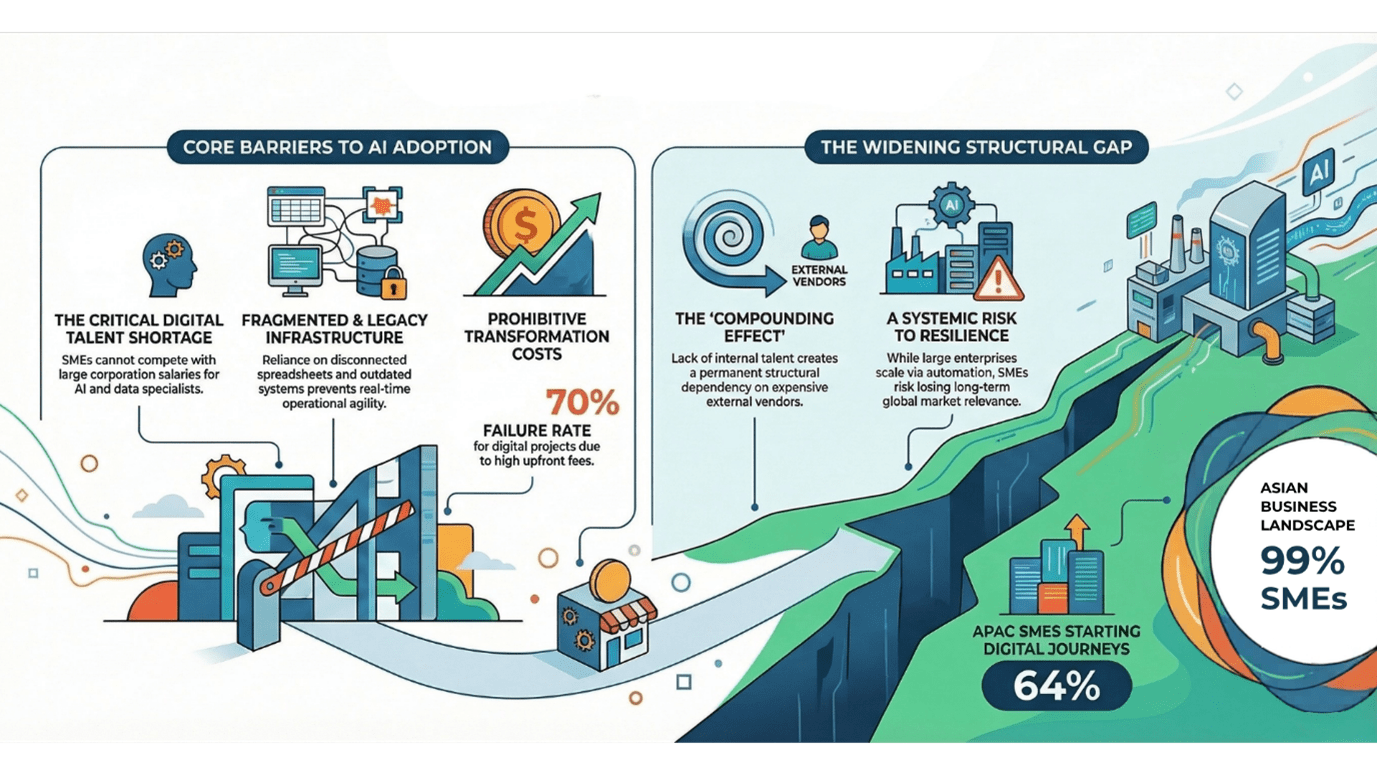
In Southeast Asia, the urgency is even sharper. SMEs account for more than 99 percent of firms in the ASEAN region, making their digital readiness central to employment, inclusion, and long-term competitiveness. If these businesses fall behind, the consequence is not only weaker firm-level performance, but slower regional productivity gains and a deeper digital divide across markets.
The Structural Barriers Holding SMEs Back
1. The digital talent shortage
The most immediate barrier is people. SMEs are being pushed toward AI, automation, analytics, and digital workflows at a time when demand for those capabilities has outpaced supply.
But the real issue goes deeper: Even when tools are available, teams lack the capability to operationalize them.
We consistently see smaller firms competing for the same digital talent as larger organizations, but without the same salaries, brand pull, training budgets, or career pathways. This makes it difficult not only to hire specialists, but also to retain them. The impact is cumulative. Without in-house capability, SMEs struggle to evaluate tools, redesign workflows, or turn technology investments into operational results.
In many Southeast Asian markets, this gap could be seen even more clearly. Countries such as Indonesia, the Philippines, and Vietnam continue to face stronger skills constraints than more digitally mature markets such as Singapore. For many SMEs, the issue is no longer whether AI matters. It is whether they have the human capacity to use it meaningfully.
2. Fragmented and outdated systems
3. Financial constraints and transformation risk
Why Traditional Approaches Keep Failing SMEs
The Need for a New Model: AI-First Self-Service Digitalization
If the challenge is structural, the response must be structural too.
What SMEs need is a model that lowers the barriers to digital transformation instead of raising them. That means reducing upfront cost, minimizing dependency on scarce external talent, and creating a practical path from manual operations to intelligent, connected workflows independently.
This is why AI-first digitalization matter the most. Rather than treating AI as a late-stage enterprise upgrade, it is seen as an operational layer that can help smaller firms augment teams, automate routine work, and improve decision-making without having to build large internal tech functions from scratch.
In this context, the most promising direction is not simply software adoption. It is the convergence of workforce enablement, intelligent agents, and connected systems.
This is where AI agents leasing for SMEs and Agentic SaaS solutions enter the picture.
Instead of forcing SMEs into large, capital-intensive transformation programs, this model gives them access to intelligence in more modular and scalable ways, the most practical path to operationalizing AI. It allows SMEs to move from vendor-led transformation to a model where teams can operate, adapt, and continuously improve AI-driven workflows internally.
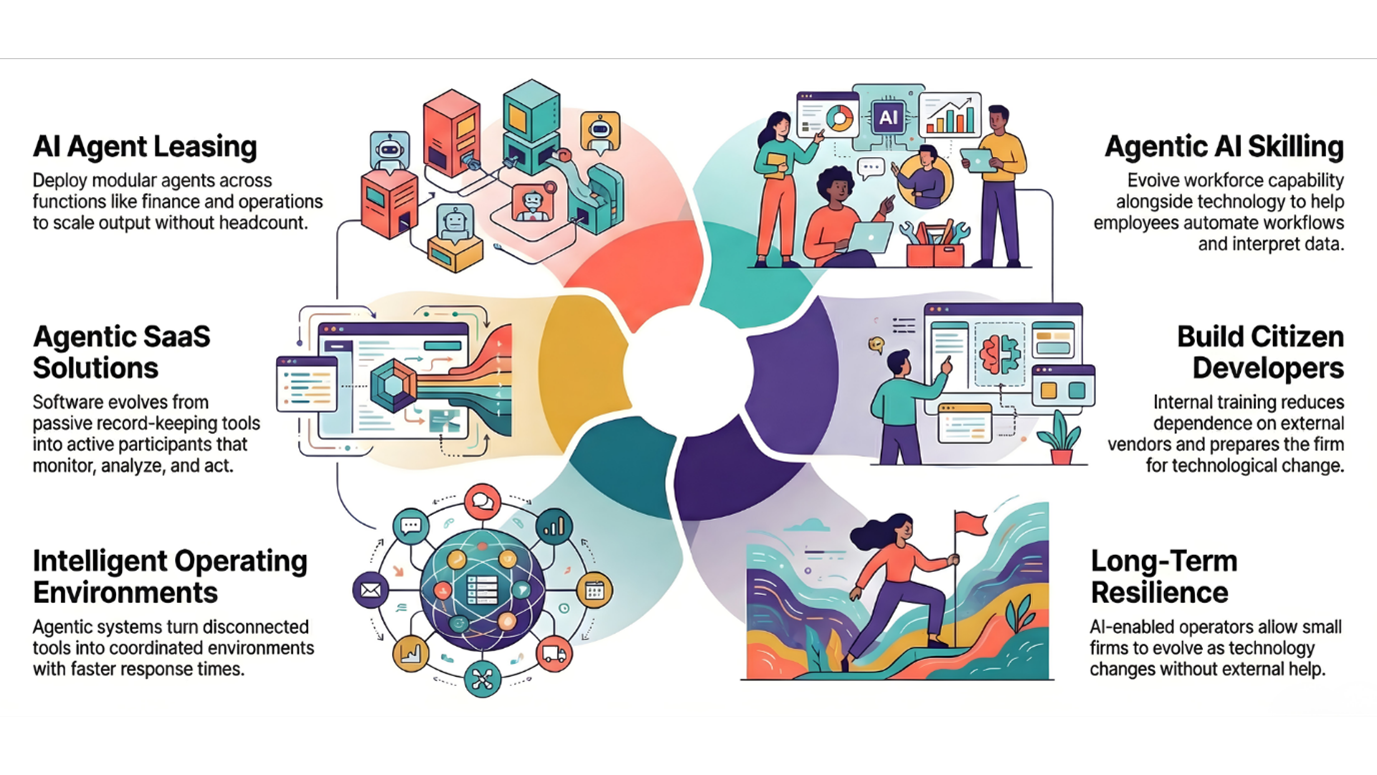
AI agents leasing
Agentic SaaS solutions
Agentic AI skilling
AI Agents Leasing and Agentic SaaS Solutions
- Agentic AI Skilling: Upskill your employees into AI-enabled digital practitioners who can build and manage automation internally.
- Agentic SaaS Solutions: Embed AI into your key functions, including sales, finance, operations, and customer service.
- Self-Service BPO: Provide flexible, expert support for specialized areas such as digital marketing, analytics, automation deployment, and CRM or ERP operations.
What Is Agentic SaaS for SMEs?
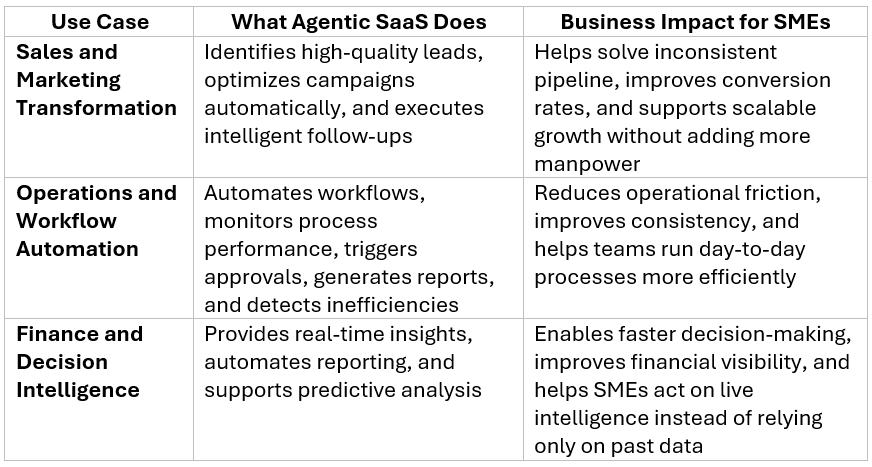
Agentic SaaS represents a shift from passive software to active systems. Unlike traditional SaaS, which mainly records data and relies on users to take action, Agentic SaaS can analyze information, recommend next steps, and support execution. In simple terms, it turns software into a more intelligent system that actively participates in business workflows.
From Tools to Intelligent Business Systems
How AI Agents Power Agentic SaaS
How Agentic SaaS Transforms Sales, Operations, and Finance for SMEs