Home Blog Lifelong Learning CET Data Analytics Course Singapore
Lifelong Learning CET

Data Analytics Course Singapore: Careers & Salary Guide

Build Your Data Career with Proven Salary Outcomes

Data Analytics Course Singapore: Careers & Salary Guide

Build Your Data Career with Proven Salary Outcomes

Banner with headline: Data Analytics Course Singapore: Careers & Salary Guide

Data analytics is one of the fastest-growing career paths globally, with professionals across industries using data to drive decisions, improve efficiency, and unlock new revenue opportunities.

Today, data analytics is no longer a standalone skill—it is increasingly integrated with AI-driven technologies such as machine learning, automation, and predictive analytics. This allows professionals to move beyond historical reporting and generate forward-looking insights that support real-time, strategic decision-making.

At CLaaS2SaaS, learners are not just taught tools, but also how to leverage AI-powered and AI-driven automation, intelligent workflows, and analytics to improve productivity and decision-making. This mirrors how modern organizations operate globally—where data professionals are expected to work alongside AI systems rather than manually process data.

If you’re exploring structured pathways, you can start with data analytics courses or pursue a data analytics certification depending on your career goals.

In Singapore—often used as a benchmark for advanced digital economies—data professionals command competitive salaries. According to Glassdoor, roles such as Data Analyst, Business Intelligence Analyst, and Data Scientist typically earn between SGD $4,000 and $9,500+ per month, depending on experience and specialization.

Globally, similar demand and salary competitiveness can be seen across markets in Southeast Asia, where organizations are rapidly investing in AI, data infrastructure, and digital transformation.

According to the World Economic Forum, data and analytics roles are among the fastest-growing job categories worldwide, with increasing overlap between data analytics, AI, and automation roles.

As a result, professionals who upskill in data analytics can:

  • Transition into high-demand roles across industries worldwide
  • Increase their earning potential in both local and global markets
  • Build future-ready skills applicable in AI, automation, and digital transformation
  • Work with AI-assisted tools to improve efficiency and scalability in their roles

What You Can Do with Data Analytics Skills

Data analytics skills are applied across industries including finance, healthcare, e-commerce, logistics, and technology.

Professionals trained in data analytics can:

  • Build dashboards to monitor business performance
  • Analyze customer data to improve marketing ROI and support data-driven marketing strategies across digital channels
  • Automate workflows using Python and SQL
  • Support decision-making with data-driven insights


Rather than focusing on theory alone, modern data analytics training emphasizes real-world application, ensuring learners can immediately contribute in roles such as data analyst, reporting analyst, or business intelligence analyst.

Career Opportunities in Data

Demand for data professionals remains strong in Singapore and globally, particularly within PMET roles.

High-Demand Roles

  • Data Analyst
  • Business Intelligence (BI) Analyst
  • Data Scientist
  • Data Engineer (including entry-level roles such as data engineer intern)

According to labour market insights from the Ministry of Manpower, digital and data-related roles continue to grow as companies invest in transformation initiatives.

Career Progression Path in Data Analytics
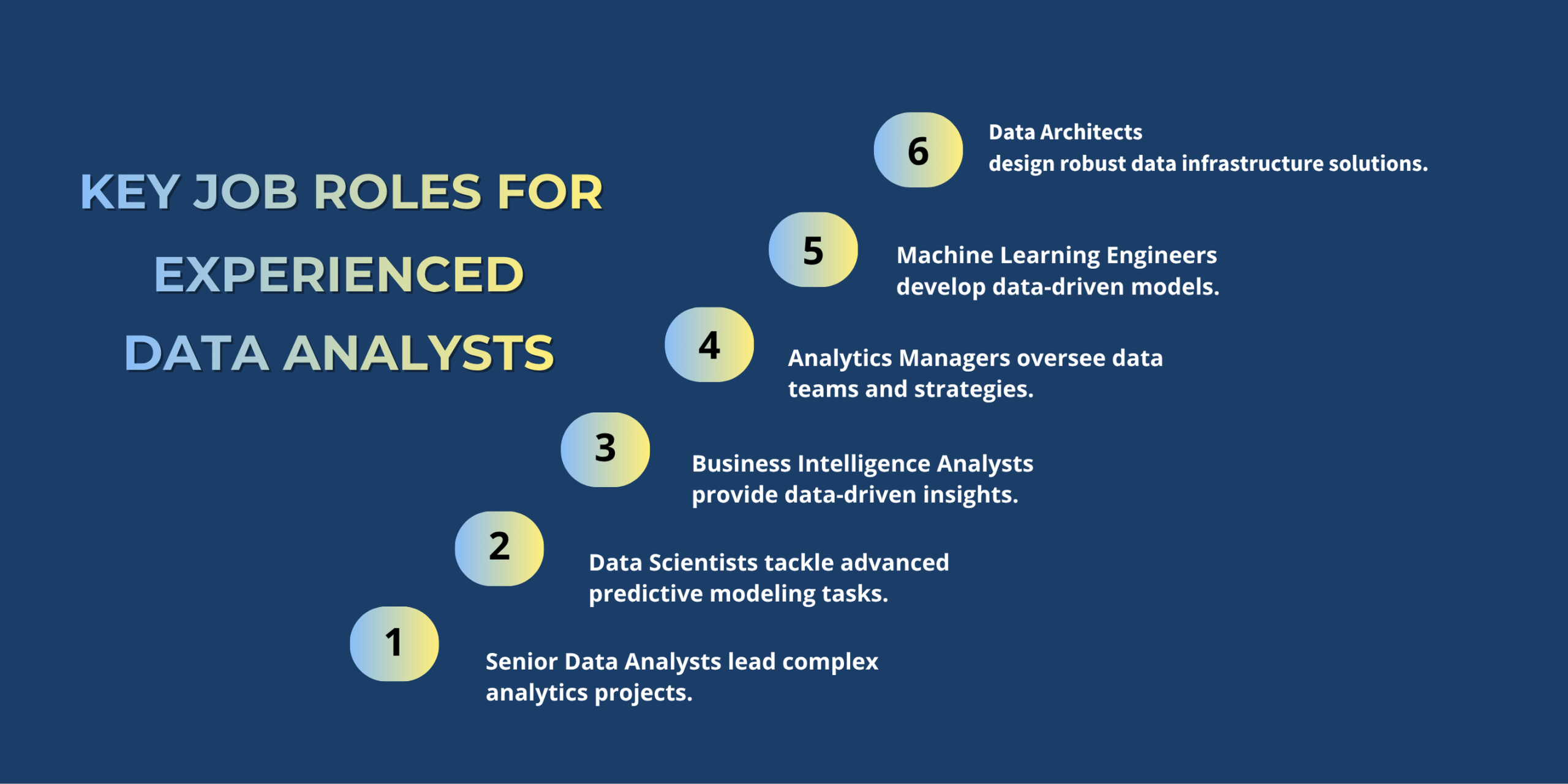
Key Job Roles

  • Entry: Data Analyst / Reporting Analyst
  • Mid-Level: BI Analyst / Data Specialist
  • Advanced: Data Scientist / Analytics Lead

These skills are transferable across industries and markets because the core workflow stays consistent: analyze data, communicate insight, and support decisions.

Data analytics is also increasingly integrated into adjacent fields such as digital marketing, finance, and supply chain management. Professionals who combine domain knowledge with analytics skills often have a competitive advantage, as they can translate data insights into business outcomes more effectively.

This makes data analytics not just a standalone career path, but a powerful skill set that enhances roles across multiple industries.

Skills and Tools Covered (Tableau / Power BI / Python / SQL)

A strong data analytics program focuses on mastering industry-standard tools used globally.
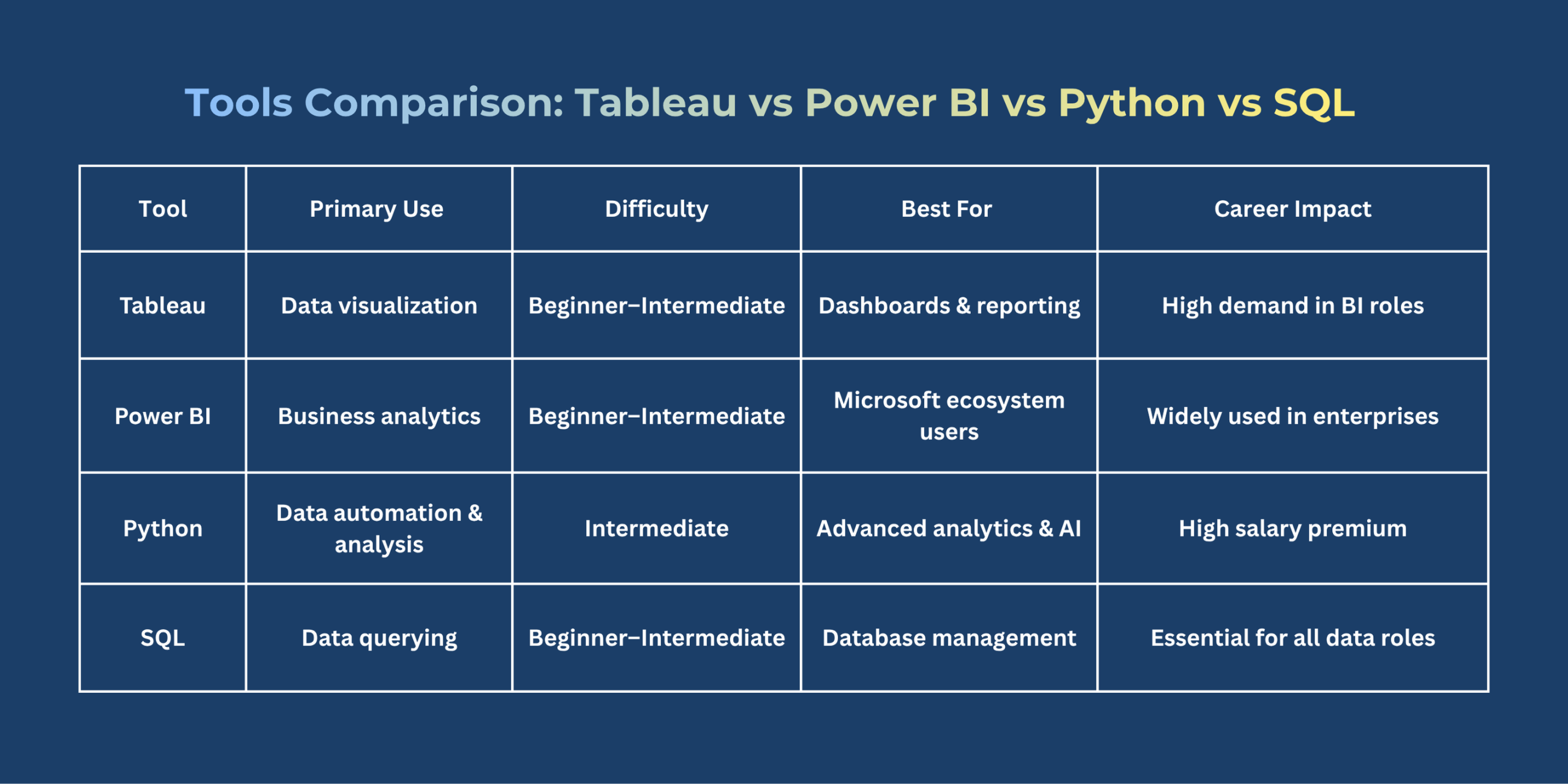
Tools Comparison: Tableau vs Power BI vs Python vs SQL

Key Insight

  • Tableau and Power BI are ideal for beginners entering analytics
  • Python and SQL are essential for advanced roles and higher salary potential

Each tool plays a distinct role within the data analytics workflow. Visualization tools like Tableau and Power BI enable professionals to present insights clearly through dashboards and reports, helping stakeholders make faster decisions.

Python is widely used for data cleaning, automation, and advanced analytics, including predictive modeling. SQL remains a foundational skill, allowing analysts to extract and manipulate structured data directly from databases.

Together, these tools help learners move beyond static reporting toward faster analysis, workflow automation, and more decision-oriented business insight. Professionals who combine visualization tools with programming skills are often better positioned for higher-paying roles, as they can manage the entire data pipeline—from data extraction to insight generation.

These tools are widely used by organizations globally, making them essential for professionals pursuing both local and international careers in data analytics.

Beginner vs Advanced Learning Path in Data Analytics
For professionals entering data analytics, learning paths typically fall into two categories.

Beginners often start with tools such as Excel, Tableau, or Power BI, focusing on data visualization and basic analysis. These skills are sufficient for entry-level roles such as reporting analyst or junior data analyst.

More advanced learners progress into Python, SQL, and statistical analysis, enabling them to handle larger datasets, automate workflows, and perform predictive analytics. These capabilities are required for roles such as data scientist or analytics specialist.

Choosing the right learning path depends on your career goals, timeline, and prior experience.

Compare Data Analytics Program Types

To better understand how different business management programs compare in terms of outcomes, learning approach, and industry relevance, the table below highlights key differences across commonly considered providers.
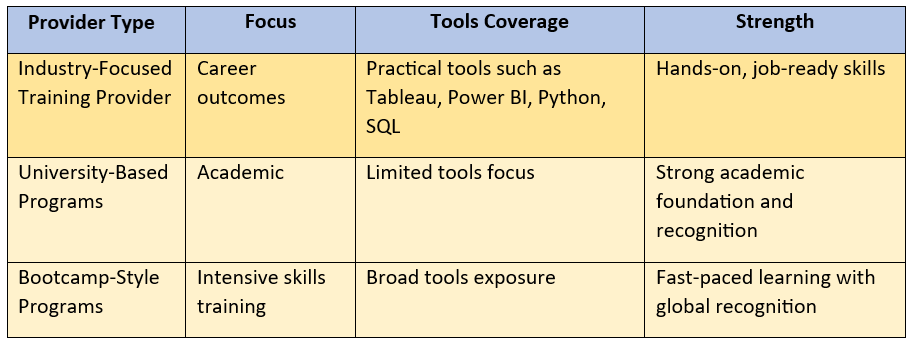
table of Comparison of Data Analytics Program Types

The key differentiator lies in the emphasis on real-world application and employability.

As shown above, each provider offers distinct strengths depending on learning goals and career stage. While some focus on academic depth or broad exposure to tools, others emphasize hands-on application and immediate workplace relevance.

The key differentiator ultimately lies in how effectively these programs translate learning into real-world outcomes—particularly in terms of employability and career progression.

Course Options: A Stackable Learning Pathway

Choosing the right data analytics course is no longer about selecting one option over another. Instead, modern learners benefit most from a stackable learning pathway, where they progressively build skills from foundational to advanced levels.

This approach allows you to start small, gain immediate job-ready skills, and then continue advancing toward deeper specialization—whether for local career growth or global opportunities.

A typical pathway looks like:

This flexible structure is especially relevant for international learners and working professionals who want to balance time, cost, and career progression.
This program is designed for professionals who want to quickly gain practical, job-ready skills without committing yet to a long-term program. At CLaaS2SaaS, the Professional Certificate is structured to reflect real-world, AI-enabled workflows used in modern organizations.

What You’ll Learn

This programs include:
  • Build foundational skills in working with data, interpreting results, and supporting business decision-making through reporting and analysis.
  • Learn how AI tools can support productivity, insight generation, and modern digital workflows.
  • Understand how to automate repetitive processes and streamline workflows in business environments.
  • Apply your learning through a practical project that reflects real-world business scenarios.
Unlike traditional training, these modules are designed to simulate how data professionals work today—leveraging AI tools, automating repetitive tasks, and focusing on insight generation rather than manual processing.

Why This Matters Globally

While Singapore-based courses often include localized frameworks, the skills taught are globally transferable. Professionals in markets such as the United States, United Kingdom, Australia, Canada, Southeast Asia use the same tools, workflows, and increasingly, AI-driven analytics platforms.

Who Should Take This Path

This pathway are ideal for:
  • Career switchers from non-technical roles (e.g., marketing, admin, finance)
  • Professionals looking to enhance their current role with data and AI skills
  • Individuals aiming to qualify for entry-level roles such as Data Analyst or Reporting Analyst
For many learners, this pathway serves as a low-risk, high-impact entry point, allowing them to quickly validate their interest while building immediately applicable, globally relevant skills.

Diploma programs build on foundational skills acquired in the professional certification, making them the next step in a stackable learning journey.

These programs expand into more advanced capabilities, including:

  • Build a stronger foundation in data science concepts, workflows, and methods used in analytics and AI roles.
  • Learn how machine learning techniques are applied to practical business and data problems.
  • Gain exposure to more advanced AI concepts and model-building approaches for complex data tasks.
  • Complete a larger applied project that brings together analytics, AI, and problem-solving in a real-world context.

This level is ideal for professionals aiming to move beyond entry-level roles and into mid-level or specialized positions globally, where deeper technical expertise and project experience are required.

For professionals who want to move beyond hands-on execution and into higher-level analytics, AI, and business decision roles, a Master’s-level pathway is the next stage in the stackable journey.

At CLaaS2SaaS, this stage is designed for learners who want to strengthen not only their analytics skills, but also their ability to connect data, AI, and business strategy in more complex environments.

What You’ll Build at Master’s Level

  • Understand core network concepts and how digital systems connect and operate in real environments.
  • Strengthen your knowledge of database design, structure, and management in support of larger information systems.
  • Build understanding of software development principles, system design, and implementation approaches.
  • Learn key concepts in cybersecurity and secure systems practices.
  • Complete a thesis or applied project that brings together your learning in a practical, advanced context.

Rather than focusing only on technical execution, this level helps learners develop the judgment and analytical maturity needed to work on larger business problems, communicate with decision-makers, and contribute to transformation initiatives.

Why This Matters

A Master’s-level pathway helps professionals to go further by strengthening:

  • credibility for more advanced roles
  • readiness for specialist or leadership-track progression
  • ability to work on more complex analytics and AI initiatives
  • long-term qualification value in both local and international markets

Expand Your Skill Set with Adjacent Tech Pathways

  • Instead of choosing between options, think in terms of progression:
    Start with the professional certificate to gain foundational, job-ready skills quickly
  • Progress to a diploma to deepen expertise and unlock higher-paying roles
  • Advance further into AI, data science, with the Master’s degree for leadership or technical tracks

This stackable approach allows you to:

  • Learn at your own pace
  • Minimize upfront commitment
  • Continuously upgrade your skills in line with global industry trends
Not sure which pathway fits your goals? Explore tech career pathways →

SkillsFuture Funding

One of the key advantages of enrolling in data analytics courses in Singapore is access to government-supported funding schemes that significantly reduce the cost of upskilling.

Through SkillsFuture Singapore, eligible individuals can use SkillsFuture Credit to offset course fees. Singaporeans aged 25 and above receive credits that can be applied to approved training programmes, making it more accessible to transition into high-demand fields like data analytics without a large upfront investment.

In addition to individual funding, companies can also benefit from enterprise-level support. Through Enterprise Singapore, businesses may tap into initiatives such as the SkillsFuture Enterprise Credit (SFEC) to subsidize workforce training. This is particularly valuable for organizations looking to upskill teams in data analytics, business intelligence, and digital transformation.

SG Data Roles Salary Benchmarks (2025)

Salary is one of the most important considerations when transitioning into data analytics.
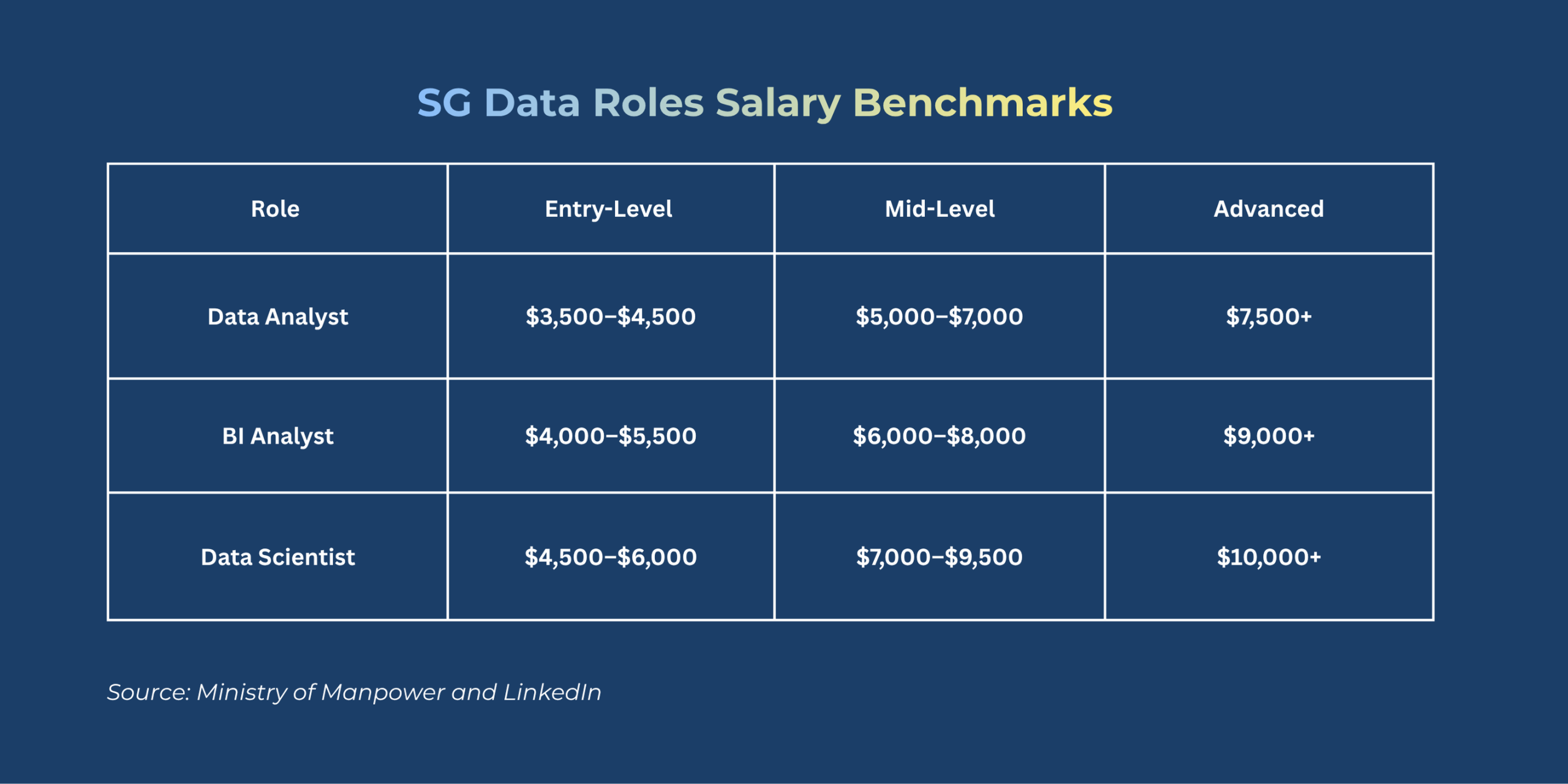
SG Data Roles Salary Benchmarks
While these benchmarks are based on Singapore data, similar roles globally offer competitive salaries depending on region, industry, and experience level.

Professionals who complete structured training and apply their skills effectively often move into higher-paying roles within 12–18 months.

This progression is driven by:

  • Practical tool proficiency (Tableau, Power BI, Python, SQL)
  • Ability to interpret and communicate insights
  • Experience working with real-world dataset

Testimonials & Career Transition Scenarios

While individual outcomes may vary, the following scenarios reflect common career transitions observed in both Singapore and global job markets.

Scenario: Finance to Data Analyst Transition
A mid-career finance professional transitions into data analytics by learning SQL, data visualization, and dashboard tools.

With these skills, they move into a Data Analyst role, taking on responsibilities such as reporting automation and performance analysis, with improved salary potential and career growth opportunities.

Scenario: Operations to Data Automation Specialist
An operations professional learns Python and data analytics techniques to automate manual reporting processes.

By applying these skills, they significantly reduce reporting time and improve efficiency, positioning themselves for higher-value roles within the organization.

Real Learner Story: Career Switch into Marketing
“Switching from IT to marketing at 30 was a big leap, but the Professional Diploma in Digital Marketing gave me the structure, support, and confidence to make it happen. The guidance from mentors and career consultants helped me reposition myself and understand what employers were looking for. Today, I’m working as a Marketing Executive—something that once felt out of reach. Starting over wasn’t a setback, but the beginning of a career I truly care about.”
— Wong Yu Hao

This example highlights how structured training, combined with the right support system, can enable successful career transitions across industries.

Career outcomes are based on typical market trends and may vary depending on individual experience, industry, and role.

Frequently Asked Questions

Yes. Data analytics is one of the fastest-growing career paths globally, with strong demand across industries and regions.
Common tools include Tableau, Power BI, Python, and SQL, each serving different functions in the analytics workflow.
Data analytics focuses on analyzing and interpreting data, while data science involves advanced modeling, machine learning, and predictive analytics.
Short courses typically take 2–6 months, while diploma programs can take 6–12 months.
Entry-level salaries typically range from $3,500 to $4,500 per month, with strong growth potential as experience increases.

Why Choose CLaaS2SaaS for Data Analytics Training

CLaaS2SaaS offers industry-aligned data analytics programs designed for real-world application.

Learners gain hands-on experience with globally relevant tools such as Tableau, Power BI, Python, and SQL, ensuring they are prepared for both local and international job markets.

Take the Next Step Toward a Data Career

If your goal is to transition into a high-growth, high-paying field, data analytics offers one of the most practical and scalable career pathways.

Want to check if this career is for you?