Accelerated Digital Leadership Program, A C-Suite Guide to Driving Enterprise Transformation

SHARE THIS:


Digital disruption isn’t slowing down and executive leaders are under pressure to respond fast.
Many working professionals begin their digital leadership journey by exploring innovation frameworks, executive learning pathways, and practical approaches to enterprise transformation. Understanding how emerging technologies reshape business strategy, organizational culture, and decision-making is now essential for leaders navigating today’s competitive landscape.
An accelerated digital leadership program equips professionals with applied frameworks, strategic insight, and executive-level capabilities to lead transformation, not just manage it.
This guide explains:
- What an accelerated digital leadership program is
- Why C-suite leaders need structured digital transformation training
- How executive programs differ from traditional leadership courses
- What to look for in a future-ready pathway
- What your next step should be
Why Digital Leadership Has Become a Core Executive Skill
Digital transformation is now a board-level priority.
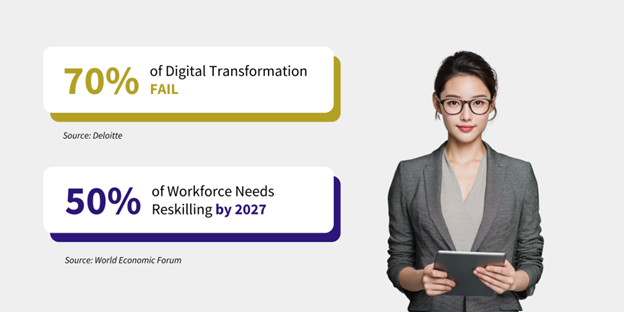
According to Deloitte, nearly 70% of digital transformation initiatives fail to achieve their intended outcomes, largely due to leadership and organizational challenges. At the same time, the World Economic Forum reports that more than 50% of employees will require reskilling by 2027 as technology reshapes the global workforce.
These statistics highlight a hard truth:
Without leadership capability, even the best digital tools fail to deliver meaningful business impact. Technology alone doesn’t transform organizations, leaders do.
Today’s executives are expected to:- Translate digital strategy into operational reality
- Champion innovation across departments
- Manage large-scale organizational change
- Make data-informed decisions
- Align people, processes, and platforms
What Is an Accelerated Digital Leadership Program?
An accelerated digital leadership program is an executive-focused development pathway designed to rapidly build digital transformation capability within a condensed timeframe.
The term “accelerated” reflects both structure and intent.
These programs are built for working professionals with limited time but high accountability. Instead of multi-year theoretical study, they emphasize applied frameworks, practical integration, and strategic clarity.
Participants engage in structured modules covering:
- Digital strategy development
- Innovation management systems
- Enterprise transformation models
- Change leadership methodologies
- Data-driven executive decision-making
Executives learn frameworks and apply them directly to real business contexts. This ensures the learning experience drives measurable organizational impact rather than abstract understanding.
An accelerated digital leadership program is not about technical specialization. It is about executive integration.
Accelerated Digital Leadership Program: Strategic Advantages for Executives
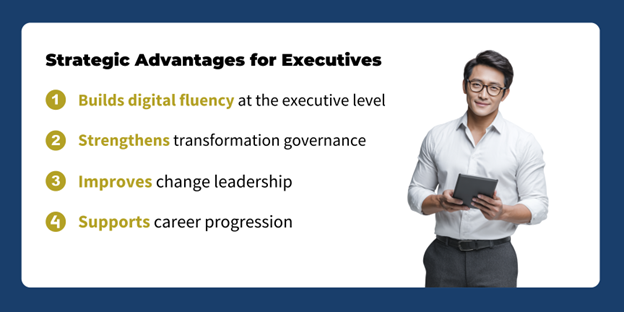
For working professionals, the value of an accelerated digital leadership program lies in strategic clarity.
- First, it builds digital fluency at the executive level. Leaders gain structured understanding of AI, automation, cloud strategy, and digital ecosystems without becoming technical operators.
- Second, it strengthens transformation of governance. Executives learn how to prioritize initiatives, manage innovation portfolios, and align with stakeholders.
- Third, it improves change leadership. Cultural resistance is one of the largest barriers to transformation of success. Structured training prepares leaders to guide behavioral shifts effectively.
- Fourth, it supports career progression. Digital transformation expertise increasingly differentiates candidates for senior roles.
An executive digital transformation program enhances strategic credibility inside and outside the organization.
Executive Digital Transformation Program vs Traditional Leadership Education
Traditional leadership programs focus on management fundamentals, communication skills, and operational efficiency. These skills remain valuable. However, they do not fully prepare executives for systemic digital reinvention. An executive digital transformation program expands the scope.
Rather than managing existing systems, executives learn how to redesign them. They examine platform business models, ecosystem partnerships, digital monetization strategies, and innovation pipelines. They learn how to integrate emerging technologies into core operations while minimizing disruption risk.
In short, traditional leadership education prepares leaders to manage stability.
Accelerated digital leadership programs prepare leaders to manage change.
Why C-Suite Digital Transformation Training Matters Now
The stakes of digital transformation are high.
Large-scale digital investments influence enterprise competitiveness, regulatory compliance, operational efficiency, and market positioning.
Deloitte underscores that transformation success depends heavily on leadership alignment, operating model redesign, and enterprise-wide coordination. Meanwhile, the European Commission’s Digital Economy and Society Index demonstrates that economies and organizations investing in digital skills consistently show stronger innovation capacity and adoption readiness.
These findings reinforce a central reality. Digital tools enable change, leadership capability sustains it.
Without structured C-suite digital transformation training, organizations risk fragmented initiatives, wasted capital, and strategic drift.
How CLaaS2SaaS Digital Innovation Lead Supports Executive Growth
The learning pathways under CLaaS2SaaS Digital Innovation Lead are designed specifically for working professionals who want applied, career-relevant capability.
Rather than isolated courses, CLaaS2SaaS offers progressive development paths that combine:
- Emerging technology fundamentals
- Innovation frameworks
- Strategic implementation
- Academic recognition
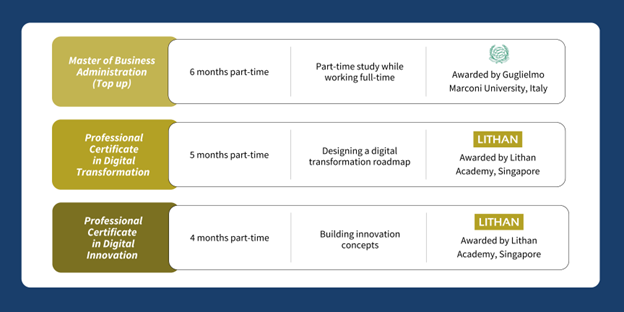
Professional Certificate in Digital Innovation
The Professional Certificate in Digital Innovation is typically where many professionals begin. It focuses on building foundational capability in emerging technologies and innovation frameworks, helping learners understand how digital tools reshape business models, customer experiences, and internal operations. This stage is about developing digital fluency, learning how to think differently about value creation before moving into large-scale transformation.
Professional Certificate in Digital Transformation
Once that foundation is in place, the Professional Certificate in Digital Transformation goes deeper into enterprise change management and strategic implementation. Here, professionals learn how to translate innovation into action, aligning stakeholders, redesigning operating models, and executing transformation initiatives across departments. This pathway is designed for those preparing to lead organization-wide change, not just contribute to isolated digital projects.
Master of Business Administration (Top up)
For professionals who want to formalize their expertise, the Guglielmo Marconi University Master’s Top-Up provides a pathway toward a fully accredited master’s degree while continuing to apply digital leadership skills in real workplace environments. It bridges practical transformation experience with academic recognition, supporting both career progression and professional credibility.
If you’re still evaluating which pathway best fits your current career stage, it often helps to first understand the broader digital innovation landscape, then review guidance on how different digital transformation programs compare in terms of depth, outcomes, and executive relevance. Many working professionals take this step to clarify whether they need foundational innovation skills, enterprise transformation capability, or formal academic progression.
What You Learn in an Accelerated Digital Leadership Program
A comprehensive accelerated digital leadership program typically integrates five strategic domains.- Digital strategy development teaches executives how emerging technologies reshape competitive positioning and industry structures.
- Innovation framework integration provides tools for experimentation, pilot testing, and scalable transformation.
- Enterprise transformation architecture focuses on governance design, stakeholder alignment, and operating model restructuring.
- Change leadership methodology prepares executives to guide cultural evolution and manage resistance.
- Data-informed decision-making builds executive confidence in interpreting analytics and guiding strategic prioritization.
From Learning to Execution: Enterprise Impact
The ultimate measure of an accelerated digital leadership program is not certification. It is execution.
Executives who complete structured transformation training frequently report stronger alignment across departments, clearer innovation roadmaps, and improved strategic decision-making.
More importantly, they develop the confidence to navigate ambiguity.
Transformation is rarely linear. Markets evolve. Technology shifts. Regulations change.
Digital leadership is the ability to maintain strategic coherence within constant change.
Choosing the Right Accelerated Digital Leadership Program
Selecting the right program requires thoughtful evaluation.
Executives should assess whether the curriculum emphasizes applied frameworks rather than theoretical discussion. They should evaluate whether the learning model supports immediate workplace integration.
An effective executive digital transformation program provides structured progression, allowing professionals to advance from foundational innovation understanding into enterprise-level strategic leadership.
It should also align with long-term career goals. Digital transformation capability increasingly defines executive readiness.
What is an accelerated digital leadership program?
An executive learning pathway designed to help professionals rapidly build digital strategy, innovation, and enterprise transformation capability through applied frameworks.
Who should take C-suite digital transformation training?
Senior managers, directors, and executives responsible for leading organizational change or digital strategy.
How is an executive digital transformation program different from traditional leadership courses?
Traditional programs focus on management fundamentals. Executive digital transformation programs emphasize enterprise reinvention, emerging technology integration, and change leadership.
How long do accelerated programs usually take?
Most range from several months to one year, depending on depth and structure.
What outcomes can professionals expect?
Participants typically gain executive-level digital fluency, stronger transformation leadership skills, and readiness for senior innovation roles.
Course

What Should You Do Next?
If your goal is to:
- Step into transformation leadership
- Build executive digital fluency
- Prepare for innovation-focused roles
- Lead enterprise change with confidence
Structured learning combined with real-world application helps professionals move from understanding digital transformation to actively leading it.