



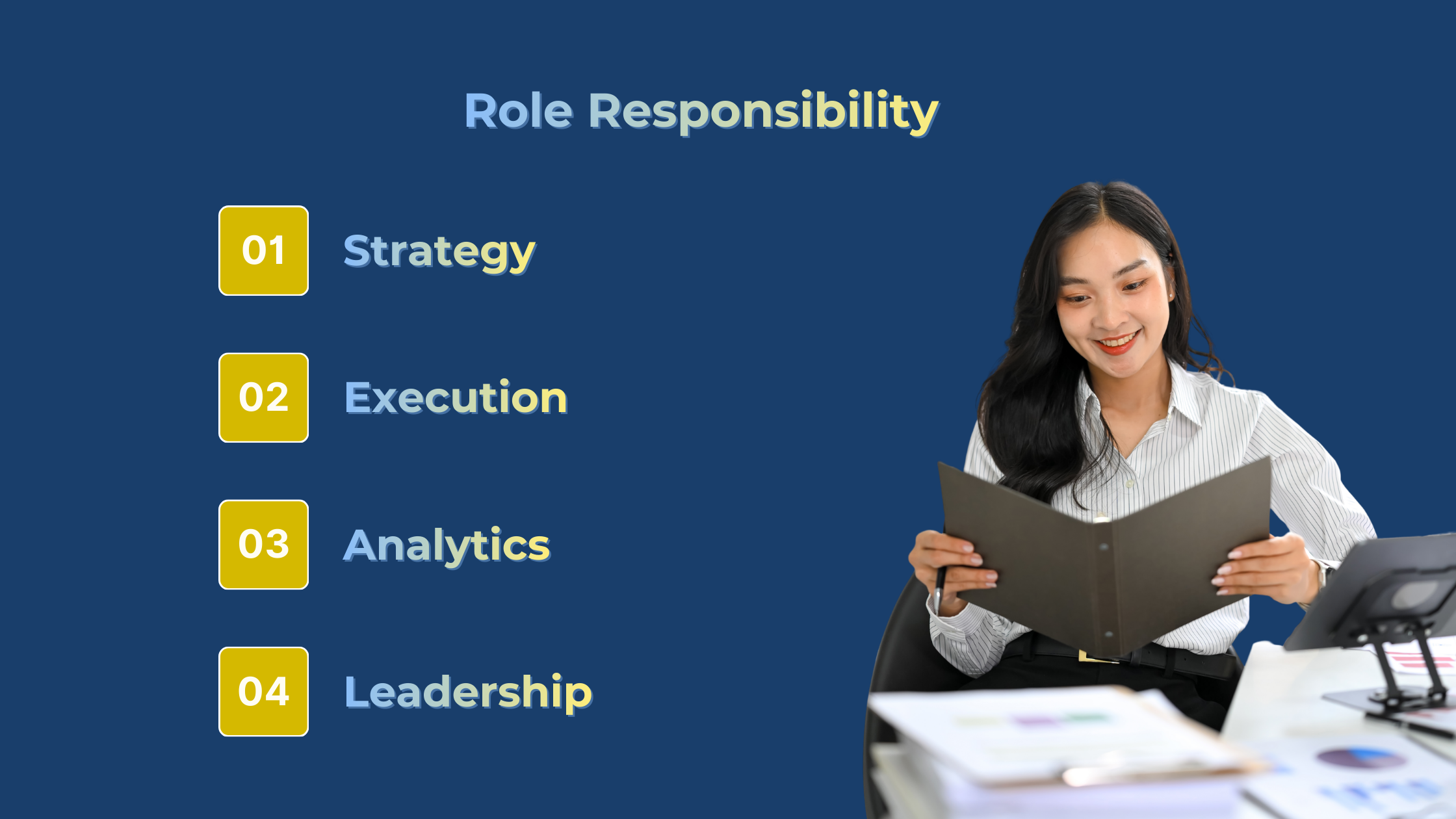
Step-by-Step Career Path to Manager Level
Step 1 — Executive / Specialist (Years 0–2)
At this stage, you are building your technical foundation. You work under supervision while learning how digital marketing systems operate in real business environments.Focus:
- executing assigned tasks
- learning platforms and tools
- running small campaigns
- supporting senior marketers
Common Roles:
- digital marketing executive
- SEO specialist
- ads coordinator
- content marketing assistant
Goal:
Build technical confidence and hands-on capability. This stage is about mastering tools, understanding metrics, and learning how performance is measured.Step 2 — Senior Executive / Team Lead (Years 2–4)
Here, you begin moving from execution to ownership. You are no longer just completing tasks — you are responsible for outcomes.Focus:
- managing campaigns independently
- optimizing budgets for better ROI
- analyzing performance data
- mentoring junior staff
Goal:
Develop strategic thinking and decision-making ability. You begin connecting marketing activities to broader business objectives.Step 3 — Digital Marketing Manager (Years 3–6)
At this level, you operate at a strategic leadership level. Your responsibility expands beyond campaigns to revenue impact and cross-functional alignment.Focus:
- setting strategy and growth targets
- allocating and managing budgets
- defining KPIs
- overseeing multiple marketing channels
- leading teams
Goal:
Drive measurable business results — not just execute marketing activities. You are accountable for performance, profitability, and long-term growth.Step 4 — Leadership (Years 6+)
This stage moves beyond marketing management into executive influence. You shape company-wide direction and long-term growth strategy.Common Roles:
- Head of Marketing
- Growth Lead
- Marketing Director
- Chief Marketing Officer (in larger organizations)
- define company positioning
- set annual revenue targets
- manage large teams and departments
- influence executive decisions
Real Career Example: From Student to Manager
Imagine this pathway: Year 1–2 Learn digital fundamentals + analytics Run real campaigns via work-study Lead a capstone growth project Graduation Portfolio includes:- ROI reports
- dashboards
- strategy decks
 Salary Expectations
- Executive: $45k–60k
- Senior: $60k–80k
- Manager: $85k–110k+
- Director: $130k+


About Mentor

Anindita Bose
ACWD – Web Development
Web Development
Husein has more than 15 years of experience in new business development, competitive market share expansion, and customer relationship management. He currently uses his digital marketing skills to expand his F& B business and teaches Digital Marketing to adult learners.
About Mentor

Lee Chee Hoe
PDIM – Innovation Management
Digital Business
Chee Hoe is a business technologist with unconventional views and a unique perspective that he applies to solve business problems. He has over a decade of experience in consultancy and collaboration projects, primarily for European and major Chinese companies in the tech sector. Chee Hoe is also a faculty member at Lithan, teaching Innovation Management.

About Mentor

Ramalakshmi Vaidhiyanathan
ACWD – Web Development
Web Development
With 18 years of experience in the software industry, Ramalakshmi transitioned to a Computer Science teacher role. She taught Computer Science curriculum for almost 2 years at a London based school for both primary and secondary students before becoming a Teaching Fellow at Swansea University. In this role, she taught various modules, such as Database Systems, Web Services, Network, and Mobile Application Development, to degree apprenticeship students working towards their B.Sc Applied Software Engineering Degree (Honors). Ramalakshmi also served as a STEM delivery officer with Technocamps, promoting Computer Science in schools across Wales. She has a Post Graduate Certificate in Higher Education and is a Fellow with AdvanceHE. Additionally, she completed their 200-hour Yoga teacher training from Sanatan Yoga and currently practice and teach Yoga during their free time.
About Mentor

Jayaprakash Subramaniam
ACWD – Web Development
Digital Business
Jayaprakash aims to be a successful software professional by staying updated with the latest technological advancements in the field of Information Technology. He aspire to utilize their technical and personal abilities to offer the best possible solutions.
About Mentor

Irene Santoso
PDDB – Digital Business
Digital Business
With 25 years of experience in the design industry and a strong portfolio in creative digital campaigns, Irene is a digital early adopter. She advises businesses on integrated branding strategy and actionable digital marketing solutions. In addition to her advisory work, She is trains adult professionals in digital marketing and digital business certification courses.
About Mentor

Rajkumar Jeyashree
Web Development
Web Development
Jeyashree has experience in planning, implementing, and managing education programs for local and overseas. She is manage over 400 students per academic year and 30 faculties locally and overseas in countries such as Indonesia, India, Malaysia, Myanmar, Philippines, Sri Lanka, and Vietnam. Capable of conducting online classes and facilitating workshops for over 200 participants with a satisfaction index of 90% or above. She also familiar with WSQ and Pearson BTEC frameworks and have experience with content curation and other training related activities. Additionally, she have comprehensive experience in Project Management, Object-Oriented System Analysis, Design, Development, Database Programming & Administration, Pre-sales support, Production Support, and MS Navision ERP implementation.
About Mentor

Goh Kum Whye (Leslie)
ACWD – Web Development
Web Development
After working in web application development for nearly 20 years, Kum Whye transitioned to become a trainer and mentor to share their expertise with those new to the IT industry. He aim to help bridge the gap between academic learning and industry needs.
About Mentor

M Nasrullah Radzwan
Learning Facilitator
Digital Business
Nasrullah facilitates and manages blended learning to provide an exceptional learning experience to Lithan’s international students. He has expertise in teaching the full range of Digital Marketing, with a particular focus on social media marketing. Additionally, he is a mindfulness coach.
About Mentor

Gold Poovan Devasagayam
PDDB – Digital Business
Digital Business
With more than two decades of experience in management, customer service, and marketing across a range of industries, Poovan is a seasoned professional. He takes a collaborative and interactive approach to help marketers and businesses place the customer at the center of their operations, resulting in measurable success. Poovan is also a faculty member at Lithan, teaching Digital Marketing, Agile Methodology, and Innovation Management.
About Mentor

Gollapalli Rajendra Kishan
Learning Facilitator
Data Science
Kishan is a Microsoft Certified Azure Data Scientist and SAP certified ABAP and HANA Consultant with 18 years of experience in SAP, Data Science, Artificial Intelligence, and Machine Learning projects and training for prestigious clients across various countries. He has managed and delivered courses on R Programming, Python Programming, Microsoft Azure Machine Learning, Power BI, Machine Learning, Deep Learning, Computer Vision, NLP, and Reinforcement Learning. He has also led trainers and established operational objectives and work plans within the Data Science and AI pool while monitoring the team’s performance using Power BI dashboards. Kishan is an expert in creating content for all Data analytics, Data Science, Machine Learning, and AI courses.
About Mentor

Sneha Kumari Biharilal Kala
EIT – IT Support
System Management
Sneha is a certified POSH Enabler, empaneled with the Government of India and a Transactional Analysis practitioner with a specialization in Cognitive Drill Therapy. In addition, she holds a Diploma in Facilitation Skills from Dale Carnegie. With a passion for meeting new people and building rapport, she has addressed over 8000 participants across various training programs. Her client base spans across industries such as Jewelry, Retail, Pharmacy, Aviation, Educational Institutes, Telecom & IT. She believes in leading by example, resulting in excellent ratings for all her conducted programs.
About Mentor

Tan Tzu Shin
PDDM – Digital Marketing
Digital Business
Tzu Shin is an accomplished e-commerce entrepreneur with a track record of achieving 30% revenue growth in online sales for five consecutive years. In addition to his expertise in contract negotiation, budget management, and omni-marketing, He is also a skilled educator. He teaches the full spectrum of Digital Marketing at Lithan.
About Mentor

Zubair Hasan Qureshi
PDDS – Data Science
Data Science
With over 24 years of experience in academics, project management, and data analysis, Zubair Hasan have worked extensively with applications such as SSAS, SSIS, SSRS, Power BI, Excel, Business Objects, and MS-Project to build data cubes, data mining, business intelligence, databases, and DWH. They have trained various national and multinational corporations, including Nomura, L&T, Capgemini, ISRO, Etisalat, Emirates, Adani Enterprises, and Credit Suisse, among others, in PAN and overseas locations. He holds MCT (Microsoft Certified Trainer) and MCTS (Microsoft Certified Technology Specialist) certifications.
About Mentor

Waheedah Binte Abdul Salim
Learning Facilitator
System Management
A view years ago, someone asked her, “Don’t you ever get tired of learning?” While in the past, one would typically have one job for life, the current buzzword is “lifelong learning.” With the constant advancement of technology, old jobs become obsolete, and new ones are created. As a result, Waheedah spent the last few years upskilling in areas that are impacting the industry, such as PDPA, Cybersecurity, Robotics Process Automation UiPath, Google Cloud Certified Architect (SGIgnite program), Visualization with Microsoft PowerBI, Digital Collaboration with Microsoft Teams, and Automation with Microsoft PowerAutomate.
About Mentor

Choong Sin Fatt
PDIM – Innovation Management
Digital Business
Sin Fatt is an experienced Design Thinking and Agile strategist who advocates for innovative approaches to implementing Design Driven Agile. With a background in IT development, consulting, pre-sales, and training, He has helped organizations improve their product team’s ability to deliver products that meet customer needs. As a certified Scrum Master, Product Owner, and Sprint 2.0 Facilitator, and Innovation Management at Lithan.
About Mentor

Umang Kejriwal
PDDS – Data Science
PDAI – Artificial Intelligence
Data Science
Umang Kejriwal is a passionate Learning & Development (L&D) professional with over 8 years of experience working with MNCs and local companies. They specialize in Machine Learning, Data Science, and Internet of Things, as well as being a Full Stack Web and Android Developer. They have delivered 500+ trainings for different technologies, including Python, Machine Learning, Data Science, AI, IoT, Android, and Web Development to more than 50 companies and 250 engineering colleges. Additionally, he have developed over 100 websites and Android apps for different companies and possess good experience in developing E-Commerce and Learning Management platforms.
About Mentor

Yee Jiong Hwa, John
Innovation Management
System Management
Yee Jiong is earned multiple IT professional certifications and maintained membership in various professional organizations related to IT. Certifications included Certified Information Systems Security Professional, ISC2 CompTIA Security+, CompTIA Certified Information System Manager, and Certified IT Project Management. He also held memberships in several professional bodies, including SCS British Computer Chartered IT Professional, British Computer Society Senior Member of Singapore Computer Society (SMSCS), British Computer Society Member (MBCS), and Associated Computing Machinery (ACM) Member.
About Mentor

Lee Yun Yi, Titan
PDDM – Digital Marketing
Digital Business
Titan is a Digital Marketing professional with over 10 years of experience in marketing spanning various industries, from TV shows (CNA – Angel’s Gate Series) to Consumer Electronics (3D Printers & Astronomy Cameras) to Wearable Technology (T.Ware’s Hug Jacket) and media events (TechinAsia). He gained recognition for successfully raising over $1 million on Kickstarter in 30 days on a budget of $50,000. At Lithan, Titan shares his knowledge and expertise by teaching Digital Marketing.
About Mentor

Shanti Sekhar
PDSS – Systems Support
Data Science
After completing a degree in Engineering, Shanti Sekhar pursued a Masters in Business Administration to support their management, marketing, and administrative roles. They also completed a Masters in Engineering at the National University of Singapore. With experience in engineering and general management, Shanti has held positions such as Designs Engineer, Purchase Manager, Marketing Manager, Senior Contracts Manager, Adjunct Lecturer, and Academic Head. She regularly attends seminars from leading technology companies and hold certifications in ACTA, TESOL, and teaching from NIE. Shanti is competent in teaching modules related to Computer Security, Computing, and Business Management.
About Mentor

Varun Pathak
EIT – IT Support
PDSS – Systems Support
System Management
Varun is a Freelance Cyber Security Trainer and Consultant. He has previous experience as a Cyber Security Consultant at PwC and a Network Engineer at Infotel Business Solutions Limited. With extensive knowledge in securing and administrating devices such as Routers, Switches, Firewalls, and Servers, he now executes projects related to Vulnerability Assessment, Penetration Testing, SOC implementation, and Corporate Training as a Fulltime Freelancer. Varun has delivered over 400 trainings on Cyber Security, CEH, CCNA, and Network Security to more than 40,000 students. He also has experience in auditing Network Infrastructure, Data Centre, SOC Review, Web Application Security Testing, and troubleshooting multiple network and security issues.
About Mentor

Nim Mala
PDDB – Digital Business
Digital Business
Nimmala is a former digital content marketer who has turned her focus to training and learning & development. She currently works with a team of faculty and learning associates to run programs at Lithan Academy, where she teaches Agile Methodology, Digital Business, and Digital Marketing.
About Mentor

Rajeev Tyagi
PDDS – Data Science
Data Science
Rajeev Tyagi has 18+ years of experience in the BPO/ITES/Education industry, a full-time Post Graduate Diploma in Business Management with specialization in Information Technology, and is UGC NET qualified in Management. They have worked with leading clients such as Google, IBM, HP, Cigna, Tiscali, among others. Additionally, the individual is certified as a Lean Six Sigma Black Belt professional.
About Mentor

Sim Gim Huat (Victor)
EIT – IT Support
System Management
Gim Huat is an instructor and mentor for various IT courses such as Fundamentals of Servers, Install, and Configure Operating System, Support and Maintain Infrastructure, and Capstone Project Implementation. He also serves as an assessor for EIT, ITCS, and PDSS.
About Mentor

Mohamed Niyaz
EIT – IT Support
PDSS – Systems Support
System Management
Niyaz is a Profesional Microsoft Exchange Professional and Certified Exchange Specialist with a passion for technology. He is in excel team development and motivation to achieve company objectives. Niyaz have strong time management skills and effective communication and interpersonal skills. He hold various certifications, including Acta, ITIL, CSM, MCSE Cloud Platform and Infrastructure, MCSE Core Infrastructure, MCSE Productivity Solutions Expert, MCSA Windows Server 2016, MCSA Windows Server 2012, CCNA, CompTIA Cloud+, and are also certified in Microsoft 365 Enterprise Administrator Expert and Modern Desktop Administrator Associate.
About Mentor

Kagalwala Husein Murtaza
PDDM – Digital Marketing
Digital Business
Husein has more than 15 years of experience in new business development, competitive market share expansion, and customer relationship management. He currently uses his digital marketing skills to expand his F&B business and teaches Digital Marketing to adult learners.
About Mentor

Chow Wing Hong, Mikey
PDDB – Digital Business
Digital Business
Mikey, an engineer turned entrepreneur, has decades of experience in international business and management. Since 1994, he has worked extensively in Greater China and returned to Singapore in 2002. Mikey has successfully co-founded and divested 5 companies, and his entrepreneurial experience includes Business Innovation, Fund Raising, Sustainable Business Model & Process, creative Product Design & Offering, creating Value Chain, and marketing. At Lithan, Mikey is a trainer for Digital Business and Digital Marketing.
About Mentor
Zubair Hasan Qureshi
PDDS – Data Science
Data Science
With over 24 years of experience in academics, project management, and data analysis, Zubair Hasan have worked extensively with applications such as SSAS, SSIS, SSRS, Power BI, Excel, Business Objects, and MS-Project to build data cubes, data mining, business intelligence, databases, and DWH. They have trained various national and multinational corporations, including Nomura, L&T, Capgemini, ISRO, Etisalat, Emirates, Adani Enterprises, and Credit Suisse, among others, in PAN and overseas locations. He holds MCT (Microsoft Certified Trainer) and MCTS (Microsoft Certified Technology Specialist) certifications.
About Mentor

Adam Chew
EIT – IT Support
System Management
Adam Chew is skilled in communication and can effectively convey solutions to customers. He has the ability to quickly learn new technology and implement systems efficiently. He is part of a global team providing support across Asia and other regions and is able to respond promptly to inquiries.
About Mentor

Benjamin Song Young Hua
PDDB – Digital Business
Digital Business
Benjamin has worked in various industries and possesses skills in negotiation, business planning, coaching, and management. He has conducted multiple training programs and facilitations in the region. Additionally, he teaches Digital Business at Lithan Academy. He holds a Bachelor’s Degree in Engineering from Nanyang Technological University.
About Mentor

Abdul Hamid Ahmad
PDSS – Systems Support
System Management
Ahmad is a professional with a strong belief in lifelong learning and constantly updating himself on emerging technologies. He enjoys mentoring talent in the world of work and sharing their personal experiences to enhance their career growth. As an educator, he is passionate about imparting knowledge in the field of AI, particularly in machine learning, deep learning, computer vision, reinforcement learning, time series, NLP, urban computing, and IoT using Python and R.
About Mentor
