Digital Transformation Course (No Tech Background): A Business-to-Digital Career Pathway

SHARE THIS:


Many professionals assume digital transformation is a technical field driven mainly by engineers and developers. If you come from a business background such as operations, marketing, consulting, or management, it may feel difficult to enter the world of digital innovation.
However, digital transformation now extends far beyond technical teams. Organizations are redesigning how they operate using artificial intelligence, automation, and data-driven systems. These technologies are increasingly used across departments, not just in IT teams. In many organizations, employees are already experimenting with generative AI tools to improve productivity and solve business problems, showing how quickly digital capabilities are spreading across roles.
For professionals exploring a digital transformation course no tech background, the goal is not to become a programmer. Instead, the focus is on learning how digital tools improve business processes, support decision-making, and enable innovation.
More importantly, the goal is to develop the capability to connect technology with real business challenges and guide digital transformation initiatives within organizations.
Why Digital Transformation Skills Matter Across Business Roles
Digital transformation has become a priority across industries. As companies adopt AI, automation, and data platforms, transformation initiatives are expanding beyond IT departments and becoming part of everyday business strategy.
Common transformation initiatives include:
- Using AI tools to improve decision-making
- Automating operational workflows
- Improving customer experience with digital platforms
- Using data analytics to guide strategy
Successful digital transformations typically involves a combination of strong leadership, workforce capability development, upgraded tools, and clear communication across teams. Without leaders who understand both business strategy and digital technologies, many transformation initiatives struggle to scale beyond early experimentation. When these factors align, organizations are far more likely to turn digital initiatives into measurable business outcomes.
Because of this, organizations increasingly need professionals who can connect technology with real business challenges and guide teams through change. Professionals who understand both business strategy and digital capabilities play a critical role in helping organizations move from experimentation to sustainable digital transformation.
Can You Enter Digital Transformation Without Technical Skills?
Yes. Digital transformation does not always require programming skills.
Many professionals transition into digital transformation from traditional business roles such as operations, marketing, consulting, or project management. Their understanding of business processes often makes them well suited to identify opportunities where digital tools can improve efficiency and performance. Professionals in these roles often work on initiatives such as:
- Identifying processes that can be automated
- Implementing AI tools that support business decisions
- Redesigning workflows using digital platforms
- Managing transformation initiatives across departments
Modern tools have also lowered the technical barrier to entry. Low-code platforms, automation tools, and AI copilots allow professionals to build solutions and analyze data without advanced programming knowledge.
Because of this, digital innovation for non-technical professionals is becoming increasingly accessible.
From Business Roles to Digital Transformation Careers
Many professionals transition into digital transformation from traditional business roles such as operations, marketing, consulting, or project management. Their understanding of business processes often makes them well suited to identify opportunities where digital tools can improve efficiency and performance.
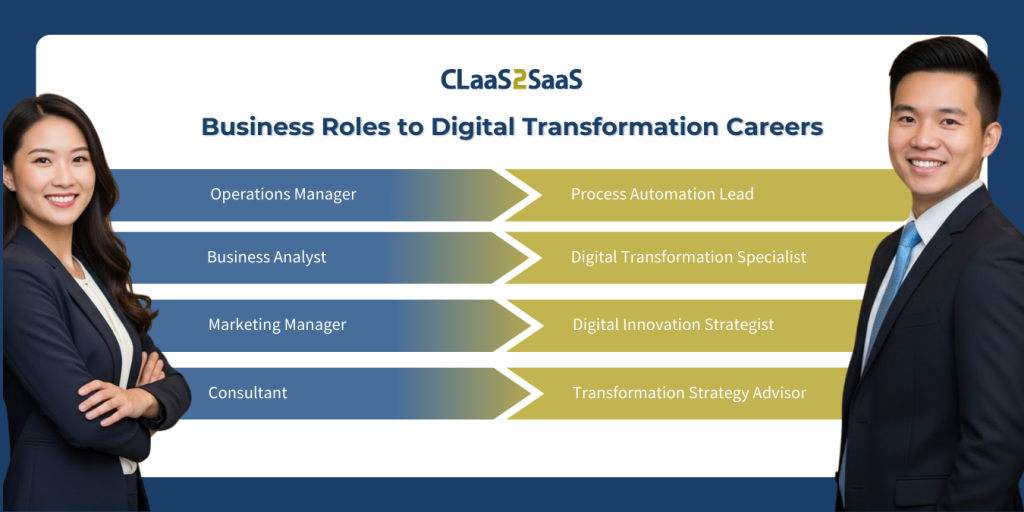
For example, an operations manager may begin by introducing workflow automation, while a marketing professional may use AI tools to improve campaign performance. Over time, these initiatives can evolve into broader digital transformation programs.
These transitions create a business to digital transformation career pathway where professionals combine existing business expertise with new digital capabilities.
A Digital Transformation Course Designed for Non-Technical Professionals
For professionals without technical backgrounds, entering digital transformation can feel overwhelming. The challenge is understanding how technology connects to real business problems.
Programs designed for non-technical professionals focus on practical applications rather than programming. Instead of learning how to code complex systems, participants develop the skills needed to apply AI, automation, and data insights to real business challenges.
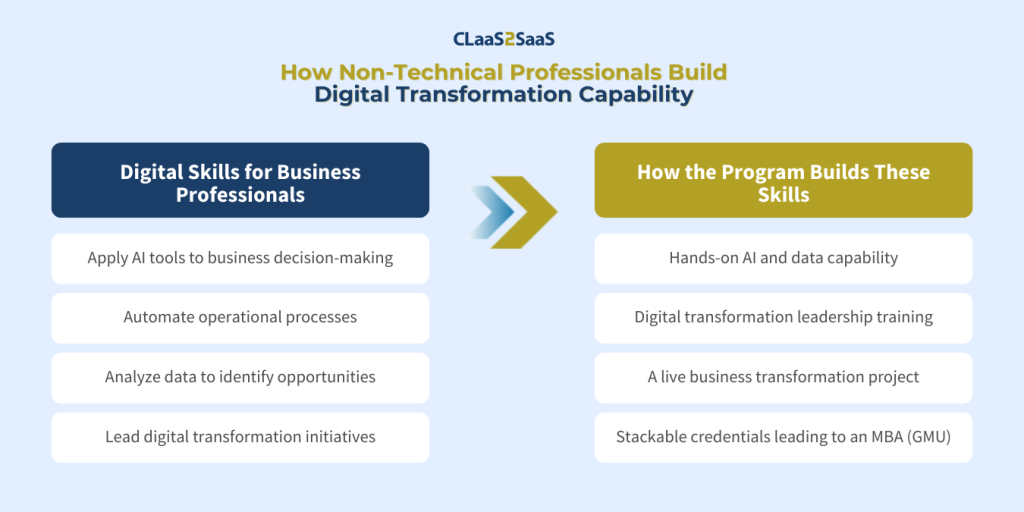
The pathway is built around a dual capability leadership model, combining business strategy capability with hands-on understanding of AI, data, and digital platforms. This allows professionals to guide digital initiatives while understanding how technology solutions are implemented in practice.
These programs help professionals move from understanding digital concepts to developing the practical capability required to support and lead transformation initiatives within their organizations.
A 3-Stage Pathway From Digital Foundations to Leadership
For professionals coming from business backgrounds, entering digital transformation can feel overwhelming. The challenge is not only learning new tools but also understanding how digital technologies connect with strategy, operations, and organizational change.
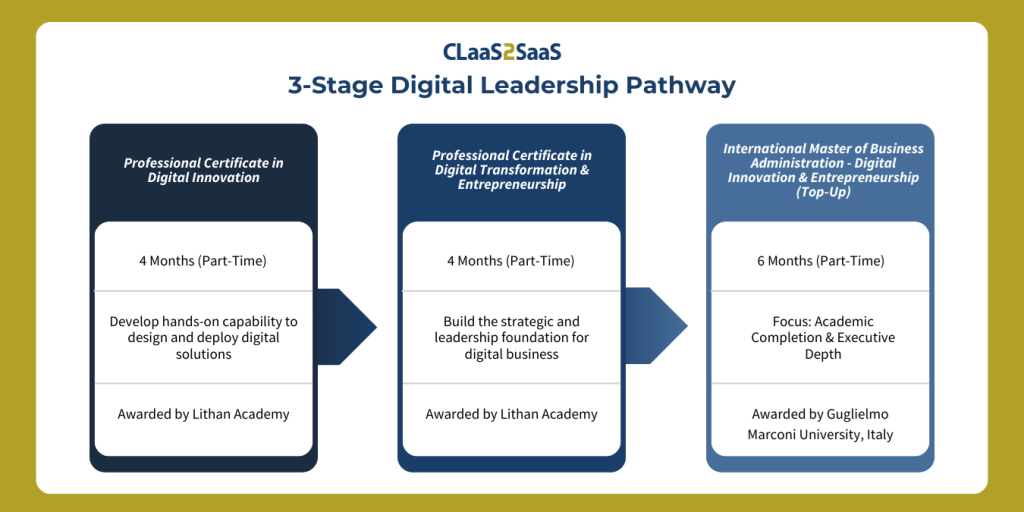
To make this transition manageable, the program is structured as a stackable learning pathway. Participants first build practical AI and digital solution capability, then progressively develop the leadership skills required to guide enterprise transformation initiatives. Each stage builds on the previous one, allowing professionals to apply what they learn in real work environments while continuing their careers.
The pathway consists of three stages.
Professional Certificate in Digital Innovation
Lithan Academy | 4 Months Part-Time
The first stage introduces the core digital capabilities needed to understand how emerging technologies support business transformation.
Participants develop foundational skills in:
- Low-code application development
- AI-enabled automation
- Data analytics and management
The stage concludes with an Intelligent Application Capstone Project, where participants design and build a digital solution that addresses a real business challenge.
Professional Certificate in Digital Transformation & Entrepreneurship
Lithan Academy | 4 Months Part-Time
The second stage focuses on developing leadership capability for digital transformation initiatives. Participants learn how to guide organizational change and align digital innovation with business strategy.
Key learning areas include:
- Digital transformation leadership
- Digital entrepreneurship and innovation
- Workforce transformation and digital learning strategies
- Organizational change management
Participants complete a Digital Transformation Capstone Project, where they design a transformation roadmap for a business or organization.
International Master of Business Administration - Digital Innovation & Entrepreneurship (Top-Up)
Guglielmo Marconi University | 6 Months Part-Time
The final stage develops strategic leadership capability for professionals who want to guide transformation at the organizational level.
Participants explore topics such as:
- Corporate finance and risk management
- International marketing and negotiation
- Business law and tax strategy
- Organizational leadership and management
- Strategy and project management
This stage prepares graduates to lead digital transformation initiatives across departments and organizations.
What Career Opportunities Can This Open?
Developing digital transformation capability can open the door to a wide range of roles that combine business strategy with digital innovation. As organizations continue investing in AI, automation, and data-driven decision-making, they increasingly need professionals who can guide transformation initiatives across departments.
Professionals who build these capabilities often move into roles such as:
- Digital Transformation Manager
- Digital Innovation Consultant
- Business Transformation Specialist
- AI Strategy Lead
- Head of Digital or Innovation
- Chief Digital Officer
These roles focus on guiding organizations through digital change, aligning technology initiatives with business strategy, and leading transformation projects across departments. Professionals in these positions often work closely with leadership teams to guide digital strategy, coordinate transformation projects, and ensure that technology investments deliver measurable business value.
For many professionals coming from business backgrounds, these opportunities represent a natural progression into leadership positions responsible for shaping how organizations adapt and grow in the digital economy.
Course

Start Your Digital Transformation Journey Without a Technical Background
Digital transformation is reshaping industries around the world. Organizations need professionals who can connect business strategy with digital innovation and guide transformation initiatives.
A digital transformation course no tech background can provide the foundation needed to understand AI tools, automation platforms, and digital strategy while developing the capability required to guide digital transformation initiatives.
If you want to explore how this pathway can support your transition into digital roles, the next step is to learn more about the program.