Digital Transformation Course (No Tech Background Required): For Business Professionals Transitioning into AI Leadership
SHARE THIS:


The phrase “digital transformation” is often shrouded in technical jargon that makes it feel inaccessible to those without a computer science degree. Yet, the reality is that the most successful digital shifts are led not by the people writing the code, but by the professionals who understand how that code solves real-world business problems. If you have spent your career in a “traditional” role whether in finance, operations, or marketing, you already possess the domain expertise that tech companies are desperate for.
This is not a coding course. It is a structured Digital Leadership pathway designed for business professionals transitioning into AI-embedded decision-making roles. As AI adoption accelerates globally, organizations increasingly require leaders who can translate strategy into AI-enabled operating models.
CLaaS2SaaS designed its curriculum to bridge this exact gap. Our digital transformation course for non-technical professionals is a strategic, beginner-friendly pathway designed to take you from a passive observer of technology to an active driver of digital innovation, a strategic decision-maker in AI-enabled environments.
The Strategic Shift: Why Non-Technical Leaders are the New Gold Standard
The “Why” behind the surge in digital capability development for business leaders is rooted in a fundamental business crisis: the communication gap. Large organizations are currently drowning in data but starving for actionable insights. Digital transformation is less about the technology itself and more about the strategy and people behind it. Many transformation projects fail not due to technology, but due to poor business–tech alignment.
The Rise of the “Digital Translator”
A digital translator is a professional who can stand in a boardroom and explain a business bottleneck, then walk into a developer’s office and explain how a specific software architecture can solve it. This role doesn’t require you to build the engine; it requires you to know how to drive the car and where it needs to go.
By pursuing a digital transformation course with no prior tech background requirement, you are essentially training to become this connective tissue. In the Work-Study Digital Leadership MBA pathway, this “Digital Translator” role becomes the foundation for enterprise-level transformation leadership.
Want to know if this is the right fit for you? Book a FREE Career Consultation now!
Defining the Curriculum: What Does a Beginner Pathway Look Like?
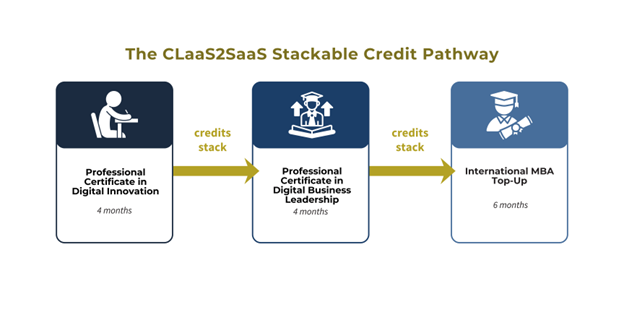
When we talk about a “beginner pathway” at CLaaS2SaaS, we aren’t talking about “Tech for Dummies.” We are talking about high-level strategic literacy and execution capability. The CLaaS2SaaS journey is a stackable, three-step transformation designed to take you from foundational literacy to global strategic leadership.
1. Delivery-Focused Execution (Professional Certificate in Digital Innovation)
This 4-month intensive phase focuses on building, and deploying intelligent digital solutions. You move beyond understanding innovation to actively delivering it. Graduates at this stage are capable of leading AI-assisted workflow redesign within functional teams.
- Low-Code & RPA Applications: Automate business processes and develop workflow-driven applications without heavy coding dependency.
- Generative AI Solutions: Master prompt engineering and AI model integration to lead AI-enabled workflow redesign.
- Data Analytics capability: Learn to transform and model data using Power BI to drive evidence-based strategic decisions.
- End-to-end Intelligent Apps Development: Integrate automation, AI, and analytics into a real-world project to graduate with demonstrable capability.
2. Leadership & Entrepreneurial Growth (Professional Certificate in Digital Business Leadership)
This 4-month phase develops your ability to lead organizational change and build digital ventures. At this stage, participants move from solution delivery to governing cross-functional transformation initiatives.
- Digital transformation frameworks: Structure operating models and manage cross-functional transformation projects.
- Digital leadership capability : Build strategic agility and data-driven decision-making to align technology with business goals and lead organizational change.
- Workforce Transformation Strategy: Design digital upskilling and learning strategies to build high-performing digital teams.
- Entrepreneurial and venture-building mindset: Apply Lean Startup methodology to validate market demand and design scalable business models.
3. Global Strategic Mastery (International MBA Top-Up)
The final 6-month stage, awarded by Guglielmo Marconi University, prepares you for senior global leadership. This stage consolidates dual capability strategic governance and applied AI execution into board-level transformation leadership.
- Corporate Finance, Accounting and Risk Management: Align corporate finance and competitive strategy into executive decision frameworks.
- Strategy, Organization and Project Management: Design expansion strategies that incorporate risk management and international market dynamics.
The Logistics of Learning: Built for professionals
One of the primary concerns for busy professionals is the “When.” The CLaaS2SaaS pathway is built specifically for the working professional:- Flexible Evening Sessions: Part-time training sessions are typically held from 7 pm to 10 pm, two to three times per week. The model ensures transformation capability is built while remaining professionally active.
- Skills-First Work-Integrated Learning: You aren’t just studying; you are engaging in industry-relevant projects that reflect real-world challenges.
- Personalized Career Support: The CLaaS2SaaS Talent Hub provides resume-building, 1-to-1 career coaching, and connections to over 2,000 companies for consulting or permanent roles.

Want to know if this is the right fit for you? Book a FREE Career Consultation now!
Breaking Down the Barriers to Digital Leadership
This program is specifically engineered for those with no prior IT experience, focusing on a skills-first approach rather than technical gatekeeping. A common misconception is that you need a “math brain” or a deep background in computer science to succeed in tech. In reality, the pathway to becoming a Digital Innovation Consultant is built on logic, domain expertise, and the ability to redesign business models.
The Profile of a Digital Innovation Leader
The pathway is engineered for strategic thinkers, not coders.- The Industry Veteran: You have spent years in a specific sector such as finance, healthcare, or logistics and understand the operational bottlenecks that only Digital Innovation Leads can solve.
- The Aspiring Consultant: You seek to command high-value roles, moving toward a career as a Digital Transformation Consultant or AI Strategy Consultant.
- The Future Manager: You are looking for a pathway into senior leadership roles, such as a Transformation Manager, or a managerial position of your current role.
- The Continuous Learner: You are ready to engage in a work-integrated journey that stacks credentials from a Professional Certificate up to an International Master’s Degree.
Disclaimer: Compensation varies by region and experience, but leadership roles in digital transformation consistently command premium remuneration globally.

Entry Requirements and Prerequisites
This pathway is designed for professionals seeking structured escalation into AI-enabled leadership roles with prior requirements to ensure you are ready for the rigor of the 4-to-14 month journey:- Academic Background: For the Professional Certificate level, a minimum of GCE O-Level (or equivalent) is required, specifically including a credit in Mathematics. No coding experience is required, only strategic curiosity and execution discipline.
- English Proficiency: As all lessons, mentoring, and peer discussions are conducted in English, an IELTS score of 5.5 or its equivalent is required to ensure success in a global, multi-cultural learning environment.
- Technical Readiness: You should have access to a PC or laptop (recommended Intel i5, 8GB RAM) to effectively run industry-standard tools like Power BI, Power Automate, and Microsoft 365 Copilot.
- Mindset: No prior coding knowledge is necessary, but a commitment to an adaptive learning model combining e-learning, flipped classes, and hands-on project implementation is essential.
The Capstone Project: Your “Proof of Concept”
The most vital part of your journey is the capstone project. In a digital transformation career, your portfolio often speaks louder than your resume. A capstone project is where you take a real-world business challenge and design a digital solution from scratch.
Why the Capstone is Your Secret Weapon:
- Tangible Evidence: It proves to a hiring manager that you don’t just “know” the theory you can execute.
- Cross-Functional Mastery: To complete a capstone, you have to use data, strategy, and design thinking all at once.
- Enterprise Proof of Capability: During your first interview for a digital role, you won’t talk about your old job; you will walk them through your capstone project. You will explain the “Why,” the “How,” and the “Result.”
Building the Career: From Business to Digital
Transitioning your title from “Operations Manager” to “Digital Transformation Lead” is a deliberate process. It involves more than just a certificate; it involves a strategic repositioning of your capability narrative.
1. Translating Your Experience
Your years in “traditional” business are not wasted. In fact, they are your biggest asset. When applying for digital roles, you must frame your past experience through a digital lens. Instead of saying “I managed a team of ten,” say “I led a team through a process optimization that increased output by 20% using digital project management tools.”
2. Networking in Tech Spaces
Start showing up where the digital leaders are. This means joining LinkedIn groups dedicated to digital innovation for non-technical leaders, attending virtual webinars, and contributing to discussions about the “Future of Work.”
3. Continuous Learning
Digital transformation is a moving target. The tools that are popular today (Generative AI) might be replaced by something else in two years. A successful pathway teaches you “how to learn” tech, ensuring that you remain relevant regardless of how the landscape shifts.
The Job Market: What Roles Can You Expect?
Once you complete a digital transformation course no tech background required, a whole new tier of the job market opens up to you. These roles often sit at the intersection of leadership and technology.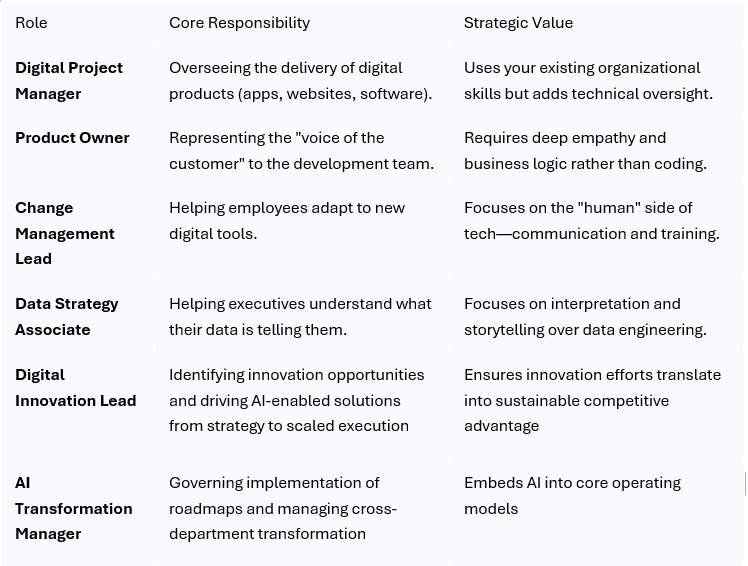
Course

Final Thoughts: The Path Forward
The journey from a non-technical background to a digital role is not a leap of faith; it is a calculated move. By choosing a structured digital transformation course that requires no prior tech background, you are taking control of the narrative of your career.The digital economy isn’t looking for more programmers; it’s looking for more leaders who aren’t afraid of technology. Whether you choose a part-time pathway or a fast-track intensive, the goal remains the same: to gain the confidence and the credentials to lead in a digital-first world.