Home Blog HigherEd Transformation Agentic Learning Platform for Universities
HigherEd Transformation

How an Agentic Learning Platform for Universities Is Transforming Higher Education Institutions

How an Agentic Learning Platform for Universities Is Transforming Higher Education Institutions

How an Agentic learning platform for universities enables, personalized workforce aligned learning at scale through Adaptive CLaaS® and Agentic CLaaS2Saas
Higher education institutions are under more pressure than ever before.
Learners expect personalized, flexible learning journeys. Governments increasingly demand workforce-aligned outcomes. Employers want job ready graduates with current digital and AI skills. At the same time, institutions must maintain academic integrity, regulatory compliance, and financial sustainability.
Yet most higher education institutions still operate batch-based, one-size-fits-all education models. Learning systems are fragmented. Curriculum updates take years. Personalization remains aspirational rather than operational. This growing gap between education and workforce reality is exactly why many institutions are rethinking their digital foundations.
This article explores how an agentic learning platform for universities enables educational institutions to move beyond LMS-driven digitization toward continuous institutional adaptation. You will learn what this platform model is, why it matters now, how it works, and why it offers a more sustainable path than traditional digital learning approaches.
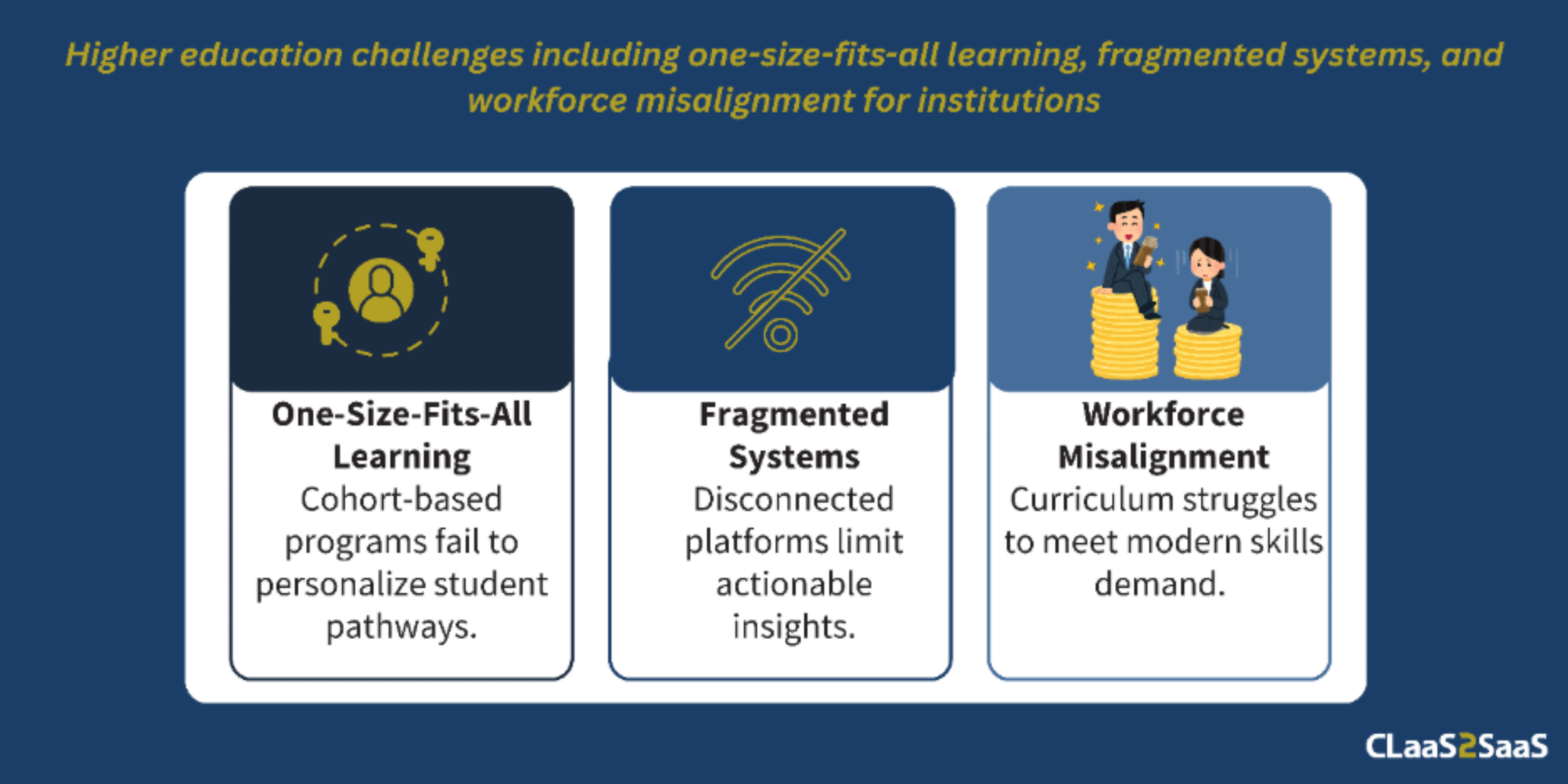
Higher education challenges showing one-size-fits-all learning, fragmented systems, and workforce misalignment.

Why Higher Education Institutions Can No Longer Rely on Traditional Digital Models

Digital transformation in higher education has been discussed for years. Learning management systems, student information systems, and online programs have become common. But adoption does not equal transformation.
Most institutions still struggle with three structural problems.
Learners enter higher education with vastly different backgrounds. Some are school leavers. Others are working professionals. Many need to reskill or upskill multiple times throughout their careers.
Courses are designed for cohorts, not individuals. Every learner moves at the same pace, regardless of background, ability, or career goals. Curriculum updates often take years, while digital skills and industry technologies evolve within months.
Batch-based education assumes uniform readiness and identical goals. This model limits engagement, increases dropout risk, and fails to reflect real workforce pathways.
Most institutions rely on multiple disconnected platforms. Learning systems do not talk to recruitment systems. Assessment data is not linked to skills intelligence. Decision making is more reactive than predictive. Data is disconnected, limiting insight and adaptability.
Without a unified platform, institutions struggle to personalize at scale or align learning outcomes with national and industry frameworks.
Governments and employers now expect higher education institutions to produce employable graduates, not just qualified ones. New digital and AI skills emerge faster than institutions can respond.
Updating curricula requires long approval cycles. Faculty is overloaded. This lag between curriculum cycles and market change creates structural misalignment.
While institutions recognize the need to modernize, transformation often stalls due to governance complexity, faculty workload, and slow curriculum cycles. These constraints are not due to lack of intent, but infrastructure that was never designed for continuous adaptation.

What Is an Agentic Learning Platform in Higher Education?

An agentic learning platform in higher education is not just another digital learning tool. In simple terms, an agentic learning platform uses intelligent AI agents that can interpret data, make contextual recommendations, and continuously optimize learning pathways across the institution. It is an AI first operating layer that continuously adapts learning, engagement, and operations across the learner lifecycle.
In the context of institutional transformation, this platform is delivered through Agentic CLaaS2SaaS, combining enterprise-grade software, AI agents, and adaptive intelligence to support decision making, orchestration, and personalization across the platform.
Unlike traditional systems that react to predefined rules and primarily distribute content, agentic platforms enable continuous adaptation. It orchestrates learning, engagement, compliance, and skills intelligence in real time. Learning pathways adjust based on learner behavior, performance, and goals. Institutions gain real time visibility into skills development, engagement, and outcomes.
Understanding the platform alone is not enough. The real impact comes from how it is applied at the institutional level. This is where AI-first adaptive university transformation becomes critical.
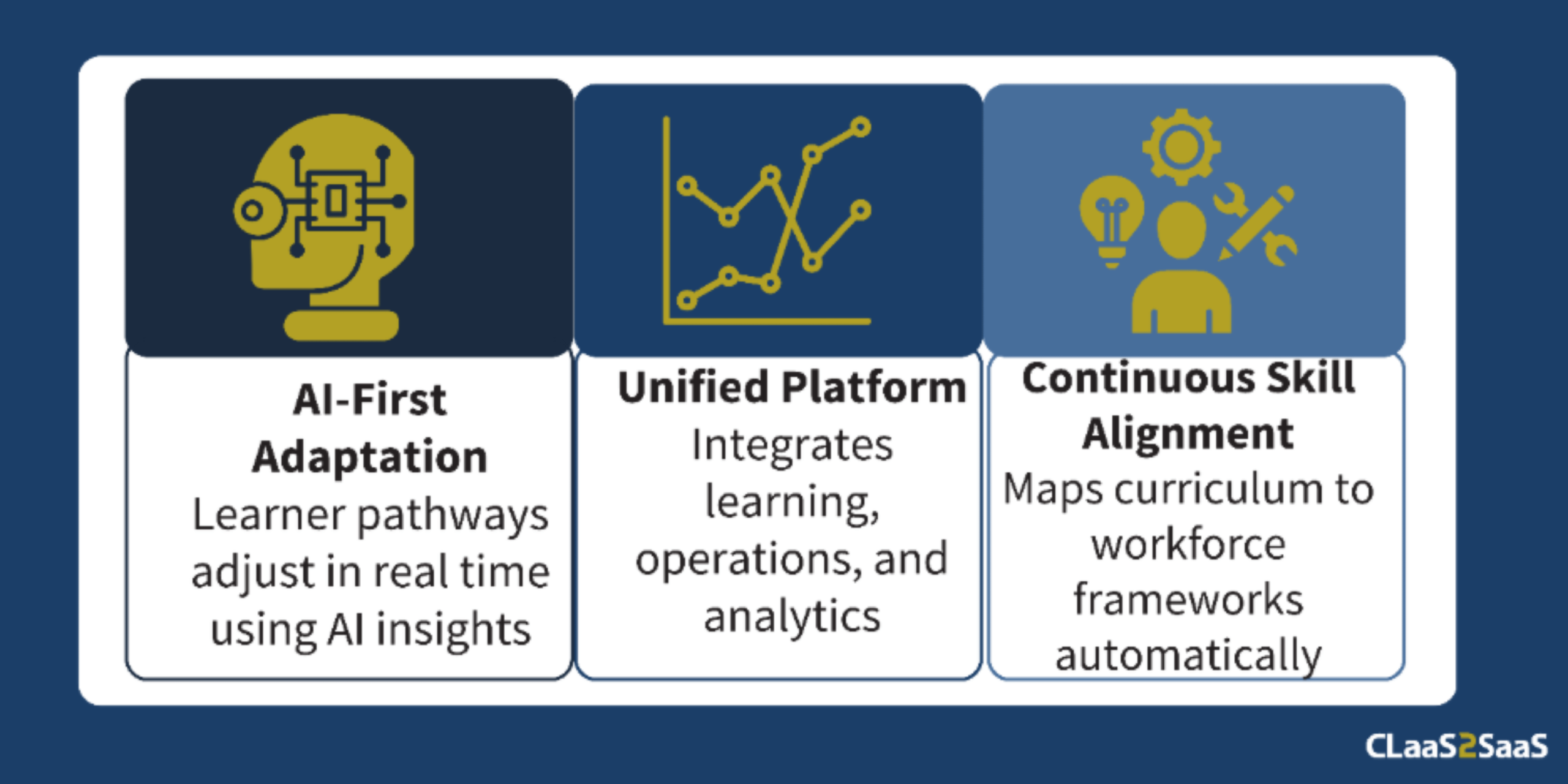
AI-driven education solutions including AI-first adaptation, unified platform, and continuous skill alignment.

Introducing AI First Adaptive University Transformation

If traditional systems cannot support continuous adaptation, universities need a fundamentally different operating model. AI First Adaptive University Transformation redefines how higher education institutions operate, deliver learning, and align with workforce needs.
This transformation shifts universities from static program delivery toward continuously adaptive learning ecosystems. Instead of layering tools on top of legacy systems, this approach unifies learner engagement, adaptive learning, operations, and intelligence into one platform.
Through an AI-powered digital platform supported by structured academic training and program development guidance, institutions can redesign and deliver modern, skill-focused programs while maintaining academic integrity and governance standards. The result is a continuously adapting institution rather than a static one.
The platform provides an intelligent infrastructure that continuously interprets learner, program, and institutional data, while enabling faculty to design curricula aligned with evolving workforce demands. This integrated model allows institutions to scale personalized learning, track skills development, and modernize delivery without increasing complexity.
When intelligent technology is combined with academic capability development, universities gain the ability to implement transformation at scale.
This approach enables institutions to:
  • Modernize academic programs faster without adding excessive workload for faculty
  • Align curricula more effectively with national skills frameworks and workforce needs
  • Deliver personalized learning journeys that adapt to individual learner progress
  • Track competency development continuously rather than relying solely on course completion metrics
  • Provide leadership teams with clearer institutional insights for faster academic and policy decisions
The result is a more agile university model capable of responding to changing industry requirements while maintaining academic quality and institutional stability.
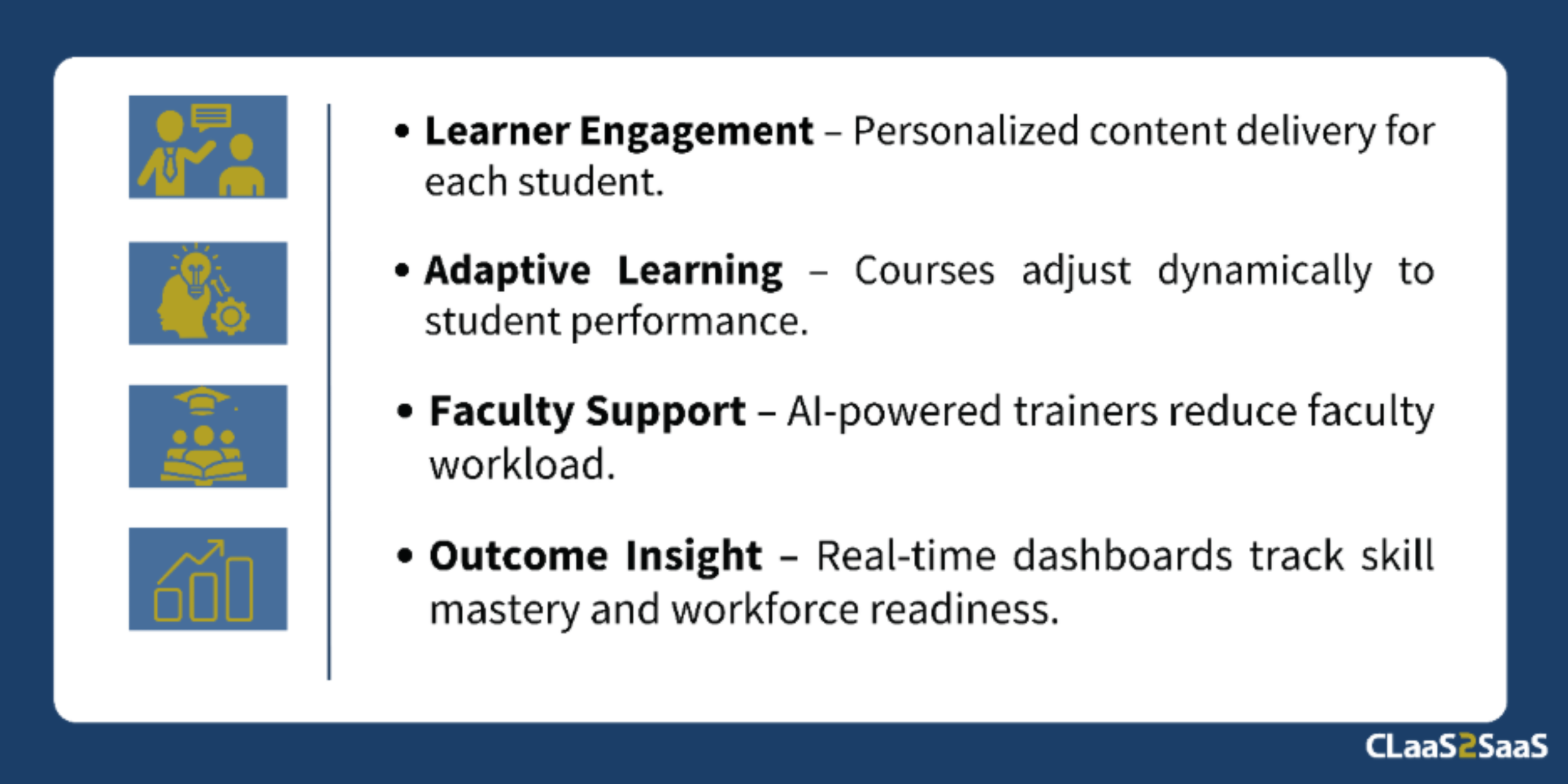
Key benefits of adaptive learning highlighting learner engagement, adaptive learning, faculty support, and outcome insights.
Beyond curriculum modernization, this integrated approach also supports the development of workforce-relevant skills. Through structured digital skilling pathways and guided program design, universities can introduce emerging technology competencies such as data analytics, automation, artificial intelligence, and other future-oriented capabilities.
This ensures that graduates develop practical, industry-relevant skills alongside academic knowledge, improving employability, and long-term career adaptability.
By combining intelligent software infrastructure with structured academic training and program development support, universities can transition toward a more adaptive and skills-focused education model.
Rather than relying on isolated technology adoption or disconnected training initiatives, institutions gain a unified transformation framework that strengthens learner success, faculty capability, and workforce alignment.
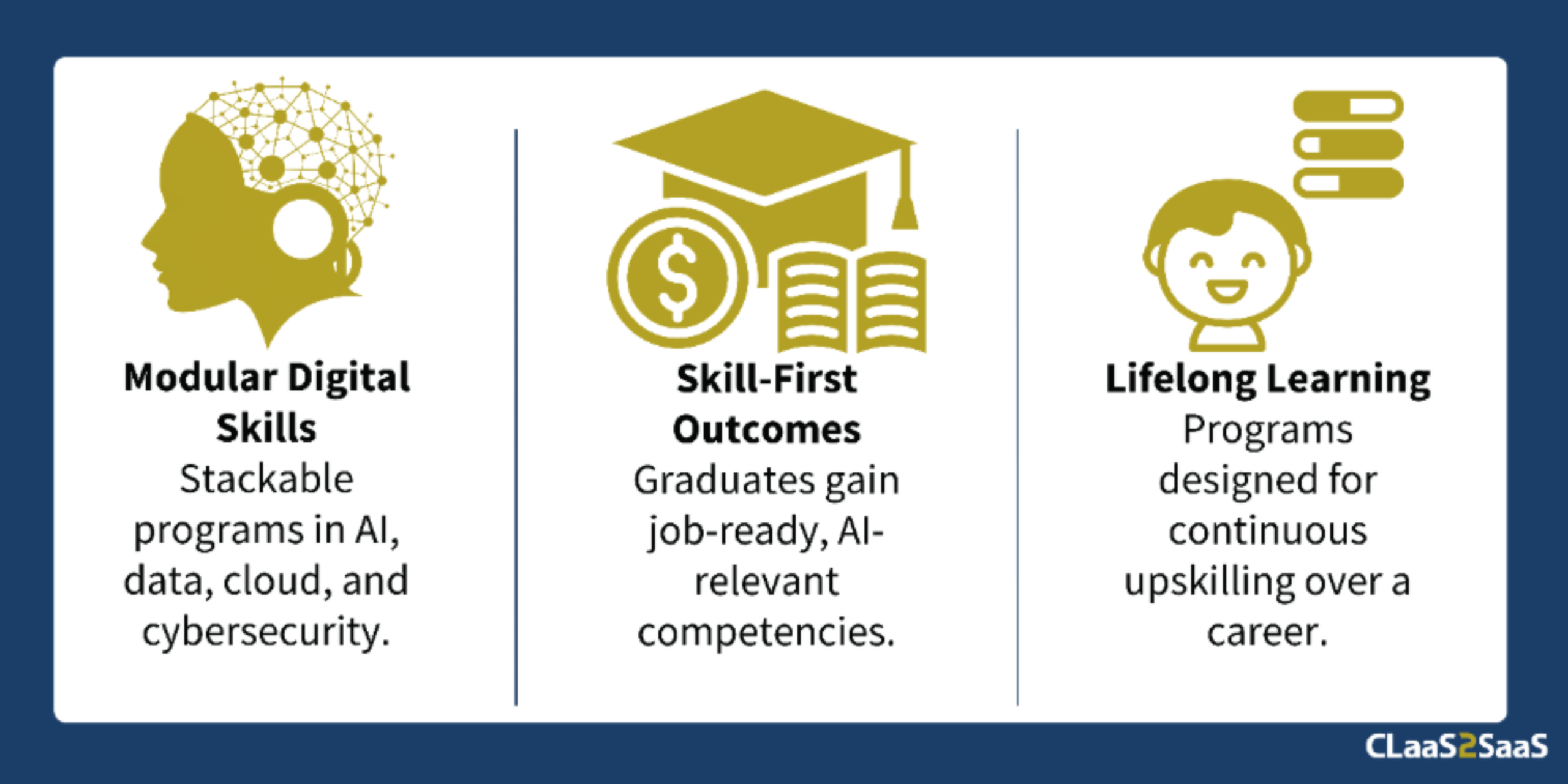
Digital career framework showing modular digital skills, skill-first outcomes, and lifelong learning programs for AI-relevant upskilling.

Why Adaptive Learning CLaaS® for Universities Outperforms Traditional EdTech

Many digital learning tools focus on content delivery. A few address system-level transformation.

Adaptive Learning CLaaS® for universities differs in several critical ways.

  1. First, it is AI-first by design. Adaptation is continuous, not rule-based.
  2. Second, it operates as an enterprise platform, not a standalone tool.
  3. Third, it aligns learning directly to skills intelligence and workforce outcomes.
For educational institutions, it goes even further by enabling higher education institutions to move from reactive administration to intelligent orchestration.
Institutions gain:
  • Real-time visibility into learner progression and skills 
  • Predictive insights for retention and performance 
  • Automated adaptation across learning and operations 
  • Scalable personalization without manual intervention 

Addressing Common Concerns About AI-First Transformation

No. Faculty remain central to academic quality and governance. AI supports delivery, personalization, and insight, reducing administrative burden rather than replacing educators.
Yes. Programs are co-developed, aligned with national frameworks, and governed by institutional academic standards.
No. These platforms support blended, hybrid, and campus-based learning models.

Who Benefits Most from This Transformation?

AI-first adaptive transformation benefits the entire higher education ecosystem.
Instead, it functions within a broader ecosystem that connects:
  • Learners gain personalized, relevant, and flexible pathways
  • Institutions gain agility, insight, and long-term sustainability
  • Governments gain workforce-aligned outcomes
  • Employers gain job-ready graduates
This alignment is what makes the model scalable and future-ready.

Why This Matters Now

The future of higher education will not be defined by those who digitized first, but by those who adapt continuously.
Institutions that rely on static systems and batch-based delivery will struggle to remain relevant. Those that adopt AI-first adaptive platforms can evolve with learners, skills, and workforce demand.
An agentic learning platform for universities enables higher education institutions to make this shift with confidence.

Conclusion: Building the Adaptive Higher Education Institution

Higher education institutions are no longer just knowledge providers. They are lifelong learning engines, workforce partners, and national development drivers.
Achieving this role requires more than incremental digital upgrades. It requires a unified, adaptive, AI-first foundation.
Through Adaptive CLaaS® and Agentic CLaaS2SaaS, institutions can transform learning, operations, and outcomes at scale.
The question is no longer whether higher education will change.
The question is whether institutions will adapt fast enough to lead that change.
Lead the Future of Higher Education—Before It Leaves You Behind
The pace of change in higher education is accelerating. Institutions that cling to static systems risk falling behind, while those embracing AI-first adaptive platforms gain agility, insight, and workforce alignment.
Institutions that adopt AI-first adaptive platforms position themselves for long-term relevance, scalability, and workforce alignment.

  • Deliver personalized, skills-focused learning journeys instantly
  • Align programs with evolving workforce and national standards
  • Track student competency and engagement in real time
  • Equip faculty with AI-driven insights, not extra workload
The next step is to understand how this model can be applied within your institutional context.
Want to check if this career is for you?