Future-Proof Your Career on a Digital Marketing Degree with AI Tools
SHARE THIS:


Digital marketing is no longer just about creativity, channels, or campaign ideas. It is about systems, data, automation, and intelligent decision-making at a scale. AI has moved from being an optional add-on to becoming the backbone of modern marketing operations. As noted by Melissa Russell of Harvard Professional, AI allows marketers to refine audience segmentation, predict trends, and make data-driven decisions in real time, shaping the future of marketing.
Yet many graduates still enter the workforce with outdated knowledge, fragmented skills, and little exposure to real marketing technology stacks. This gap between education and industry expectations is growing fast. With automation and AI reshaping roles globally, the World Economic Forum estimates that by 2030, 170 million new jobs will emerge even as 92 million roles are displaced, highlighting the need for adaptable, tech-savvy marketers.
For students choosing their first degree, the challenge is no longer just studying marketing, but choosing a digital marketing degree that stays relevant as technology reshapes the industry
A digital marketing degree with AI tools directly addresses this problem. It prepares learners not just to enter the workforce, but to stay relevant, adaptable, and competitive as marketing continues to evolve.
Why Digital Marketing Careers Need to Be Future-Proofed
Marketing roles are changing faster than job titles can keep up. Businesses now expect marketers to operate across platforms, channels, and customer touchpoints while making data-driven decisions in real time. Several shifts are driving this change:
- AI-powered automation is handling repetitive tasks
- Customer journeys are becoming non-linear and conversational
- Marketing performance is measured continuously, not campaign by campaign
- Teams are expected to do more with fewer resources
The result is a demand for marketers who can think holistically and execute efficiently. Employers are no longer hiring single-skill specialists. They are hiring adaptable professionals who understand systems, tools, and outcomes. This shift means that undergraduate education must now prepare students not just for their first job, but for how marketing roles will evolve over the next decade.
What Is a Digital Marketing Degree with AI Tools?
A digital marketing degree with AI tools is designed around how modern marketing actually works inside organizations today. Instead of focusing only on theory, this degree integrates artificial intelligence, automation, and real-world platforms into the learning process from the beginning. It is designed for undergraduate learners, combining academic foundations with applied AI-enabled marketing practice rather than taught as standalone electives or short courses. Students build capability progressively over the duration of the degree, moving from fundamentals to applied, real-world marketing systems.
The goal is not to turn students into data scientists. The goal is to train marketers who can confidently use AI to plan, execute, optimize, and scale marketing strategies.
Core characteristics include:
This approach ensures that graduates do not just understand marketing concepts. They know how to apply them in real environments. - Hands-on use of AI-powered marketing platforms
- Full-funnel and omni-channel marketing execution
- Real business scenarios and applied projects
- Continuous assessment based on outcomes, not memorization
- Alignment with real digital marketing roles
How AI Is Reshaping the Digital Marketing Career Path Degree
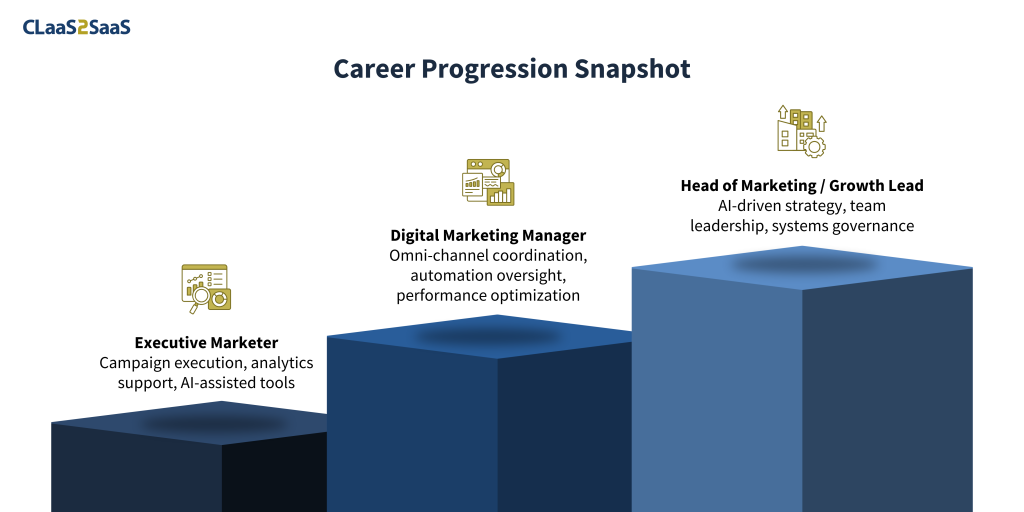
AI has changed the expectations placed on marketers at every level. Entry-level roles now require tool proficiency. Mid-level roles demand automation and analytics skills. Leadership roles require strategic oversight of AI-driven systems.
A modern digital marketing career path degree reflects this progression. As students progress through the degree, learning shifts from execution-level tasks to understanding how AI-enabled marketing systems support strategic decision-making. With AI and analytics among the fastest-growing skill areas globally, students trained in these tools are better positioned to meet the demands of an evolving job market.
From Execution to Strategy
AI handles tasks like scheduling, testing, and data processing. This frees marketers to focus on:
- Strategy and decision-making
- Customer experience design
- Creative direction and messaging
- Performance optimization
From Channels to Systems
Marketing is no longer siloed. SEO, paid ads, email, social media, CRM, and automation platforms now work together.
Students learn how to:
- Connect multiple channels into a single customer journey
- Use AI to personalize messaging at scale
- Analyze performance across platforms
- Optimize continuously based on data
Traditional Digital Marketing Degrees vs AI-Integrated Programs
Both pathways award recognised academic degrees, but AI-integrated programs differ in how deeply real tools, platforms, and applied work are embedded into the learning experience. In AI-driven marketing roles, especially leadership and regional roles, employers increasingly value degree-qualified professionals who also possess applied AI capability.
Traditional Digital Marketing Degrees
Many traditional programs still emphasize:
- Static frameworks and textbook models
- Limited exposure to live tools
- Separate treatment of channels
- Heavy reliance on exams and theory
Digital Marketing Degrees with AI Integration
AI-integrated programs are designed around employability and real-world relevance. Through a work-study approach, students don’t just learn theory and get an undergraduate degree—they gain hands-on experience while applying skills in practical, professional settings.
Students develop a structured applied experience with:
- Marketing automation and conversational tools
- AI-assisted content and performance optimization
- CRM-driven personalization
- Data-informed campaign planning
Learning to Become a Full-Stack, Omni-Channel Marketer
One of the defining strengths of an AI-driven marketing degree is its full-stack focus.
Rather than preparing students for just one narrow role, it equips them with a broad, connected skill set that mirrors how marketing works in the real world. Students don’t just learn concepts. They get hands-on experience across multiple channels, tools, and strategies, seeing how each part of the marketing ecosystem interacts.
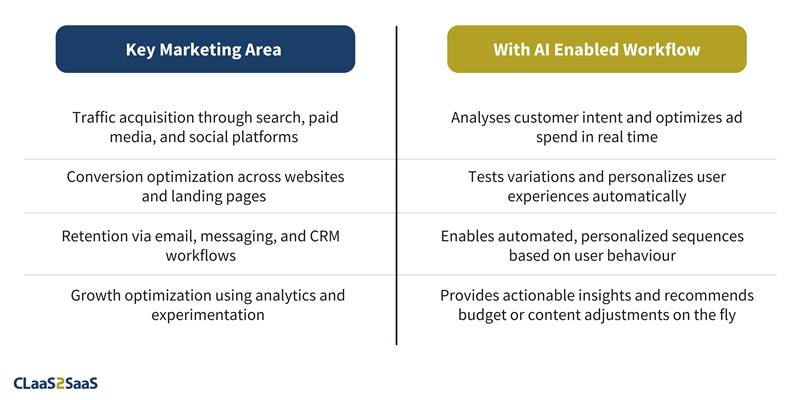
AI tools act as accelerators across all these areas, helping marketers work smarter rather than harder. This applied, AI-enabled approach forms the foundation of omni-channel conversational marketing, where every interaction feels connected and personalized.
Career Outcomes: From Graduate to Leadership Role
A major advantage of this pathway is how it supports long-term career progression.
Graduates are not limited to execution roles. They are trained to understand the entire marketing ecosystem, which positions them to become digital marketing manager candidates earlier in their careers.
Employers value professionals who can:
This digital marketing career path degree structure builds those capabilities step by step. - Coordinate campaigns across teams and platforms
- Interpret data and translate it into action
- Oversee automation and AI-driven workflows
- Align marketing efforts with business goal
Why Employers Prefer AI-Ready Marketing Graduates
Hiring managers are increasingly cautious about credentials that do not translate into real performance.
Employers prioritize candidates who:
- Can contribute quickly with minimal onboarding
- Understand modern marketing tools and workflows
- Adapt easily as platforms evolve
- Think strategically, not just tactically
Addressing Common Concerns About AI-Based Marketing Degrees
Will AI replace marketing jobs?
AI replaces repetitive tasks, not human judgment. Strategy, creativity, and ethical decision-making remain human-led. Education should focus on collaboration with AI, not competition.
Is this degree too technical?
The focus is on application, not engineering. Students learn how to use and interpret tools, not how to build algorithms.
Is it suitable for beginners?
Yes. Strong programs include structured learning paths that build confidence gradually, starting from fundamentals and progressing to advanced applications.
Who Should Choose This Degree Path?
This pathway is especially well-suited for:
Students Seeking Career Security
AI skills reduce the risk of role obsolescence and increase adaptability across industries.
Career Switchers Entering Digital Marketing
A structured degree with applied learning provides clarity, credibility, and faster entry into professional roles.
Aspiring Marketing Leaders
Understanding automation, analytics, and systems is essential for managing modern marketing teams.
Why This Degree Is a Smarter Long-Term Investment
Instead of stacking certifications after graduation, students graduate with an integrated skill set that reflects real-world expectations. Nearly 39% of workers’ skills are expected to become outdated by 2030, which makes continuous learning and AI-focused education essential for long-term career growth.
Benefits include:
- Faster employability
- Broader career options
- Stronger portfolios
- Higher confidence in professional environments
Building a Career That Grows with Technology
If you’re planning a career in digital marketing, the real question is no longer whether AI will shape your role, but whether your education prepares you to work with it. A digital marketing degree with AI tools gives you more than theoretical knowledge; it builds the practical, data-driven, and system-level skills employers now expect.
You don’t have to choose between creativity and technology, or between a recognised degree and real-world skills. With the right AI-integrated pathway, you can develop both at the same time and stay relevant as marketing continues to evolve.
Course

Ready to Take the First Step?
If you’re ready to move beyond theory-heavy education, explore how the CLaaS2SaaS Work-Study pathway can help you gain practical digital marketing skills, hands-on experience with AI tools, recognised certifications, and a bachelor’s degree, all in one structured journey.
Explore how this AI-integrated digital marketing degree prepares you for real-world roles and long-term career growth.