International Bachelor's Digital Business: Guide to Global Economy
SHARE THIS:


Choosing a degree today feels risky.
Students worry about graduating without getting a job. Parents worry about spending years and money on programs that do not deliver real-world value. Working learners struggle to balance education with employment while still trying to move their careers forward
This anxiety is not imagined. The global education landscape has evolved significantly, but it still faces many challenges. Degrees alone no longer ensure employability. Skills, experience, and the ability to contribute immediately now matter just as much as academic credentials.
That’s why international digital business bachelor options are becoming an increasingly popular choice for students around the world
This article explores how international digital business degrees are evolving, how global models differ, and why applied, work-integrated pathways are becoming increasingly relevant, especially in Asia and Singapore.
The International Degree Landscape
Around the globe, digital business education is growing rapidly. Traditional university programs have long been the standard for acquiring higher education, but as the digital economy expands, students are increasingly seeking international digital business bachelor options that offer more than just academic theory alone.
From Singapore to Europe, the demand for digital business degrees is at an all-time high, driven by rapid technological advancements, e-commerce, and digital transformation. Whether you’re looking to study in Singapore or pursue an international bachelor digital business degree in Europe or Asia, the flexibility and global applicability of these programs are key drivers of their popularity.
These programs typically focus on:
- Global digital marketing strategies
- E-commerce solutions
- Digital transformation tools
- Tech-driven business management
As businesses continue to evolve, an international bachelor digital business degree can open doors to global opportunities. However, international reach alone does not guarantee relevance. Increasingly, students and employers are evaluating degrees based on how well they translate into real-world capability.
This is where many traditional international degree models begin to show their limits.
Why Traditional International Models Struggle
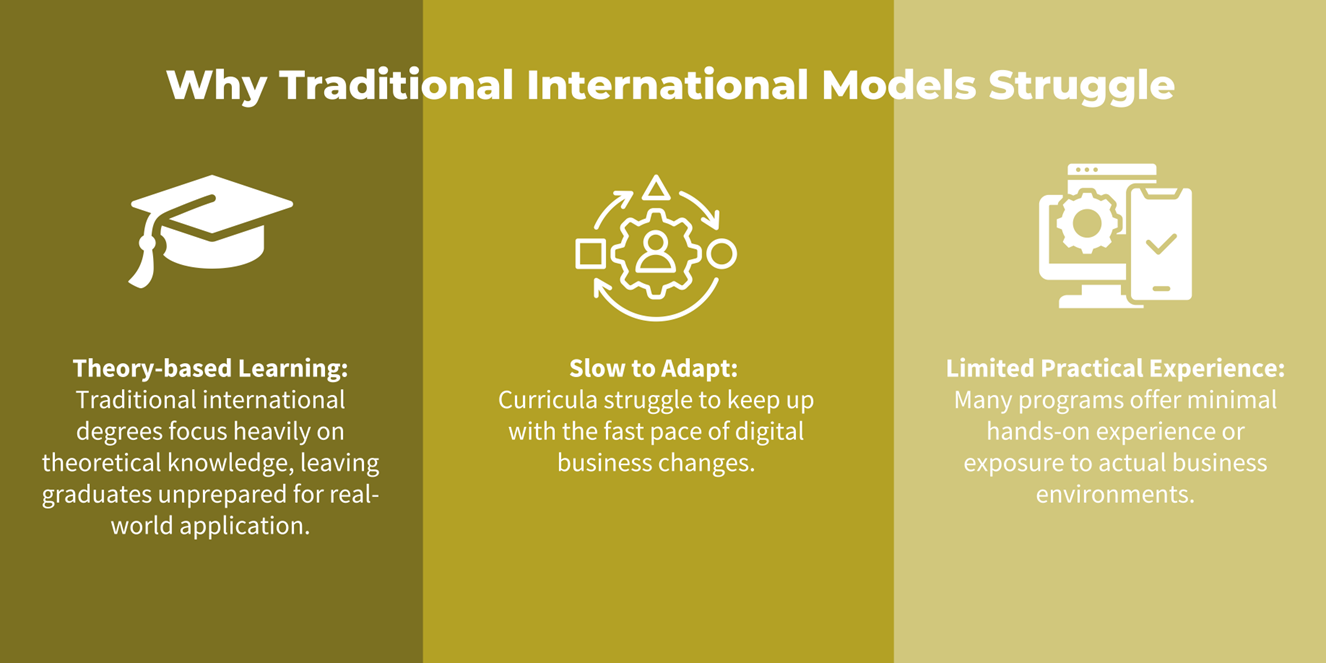
While many programs share similar titles, the learning experience and outcomes differ significantly. Traditional international bachelor’s degree programs often focus heavily on theory, providing students with strong academic foundations but leaving them unprepared for the real-world application of their knowledge.
As the digital business landscape evolves, these models struggle to keep up with the rapid pace of technological change and the need for practical experience.
Many international business programs:
- Rely on static or slow-to-update curricula
- Offer limited real-world exposure
- Provide minimal practical experience in actual business environments
For students aiming for international digital business bachelor programs, these gaps create a challenge. As the global digital economy matures, students are evaluating international degrees not just by geography or prestige, but by how effectively they prepare graduates for real digital business roles.
Graduates often find themselves needing to catch up in the workforce. Despite having a prestigious international degree, many employers must still invest time and resources to close skills gaps. This mismatch creates frustration for learners and inefficiency for employers.
These limitations are not execution issues alone, they reflect structural constraints in traditional degree design. This gap has driven interest in more applied and work-integrated degree structures.
Work-Study: The Evolved Global Pathway
Work-study programs, which integrate applied learning with formal education, have evolved as a response to the challenges posed by traditional international models. By combining digital business education with real-world work experience, work-study degrees prepare students for immediate success in the global workforce.
In digital business education, this approach allows students to:
- Apply concepts while learning them
- Work with real tools used by modern organisations
- Develop professional habits alongside academic knowledge
Rather than treating work as something that happens after graduation, applied pathways integrate learning and execution throughout the degree journey. This evolution reflects changing employer expectations and the realities of digital-first industries.
What Is an International Digital Business Bachelor Degree?
An international work-study digital business bachelor’s degree blends academic study with structured, real-world experience, preparing graduates to operate confidently in the global digital economy.
The work-study model works especially well in the digital business field, where practical skills in digital marketing, e-commerce, and business analytics are in high demand. Students engage with the latest digital tools, like Google Ads, CRM software, and AI-driven analytics, during their studies, applying them to live business projects.
In a work-study model:
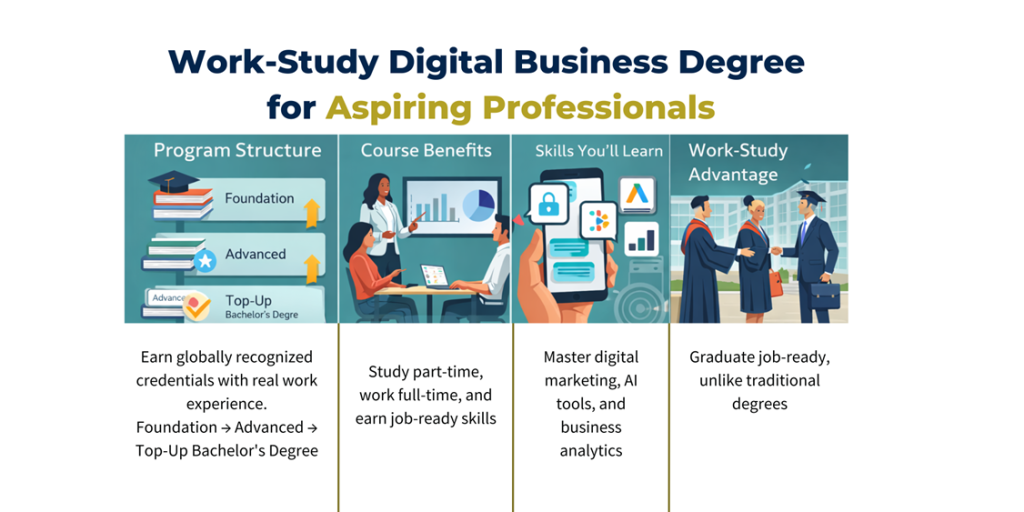
- You study part-time
- You work full-time or complete a structured apprenticeship
- Your work experience directly supports your academic outcomes
This approach ensures that what you learn in class is immediately applied in a real business environment. Concepts are not memorized for exams and forgotten later. They are practiced, tested, and refined on the job. This means graduating with both a recognized qualification and a year of relevant experience. And since it’s international, this also means that degree provides worldwide recognition and global employability.
Why Work-Study Is Replacing Traditional Degrees
The shift toward work-study education is driven by employer demand.
Hiring priorities have shifted away from academic results alone toward practical, job-ready skills. Employers increasingly look for graduates who can contribute from day one, adapt quickly to new tools, and operate confidently in real workplace environments. According to the World Economic Forum, hands-on experience and applied digital skills are now among the most critical factors influencing graduate employability in the modern labour market.
Traditional degrees often fall short because:
- Students graduate with little to no practical experience
- Skills taught may not align with current digital job requirements
- Employers must invest time and resources retraining new hires
This gap creates frustration for graduates and employers alike. Applied and work-integrated degrees respond directly to this demand. By graduation, learners are not starting from zero, they have context, experience, and confidence.
Digital Business Degree Singapore and Asia
A digital business bachelor from a reputable institution can open doors to a multitude of opportunities in Asia. As businesses in Singapore and across the continent adopt more digital tools and strategies, demand is rising for graduates who combine business understanding with digital execution.
For students aiming to build careers in Asia’s digital economy, the CLaaS2SaaS international bachelor digital business program is the ideal foundation for long-term success. The program offers a pathway designed to match regional growth velocity with global employability standards.
The digital economy in Asia is booming, and businesses across industries are increasingly investing in technology, digital marketing, and e-commerce. With this degree, you’ll be prepared to work in the most exciting, fast-paced industries around the globe.
What You Learn While You Work
The CLaaS2SaaS bachelor’s degree in digital business earned through work-study focuses on execution rather than rote learning.
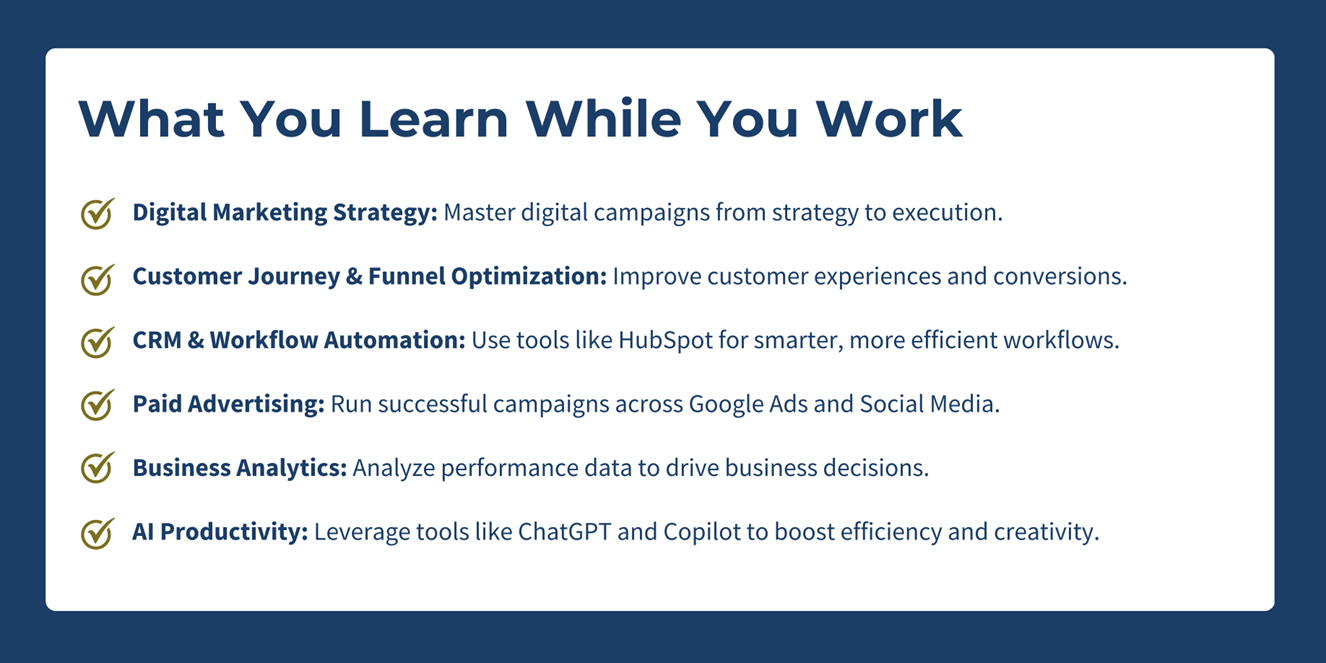
While completing a work study digital business degree, students develop capability in:
- Digital marketing strategy and execution
- Customer journey and funnel optimisation
- CRM and workflow automation using tools like HubSpot
- Paid advertising across Google and social platforms
- Business analytics and performance reporting
- AI-enabled productivity using tools such as ChatGPT and Copilot
Because learning happens alongside employment, concepts are reinforced daily. Mistakes become learning opportunities. Confidence grows through real responsibility.
This applied learning model explains why employers increasingly prefer work-study graduates over those with purely academic backgrounds.
Why Employers Value Work-Study Graduates
From an employer’s perspective, hiring a work-study graduate reduces uncertainty.
These graduates already understand:
They do not require months of onboarding before becoming productive. A work study digital business degree functions not just as a credential, but as a signal of real-world readiness, that a candidate can balance responsibility, learn quickly, and perform under real conditions. - Professional communication standards
- Accountability, deadlines, and teamwork
- Industry-standard digital tools and workflows
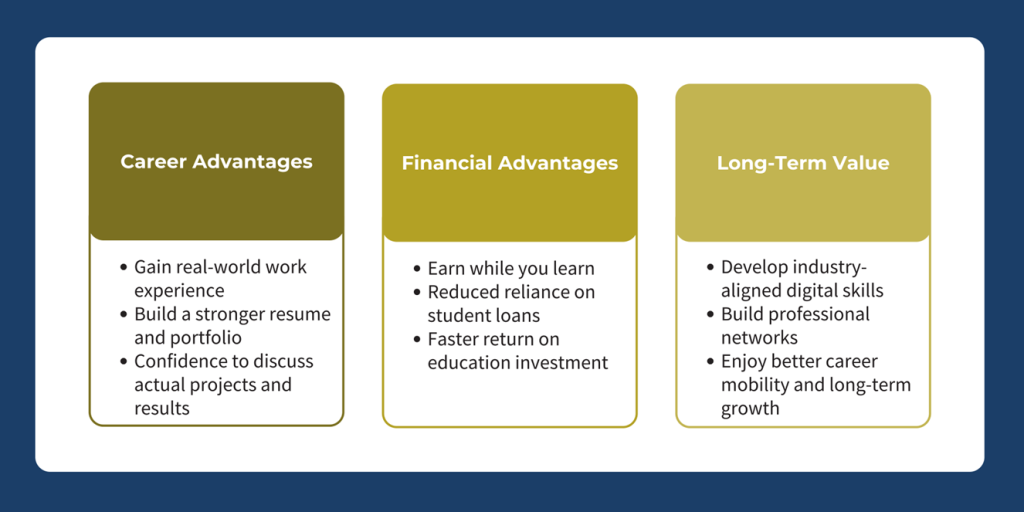
Key Benefits of a Work Study Digital Business Degree
Career Advantages
Graduates benefit immediately from:
Instead of explaining hypothetical knowledge, students can discuss real projects, campaigns, and outcomes. Graduates benefit immediately from:
- One year or more of real work experience
- Stronger resumes and professional portfolios
- Greater confidence during interviews
Financial Advantages
Work-study programs reduce financial pressure because:
Work-study programs reduce financial pressure because:
- Students earn income while studying
- Reliance on student loans is reduced
- Return on investment is achieved faster
Long-Term Value
Beyond graduation, work-study graduates gain:
Beyond graduation, work-study graduates gain:
- Industry-aligned, future-ready digital skills
- Professional networks built during study
- Better career mobility across sectors
Understanding the 2-Year Bachelor Pathway in Digital Business
Fast-track digital business programs differ from traditional universities.
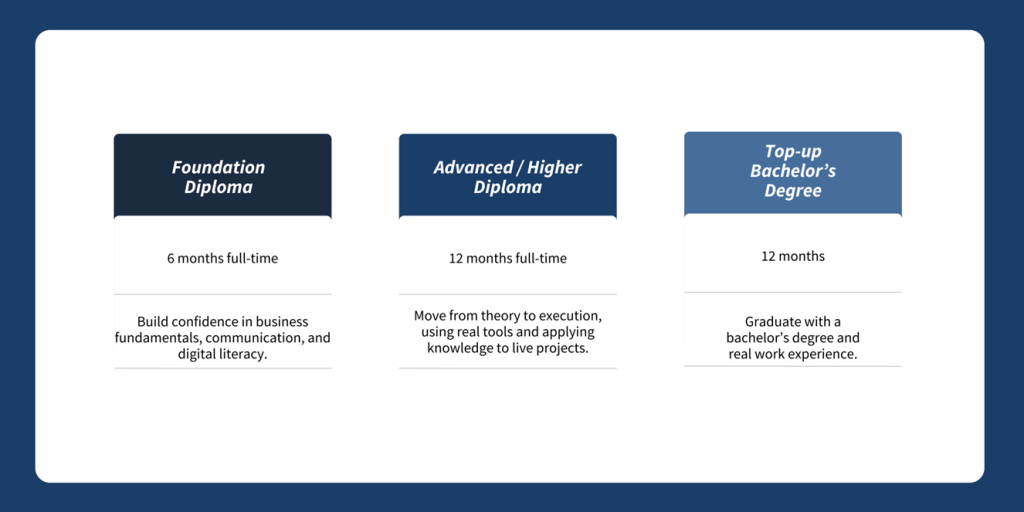
Rather than fixed semesters and extended timelines, these programs are modular and stackable. Students progress through recognized credentials while remaining career-focused.
Overview of the Program Structure
Foundation Diploma (Optional)
Build confidence in business fundamentals, communication, and digital literacy.
Build confidence in business fundamentals, communication, and digital literacy.
Advanced or Higher Diploma
Move from theory into execution using real tools and applied projects.
Move from theory into execution using real tools and applied projects.
Top-Up Bachelor’s Degree (Work-Study Year)
Graduate with a bachelor’s degree and significant work experience.
Graduate with a bachelor’s degree and significant work experience.
This structure allows students to advance efficiently while reducing academic and financial risk.
Who Should Choose This Path?
A work study digital business degree is ideal for learners who want certainty and momentum.
– Students Who Want Clarity
They see the connection between education and employment in real time.
They see the connection between education and employment in real time.
– Parents Seeking ROI-Driven Decisions
Work-study reduces financial risk while improving employability.
Work-study reduces financial risk while improving employability.
– Learners Who Thrive in Hands-On Environments
Applied learning builds competence faster than exams alone.
Applied learning builds competence faster than exams alone.
If relevance, employability, and global mobility matter, this pathway is worth serious consideration.
Realistic Use Case: Student vs Traditional Graduate
Traditional Path:
4 years of study → limited experience → entry-level job hunt
Traditional graduates often face delayed employability and additional retraining.
Work-Study Path:
2 to 2.5 years of study → 1 year of work experience → job-ready graduate
Work-study graduates finish with real outcomes, stronger resumes, and faster career momentum.
FAQs: Work Study Digital Business Degree
Is the degree internationally recognised?
Yes. The bachelor’s qualification carries global credibility.
Can I work full-time while studying?
Yes. Many students begin with a Foundation Diploma.
Do employers really value a work-study degree?
Yes. Work-study graduates arrive with practical tool knowledge, real project outcomes, and workplace readiness.
Course

Ready to Take the Work-Study Route?
If you are ready to earn an internationally recognised qualification while building real-world experience, now is the time to act. Your next step is to understand entry requirements and pathway options.
Discover how CLaa2SaaS upports students in meeting digital business degree requirements, gaining structured work experience, and graduating with skills employers actively seek.