Blog
How To Fast Track Software Engineering Bachelor in 2 Years

SHARE THIS:


Stop listening to the “coding is dead” headlines. While skeptics claim AI will render developers obsolete by the time you graduate, the reality is the exact opposite: the industry is desperate for engineers who can actually build and manage these systems. The real danger isn’t AI it’s the four-year lag of a traditional curriculum.
We understand the frustration of watching technology move faster than your syllabus. If you are worried about entering a saturated market with outdated skills, you are right to be cautious. However, you can outpace the disruption. By enrolling in a fast-track software engineering bachelors, you can secure your seat at the table before the next major industry shift.
This article is for high-achieving students and career-changers who need to enter the tech workforce immediately. You will learn how a 2-year software engineering degree provides the essential rigor you need and why a software engineering degree is worth it even in an automated world. We will break down the strategies to help you graduate with a competitive edge, ensuring you become the person who masters AI, rather than the one replaced by it.

Step 1: Understand Why Timing is Everything in the AI Revolution
The tech industry no longer rewards those who wait. In the past, a four-year degree was the standard “ticket” to a stable career. Today, that timeline is a liability. By the time a freshman completes their introductory courses in a traditional setting, the programming languages and frameworks they started with have likely been updated or replaced by AI-driven automation tools.
This is where a 2 year software engineering degree changes the game. Consider the current market: according to the U.S. Bureau of Labor Statistics, employment for software developers is projected to grow 15% from 2022 to 2032, much faster than the average for all occupations. However, this growth is concentrated in emerging sectors like machine learning, cybersecurity, and cloud architecture.
Imagine spending four years studying legacy systems only to find that the “entry-level” roles you expected are now being handled by AI agents. The pain point isn’t a lack of jobs it’s the skills gap created by a slow education. Research from the World Economic Forum suggests that 44% of workers’ skills will be disrupted by 2027, making speed of learning your greatest competitive advantage. To avoid this, you need a curriculum that moves as fast as the industry itself. Check out our software engineering career roadmap to see how shifting market demands favor accelerated learners.

Step 2: Break Down the Fast-Track Model for Maximum Intensity
A condensed program isn’t about “learning less”; it’s about immersive intensity. To succeed in a high-speed environment, several components must align:
- Year-Round Learning: Unlike traditional paths, a fast-track software engineering bachelor eliminates long summer breaks, keeping your coding logic sharp and your momentum high.
- Project-Based Pedagogy: You spend less time reading about theory and more time building full-stack applications that mirror real-world industry demands.
- AI Integration: Using AI as a “co-pilot” to double developer productivity, a trend Gartner identifies as a top strategic priority for 2025.

Step 3: Debunk the "Quality vs. Speed" Myth to Validate Your Path
A common misconception is that a shorter timeline equates to a “watered-down” education. Critics often ask: is a software engineering degree worth it if it’s completed in half the time?
The data suggests otherwise. Industry best practices now prioritize competency-based education. Top tech firms including Google and Amazon have shifted their hiring focus toward demonstrable technical proficiency and portfolio strength over the length of time spent in a classroom. In fact, many intensive programs yield higher retention of complex concepts because the “immersion” phase is never interrupted by long academic breaks.
LinkedIn’s Skills-First research likewise highlights a growing shift toward hiring based on demonstrable skills, showing that employers are expanding talent pools by focusing on capabilities instead of relying only on degrees or job titles. In that environment, a strong portfolio of real projects and applied technical work can be a meaningful signal of readiness to employers.
Step 4: Analyze the ROI of Accelerated Engineering
Focusing on the outcome of your education reveals a clear financial and professional advantage:
- Financial Impact: You save two years of tuition and housing costs while gaining two additional years of professional income. Recent Research.com studies indicate that accelerated tracks deliver a higher return on investment, with earnings potentially increasing by 27% over a decade compared to traditional routes.
- Operational Benefits: You enter the workforce with modern toolset fluency. You aren’t unlearning old habits; you are building for the current ecosystem.
- Long-Term Value: Graduating early allows you to reach “Senior Engineer” status by your mid-20s, significantly increasing your lifetime earnings.
Bold takeaways:
- Minimize debt, maximize earnings.
- Beat the saturation of the junior developer market.
- Master AI-assisted development before it becomes the baseline.

Step 5: Review Real-World Success via Case Studies
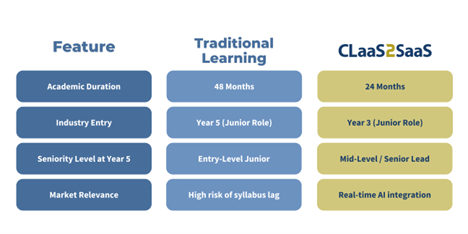
Focusing on the outcome of your education reveals a clear financial and professional advantage:
This contrast highlights the primary value proposition: speed is a competitive feature. At CLaaS2SaaS, we ensure our graduates aren’t just looking for jobs they are the most sought-after candidates in the room. - Example 1: The Traditional Path Alex enrolled in a standard 4-year program. By Year 3, the “hot” framework he learned in Year 1 was obsolete. He graduated with significant debt and entered a crowded market alongside thousands of other generic applicants.
- Example 2: The Fast-Track Success Sarah chose a fast-track software engineering bachelor at CLaaS2SaaS. By utilizing an intensive year-round schedule, she mastered Python, Rust, and AI integration within 18 months.
- Long-Term Value: Graduating early allows you to reach “Senior Engineer” status by your mid-20s, significantly increasing your lifetime earnings.
- The Result: Sarah secured a Junior Dev Role at a Fintech startup 20 months after starting her degree.
- The Outcome: By the time Alex graduated, Sarah had already received a promotion and a 15% raise, having contributed to three major product launches.
Conclusion: Your Roadmap to a Future-Proof Career
The tech industry waits for no one. As AI continues to redefine the boundaries of what is possible, the window for entering the market as a high-value developer is narrowing. Choosing a traditional, four-year path may have been the standard a decade ago, but in today’s landscape, it often results in graduating with skills that are already behind the curve.
By prioritizing speed and immersive, project-based learning, you effectively bypass the noise and position yourself as a leader in the new digital economy. Why does this matter? Because the most successful engineers are those who master the tools of tomorrow, today.
By enrolling with CLaaS2SaaS fast track software engineering bachelor program, you aren’t just earning a degree; you are gaining a two-year head start on seniority, salary increases, and real-world impact. Don’t let the fear of automation hold you back use it as fuel to accelerate your journey and become the engineer that companies are currently scrambling to hire.
Course

Ready to jumpstart your career?
Building a successful future in tech requires a strategy that values both depth and efficiency. Now that you understand why time is your most valuable asset, it’s time to take the first step toward your professional goals.
Explore how our curriculum helps you achieve better results and a faster graduation date. Checkout our software engineering bachelor’s degree program. Get started today and transform your ambition into a tangible technical career.