Leadership Development Programs for Digital Leadership in 2026
SHARE THIS:


Artificial intelligence is transforming corporate decision-making, compressing timelines from years to months. It is actively reshaping how companies operate, compete, and innovate. Decision cycles that once took years are now compressed into months or even weeks as organizations race to adapt to rapidly evolving technologies.
This shift has exposed a major gap in leadership capability. Many executives were trained in traditional management environments where change happened gradually. Today’s leaders must guide organizations through AI-driven transformation, digital innovation, and constant disruption.
This is why leadership development programs are evolving. Modern programs must move faster, integrate real-world business challenges, and develop leaders who can execute digital strategies in real time.
A modern digital leadership program focuses on building AI-ready leaders who can combine strategy, technology, and execution to drive transformation. Instead of purely theoretical learning, these programs emphasize practical application, work-integrated projects, and stackable credentials that accelerate leadership capability.
CLaaS2SaaS supports this shift by connecting leadership education with real-world digital innovation ecosystems and enterprise transformation initiatives.
Why Leadership Development Programs Must Evolve for the AI Era
Artificial intelligence is fundamentally changing the speed of business.
Organizations today operate in an environment where:
- product innovation cycles are shorter
- digital competitors emerge rapidly
- data-driven decision making is essential
- automation reshapes entire industries
Leadership and digital skills are among the most critical capabilities required for the future workforce, according to the Future of Jobs Report 2023.
However, technology alone does not drive transformation. Leadership does.
Modern leaders must understand how to:
This is why organizations are increasingly investing in leadership development programs focused on digital transformation and AI-driven strategy. - translate AI capabilities into business strategy
- build digital-first operating models
- manage innovation at scale
- guide teams through continuous change
The Rise of the Digital Leadership Program
A digital leadership program prepares executives to lead organizations in AI-accelerated markets.
Unlike traditional leadership training, these programs combine leadership frameworks with digital strategy, innovation management, and technology understanding.
Key capabilities developed include:
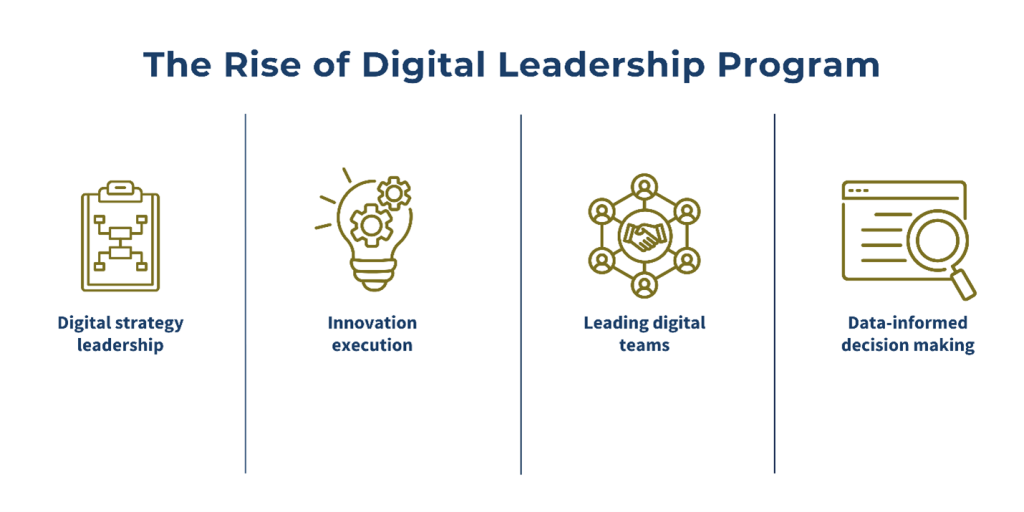
Digital strategy leadership
Leaders learn how to align AI and digital technologies with business objectives.Innovation execution
Programs focus on building systems that allow organizations to test, iterate, and launch innovations quickly.Leading digital teams
Modern leaders must coordinate cross-functional teams that include engineers, analysts, and product specialists.Data-informed decision making
Executives develop the ability to use analytics and insights to guide strategy.
Organizations that successfully adopt digital technologies significantly outperform competitors in productivity and growth.
Why Traditional MBA Programs Struggle in AI-Speed Markets
Traditional business education was designed for a slower era.
Conventional MBA programs often focus on:
- theoretical frameworks
- long academic cycles
- classroom-based learning
While valuable, these models struggle to keep pace with the speed of AI-driven markets.
Organizations increasingly prioritize leaders who can adapt quickly to technological change rather than those who only possess traditional management training.
Today, companies need leaders who can learn, apply, and adapt quickly.
This has created growing demand for skills-first leadership development programs that combine learning with real-world execution.
The Skills-First Approach to Leadership Development
Modern corporate leadership development programs are increasingly adopting a skills-first model.
This approach prioritizes applied capability over purely theoretical knowledge.
Key elements include:
Work-integrated learning
Participants apply leadership frameworks directly to real business problems.Industry-driven curriculum
Programs are aligned with real digital transformation challenges faced by organizations.Adaptive learning pathways
Professionals can build capabilities progressively instead of committing to long programs upfront.
This model significantly improves both learning speed and leadership impact.
In CLaaS2SaaS, this skills-first model is supported by collaborations between enterprises, education institutions, and technology partners to accelerate digital leadership capability development.
Building AI-Ready Leaders Through Stackable Credentials
One of the most effective approaches to leadership development today is stackable credential learning. Professionals build expertise through progressive stages.
A modern digital leadership pathway can include:
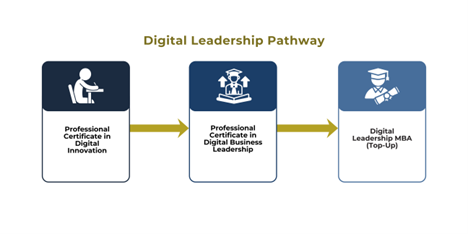
Stage 1 - Professional Certificate in Digital Innovation[
This stage focuses on executing digital transformation projects and building AI-enabled solutions.
Outcomes:
- Learn how to design and implement digital innovation projects
- Apply frameworks for managing AI, automation, and emerging technologies in business
- Strengthen capabilities in leading cross-functional digital teams and innovation initiatives
Stage 2 - Professional Certificate in Digital Business Leadership
Participants learn the foundations of digital strategy, innovation leadership, and modern business models.
Outcomes:
- Understand how digital technologies reshape industries and competitive strategy
- Develop the ability to identify digital transformation opportunities within an organization
- Build strategic thinking skills to lead innovation initiatives and digital change
Stage 3 - Digital Leadership MBA (Top-Up)
Professionals can extend their credentials into a fully recognized international MBA (awarded by Guglielmo Marconi University) focused on digital innovation, leadership, and entrepreneurship. This top-up stage enables participants to build on their earlier certificates and complete a globally relevant postgraduate qualification designed for the digital economy.
Outcomes:
- Develop advanced leadership capabilities for managing large-scale digital transformation initiatives
- Build strategic expertise in innovation-driven business growth and emerging technologies
- Earn an international MBA qualification that strengthens global career opportunities and executive credibility
Learning Velocity as a Competitive Advantage
In AI-driven markets, the speed at which leaders learn and apply knowledge is becoming a major competitive advantage.
Organizations with faster learning cycles can:
Organizations that invest in leadership capability and continuous learning are significantly more likely to succeed in digital transformation initiatives.
- Innovate more rapidly
- Adapt strategies quickly
- Respond to market changes faster
For leaders, this means continuous learning is no longer optional.
This is where work-study degree models become increasingly valuable. By allowing professionals to learn while continuing to work, leaders can immediately apply new strategies, digital tools, and innovation frameworks within their organizations.
Work-integrated learning environments by CLaaS2SaaS help shorten the gap between learning and execution by embedding leadership development within real digital transformation initiatives.
Instead of waiting years to use new knowledge, professionals can shorten the gap between learning and execution, accelerating both personal leadership growth and organizational transformation.
Modern leadership development programs therefore focus on fast skill acquisition, practical application, and flexible learning pathways that support professionals as they build capabilities while staying active in the workforce.
How Leadership Development Programs Support Career Growth
Professionals who develop digital leadership capabilities are increasingly valuable in today’s workforce.Rather than simply preparing participants for specific job titles, modern leadership development programs focus on building strategic capabilities that enable leaders to drive transformation and innovation within their organizations.
Graduates of advanced digital leadership programs often develop the ability to:
- Lead digital transformation initiatives that improve organizational performance
- Translate emerging technologies such as AI and automation into real business value
- Design and implement innovation strategies that support long-term growth
- Lead cross-functional teams through complex digital change initiatives
- Make data-informed strategic decisions in fast-moving markets
Organizations are actively seeking leaders who can connect technology capabilities with measurable business outcomes.
By building these capabilities through structured leadership development programs, professionals can strengthen their strategic leadership impact while accelerating their long-term career growth.
Conclusion

The leadership challenges facing organizations today are fundamentally different from those of the past.
Artificial intelligence is accelerating the pace of business, compressing decision cycles, and transforming how companies compete. Leaders must adapt quickly to guide their organizations through this new environment.
This is why modern leadership development programs are evolving toward faster, more practical learning models. Programs that integrate digital strategy, work-integrated learning, and stackable credentials provide a powerful pathway for developing leaders who can navigate continuous technological change.
Initiatives developed through CLaaS2SaaS reflect this shift by supporting leadership education models that combine academic learning with real-world application. These programs emphasize innovation, digital transformation, and applied leadership capabilities designed for today’s technology-driven business environment.
For professionals navigating digital transformation, developing these capabilities is no longer just a career advantage. It is increasingly a core requirement for leading organizations in the AI era.
Course

Frequently Asked Questions
What are leadership development programs?
Leadership development programs are structured training programs that help professionals build skills in strategic thinking, decision-making, and team leadership. Modern programs also focus on digital transformation, innovation management, and technology strategy to prepare leaders for today’s fast-changing business environment.
Who should join a digital leadership program?
A digital leadership program is designed for managers, executives, and professionals responsible for guiding teams, innovation initiatives, or digital transformation projects. It is especially valuable for leaders who want to strengthen their ability to navigate AI-driven and technology-focused business environments.
Why are leadership development programs important in the AI era?
Artificial intelligence is accelerating business change and creating new competitive pressures. Leadership development programs help professionals understand digital technologies, develop strategic thinking, and lead organizations through continuous transformation.
What skills are taught in digital leadership programs?
Most digital leadership programs focus on skills such as digital strategy, innovation leadership, data-driven decision making, change management, and cross-functional collaboration. These capabilities help leaders guide organizations through complex digital initiatives.
Can leadership development programs lead to an MBA?
Some modern corporate leadership development programs use stackable learning pathways. Professionals can first complete shorter leadership certificates and later progress toward advanced qualifications such as a Digital Leadership MBA or other postgraduate degrees.