Top-Tier Data Science Certifications: Google vs. IBM vs. Microsoft
SHARE THIS:


Data roles are among the fastest growing in today’s job market. Demand for data professionals continues to rise as organizations seek people who can turn data into insights and support critical decisions. Increasingly, organizations also expect analysts to work with AI-enabled workflows, such as automated reporting, assisted forecasting, and AI-supported decision insights.
According to industry research, employment in data related occupations is projected to grow significantly through 2031, outpacing many other roles and reflecting ongoing market demand.
Certifications are one of the most effective ways to validate technical expertise and make your resume stand out to employers. With so many options available, choosing the right certification path is critical. Choosing the wrong pathway can delay your entry into the field or limit progression into AI and data science roles later. Understanding the differences upfront helps you invest time and resources strategically.
In this blog you will learn how the Google Data Analytics Professional Certificate, IBM Data Analyst Professional Certificate, and Microsoft Certified: Power BI Data Analyst Associate stack up against each other and how credential pathways like CLaaS2SaaS’s Data Analytics and AI solution fit into the landscape. You will also see how AI fits into modern analytics work, not as a bonus skill, but as part of how professionals build and deliver outputs.
Certification Overviews: What Each Credential Offers
Before diving deeper, let us look at what each certification is designed to do.
Google Data Analytics Professional Certificate
The Google Data Analytics Professional Certificate is designed to give learners a strong foundation in data analysis skills needed for entry level roles. Participants learn how to clean and organize data, apply analytical techniques, and create data visualizations to communicate insights. The curriculum covers tools that reflect real workplace standards, such as spreadsheets, SQL, and data presentation principles. Many learners find it effective for launching their analytics careers because it includes hands on activities and applied examples.
This certificate is best suited for beginners and those looking to transition into data analytics without needing prior experience. It is also a solid baseline for working with AI-assisted analytics later, since clean data, structured thinking, and clear reporting are the foundation that AI builds on. Graduates typically pursue junior data analyst or entry-level reporting roles where foundational data cleaning and visualization skills are required.
IBM Data Analyst Professional Certificate
The IBM Data Analyst Professional Certificate emphasizes applied tools and technical depth alongside practical analytics skills. Learners gain training in Python programming, SQL, Excel, and visualization tools while completing projects that build a professional portfolio. Because it explores both technical and applied capabilities, it supports learners who may want to progress from analytics into broader data or AI roles.
IBM’s certification is a strong option for professionals who want a balance between data fundamentals and technical analytics skills. It can also support AI-related growth because Python-based workflows often connect to machine learning pipelines and model-driven analysis in real teams. This pathway is often chosen by learners who want stronger technical grounding before progressing into advanced analytics or machine learning roles.
Microsoft Certified: Power BI Data Analyst Associate
The Microsoft Certified: Power BI Data Analyst Associate certification validates expertise in Power BI, a widely used business intelligence and visualization tool. It demonstrates that you can extract, model, and visualize data for organizational decision making. According to industry insights, certifications like this validate proficiency in converting raw data into actionable and accessible dashboards and reports, skills highly sought by employers in analytics and BI focused roles.
This credential is ideal for professionals focused on business intelligence, reporting, and dashboarding roles. It also aligns well with AI-enabled analytics because Power BI and the Microsoft ecosystem increasingly support automated insights, assisted reporting, and workflow automation that teams use to move faster. It is particularly suitable for professionals working within Microsoft ecosystems or organizations that rely heavily on Power BI dashboards for decision-making.
Side by Side Comparison
Here is how the three credentials compare based on focus, tools covered, and typical outcomes.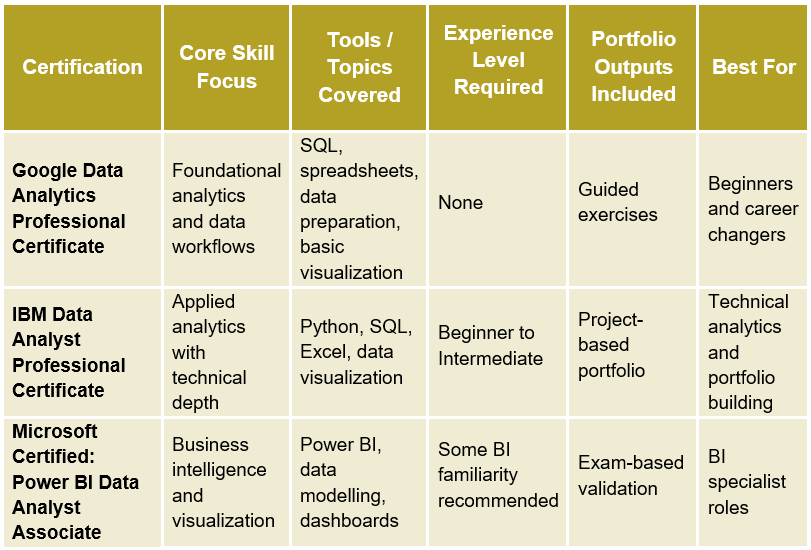
This comparison helps you match your career direction with the certification that makes the most sense for you. It also shows an important reality in 2026: strong analytics skills are still the core, but AI increasingly sits inside the workflow, assisting with speed, pattern detection, and automation.
Current Market Demand for Data Analysts
The demand for data analysts remains strong globally as companies increasingly rely on data to drive strategy. According to Gitnux, the number of data analyst jobs has grown significantly in recent years, with many organizations planning to hire more analysts in 2025 and beyond. Certification and tool mastery are often key differentiators in hiring decisions because employers want professionals who can produce insights that support key business outcomes.
The hiring landscape today favors candidates who are proficient in core analytics tools such as SQL, Excel, and Power BI, and it values practical experience as much as formal qualifications. Just as important, employers increasingly value professionals who can build with AI-enabled tools responsibly, meaning you can use automation to accelerate work while still validating accuracy and business relevance. However, hiring managers increasingly look beyond certification names and focus on demonstrable output. This is where the distinction between standalone certificates and structured learning pathways becomes important.
Planning a Career Beyond Entry Roles
If you are considering advancing beyond analytics into machine learning or AI fields, you might find it helpful to explore our Accelerate Your Machine Learning Expertise guide for deeper insights into roles that build on analytics foundations.Similarly, if you are thinking about a long term transition into data science roles, our Step-by-Step Guide to Data Scientist Career Transition outlines key skills and milestones that support progression over time.
Many professionals complete one certification, secure an entry-level role, and then realize they must start over to progress into AI or data science roles. The smarter strategy is choosing a pathway that anticipates progression from the beginning. Planning progression from the beginning can prevent skill plateaus and reduce the need to restart your education at each career stage.
If you want a pathway that combines certification outcomes with job-ready projects and AI-integrated workflows, compare your options and get support choosing the right track.
How CLaaS2SaaS Fits Into the Certification Landscape
While Google, IBM, and Microsoft credentials each have clear value, professionals often benefit from a structured, stackable, and work integrated learning pathway that builds skills, credentials, and professional confidence in sequence. That is where CLaaS2SaaS’s Data Analytics & AI Certification Pathway offers a strong advantage.
CLaaS2SaaS is not just a course provider. It is Career Architecture, a structured blueprint that helps learners stack credentials, build portfolio outcomes, and progress from analytics into AI-enabled roles without restarting their learning journey.
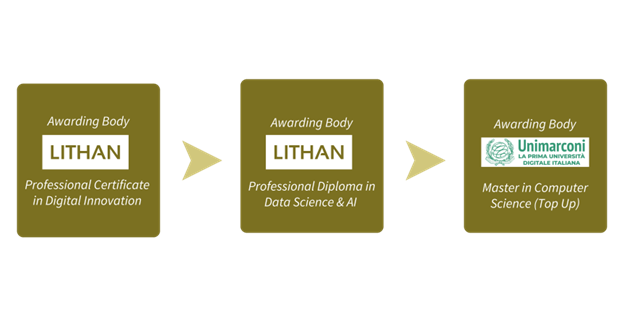
Professional Certificate in Data Analytics & AI
This part-time professional certificate, work integrated program equips learners with core data analytics and AI capabilities and includes multiple accredited certifications. Learners do not only study AI concepts. They build with AI-enabled tools as part of reporting, automation, and solution design.
Upon completion, learners earn:
- Professional Certificate in Data Analytics and Artificial Intelligence awarded by CLaaS2SaaS
- Microsoft Power BI Data Analyst (PL 300) certification
- Microsoft Power Platform App Maker (PL-100T00-A) credentials
- Microsoft Power Platform Fundamentals (PL-900) badge
This combination validates skills in data interpretation, reporting, automation, and Power BI analysis. The inclusion of Microsoft certifications gives you industry recognized credentials within a broader pathway oriented toward job readiness, including AI-supported workflows that reflect how modern teams actually operate. This integrated structure ensures that technical validation, practical implementation, and career progression are aligned from the beginning.
Professional Diploma in Data Science & AI
After completing the certificate, learners can progress to a professional diploma stage that deepens technical analytics and AI implementation competencies. Certifications at this level include cloud oriented and advanced analytics badges, positioning learners well for mid level roles in data science and applied analytics where AI and machine learning are part of day-to-day delivery.
Master in Computer Science (Top Up)
For professionals who want mastery and leadership potential in data and AI, the top up international master’s degree provides advanced academic and applied training. Graduates are prepared for strategic roles that combine analytics, AI, and enterprise problem solving.
This stackable pathway lets you progress without starting over each time you want to build deeper skills and credentials. It is designed to keep you employable at every stage while helping you move upward in capability and responsibility.
Frequently Asked Questions
What makes the Google Data Analytics Professional Certificate valuable?
It offers a strong foundation in core analytics workflows, focusing on practical tasks and tools that entry level data analysts use daily.
Is the IBM Data Analyst Professional Certificate more technical?
Yes. It emphasizes Python, SQL, and other analytical tools alongside real dataset projects and portfolio development.
Why should I consider the Microsoft Power BI Certified Associate?
This credential demonstrates expertise in Power BI, a key tool for business intelligence roles, and is valued in analytics and reporting focused careers. It also supports AI-enabled analytics workflows in the Microsoft ecosystem.
Can I pursue all three certifications?
Many professionals do choose multiple credentials as a way to expand their skill set and improve employability. Combining practical pathways like CLaaS2SaaS with vendor-specific badges can be especially powerful, especially when AI integration is built into how you practice and deliver outputs.
Course

Choosing a certification is an investment in your future career growth. The right credential can shorten the path to a data analyst role and expand your opportunities in analytics and business intelligence.