Blog
Work Study Digital Business Degree for Aspiring Professionals
SHARE THIS:


Choosing a degree today feels risky.
Students worry about graduating without getting a job. Parents worry about spending years and money on programs that do not deliver real-world value. Working learners struggle to balance education with employment while still trying to move their careers forward.
This anxiety is not imagined. The way employers hire has changed faster than traditional education models can adapt. Degrees alone are no longer enough. Skills, experience, and the ability to contribute immediately now matter just as much as academic credentials.
That is exactly why our work-study bachelor’s degree exists.
This article is for:
- Students who want to study and work at the same time
- Parents seeking a safer, ROI-driven education route
- Learners who value experience as much as credentials
You will learn how a bachelor’s degree in digital business can be earned through a work-study pathway, what the digital business degree requirements are, and why this model is becoming the preferred choice for career-focused students who want stability and employability.
What Is a Work Study Digital Business Degree?
A work study digital business degree is a structured education model that integrates formal academic study with real, full-time work experience.
Instead of treating education and employment as two separate phases of life, this pathway connects them from the beginning.
In a work-study model:
- You study part-time
- You work full-time or complete a structured apprenticeship
- Your work experience directly supports your academic outcomes
This approach ensures that what you learn in class is immediately applied in a real business environment. Concepts are not memorized for exams and forgotten later. They are practiced, tested, and refined on the job.
For students pursuing a bachelor’s degree in digital business, this means graduating with both a recognized qualification and a year of relevant experience.
Learn more about the full pathway in our work study digital business degree program.
Why Work-Study Is Replacing Traditional Degrees
The shift toward work-study education is driven by employer demand.
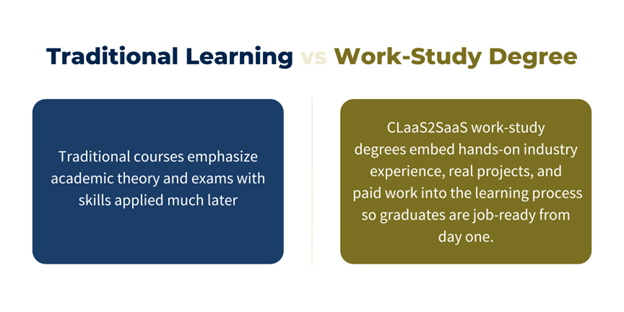
According to LinkedIn’s Workplace Learning Report, 79 percent of hiring managers prioritize practical experience over academic results. This statistic reflects a broader reality. Employers want graduates who can contribute quickly, adapt to tools, and understand workplace dynamics.
Traditional degrees often fall short because:
- Students graduate with little to no real experience
- Skills taught do not always match current job requirements
- Employers must retrain graduates from scratch
- This gap between education and employment creates frustration for both graduates and employers
A work study digital business degree solves this by ensuring students already know how to:
- Use real marketing and business platforms
- Manage live campaigns and workflows
- Operate in professional environments
- Teaching both basic soft and technical skills
By the time students graduate, they are not beginners. They are early-career professionals with proven experience.
Digital Business Degree Requirements Explained
One of the most common concerns from students and parents is eligibility.
The good news is that digital business degree requirements for work-study pathways are designed to be accessible and inclusive.
Typical Entry Requirements
Most work-study digital business degree programs require:
- High school completion or equivalent
- A Foundation Diploma for certain entry routes
- Commitment to full-time work during the top-up year
- Genuine interest in digital business, marketing, or technology
This pathway is especially suitable for students who:
Rather than filtering students based purely on grades, work-study programs focus on motivation, commitment, and employability potential. - Did not enter their first-choice university
- Prefer a practical, job-oriented learning style
- Want a faster route into a stable career
What You Learn While You Work
A bachelor degree in digital business earned through work-study focuses on execution, not rote learning.
Students do not just study digital concepts. They actively practice them in real business contexts.
Core Skills Developed
While working and studying, students learn to:
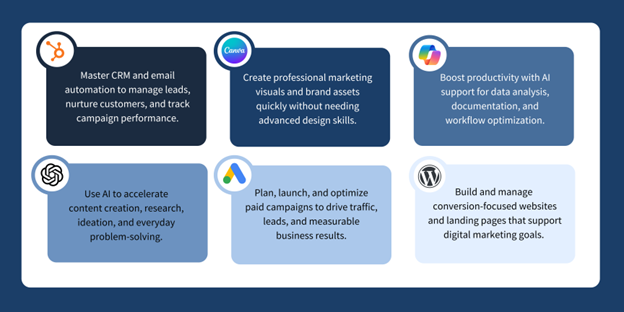
- Build and optimize digital funnels
- Run paid advertising campaigns on Google and social platforms
- Automate CRM and email workflows using tools like HubSpot
- Use AI tools such as ChatGPT and Copilot to enhance productivity
- Analyze data to support business decisions
Because learning happens alongside employment, concepts are reinforced daily. Mistakes become learning opportunities, and theory turns into confidence.
This applied model is why employers increasingly prefer work-study graduates over those with purely academic backgrounds.
Why Employers Value Work-Study Graduates
From an employer’s perspective, hiring a work-study graduate reduces risk.
These graduates already understand:
- Professional communication and expectations
- Deadlines, accountability, and teamwork
- Industry-standard tools and workflows
- They do not need months of onboarding to become productive
A work study digital business degree signals to employers that a candidate can balance responsibility, learn quickly, and perform under real conditions.
In competitive hiring markets, this practical credibility often outweighs traditional academic prestige.
Key Benefits of a Work Study Digital Business Degree
Career Advantages
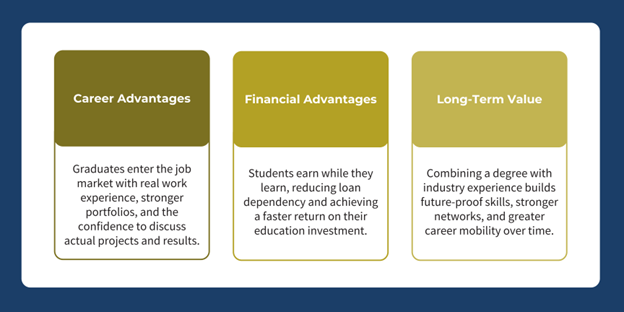
Graduates benefit immediately from:
- One year or more of real work experience
- Stronger resumes and practical portfolios
- Greater confidence during interviews
Instead of explaining hypothetical skills, students can discuss real campaigns, projects, and results.
Financial Advantages
Work-study programs also reduce financial pressure:
- Students earn income while studying
- Lower dependence on student loans
- Faster return on education investment
Long-Term Value
Beyond graduation, work-study graduates enjoy:
- Better career mobility
- Industry-aligned, future-proof skills
- Access to professional networks built during study
Understanding the 2-Year Bachelor Pathway in Digital Business
Fast-track digital business programs are designed differently from traditional universities. Rather than following fixed semester schedules, these programs are modular and stackable, enabling students to advance efficiently while earning recognized credentials throughout the journey.
Overview of the Program Structure
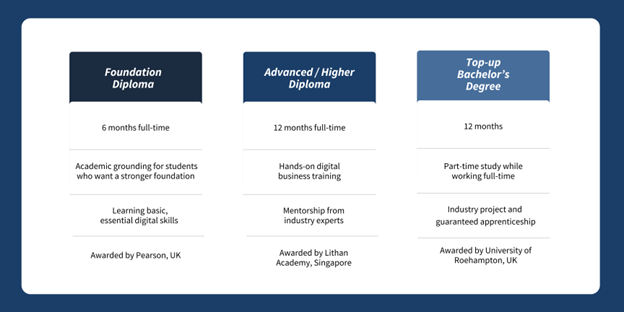
• Foundation Diploma (Optional)
This stage equips students with confidence in business fundamentals, communication, and digital literacy, preparing them to succeed in more advanced, applied learning.
• Advanced / Higher Diploma
During this phase, students move from theory into practical execution, applying real-world tools and solving realistic business challenges that mirror what they will encounter in professional roles.
• Top-Up Bachelor’s Degree
The final stage bridges education and employment, ensuring graduates leave with both a bachelor’s degree and significant work experience. Students gain skills, confidence, and proven results they can showcase to employers immediately.
This structured, step-by-step pathway allows students to earn credentials progressively, reducing risk and building confidence at every stage while keeping their career trajectory on track.
Who Should Choose This Path?
A work study digital business degree is ideal for learners who want certainty and momentum.
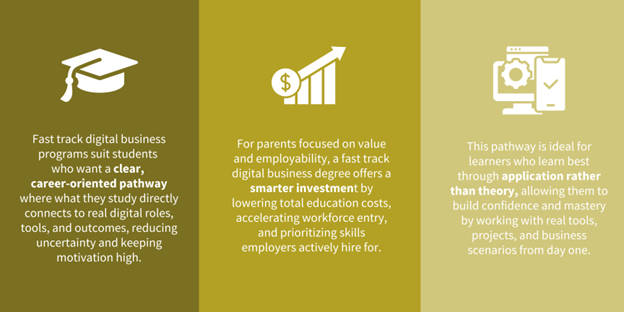
- Students Who Want Clarity and Direction
This pathway suits students who want a clear link between education and career outcomes. Instead of guessing how a degree translates into a job, they see it happening in real time.
- Parents Seeking ROI-Driven Education Decisions
Parents value degrees that lead to employment, not prolonged uncertainty. Work-study programs reduce financial risk while improving employability.
- Learners Who Thrive in Hands-On Environments
Students who learn best by doing, not memorizing, benefit most from applied education. Real projects build confidence and competence faster than exams alone.
If employability, relevance, and speed matter to you, this path makes sense.
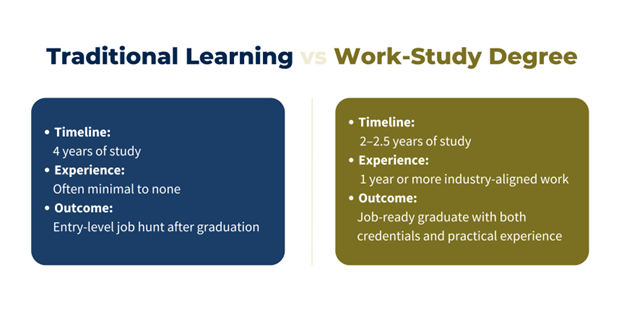
Realistic Use Case: Student vs Traditional Graduate
- Traditional Path:
4 years study → no experience → entry-level job hunt - Work-Study Path:
2–2.5 years study → 1 year work experience → job-ready graduate
To understand the impact of a work-study digital business degree, consider the real-world contrast between the traditional path and the work-study path.
Traditional Path
Students on the traditional path spend the majority of their time in classrooms, focusing on theory-heavy modules, essays, and exams. While they may complete a short internship or optional project near the end, this rarely provides sufficient exposure to professional workflows.
Graduates enter the workforce with credentials but often struggle to apply academic knowledge in practical situations. They may spend months learning tools like CRM platforms, digital marketing software, or analytics dashboards that are already in active use by employers.
The traditional path may provide a strong foundation in business concepts, but it often delays employability, increases financial cost due to longer study duration, and adds stress when searching for that first job with limited experience.
Work-Study Path
Work-study students balance part-time study with full-time work. Every concept learned in class is reinforced through immediate application in the workplace. For example:
- Campaign strategies studied in class are implemented in live marketing projects.
- CRM workflows are applied to real customer journeys.
- Analytics and reporting assignments feed directly into business decisions at work.
By graduation, students are not just theoretical learners , they are working professionals with measurable accomplishments, confident in navigating digital business challenges. They can demonstrate tangible results on their resumes, which dramatically improves employability and salary potential.
The work-study path compresses learning and experience, preparing graduates for success far earlier than traditional programs.
FAQs: Work Study Digital Business Degree
Is the degree internationally recognized?
Yes. The bachelor’s degree is awarded by the University of Roehampton (UK), ensuring that your qualification carries global credibility. This recognition means graduates can explore career opportunities both locally and internationally without concerns about degree validity.
Can I really work full-time while studying?
Yes. The program is specifically structured to allow part-time study alongside full-time work or apprenticeships. Learning is integrated into the workflow, meaning students apply concepts directly to real business tasks.
This approach develops time management, professionalism, and multitasking skills — qualities that employers highly value. The program’s structure ensures students are challenged but never overwhelmed, balancing academic progression with practical exposure.
Is this suitable for fresh high school graduates?
Absolutely. Many students begin the pathway with a Foundation Diploma, providing academic grounding before entering the work-study stage.
This makes the program inclusive for learners who:
Fresh graduates enter a supportive system that accelerates skill development while securing professional experience, giving them a head start over peers in traditional programs. - Are eager to start a career without waiting years for a traditional degree
- Value practical experience alongside formal education
- Need a structured environment to gain both confidence and employability skills
Will I be too stressed balancing work and study?
Many students worry that combining full-time work with part-time study might be overwhelming. The program is carefully structured to balance workload:
- Academic modules are designed for part-time study without unnecessary electives
- Work assignments align with learning objectives, so tasks reinforce academic knowledge
- Mentors and program coordinators provide guidance to ensure progress without burnout
Do employers really value a work-study degree?
Yes. Employers increasingly prefer candidates who can contribute immediately, rather than needing months of training.
Work-study graduates:
Because graduates have experience doing the job while learning, they are often more attractive to hiring managers than traditional graduates with only theoretical knowledge.
- Arrive with practical knowledge of digital tools like WordPress, HubSpot, Google Ads, and AI platforms
- Have completed actual projects with measurable outcomes
- Understand workplace communication, deadlines, and accountability
Can I switch to a traditional degree if needed?
Yes, pathways often allow flexibility. Some students may start with work-study to gain experience and later transfer credits to other recognized programs if desired. However, most find that the career-ready skills and experience gained in work-study make transferring unnecessary, because the degree aligns closely with employer expectations.
Is the workload different for technical vs non-technical students?
While digital business involves technology, the program is designed to be accessible to students from any background:
By graduation, all students, regardless of prior experience, are capable of executing real digital business campaigns independently. - Technical skills like website building, CRM automation, and analytics are taught progressively
- Students receive mentorship and step-by-step guidance
- Applied learning ensures that even beginners gain confidence quickly
Course

Ready to Take the Work-Study Route?
Ready to improve your work study digital business degree plan?
If you are ready to earn a degree while building real-world experience, now is the time to act.
Discover how CLaa2SaaS helps students meet digital business degree requirements, gain paid experience, and graduate with skills employers actually want.