How AI Agents for Enterprise Workflow Automation Are Transforming Business Operations
SHARE THIS:


Enterprises today face a growing gap between digital ambition and operational reality. While automation initiatives are widespread, many organizations still rely on rule-based workflows, and manual coordination across teams. The result is slower execution and limited visibility. This concentration of decision authority introduces systemic execution fragility, not merely operational inefficiency. At the executive level, this gap translates into decision latency, rising compliance exposure, and reduced operational resilience in increasingly volatile markets.
This is where AI agents for enterprise workflow automation, powered by Agentic CLaaS2SaaS, are enabling AI-first adaptive enterprise transformation.
Rather than simply automating tasks, AI agents introduce intelligence directly into workflows. Built on Adaptive CLaaS®, these agents observe context, reason across systems, and act in real time. This shift moves enterprises toward adaptive, intelligence-driven operations.
What Are AI Agents in the Enterprise Context
AI agents are software entities designed to operate autonomously within enterprise workflows as part of a governed enterprise AI platform. These agents function as part of a governed intelligence layer rather than isolated tools.
In an enterprise context, AI agents typically perform four core functions:
- Sense data across systems connected
- Reason using business logic, policies, and contextual intelligence
- Recommend or execute actions within governed workflows
- Learn and improve through continuous feedback
This allows enterprises to move beyond task automation toward coordinated, human–AI collaboration. Unlike copilots that assist individuals, enterprise AI agents operate at the workflow and system level, coordinating actions across multiple functions.
When deployed through the platform, real-time AI agents for business operations act as digital coworkers embedded directly into day-to-day workflows.
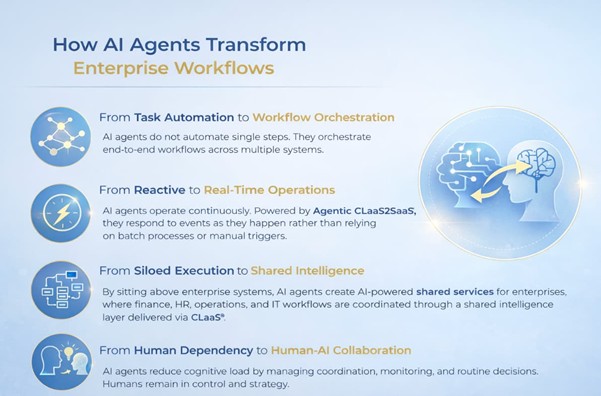
How AI Agents Transform Enterprise Workflow Automation
Certifications also allow career switchers and early professionals to gain relevant skills without committing to a full degree program through platforms like Coursera or edX. Still, choosing the right certification depends on your career goals, timeline, and the level of technical depth you want.
From Task Automation to Workflow Orchestration
AI agents orchestrate end-to-end workflows across multiple systems. For example, instead of automating invoice entry, an AI agent can monitor procurement data, validate compliance, trigger approvals, and update finance systems automatically.
From Reactive to Real-Time Operations
AI agents operate continuously. They respond to events as they happen rather than relying on batch processes or manual triggers.
This enables faster response times and reduces operational friction.
From Siloed Execution to Shared Intelligence
By sitting above enterprise systems, AI agents create AI-powered shared services for enterprises, where workflows are coordinated through a shared intelligence layer.
From Human Dependency to Human–AI Collaboration
AI agents reduce cognitive load by managing coordination and routine decisions. Humans remain in control, focusing on judgment, oversight, and strategic decision-making.
Key Enterprise Use Cases for AI Agents
Finance and Shared Services
Using Agentic CLaaS2SaaS, AI agents reconcile financial data across systems, flag compliance risks, manage approvals, and improve accuracy and cycle time. Enterprises could typically see 20–40% reduction in reconciliation cycle time and improved audit traceability across multi-entity environments.
Operations and Supply Chain
AI agents monitor inventory, suppliers, and logistics data across ERP and operations systems, enabling proactive intervention before disruptions escalate. Real-time monitoring can reduce disruption response time by 30% or more, improving SLA adherence.
HR and Workforce Operations
AI agents support onboarding, skills tracking, workforce planning, and internal mobility across HR systems. Automated onboarding orchestration reduces manual coordination and improves compliance documentation accuracy.
Customer Operations
AI agents unify CRM, service, and billing workflows, enabling faster resolution and consistent customer experiences. Cross-system orchestration improves first-response resolution and reduces escalation rates.
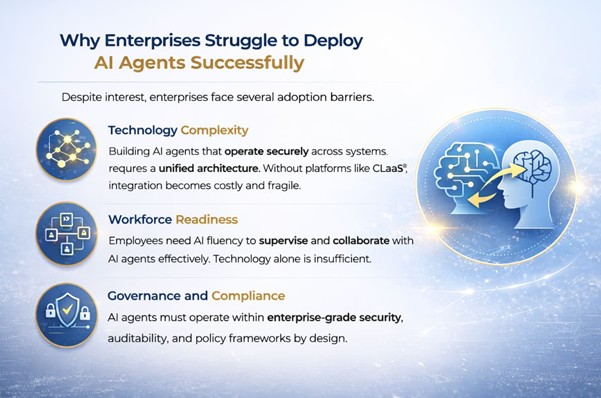
Why Enterprises Struggle to Deploy AI Agents Successfully
Enterprises face several adoption barriers.
Technology Complexity
Building AI agents that operate securely across systems requires a unified architecture. Integration can become costly and fragile. Without it, AI agents become isolated scripts rather than enterprise infrastructure, increasing integration fragility instead of reducing it.
Workforce Readiness
Employees need AI fluency to supervise and collaborate with AI agents effectively. Technology alone is insufficient.
Governance and Compliance
AI agents must operate within enterprise-grade security, auditability, and policy frameworks.
How Agentic CLaaS2SaaS Enables Enterprise-Grade AI Agents
Agentic CLaaS2SaaS is not another AI tool layered onto existing systems. It is not a standalone chatbot platform. It is not point-to-point automation. It functions as an enterprise intelligence layer that governs how decisions flow across systems.
Agentic CLaaS2SaaS provides a unified enterprise AI operating layer designed for real-world workflows.
A Unified Intelligence Layer Across Systems
Agentic CLaaS2SaaS connects ERP, CRM, HR, analytics, and workflow platforms into a single enterprise intelligence layer. Instead of operating as isolated systems with fragmented data, enterprise workflows become coordinated through a shared decision context.
This architectural shift reduces manual reconciliation across departments, minimizes handoff delays, and improves end-to-end process visibility. Finance, operations, HR, and customer teams no longer operate in silos but respond to the same real-time intelligence layer.
As a result, enterprises experience:
- Faster cross-functional decision cycles
- Reduced operational errors caused by inconsistent data
- Lower integration overhead compared to point-to-point automation
- Improved auditability across multi-system workflows
Rather than adding another tool, the platform restructures how intelligence flows across the organization — enabling coordinated execution at scale.
Embedded Governance and Compliance
In many enterprises, AI initiatives stall not because of capability gaps, but because governance concerns prevent deployment into mission-critical workflows. Security, auditability, and policy enforcement are often retrofitted after experimentation — creating risk, hesitation, and executive resistance.
Agentic CLaaS2SaaS embeds governance at the architectural level rather than layering it on afterward. Role-based access, decision traceability, policy controls, and audit logs are designed into how agents operate across systems.
This structural approach transforms governance from a constraint into an enabler. Enterprises can deploy AI agents into finance, operations, HR, and customer workflows with confidence, accelerating adoption while maintaining compliance and accountability.
As a result:
- AI moves from pilot environments into production workflows
- Risk exposure is reduced at scale
- Executive trust in AI-driven processes increases
Governance is not treated as a feature — it is embedded as operating infrastructure.
Self-Service Innovation Without IT Bottlenecks
Business teams can co-develop and adapt AI agents using low-code tools, while IT maintains governance through CLaaS®.Workforce Enablement Built In
Agentic CLaaS2SaaS combines technology with workforce upskilling, ensuring employees can work effectively with AI agents in daily operations.
Enterprises deploying AI agents through Agentic CLaaS2SaaS typically see:
- Reduced workflow cycle time
- Improved SLA compliance
- Reduced audit findings
- Higher operational resilience
- Stronger governance and data trust
- Scalable innovation across departments
This architectural shift reduces the total cost of orchestration, minimizes exception management overhead, and lowers compliance risk exposure — delivering both operational efficiency and structural resilience.
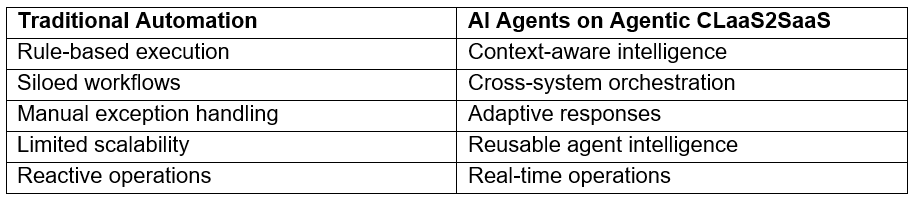
How AI Agents Compare to Traditional Automation Approaches
Who Benefits Most From AI Agents
AI agents are ideal for:
- Enterprises with complex, cross-functional workflows
- Organizations struggling to scale AI beyond pilots
- Shared services teams seeking efficiency and governance
- Leaders focused on compliance and decision quality
Learners can progress through multiple stages depending on their goals.
Getting Started With AI Agents Using CLaaS®
Begin with an enterprise workflow assessment to identify high-friction execution gaps. From there, define governance architecture, deploy AI agents in high-impact workflows, and scale through structured workforce enablement. Successful adoption follows a structured path:- Identify high-friction enterprise workflows
- Ensure data governance and system readiness
- Deploy AI agents using Agentic CLaaS2SaaS
- Enable teams through always-on adaptive learning, ensuring continuous workforce capability development.
- Measure outcomes and continuously improve
Course

Conclusion: Building Adaptive Enterprise Operations With Agentic CLaaS2SaaS
AI agents embed adaptive intelligence into enterprise workflows. Enterprises that fail to embed intelligence into workflows risk increasing operational fragility as complexity accelerates.
By embedding governed, AI agents directly into workflows through Agentic CLaaS2SaaS, enterprises can move beyond isolated automation toward coordinated, intelligence-driven operations.