Boost Operational Efficiency with Enterprise AI Agents
SHARE THIS:


In complex enterprise environments, operational efficiency is no longer defined by how quickly individual tasks are completed or how much manual work can be removed. It is defined by how well the enterprise executes across systems, functions, and decisions at scale.
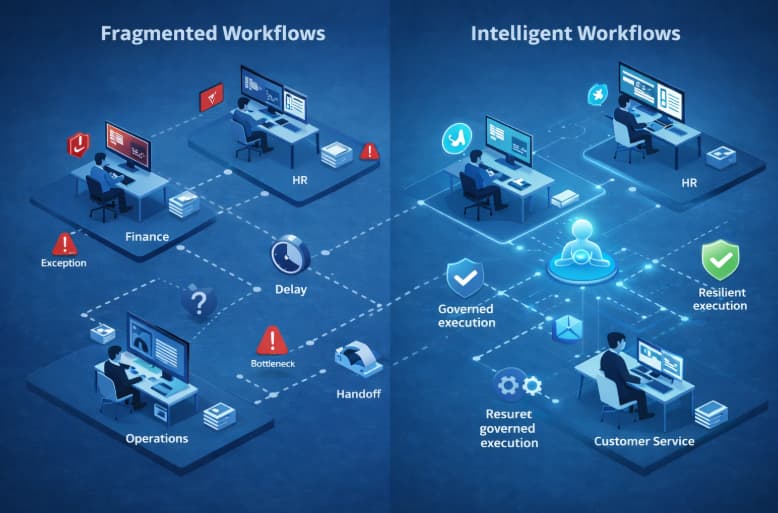
Many organizations still operate through fragmented ERP, CRM, HR, and workflow environments that record transactions but do not create real-time enterprise intelligence. As a result, inefficiency does not show up only as wasted time. It appears as decision latency, execution bottlenecks, rising exception resolution time, excessive handoff density, and growing operational noise across teams.
This is why operational inefficiency is fundamentally a capability architecture issue. When workflows depend on disconnected systems, manual coordination, and isolated knowledge, execution slows down, exception handling becomes expensive, and throughput becomes harder to sustain.
This is where enterprise AI agents become strategically important. They represent a shift from fragmented automation toward intelligence embedded directly inside enterprise workflows.
In this article, we explore how enterprise AI agents reduce cycle time, lower coordination friction, improve throughput, and help enterprises redesign execution for AI-First Adaptive Enterprise Transformation.
Operational Efficiency Is an Execution Design Problem
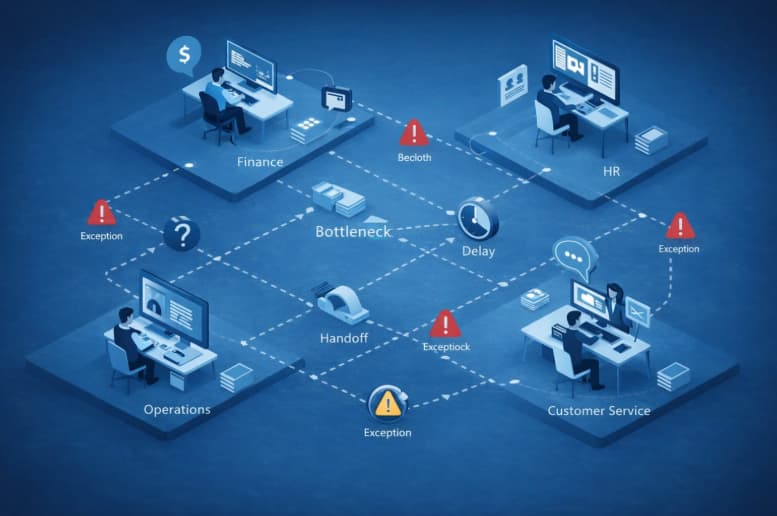
Most enterprises do not lose efficiency because employees are unproductive. They lose efficiency because work moves through an operating environment with too many delays, too many handoffs, and too little shared intelligence. In practice, this usually appears in five ways:
- Cycle time expands because work waits between systems, teams, and approvals
- Exception handling costs rise because non-standard cases require repeated manual intervention
- Coordination cost increases because teams spend more time aligning than executing
- Throughput weakens because execution depends on a few experienced individuals to keep work moving
- Execution continuity breaks when workflow context is lost between systems or teams
For example, a procurement approval may pass through multiple systems, email threads, and manual checks before completion. The task itself may take minutes, yet the total cycle time may extend to days due to fragmented execution.
These are structural symptoms of fragmented execution architecture. That is why enterprises that focus only on small automation gains often see limited long-term impact. They may automate repetitive tasks, yet still struggle with slow decisions, inconsistent workflow resolution, and operational bottlenecks that continue to scale with complexity.
What Enterprise AI Agents Actually Improve
For AI agents to improve operational efficiency at scale, they must operate within a unified intelligence layer that connects ERP, CRM, HR, procurement, and shared services systems under consistent governance.
AI execution agents improve operational efficiency by reducing the invisible friction that slows enterprise execution. They can pull context from multiple systems, identify where work is stalling, recommend next actions, support governed execution, and reduce unnecessary escalation loops.
When deployed effectively, enterprise AI agents improve core operational metrics such as:
- Decision latency – how long it takes to move from signal to decision
- Execution latency – how long it takes for work to progress after a decision is made
- Exception resolution time – how quickly non-standard cases are identified and resolved
- Handoff density – how many transfers, approvals, or coordination points are required to complete work
- Operational noise index – the volume of manual follow-ups, duplicate checks, and clarification loops required to sustain execution
The real value is that AI agents help enterprises redesign how execution happens efficiently as it converts information into coordinated action, since many enterprise automation initiatives fail to deliver sustained impact.
They reduce friction inside workflows, strengthen cross-functional coordination, and preserve continuity across roles, systems, and decisions. In that sense, enterprise AI agents should be understood as execution infrastructure, not just intelligent assistants. This shifts AI from a productivity tool into a structural component of enterprise operating models.
For many organizations, this represents the transition toward AI-First enterprise operating models, where intelligence is embedded directly into execution rather than added as an external tool.
How CLaaS2SaaS Transforms Operational Efficiency with AI Agents
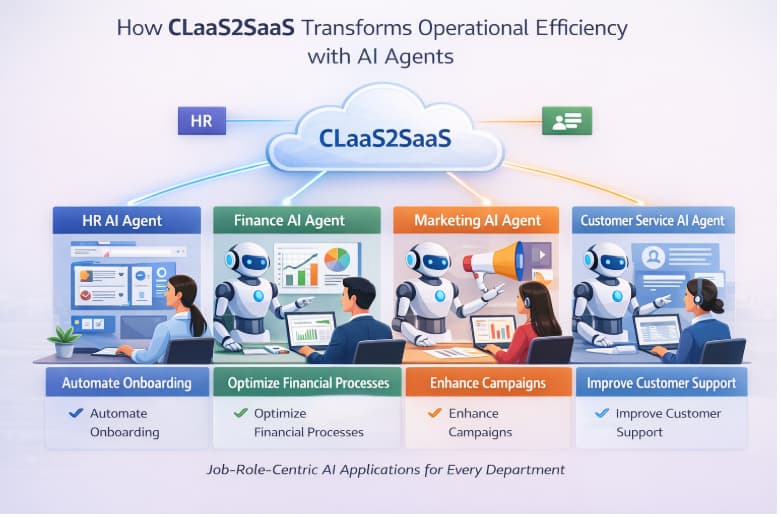
CLaaS2SaaS supports this shift by providing an enterprise execution infrastructure powered by customizable AI agents designed for business users across functions. Instead of operating as standalone automation tools, these agents function within a governed intelligence layer that connects enterprise workflows, systems, data, and decision context. It offers job-role-centric AI applications that embed intelligence directly into day-to-day workflows.
This ensures that each department benefits from AI capabilities aligned to its responsibilities, while maintaining enterprise-wide coherence and governance with intelligence applied where decisions actually occur.
Overcoming Operational Challenges with CLaaS2SaaS AI Agents
Exception Handling Is Where Operational Cost Quietly Scales
In many enterprises, routine work is not the main operational problem. The real cost appears in the exceptions.
Exceptions create escalations, rework, delays, and managerial dependency. They also consume disproportionate attention because they often require people to reconstruct context across systems that were never designed to work together intelligently.
Enterprise AI agents improve exception handling by identifying anomalies earlier, bringing relevant context into one place, and recommending the next best action under governance. They make exception management more consistent and traceable.
AI agents can detect patterns of recurring exceptions across workflows, allowing enterprises to address root causes rather than repeatedly resolving individual cases. This reduces exception resolution time and lowers the coordination burden placed on already stretched teams.
Coordination Cost Is the Hidden Tax on Enterprise Execution
One of the drivers of inefficiency is coordination cost. As enterprises scale, more time is spent chasing approvals, aligning teams, clarifying ownership, checking status, and reconstructing the logic behind prior decisions.
This cost is often hidden because it is distributed across departments and absorbed into everyday work. But the impact is significant. High coordination cost slows decisions, reduces throughput, and makes execution fragile.
Enterprise AI agents help reduce coordination cost by connecting data, workflows, and decision context across the enterprise. Instead of relying on fragmented updates and manual follow-ups, AI agents create shared visibility so teams can operate with clearer triggers, and more consistent action pathways. This shifts execution toward intelligence-guided coordination.
Throughput Depends on Execution Continuity
Sustainable throughput depends on whether work can continue moving without interruption or loss of context.
In many enterprises, throughput weakens when workflows rely too heavily on experienced employees to interpret exceptions, recover missing context, or manually bridge disconnected systems. This creates concentration risk and makes execution less resilient.
Enterprise AI agents improve throughput by preserving continuity across workflows. They help ensure that work does not lose momentum when ownership changes, priorities shift, or exceptions occur. This continuity is critical for enterprises operating complex, cross-functional workflows at scale as it reduces reliance on individual employees to reconstruct workflow context. So, instead of restarting analysis at every handoff, teams can continue execution with more context, consistency, and speed.
This is especially important in enterprises managing cross-functional processes across finance, HR, procurement, customer operations, and shared services.
Cycle Time Reduction Requires More Than Faster Tasks
A common mistake in operational transformation is assuming that faster tasks automatically create faster operations.
In reality, cycle time is often shaped less by task duration and more by what happens between tasks: waiting for approvals, searching for context, clarifying ownership, resolving exceptions, and passing work across systems.
Enterprise AI agents reduce cycle time by improving the movement of work across the enterprise. They help surface the right context earlier, reduce back-and-forth loops, and route issues before they become bottlenecks. Enterprise AI agents shorten cycle time not by accelerating individual tasks, but by improving the flow of work between tasks. This shortens the time between signal, decision, and action. The result is improved flow across the operating model.
CLaaS2SaaS: From AI Tools to Execution Infrastructure
This is where CLaaS2SaaS becomes relevant — as a platform designed to structurally improve enterprise execution by unifying people, data, and workflows into a governed intelligence layer embedded directly into operations. Instead of introducing another disconnected application to the technology stack, the platform enables enterprises to coordinate execution across systems, functions, and decisions with greater continuity and visibility.
In this model, AI agents do not operate as isolated assistants. They function as part of an execution infrastructure that supports adaptive enterprise workflows, improves decision timing, and strengthens operational resilience as organizations scale.
At the same time, the system supports the workforce side of transformation by enabling role-based capability development. Employees are equipped with the capabilities required to work alongside AI-driven workflows, ensuring that technology adoption translates into sustained operational improvement. This is critical because even the strongest AI execution layer will underperform if the workforce is not equipped to operate within a more adaptive, intelligence-driven model.
Together, this makes transformation structural by combining platform intelligence, workflow redesign, and workforce enablement.
Case Example: Improving Efficiency in Marketing with AI
Enterprises using Agentic CLaaS2SaaS can reduce campaign cycle time, lower coordination overhead, and improve execution continuity across regional teams, content pipelines, and reporting processes. The value lies in redesigning marketing execution as an integrated, intelligence-led operating flow.
The problem is not just workload. It is a coordination complexity.
Enterprise AI agents can reduce this complexity by improving workflow flow: helping teams identify next-best actions, reduce repeated manual checks, surface performance insights earlier, and support more consistent execution across campaigns.
The value is redesigning marketing execution as an integrated, intelligence-led operating flow.
Real-Time Intelligence Improves Decision Timing
A major source of inefficiency in enterprise operations is reporting lag.
When teams rely on delayed dashboards, fragmented updates, or manually assembled reports, decisions are made too late or with incomplete context. This increases decision latency and often leads to downstream execution problems.
Enterprise AI agents improve this by embedding real-time intelligence directly inside operational workflows. Rather than waiting for periodic reporting cycles, teams can act on live signals with better timing and better context.
For finance, that may mean earlier identification of spend anomalies or cash flow risk.
For HR, it may mean faster visibility into workforce patterns affecting productivity or retention. For operations leaders, it may mean earlier intervention before workflow delays become systemic bottlenecks.
AI agents improve decision quality by strengthening the infrastructure around judgment. Embedding intelligence directly into workflows, as enabled within CLaaS2SaaS, reduces reporting lag at its source.
CLaaS2SaaS vs Traditional SaaS: A Scalable, Intelligent System for the Future
Unlike traditional SaaS platforms that automate isolated functions, CLaaS2SaaS establishes an enterprise-wide intelligence layer that continuously learns and adapts. It integrates systems across the enterprise, providing a cohesive, adaptable framework for future growth.
This shift from transaction-based automation to intelligent automation powered by AI agents allows enterprises to remain agile, resilient, and competitive in a rapidly evolving business landscape, enabling continuous operational optimization.
The Future of Operational Efficiency Is Structural
The future of operational efficiency will be defined by whether enterprises can redesign execution around intelligence, continuity, and adaptive coordination. That means treating operational inefficiency as a structural issue. It means recognizing that AI agents are not just efficiency add-ons, but part of a broader execution architecture. And it means understanding that transformation must happen across systems, workflows, and workforce capability together.
Enterprises that make this shift will be better positioned to reduce cycle time, handle exceptions more effectively, lower coordination cost, increase throughput, and sustain execution continuity under growing complexity. Platforms such as CLaaS2SaaS make this shift operationally viable.
Course

Conclusion: Efficiency Improves When Execution Architecture Improves
Enterprise AI agents matter because they change how work moves through the enterprise.
They help reduce decision latency, shorten execution delays, improve exception resolution, lower coordination friction, and preserve continuity across workflows. That is why their value should not be framed as simple task automation.
Operational efficiency is a capability architecture issue.
AI agents are execution infrastructure.
With CLaaS2SaaS, enterprises can move toward a more coherent, intelligence-led execution model, combining platform intelligence with workforce enablement to support AI-first adaptive enterprise transformation.