Driving Digital Transformation with AI Agents in the Enterprise
SHARE THIS:

 document.addEventListener("DOMContentLoaded", function () {
var url = encodeURIComponent(window.location.href);
document.getElementById("fb-share").href =
"https://www.facebook.com/share.php?u=" + url;
document.getElementById("li-share").href =
"https://www.linkedin.com/sharing/share-offsite/?url=" + url;
});
document.addEventListener("DOMContentLoaded", function () {
var url = encodeURIComponent(window.location.href);
document.getElementById("fb-share").href =
"https://www.facebook.com/share.php?u=" + url;
document.getElementById("li-share").href =
"https://www.linkedin.com/sharing/share-offsite/?url=" + url;
});
The pace of enterprise change has accelerated. New regulations, rising customer expectations, compressed operating cycles, and ongoing AI disruption are forcing organizations to evolve faster than their existing operating models were designed to handle.
Many enterprises have already invested heavily in SaaS, automation, and analytics. Yet the same execution problems persist: manual coordination, slow decision cycles, inconsistent handoffs, and transformation initiatives that struggle to move beyond isolated successes and scale across the enterprise.
This is the gap many digital transformation programs fail to close. AI agents for enterprise digital transformation are becoming central because their value goes beyond automating tasks. They help modernize how work is coordinated, how decisions are made, and how execution is sustained across the enterprise. In this sense, AI agents should be understood not as productivity add-ons, but as a marker of operating model maturity. For enterprises moving toward more adaptive operating models, intelligence must move closer to the point of execution.
In this article, we explore what AI agents mean in an enterprise context, why many digital transformation efforts stall, how AI agents reshape execution and decision-making, and where CLaaS2SaaS supports this shift through Agentic CLaaS2SaaS.
What Are AI Agents for Enterprise Digital Transformation?
AI agents are intelligent software systems that go beyond traditional automation by performing tasks autonomously or semi-autonomously. These systems can automate end-to-end workflows, analyze enterprise-wide data streams, and make informed decisions in real time.
In enterprise environments, AI agents operate as an intelligence layer that connects systems, workflows, and decision context. To position this clearly, it helps to separate three commonly confused concepts:
AI features are embedded enhancements inside a single application, such as summarizing emails or generating draft content. They may improve convenience, but they rarely change how execution works across the enterprise.
AI tools are standalone experiences used outside daily workflows. They may be powerful, but adoption often depends on people remembering to use them, moving data manually, and translating outputs into action.
An AI agent operating layer connects systems, context, and workflows so intelligence can be applied directly at the point of work. For example, in finance operations an AI agent can monitor transactions, identify anomalies, retrieve supporting data from ERP systems, and trigger investigation workflows automatically. Instead of producing suggestions that require manual follow-through, it supports execution through governed actions, traceability, and cross-system coordination.
This operating layer is what allows AI agents for enterprise digital transformation to support coordinated execution rather than isolated automation. That is why AI agents matter. They are not just automation upgrades. They represent a more advanced form of intelligence modernization, where decisions become faster, more consistent, and more execution-ready because context and action are connected.
This approach enables enterprises to move from isolated automation toward coordinated, intelligence-guided execution. Platforms that support this model by integrating AI agents into the wider operating ecosystem help organizations modernize processes without disrupting existing infrastructure.
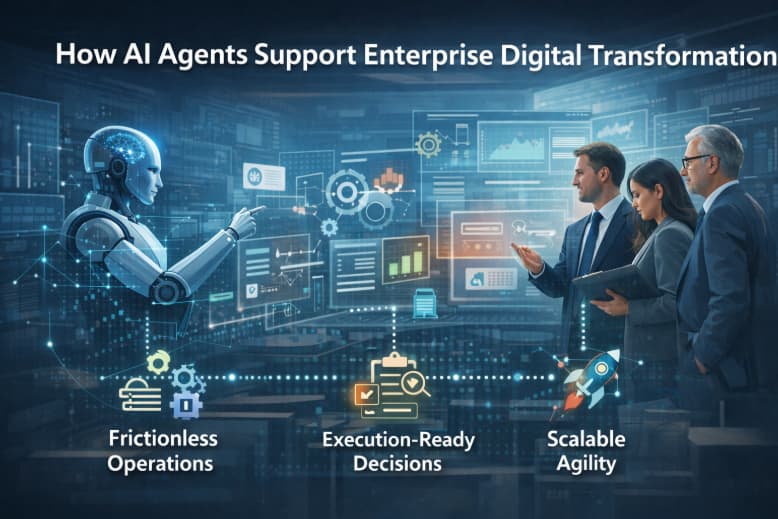
How AI Agents Support Enterprise Digital Transformation
Digital transformation is not just about digitizing operations.
It is about redesigning how the enterprise functions, improves, and delivers value.
AI agents are becoming central to this shift because they enable organizations to transform both operational execution and decision-making.
Here’s how AI agents for enterprise digital transformation create measurable impact:
1. They reduce execution friction across workflows
A large share of enterprise inefficiency does not come from individual tasks. It comes from what happens between tasks: waiting for approvals, clarifying context, resolving ownership, and reconnecting information across functions.
AI agents help reduce this friction by bringing together relevant context earlier, guiding next actions, and supporting governed progression through workflows. This shortens the distance between signal, decision, and execution.
For example, in procurement operations, approvals may stall while managers search for supporting documentation across systems. AI agents can retrieve relevant policy rules, contract history, and spending context automatically, allowing approvals to move faster and with greater confidence. This reduces approval delays while maintaining compliance with procurement policies.
The result is not just faster work. It is more reliable work.
2. They improve decision readiness
Many organizations have access to data, but not to decisions that are ready to be acted on.
Leaders often receive information that is delayed, fragmented, or difficult to translate into operational next steps. AI agents improve this by helping organize signals into clearer recommendations, with stronger traceability and better timing. Instead of receiving fragmented reports after delays, leaders can act on contextual insights embedded directly within operational workflows.
For example, in supply chain operations, AI agents can identify inventory risks earlier by analyzing demand patterns, supplier performance, and logistics data simultaneously.
This strengthens decision quality because action becomes more informed, more timely, and more execution-ready.
3. They strengthen execution continuity
Transformation efforts often lose momentum when work depends too heavily on individual memory, informal follow-ups, or manual bridging across teams.
AI agents help preserve execution continuity by carrying forward relevant context, supporting consistency across handoffs, and reducing the need to repeatedly reconstruct the same information. This is especially valuable in cross-functional processes where work passes between departments such as finance, operations, and customer teams.
This makes operations more resilient as organizations scale.
4. They support structural, not incremental, transformation
Incremental transformation improves isolated parts of work. Structural transformation improves how the enterprise operates as a system.
AI agents contribute to structural transformation because they do not simply automate one task at a time. They help redesign how coordination, decisions, and governed actions happen across the business. That is why their role in digital transformation is broader than efficiency alone. Structural transformation occurs when enterprises redesign how work flows across the organization rather than optimizing isolated activities.
They reshape the conditions under which execution becomes scalable.
The Enterprise Value of AI Agents
When AI agents are deployed within enterprise workflows, their value becomes visible across several operational dimensions. In complex enterprises, a large share of delays often occurs between tasks rather than within tasks, making workflow coordination a critical target for improvement.
- Faster cycle times: Workflows progress with fewer delays, approvals, and coordination loops.
- Stronger decision integrity: Signals are surfaced earlier, context is clearer, and next actions are easier to govern.
- Lower coordination drag: Teams spend less time chasing updates, reconstructing logic, and managing avoidable handoffs.
- Better resilience under complexity: Exceptions and disruptions become manageable because agents help detect issues earlier and route actions consistently.
- Transformation that scales: Enterprises build repeatable patterns to deploy AI across workflows rather than running one-off pilots.
- Stronger human AI collaboration: Adoption improves when the workforce is enabled to operate with AI inside daily workflows, supported by role-based capability building through Adaptive Learn2Work workforce upskilling.
Enterprise Digital Transformation with CLaaS2SaaS
Rather than positioning AI as another disconnected layer, Agentic CLaaS2SaaS supports enterprises in modernizing execution by helping connect people, data, and workflows within a governed environment. Its role is not merely to add AI functionality, but to help organizations apply intelligence closer to the point of work. It embeds AI agents directly within execution environments.
This matters because transformation becomes more sustainable when intelligence can support real operating decisions, workflow progression, and cross-functional coordination rather than remaining separate from execution.
Through Adaptive CLaaS®, enterprises also build workforce capability to operate effectively alongside AI-driven workflows. This is important because enterprise modernization depends not only on deploying intelligent systems, but also on enabling people to work effectively within new execution models.
Together, these capabilities support a broader shift toward more adaptive, intelligence-led enterprise execution.
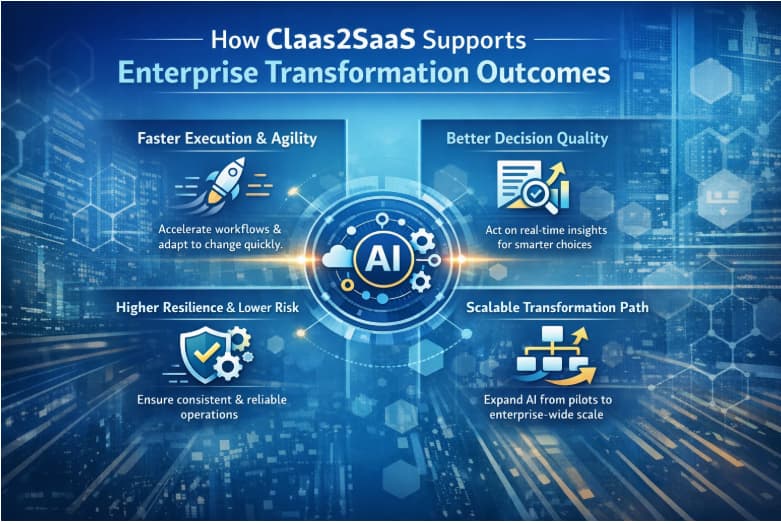
How CLaaS2SaaS Supports Enterprise Transformation Outcomes
For enterprises, the impact of AI agents becomes most visible through improvements in execution speed, decision quality, and organizational resilience. Implementing AI agents is not just an efficiency upgrade. Agentic CLaaS2SaaS helps organizations move beyond isolated automation toward a more adaptive and governed transformation model.
1. Faster execution and stronger operating agility
Faster execution enables organizations to respond to market shifts, regulatory changes, and operational disruptions more effectively.
AI agents reduce the friction that slows cross-functional work, especially when handoffs, approvals, and exceptions pile up. The advantage is not only time saved, but the ability to execute change faster and respond to shifting priorities without operational disruption.
2. Better decision quality at scale
Enterprises do not struggle because they lack data. They struggle because data is fragmented and decisions arrive too late.
By helping teams act on real-time operational signals, CLaaS2SaaS enables leaders to detect risks earlier, prioritize with clearer context, and reduce costly decision delays. This reduces delays between identifying a problem and taking action.
3. Higher resilience and lower execution risk
As transformation scales, inconsistency becomes a risk: process drift, shadow workarounds, and uneven adoption across teams.
AI agents support more consistent execution by guiding work through governed workflows, improving reliability across functions, and reducing the operational risk that grows with complexity. It becomes especially important in large organizations where processes span multiple teams and regions.
4. A scalable path from pilots to enterprise-wide transformation
Many organizations prove AI in one area but struggle to expand it without creating more complexity.
CLaaS2SaaS supports broader adoption through a more structured transformation path, helping enterprises scale capability in a controlled and repeatable way. For example, AI agents deployed in procurement workflows can later be extended to finance and operations without redesigning the entire system architecture.
The Future of Enterprise Digital Transformation
The future of digital transformation will not be defined by how many digital tools an enterprise adopts. It will be defined by whether the enterprise can redesign execution to operate with greater intelligence, continuity, and adaptability.
AI agents will play a growing role in that future because they help modernize how decisions are translated into action, how workflows progress under complexity, and how enterprises maintain performance as change accelerates.
And as AI agents become more deeply involved in enterprise workflows, governance becomes more important, not less. This is especially important in enterprises operating across high-impact functions where decisions carry regulatory, financial, or operational consequences. Leaders need confidence that AI-supported execution remains accountable and reviewable.
Organizations will increasingly need clear controls around permissions, approvals, traceability, escalation rules, and policy-aligned behavior. The goal is not unrestricted autonomy. The goal is trusted, governed execution.
Overall, organizations that benefit most will not be those that simply experiment with AI more aggressively. They will be those that use AI to improve execution architecture, decision discipline, governance maturity, and workforce readiness together. In this sense, governance is not a barrier to transformation. It is what makes scaled transformation possible.
That is what turns digital transformation from a technology initiative into an enterprise capability. These developments are shaping the emergence of the Adaptive Enterprise, where intelligence continuously supports execution across the organization.
Course

Conclusion
Digital transformation is no longer just about digitizing tasks or adding new software into the stack. It is about redesigning how the enterprise executes, decides, and adapts under growing complexity.
This is why AI agents are becoming strategically important.
Their role is not limited to automation.
They help reduce execution friction, strengthen decision readiness, improve continuity across workflows, and support transformation that is structural rather than incremental.
Agentic CLaaS2SaaS enables enterprises to combine execution modernization with workforce enablement in a more governed and scalable way. The enterprises that move earliest in this direction will be better positioned not only to adopt AI, but to operate more effectively because of it.