Blog
Fast Track Digital Business Degree You Can Finish in 2 Years
SHARE THIS:


Here’s the uncomfortable truth: most traditional business degrees are too slow for today’s digital economy.
By the time many graduates complete a four-year program, the tools, platforms, and skills they learned in their first year are already outdated. Digital marketing platforms update monthly. AI tools evolve weekly. Consumer behavior shifts constantly. Yet many universities still rely on rigid syllabi designed years ago.
Meanwhile, companies are hiring digital marketers, automation specialists, CRM managers, e-commerce executives, and growth strategists right now, not four years later. Employers don’t have the luxury of waiting for graduates to “catch up.” They need talent that can contribute immediately.
If you’re a student (or parent) worried about wasting time, money, and momentum, a fast track digital business degree may be the smartest alternative to the traditional university route.
This article is for:
- High school graduates who want a job-ready degree with real outcomes
- Parents seeking a shorter, lower-risk return on education investment
- Students who want a bachelor’s degree without the long wait, debt, or uncertainty
You’ll learn how a 2 year digital bachelor’s degree works, what makes it different from conventional programs, and why it’s increasingly recognized as one of the best digital business bachelor programs for today’s job market.
Why a Fast Track Digital Business Degree Matters Now
Digital roles are growing faster than universities can redesign their curriculum.
According to the World Economic Forum, more than 50% of employees will need reskilling by 2027, driven largely by digital transformation, automation, and AI adoption. This shift isn’t limited to tech companies — every industry now relies on digital channels to sell, communicate, and grow.
The problem? Most traditional degrees still prioritize:
- Theory over execution
- Exams over application
- Academic pacing over industry urgency
Businesses aren’t looking for graduates who can write essays about digital strategy. They’re looking for people who can launch campaigns, analyze performance, automate workflows, and adapt quickly.
CLaaS2SaaS’ bachelor’s degree in digital business addresses this gap by solving three critical problems: time, relevance and employability.
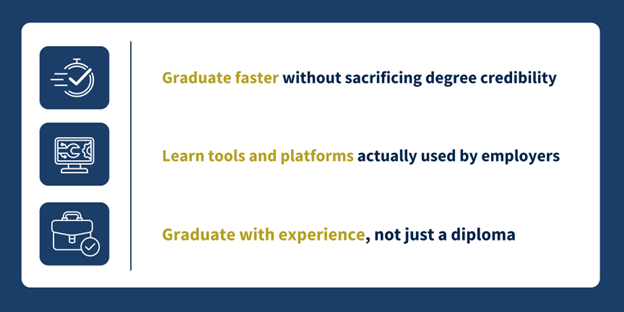
Unlike traditional programs, fast-track degrees are designed around skills, platforms, and real outcomes, ensuring students are prepared for the workforce the moment they graduate.
What Is a Fast Track Digital Business Degree?
A fast track digital business degree compresses a full bachelor’s education into an accelerated, structured pathway — typically completed in 2 years, or 2.5 years with a foundation option.
Instead of long academic breaks, filler electives, and theory-heavy modules, students progress through a focused pathway that emphasizes:
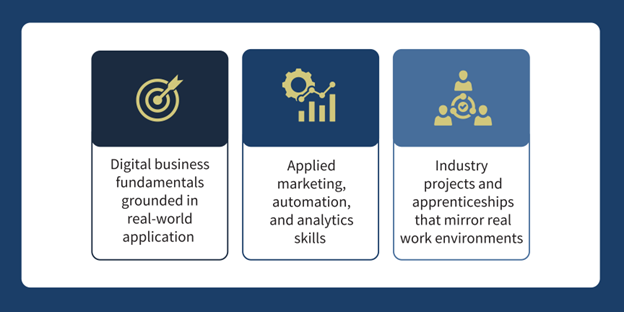
This approach is ideal for students who want to enter the workforce earlier without compromising on degree recognition, academic quality, or long-term career growth.
Rather than delaying employability, fast-track programs are designed to accelerate career readiness.
Learn more about the full pathway via about our digital business degree program!
Traditional Degree vs CLaa2SaaS’ Work-Study Degree
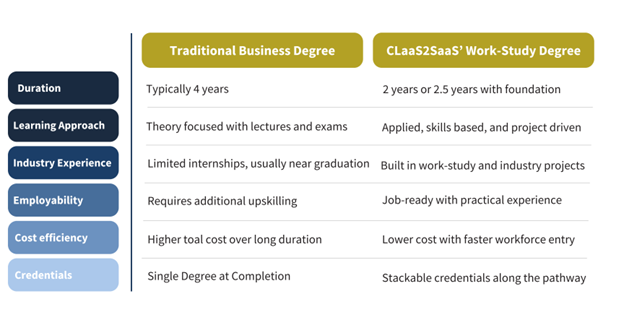
Choosing a degree pathway today is no longer just about prestige or duration. It is about relevance, employability, and return on investment. While traditional business degrees still follow an academic-first model, CLaa2SaaS’ Work-Study Degree in Digital Business is designed around how employers actually hire and how digital roles function in real life.
Understanding the difference helps students and parents make a clearer, more confident decision.
Traditional Business Degree
A traditional business degree typically follows a four-year academic structure focused on theory, examinations, and broad business concepts. Students spend most of their time in classrooms, learning foundational subjects such as economics, management theory, and general marketing principles.
While these programs offer academic depth, they often struggle to keep pace with rapidly changing digital tools and platforms. Practical exposure is usually limited to short internships or final-year projects, meaning many graduates enter the workforce with minimal hands-on experience.
Graduates are often required to upskill after graduation to meet employer expectations, especially in digital marketing, automation, and data-driven roles.
CLaa2SaaS’ Work-Study Digital Business Degree
CLaa2SaaS’ Work-Study Degree in Digital Business is built for speed, relevance, and employability. Instead of stretching learning across four years, the program compresses essential business and digital skills into a focused two-year pathway, or two and a half years with foundation.
Students learn through applied modules, real tools, and industry projects. The program integrates work and study, allowing learners to gain real experience while completing their degree. This means graduates do not just understand digital business concepts, they have already used platforms like WordPress, HubSpot, Google Ads, and Generative AI tools in real scenarios.
The degree is awarded by recognized institutions, including the University of Roehampton, ensuring academic credibility alongside strong industry alignment.
How a 2 Year Bachelor’s Degree in Digital Business Works
Unlike traditional universities that rely on rigid semester systems, fast-track programs are modular and stackable, allowing students to progress efficiently while earning credentials along the way.
Typical Program Structure
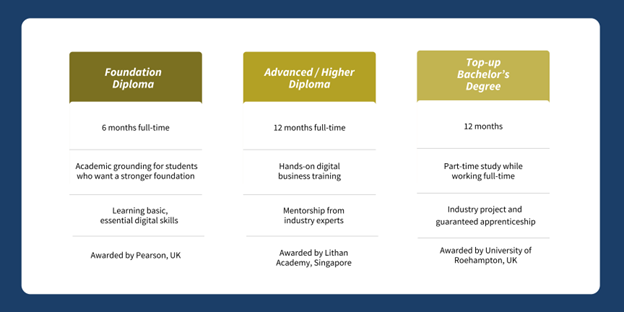
• Foundation Diploma (Optional)
This stage helps students build confidence in business fundamentals, communication skills, and digital literacy before advancing.
• Advanced / Higher Diploma
At this stage, students transition from theory into applied execution, working with real tools and solving realistic business challenges.
• Top-Up Bachelor’s Degree
This final phase bridges education and employment, ensuring graduates leave with both a bachelor’s degree and real work experience.
This structure allows students to earn credentials progressively, reducing risk and increasing confidence at every stage.
What You Actually Learn (Not Just Theory)
One reason this pathway is considered among the best digital business bachelor programs is its full-stack digital focus.
Students don’t just learn about digital business — they learn how to execute it.
Key competencies include:
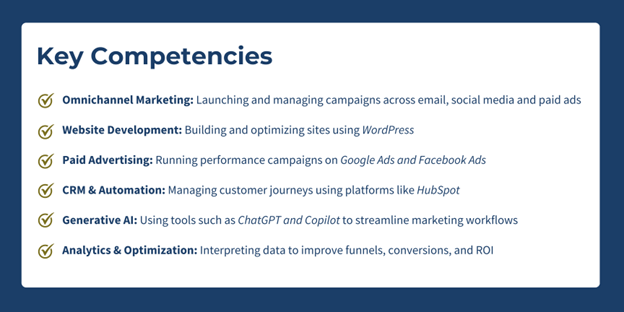
These are not “nice-to-have” skills. They are core job requirements across modern digital roles.
Career Outcomes That Justify the Fast Track
A fast track digital business degree focuses on outcomes, not academic fluff.
Employers today aren’t hiring based on how long you studied; they’re hiring based on what you can actually do.
They care about:
- Practical capability
- Platform familiarity
- Speed to productivity
That’s why fast-track programs are built around job roles, tools, and real execution, not just theory-heavy modules.
Graduates are trained for real, in-demand digital roles, including:
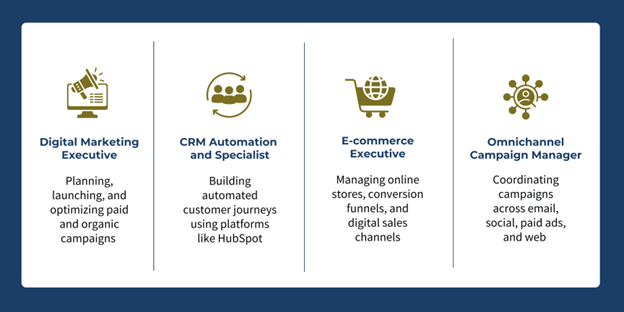
These roles reflect what employers consistently look for: hands-on platform experience, analytical thinking, and the ability to execute independently from day one.
Why Employers Prefer Fast-Track Graduates
The key advantage of a fast track digital business degree is simple: you don’t just graduate faster, you graduate more employable.
Compared to traditional four-year degree holders, fast-track graduates typically:
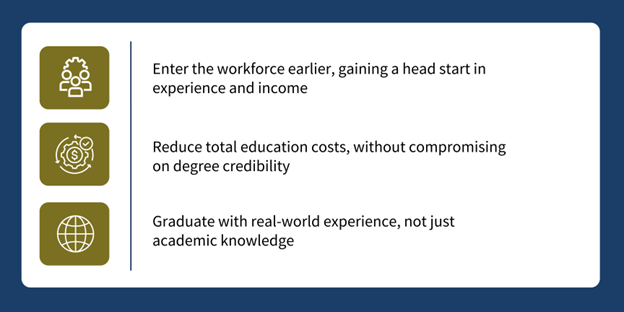
Because learning is tightly aligned with industry tools, workflows, and employer expectations, graduates are better prepared to contribute immediately, a quality hiring managers value highly.
In a job market where skills age faster than degrees, speed, relevance, and experience are no longer optional. They’re the difference between struggling to find a job and being ready when opportunities appear.
Addressing Common Misconceptions
“Is a fast-track degree less credible?”
This is one of the most common concerns — especially among parents.
The answer is no. Credibility comes from accreditation and awarding bodies, not program length. Degrees are awarded by recognised institutions such as the University of Roehampton (UK), ensuring international recognition.
Fast-track programs meet the same academic standards, but remove inefficiencies that don’t contribute to employability.
“Does finishing faster mean learning less?”
Not at all. Students often learn more relevant content, not less.
Traditional degrees spread learning over years, often repeating concepts. Fast-track programs focus learning on:
- What employers actually use
- What students will apply immediately
- What delivers career value
“Is the workload too intense or stressful?”
Fast-track programs are focused, not overloaded.
Students study fewer irrelevant subjects and spend more time applying what they learn. Clear structure, mentorship, and real-world context often make learning more manageable, not less.
“Will employers take this degree seriously?”
Employers prioritize:
- Skills
- Experience
- Portfolio evidence
“Is this only suitable for top-performing students?”
No. This pathway is designed for motivated learners, not just academically elite ones. Foundation routes exist to support students who need additional preparation.
Addressing a Common Misconception: “Faster Means Lower Quality”
One of the biggest misconceptions about fast track degrees is the assumption that shorter duration equals weaker education.
In reality, fast track programs don’t cut content, they cut inefficiencies.
What’s removed are:
- Repetitive general education modules
- Outdated theoretical content
- Courses unrelated to modern digital careers
What remains is:
- Focused, industry-aligned learning
- Practical skill development
- Continuous assessment through real outputs
The result is a degree that is leaner, not lesser, designed around relevance rather than tradition.
Who Should Choose This Path?
A fast track digital business degree is not for everyone, and that’s exactly why it works so well for the right students.
This pathway is designed for individuals who value direction over delay, skills over theory, and outcomes over tradition. If you already know that you want a career in the digital economy, a fast track program offers a more focused, intentional way to get there.
Students Who Want Clarity and Direction
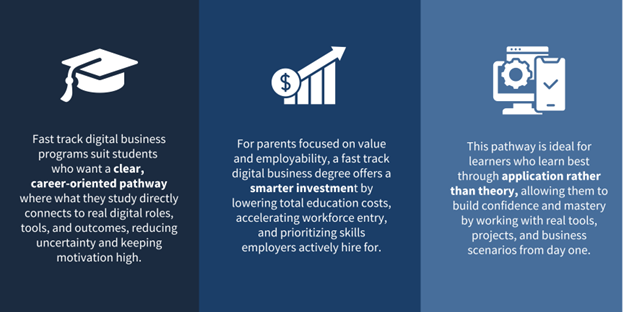
Many students struggle not because they lack ability, but because traditional degrees leave them uncertain about where they’re headed.
Fast track digital business programs are ideal for students who:
- Want a clear link between what they study and the job they’ll get
- Prefer learning why something matters before memorizing theory
- Feel frustrated by long general-education requirements that don’t align with their goals
Instead of spending years “figuring it out,” students follow a defined career-oriented pathway that connects coursework directly to real digital roles, tools, and workflows used by employers today.
This structure reduces guesswork and keeps motivation high — because progress feels tangible.
Parents Seeking ROI-Driven Education Decisions
For parents, higher education is both an emotional and financial investment.
A fast track digital business degree appeals to parents who are:
- Concerned about rising tuition costs
- Questioning whether a traditional four-year degree still guarantees employability
- Looking for programs that balance academic credibility with career outcomes
This path makes sense because it:
Rather than paying more for time spent, parents are investing in measurable outcomes such as job readiness, career acceleration, and long-term earning potential. - Shortens time to graduation, lowering total education costs
- Enables earlier entry into the workforce
- Emphasizes skills employers actively hire for
Learners Who Thrive in Applied, Hands-On Environments
Fast track programs are especially well-suited for learners who:
- Learn best by doing, testing, and applying
- Prefer projects, simulations, and real-world case studies
- Want exposure to industry tools rather than purely academic models
If traditional lectures and exams feel disconnected from reality, this path offers a more engaging alternative. Learning is applied immediately, reinforcing retention and building confidence along the way.
Students graduate not just knowing what digital business is, but knowing how to operate within it.
Is This Path Right for You?
If you value:
- Speed without sacrificing credibility
- Relevance over routine
- Employability as a core outcome, not an afterthought
Then a fast track digital business degree isn’t a shortcut, it’s a strategic choice.
For students ready to commit, parents focused on value, and learners eager to enter the workforce with confidence, this path makes sense.
Start Your Journey Now!
The digital economy won’t wait and neither should your education.
Industries are evolving faster than traditional degree timelines, and employers are no longer hiring based on credentials alone. They’re hiring for skills, adaptability, and real-world experience. A fast track digital business degree responds directly to that shift, offering a smarter, faster, and more practical alternative to conventional programs.
With a 2-year bachelor’s degree in digital business, industry-aligned curriculum, and exposure to real work environments, you’re not just earning a qualification, you’re building the foundations of a sustainable career in the digital economy.
This pathway is designed for students who want momentum, parents who want value, and employers who want graduates that can contribute from day one.
The real question isn’t, “Is a fast-track degree right for everyone?”
It’s “Can you afford to delay becoming job-ready in a rapidly changing market?”
Course

Ready to Start Your Fast Track Digital Business Degree?
Ready to improve your fast track digital business degree journey?
If you’re ready to move beyond theory-heavy education and into a results-driven learning experience, now is the time to take the next step.
Explore how CLaa2SaaS’ Work-Study Degree in Digital Business enables students to graduate faster, gain meaningful industry experience, and develop future-proof digital skills — all while earning a globally recognised qualification.