How to Prepare for a Software Engineering Degree: Requirements & Prerequisites
SHARE THIS:

 document.addEventListener("DOMContentLoaded", function () {
var url = encodeURIComponent(window.location.href);
document.getElementById("fb-share").href =
"https://www.facebook.com/share.php?u=" + url;
document.getElementById("li-share").href =
"https://www.linkedin.com/sharing/share-offsite/?url=" + url;
});
document.addEventListener("DOMContentLoaded", function () {
var url = encodeURIComponent(window.location.href);
document.getElementById("fb-share").href =
"https://www.facebook.com/share.php?u=" + url;
document.getElementById("li-share").href =
"https://www.linkedin.com/sharing/share-offsite/?url=" + url;
});
You want to build apps, create websites, or solve real-world problems with code. But before you can do any of that, you need to answer one question: do you meet the requirements for a software engineering program? Whether you’re a fresh high school graduate or exploring your first degree in tech, understanding what it takes to get in is the first step. Explore the Software Engineering program by CLaaS2SaaS to see what a structured, industry-aligned pathway looks like from start to finish.
This guide breaks down the core software engineering requirements, the key prerequisites you should know, and how the right computer software development courses can set you up for a successful career in tech. If you are still deciding on your entry point, CLaaS2SaaS offers pathways starting from a Foundation Diploma in Software Engineering, a Higher Diploma, and a Bachelor’s Degree, so there is a starting point for every background.
Why Software Engineering? The Opportunity is Real
The global software development market is projected to exceed $1 trillion by 2030, according to Statista. The U.S. Bureau of Labor Statistics projects software developer roles to grow 25% through 2032, far faster than any other profession. The average software developer salary sits above $120,000 per year in the U.S., and demand in areas like web and mobile applications development, object-oriented programming, and information systems and technology continues to outpace the supply of qualified graduates.AI is accelerating this gap, not closing it. As automation handles routine tasks, companies are paying more for engineers who understand systems, architecture, and how to build software that actually works at scale. Starting earlier gives you more time to build experience, specialize, and grow into advanced roles.
That is where you come in. The software industry needs more builders, thinkers, and creative problem-solvers who build real products. But getting there starts with meeting the right academic and skill prerequisites and knowing exactly what to expect when you apply.
Core Software Engineering Requirements You Need to Know
Every program has its own entry criteria, but most software engineering requirements fall into three areas: academic background, technical prerequisites, and soft skills. Do not feel intimidated. Most students meet more of these than they realize, and the gaps are easier to close than you think.
Academic Requirements
-
Secondary school completion or GCE A Level (or equivalent)
For the CLaaS2SaaS Foundation Diploma, completing secondary school is enough to get started. For the Higher Diploma, CLaaS2SaaS requires a minimum of 2 credits in Mathematics and English at GCE A Level or equivalent. Already have a Foundation Diploma in IT? You qualify directly. -
Mathematics and English are the two non-negotiables
CLaaS2SaaS specifically requires credits in both subjects. You do not need advanced calculus, but comfort with logical reasoning and basic algebra will carry you through the first year and beyond. -
Relevant work experience counts for mature candidates
If you have at least 8 years of relevant industry experience, you may be considered for the Higher Diploma on a case-by-case basis. A formal academic background is not always required. -
English proficiency: IELTS 5.5 or equivalent
If you completed your schooling in English, you are likely already eligible. For non-native speakers, CLaaS2SaaS accepts IELTS 5.5 or its equivalent as the minimum proficiency requirement.
Technical Prerequisites (Nice to Have, Not Required)
If you are a high school student with zero coding experience, you are in the right place. These are not gatekeeping requirements. They are simply a head start. The Software Engineering program is designed to teach you all of this from the ground up.
-
Some exposure to a programming language like Python, Java, or C++
Helpful, but not expected. If you have never written a line of code, that is completely fine. You will learn this on Day 1. -
A basic idea of what object-oriented programming (OOP) means
Even just knowing the term puts you ahead. The program covers OOP in depth, so no prior mastery is needed. -
General awareness of how software and data work together
Curiosity counts here more than knowledge. If you have ever wondered how apps store your data or why websites behave differently, you already have the right mindset. -
Any tinkering with web or mobile development is a bonus
Built a basic webpage? Customized a website template? That counts. But if you have not, do not worry, responsive web development is covered in the curriculum.
Soft Skills That Matter
- Logical thinking and problem-solving
- Attention to detail
- Persistence when debugging or learning new concepts
- Ability to work collaboratively on software development projects
Not sure if you qualify? Get Your Personalized Eligibility Assessment
Diploma vs. Degree: Which Path Is Right for You?
One of the most common questions students ask is whether to start with a diploma or go straight for a degree. The answer depends on your current qualifications and your long-term goals.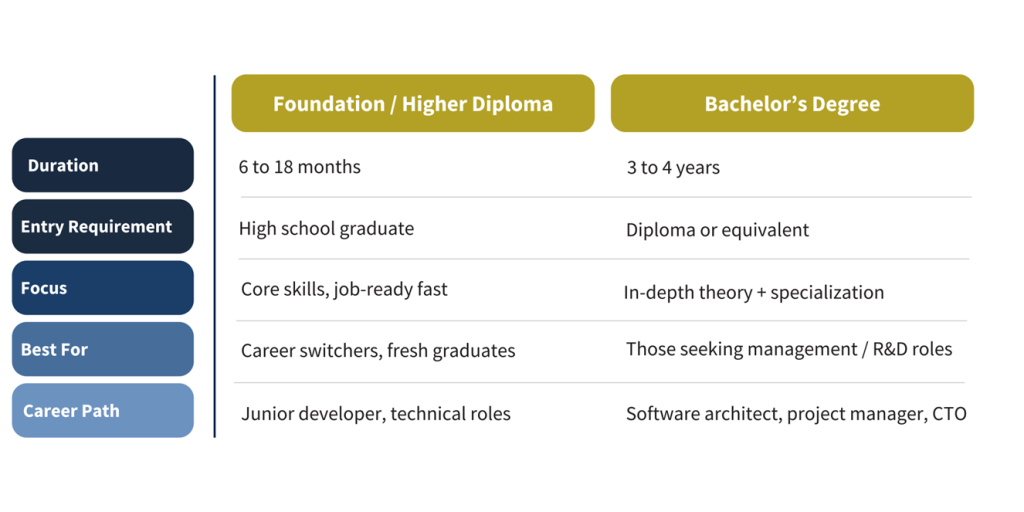
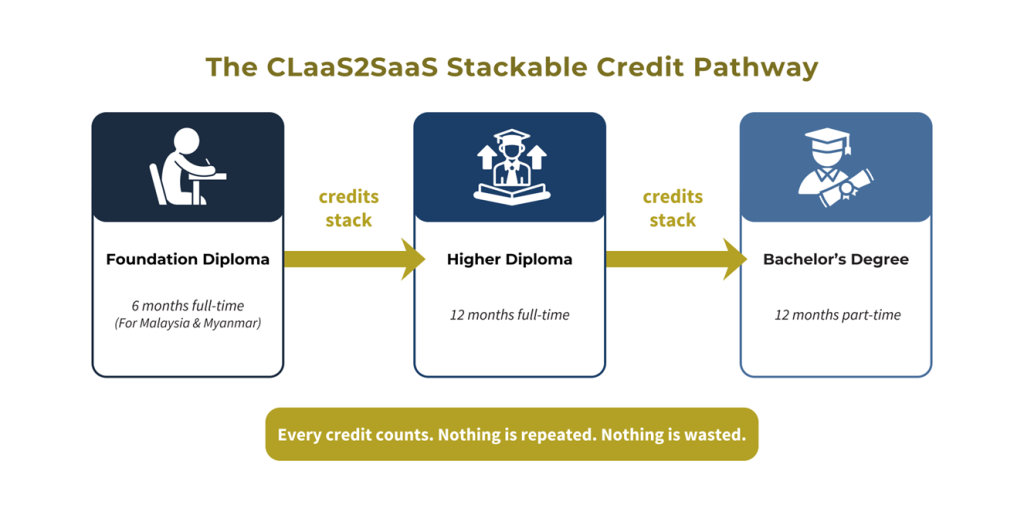
In most institutions, diploma and degree programs run on separate tracks. Credits rarely transfer. Students repeat modules they have already mastered, losing months and thousands in tuition fees in the process.
The CLaaS2SaaS’ Software Engineering pathway eliminates that entirely. Your Foundation Diploma credits stack directly into the Higher Diploma, and both feed into your Bachelor’s Degree. The Bachelor’s Degree is awarded in partnership with the University of Roehampton London, ensuring international recognition and progression opportunities.
Every step counts. Nothing is wasted. You move forward, not in circles.
What You Will Learn: Core Subjects in the Software Engineering Program
Every subject in the Software Engineering curriculum connects to a real skill employers look for. And unlike traditional classroom programs, the Software Engineering pathway is built around project-based learning, hands-on practice, and real apprenticeship opportunities, so you are not just studying software engineering, you are doing it. Here is what you build, year by year:
Year 1 – Build Your Foundation
- Programming fundamentals and software development patterns, so you can read, write, and think in code
- Computer information systems, so you understand how data moves through real applications
- Responsive web development, so your first projects actually work across devices
- Mathematics for computing and logical problem-solving in real code environments
Learning method: E-learning modules combined with guided projects and mentoring sessions, so concepts stick through practice, not just theory.
Year 2 – Apply What You Know
- Object-oriented programming with hands-on projects that mirror actual developer workflows
- Web and mobile applications development, building products people can use
- Database design and managing information systems, because every app runs on data
- Software project management, so you can lead and collaborate, not just code
Learning method: Apprenticeship-style work sprints where you apply skills on real project briefs, building a portfolio employers can actually evaluate.
Year 3 and Beyond – Lead and Specialize
- Advanced engineering practices and building information management systems at scale
- Management information technology and information systems project management for leadership roles
- Capstone projects built alongside industry partners, with real briefs and real deadlines
- Deployment, scaling, and software delivery, the skills that separate juniors from seniors
Learning method: Industry collaboration and capstone delivery, where you graduate with a completed, deployable project, not just a transcript.
How to Prepare Before You Enroll
You do not have to wait until orientation to start getting ready. Here are practical steps you can take right now:- Pick one programming language and commit to building one small project. Free platforms like freeCodeCamp or Khan Academy are great places to start.
- Brush up on your math. Algebra and basic logic will be your best friends in the early semesters.
- Explore a mobile app or website project on your own. Even a simple portfolio page using HTML and CSS counts as experience.
- Read about information systems and technology. Understanding how businesses use software helps you think like a professional developer from Day 1.
- Review admission requirements for your chosen pathway. The Software Engineering page has everything you need to compare entry points.
Ready to start your journey? Download Enrollment Checklist
Frequently Asked Questions
What are the software engineering requirements if I have no coding experience?
No prior experience is required for the Foundation Diploma. The program is designed to start from the ground up, building your skills step by step. For the Higher Diploma or Bachelor’s entry, basic programming knowledge and some familiarity with logic or math is recommended.
What computer software development courses are included in the program?
The Software Engineering program covers everything from web development and mobile app programming to database management, object-oriented systems, and software project management. See the full curriculum on the program pages linked throughout this article.
Can I transfer my diploma credits toward the degree?
Yes. The CLaaS2SaaS Software Engineering pathway is designed as a stackable credit system. Your Foundation and Higher Diploma credits count toward your Bachelor’s Degree, so you progress without repeating work.
Is this program recognized internationally?
The Bachelor’s program is offered in partnership with the University of Roehampton London and aligns with international software engineering standards. You can verify accreditation details on the Bachelor’s Degree program page.
How long does it take to complete the full pathway?
Completing the full pathway from Foundation Diploma to Bachelor’s Degree takes approximately 2 to 2.5 years depending on your entry point and study pace. Starting from the Higher Diploma shortens the timeline significantly.
What can I do with a software engineering degree?
Graduates work as software developers, web and mobile app developers, systems analysts, IT project managers, and more. The tech industry values both strong technical skills and strategic thinking. Specialization in management information technology or information systems project management open pathways toward leadership roles earlier in your career, especially when combined with practical project experience.
Course

Your Next Step Starts Here
You already have the most important requirement: the decision to start. That counts for more than you think. The tech industry will not slow down. The question is whether you move with it. Whether you are a high school student exploring computer software development courses, or someone ready to formalize your skills, CLaaS2SaaS has a pathway built for your exact starting point. The Software Engineering program does not just teach you to code. It teaches you to think, build, and lead in a world powered by software.
Do not wait for the perfect moment. Take the first step toward a career that matters.