Project Based Software Development Degree Program
SHARE THIS:


A degree alone is no longer enough to break into tech.
Thousands of graduates finish university every year with impressive transcripts, yet many still struggle to land their first software engineering job. Not because they lack intelligence, but because they lack real project experience.
Hiring managers are not just asking what you studied. They are asking what you have built.
Can you ship a working web app?
Can you design secure APIs?
Can you deploy systems to production and solve real user problems?
If the answer is uncertain, even the best grades may not help.
That is why more students and parents are searching for computer software development courses that go beyond lectures and theory. They want practical training that mirrors real industry work, builds a strong portfolio, and leads directly to employment.
A project-based software engineering degree does exactly that.
Instead of spending four years in classrooms, you learn by building real applications, working with modern tools like React and Spring Boot, integrating AI into development workflows, and gaining hands-on industry experience while you study.
Delivered through CLaaS2SaaS’ structured Work-Study pathway in Singapore, the program progresses from foundation to an internationally recognized Bachelor’s degree awarded by the University of Roehampton (UK). This ensures academic credibility while maintaining strong industry alignment.
If your goal is not just to graduate, but to get hired, CLaaS2SaaS’ pathway is built for you.
Why Traditional Tech Degrees Struggle to Keep Up
Software engineering evolves faster than academic calendars.Frameworks change yearly, AI tools update monthly and security standards shift constantly. In some traditional models, curricula may not update as quickly as the pace of industry changes, relying on:
- Theory-heavy lectures
- Paper exams
- Minimal coding practice
- Short internships only at the end
- Little exposure to modern production tools
Graduates often understand concepts but cannot confidently build and deploy complete systems.
Employers notice this gap immediately.
They want contributors from day one.
This is exactly the problem CLaaS2SaaS set out to solve with its Project-based Degree in Software Engineering.
What Employers Actually Expect Today
Modern companies no longer hire based on GPA alone. Academic results may open the door, but they rarely secure the job.
What hiring managers really look for is proof of capability.
Industry hiring trends consistently show that employers prioritize demonstrable technical skills, project experience, and real-world problem solving over classroom performance alone. Candidates who can show working applications and portfolios consistently outperform those who only present academic credentials.
This shift explains why practical, project-based training has become far more valuable than theory-heavy education.
Technical Foundations
Employers expect software engineers to contribute immediately across the full development stack.
As mentioned in industry skills breakdowns for full-stack hiring, companies consistently list frontend frameworks, backend systems, APIs, databases, and cloud deployment as baseline requirements, not optional extras.
- Frontend frameworks like React so engineers can build responsive user interfaces
- Backend systems such as Spring Boot to power server-side logi
- APIs and integrations to connect services and third-party tools
- Databases and cloud hosting to manage scalable, production-ready applications
Without hands-on exposure to these tools, graduates often struggle to meet entry-level expectations.
Security and Reliability
Shipping software is only half the job. Keeping it secure and stable is equally important.
As reflected in professional developer requirements compiled by Indeed’s’ backend developer skills guide, industry job descriptions consistently highlight secure development and testing practices as critical competencies. Developers are expected to understand how to protect users and prevent system failures before software ever reaches production.
- Authentication and authorization are key security features required in most applications today.
- Secure coding practices and defensive development help protect applications against common threats while ensuring reliability.
- Testing and debugging are integral to quality software engineering, and they are frequently referenced in skills frameworks employers use when evaluating candidates.
AI-Driven Productivity
Another major shift is happening inside development teams.
AI is no longer experimental. It is part of everyday workflows.
As per industry insights on emerging tech skills demand, employers increasingly value engineers who use automation and AI tools to move faster and reduce manual effort.
- Skills in AI-augmented coding tools and automation are gaining traction as part of modern developer productivity toolchains.
- Cloud and DevOps knowledge, including automation practices and containerization, enhances deployment speed and operational reliability.
Business Thinking and Communication
Finally, employers want engineers who think beyond code.
Highlighted in broader workforce skills research by Phenom’s State of Skills industry report, strong communication and collaboration skills are frequently cited in workforce reports as key differentiators between average and high-performing developers. The ability to translate requirements into working features and explain technical decisions clearly is often what drives promotions and leadership opportunities.
- Employers seek candidates capable of translating requirements into functional features and contributing to product outcomes.
- Communication and collaboration skills remain essential, particularly in teams that employ Agile, Scrum, or cross-functional development practices.
All of these capabilities define professionals in today’s information system & technology landscape. Without training that includes real projects and applied practice, many of these practical skills remain difficult to develop and harder to demonstrate to employers.
Not sure if you already got these skills? Get Your Personalized Eligibility Assessment!
Project-Based Learning vs Lecture-Based Learning
Here is the simple truth.
You cannot learn engineering without engineering.
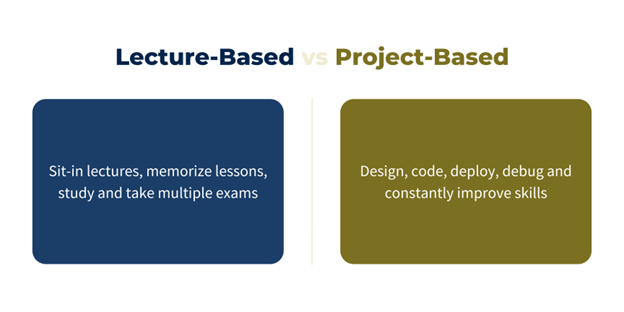
Lecture-Based Model
You sit-in for lectures, memorize the lessons, take the test and most likely forget right after.Project-Based Model
You design, code, deploy, debug and constantly improve.
That is why CLaaS2SaaS’ Work-Study Degree in Software Engineering focuses on live builds and industry problems, not theoretical exercises. Which results to students graduating with meaningful hands-on experience.
How Our Work-Study Pathway Works
The program is structured to balance academic progression with industry immersion for speed, relevance, and employability.
It compresses learning into three focused stages while integrating real-world exposure.
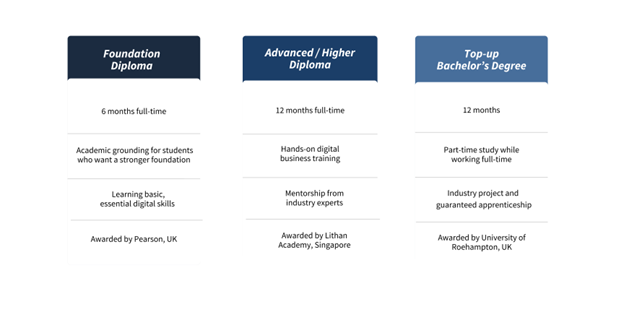
Stage 1: Foundation Diploma (6 months)
Awarded by Pearson
With our foundation diploma learners can build core fundamentals during their bootcamp:
- Programming logic
- Problem solving
- Mathematical foundation
- Computing basics
Stage 2: Advanced or Higher Diploma (12 months)
Awarded by Lithan Academy
With our Higher Diploma learners move into applied engineering:
- Full-stack development
- React and Spring Boot
- APIs and databases
- Cloud deployment
- Team-based builds
Stage 3: Top-Up Bachelor’s Degree (12 months)
Awarded by University of Roehampton
In our Top-Up Bachelor’s is where education meets employment:
- Industry projects
- Integrated apprenticeship opportunities with industry partners
- Real company work
- Professional portfolio
Total duration is just two years. Nearly half the time of traditional pathways.
How This Differs from a Traditional Computer Information Systems Degree
Computer software development courses typically emphasize systems theory, IT management, and infrastructure planning.
These areas are valuable.
But many programs lack deep coding and production experience.
This pathway integrates applied engineering practice from the first year onward. The CLaaS2SaaS work-study model prioritizes:
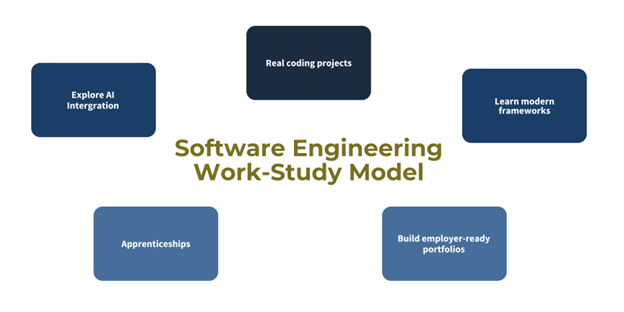
- Real coding projects
- Modern frameworks
- AI integration
- Apprenticeships
- Employer-ready portfolios
That difference dramatically improves employability.
What You Actually Build During Training
Learning software engineering should feel like building real software, not completing disposable assignments. Instead of theoretical exercises or one-off lab tasks, true transformation happens when learners repeatedly create systems that mirror what companies ship to customers every day.
That is exactly how the training is structured.
We guide our learners to create:
Full-stack web applications
Design and develop complete applications from frontend to backend, connecting user interfaces, servers, and databases into one working system. This teaches learners how features move from idea to deployment, giving you confidence to build products independently.
Secure login systems
Implement authentication, authorization, and user management flows that protect sensitive data. These security fundamentals help in understanding how real platforms safeguard users and comply with industry best practices.
API integrations
Connect applications with third-party services such as payment gateways, messaging tools, or analytics platforms. This mirrors real-world engineering work, where systems rarely operate alone and must communicate seamlessly with other technologies.
Cloud-hosted platforms
Deploy projects to live cloud environments rather than running them only on your laptop. This experience is a preparation for production environments and teaches scalability, monitoring, and performance optimization.
AI-powered features
Integrate intelligent capabilities such as recommendations, predictions, or automated workflows directly into applications. This allows designing smarter products that deliver measurable business value.
Each project simulates real engineering work, which means you graduate with more than knowledge. You will graduate in just 2 years, with proof that you are job-ready.
By the time you complete our project-based software development degree, your portfolio reflects responsibilities aligned with professional development environments, not an entry-level beginner trying to learn on the job.
Integrating Generative AI Into Development
Modern software engineering is no longer just about writing code manually. The best developers today combine technical expertise with AI tools to work faster, solve problems creatively, and deliver results more efficiently.
AI has shifted from being a bonus skill to a daily necessity.
That is why the program intentionally embeds AI workflows directly into the development process. We focus on having you to develop capabilities in:
Use generative AI for code assistance
Learn how to generate boilerplate code, explore solutions, and speed up debugging using AI copilots. This helps learners focus on solving problems instead of spending hours on repetitive syntax.
Automate repetitive tasks
Create workflows that handle routine processes such as data formatting or report generation automatically. This frees up time for higher-value engineering work and strategic thinking.
Create documentation
Use relevant AI tools to produce clean technical documentation, comments, and explanations faster. Clear documentation improves collaboration and is highly valued in professional teams.
Test applications
Generate test cases and validation scripts to identify bugs earlier in development. This leads to more reliable software and reduces costly fixes later.
Prototype features quickly
Rapidly build and refine ideas using AI-assisted scaffolding. Faster prototyping means quicker experimentation and stronger innovation.
By mastering these capabilities, you become more than just a developer. You develop the ability to work effectively alongside AI-assisted tools. Employers increasingly prefer professionals trained this way, which is why CLaaS2SaaS integrates AI directly into every stage of the learning journey.
Career Outcomes After Graduation
A strong software engineering program should lead somewhere concrete, not leave you guessing what comes next. The goal is simple: when you graduate, you should already have the skills, portfolio, and confidence to step directly into real technical roles.
Graduates commonly step into roles such as:
Full-Stack Software Engineer
Build complete applications from frontend interfaces to backend systems and databases. You understand how every layer connects, which makes you highly valuable to startups and fast-moving tech teams that need versatile problem solvers.
Backend Developer
Design server logic, databases, and APIs that power applications behind the scenes. You focus on performance, scalability, and security to ensure systems run reliably for thousands or even millions of users.
Frontend Developer
Create responsive, user-friendly interfaces that customers interact with daily. You turn designs into functional experiences using modern frameworks while optimizing usability and speed.
AI Applications Developer
Integrate generative AI and intelligent automation into real products and workflows. You build smarter systems that improve productivity, personalize experiences, and help businesses make faster decisions.
Systems Engineer
Oversee how software, infrastructure, and networks work together as one ecosystem. You ensure applications remain stable, secure, and efficient across different environments and platforms.
DevOps Associate
Bridge development and operations by managing deployments, cloud services, and continuous integration pipelines. You help teams release features faster while maintaining reliability and minimizing downtime.
Being part of the CLaaS2SaaS Work-Study degree means you do not just learn these roles in theory. Through real projects and apprenticeships, you practice the same tasks professionals handle daily, making you job-ready before graduation.
And graduating faster means earning sooner. Entering the workforce one two years earlier can translate into significant income gains and experience advantages, reducing the opportunity cost that often comes with traditional degree paths.
Who Suits a Software Engineering Path
Not every learner thrives in a traditional four-year university setup. Some want speed, others want practicality, and many simply want certainty that their education will lead directly to a real job.A project-based, work-study pathway is designed for people who value outcomes over tradition and employability over theory.
This pathway is ideal for: 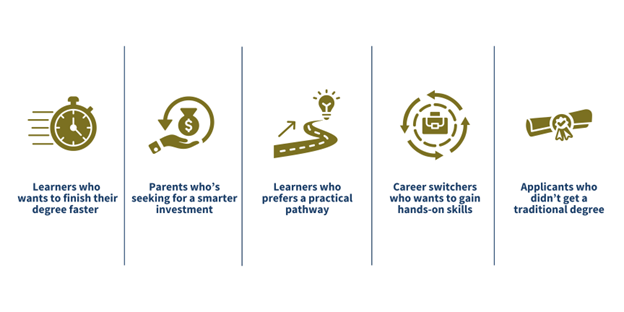
Students seeking faster graduation
Learners who want to finish their degree in as fast as two years instead of four.
By entering the workforce earlier, you gain a head start on income, experience, and career progression while your peers are still completing lectures.
Parents focused on ROI
Parents seeking a structured, internationally recognized pathway that balances tuition investment with earlier workforce entry.
Shorter study duration reduces total education costs, and earlier job placement means students begin earning and building careers sooner, making the investment more practical and predictable.
Practical learners
Learners who prefer building over memorizing.
If you learn best by coding, testing, and solving real problems rather than sitting through long lectures, a hands-on environment helps you retain knowledge faster and build real confidence.
Career switchers
Career switchers who want hands-on skills quickly.
Instead of spending years restarting academically, you focus only on job-relevant tools and projects that prepare you for immediate transition into tech roles.
Applicants who missed traditional universities
Learners who still want earn an internationally recognized degree.
This pathway provides a credible bachelor’s qualification and real industry exposure, proving that success does not depend on entering a conventional university route.
The hybrid work-study structure from CLaaS2SaaS supports flexible pacing while maintaining strong mentorship, allowing learners to study, build projects, and gain professional experience at the same time. The result is a graduate who is not only qualified on paper, but fully prepared to perform in real engineering teams from day one.
Having doubts about the program? Ask all of your questions to our team
Frequently Asked Questions (FAQs)
How is a project-based degree different from a traditional tech degree?
Instead of mostly lectures and exams, you learn by building real applications. Learners graduate with hands-on experience and a portfolio, not just theory.
Will I get real work experience during the program?
Yes. The CLaaS2SaaS Work-Study pathway includes live projects and apprenticeships, giving up to 12 months of industry experience before graduation.
Is the qualification recognized internationally?
Yes. Credentials are awarded by Pearson (UK), Lithan Academy (Singapore), and the University of Roehampton (UK), providing an internationally recognized academic pathway.
What skills will I learn?
Full-stack development, APIs, databases, cloud deployment, secure coding, and AI-assisted workflows using modern tools like React and Spring Boot.
Who is this program best for?
Students, career switchers, and practical learners who want faster graduation, real experience, and job-ready skills.
Course

Start Your Software Engineering Journey Today
If you want an international degree, real project experience, and a faster path into high-income tech roles, explore the Work-Study Software Engineering Degree from CLaaS2SaaS.
Book a career consultation today and take the first step toward becoming a full-stack or AI applications developer.