Digital Innovation: Systems and Software Application Development Skills
SHARE THIS:


Artificial intelligence is transforming how businesses operate, compete, and innovate. What once took years of strategic planning can now happen in months as AI accelerates decision cycles, automates processes, and reshapes entire industries.
Organizations today are no longer simply adopting new technologies. They are rewiring their operating models around digital platforms, data systems, and AI-enabled workflows.
At the center of this shift is software application development, the capability to design, build, and deploy intelligent digital solutions that power modern enterprises.
However, the challenge most organizations face today is not a lack of technology. It is a lack of leaders who can translate digital strategy into real execution.
According to the World Economic Forum Future of Jobs Report, technological change will significantly reshape the global workforce over the next decade. The report estimates that 170 million new jobs could be created while 92 million may disappear, resulting in a net gain of 78 million roles by 2030.
At the same time, organizations face a growing digital skills shortage. In fact, 63% of employers identify skills gaps as the biggest barrier to business transformation, highlighting the urgent need for professionals with technology and digital leadership capabilities.
This shift is creating a new category of professionals: digital innovation leaders who can design systems, integrate AI capabilities, and lead transformation initiatives across complex organizations.
Explore the Digital Innovation Leadership Work-Study pathway by CLaaS2SaaS and learn how to build real digital transformation skills while continuing your professional career.
AI Is Rewiring Business at Market Speed
Artificial intelligence is no longer an experimental technology. It is rapidly transforming how businesses operate, make decisions, and create value.
Across industries, organizations are embedding AI into core operations such as:
- Predictive analytics and forecasting
- Intelligent automation of workflows
- Data-driven customer experience platforms
- AI-assisted product development
- Real-time decision support systems
This transformation is occurring at the core of business strategy, not just at the edges.
Markets now evolve faster than traditional business planning cycles. Customer expectations change rapidly, and competitive advantages can disappear quickly.
In this environment, leaders must not only understand technology conceptually. They must be able to design and deploy AI-enabled systems that deliver measurable business outcomes.
Research from PwC shows that industries adopting AI most aggressively are experiencing significantly higher productivity growth, while workers with AI-related skills command a 56% wage premium compared with others.
As AI becomes embedded into business operations, software application development becomes the critical capability that enables organizations to build, integrate, and scale these intelligent systems effectively.
This trend highlights a fundamental shift: technology capability is becoming a leadership capability.
The Leadership Gap in the AI Era
Despite massive investments in digital technologies, many organizations struggle to execute transformation initiatives successfully.
The challenge is not technology alone. It is leadership capability.
Many managers understand digital technologies conceptually but lack practical experience designing and deploying AI-enabled solutions within real enterprise environments.
This creates what can be described as a structural leadership gap.
Traditional leadership education often focuses on theory, case studies, and retrospective analysis. Leaders study frameworks first and then attempt to apply them later in the workplace.
In AI-accelerated markets, this sequence no longer works.
Technology evolves too quickly for leadership capability to develop through detached academic study alone. By the time lessons are applied, the market may already have shifted.
Instead, leaders must develop capability while executing transformation initiatives in real time. This is why the Digital Innovation Leadership pathway by CLaaS2SaaS integrates work-integrated learning to prepare leaders who can apply knowledge immediately to drive business results.
Why Software Application Development Drives Digital Innovation
Digital transformation ultimately depends on building systems that work in real business environments.
This is why software application development remains one of the most critical capabilities for digital innovators.
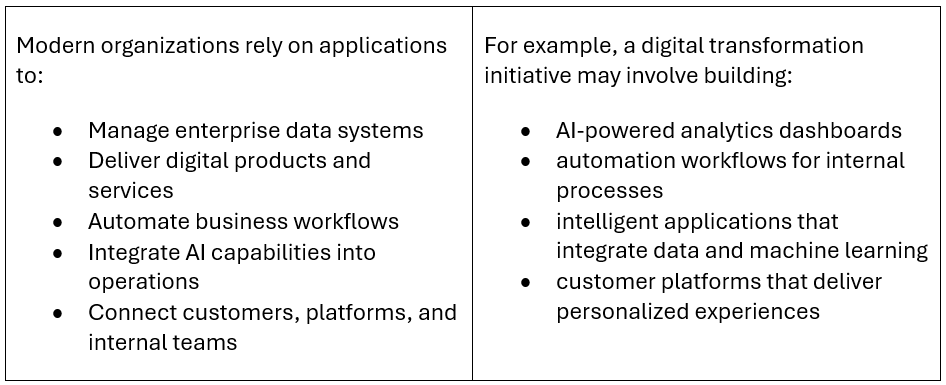
Without the ability to design and deploy such systems, digital strategies remain ideas rather than operational realities.
Digital innovators therefore need a combination of technical and strategic skills that allow them to translate business goals into functioning digital systems.
CLaaS2SaaS’s Digital Innovation Leadership pathway helps professionals develop these capabilities, equipping them to manage end-to-end digital solutions and lead transformation across organizations.
The Role of Management Information Technology
As digital systems become more complex, organizations must also manage how these technologies interact across the enterprise.
This is where management information technology becomes essential.
Management information technology focuses on designing and managing information systems that support organizational decision-making and operational performance.
Professionals working in this area develop capabilities such as:
- Enterprise system architecture design
- Data governance and management
- Digital platform integration
- Business intelligence and analytics
- Technology-driven operational strategy
These skills ensure that digital technologies are implemented in ways that support long-term organizational growth.
In digital transformation initiatives, management information technology provides the foundation that allows digital systems to scale effectively.
These capabilities go beyond technical expertise, equipping leaders with the ability to design, govern, and scale enterprise-wide digital transformation initiatives aligned with business strategy.
System Design Interview Preparation and Strategic Thinking
Professionals involved in digital innovation must develop strong system design capabilities.
This is why system design interview preparation has become a critical skill in both technical and leadership roles.
System design thinking focuses on solving large-scale challenges such as:
- Designing scalable applications that support millions of users
- Building resilient cloud platforms
- Integrating distributed data systems
- Ensuring performance and reliability under high demand
Developing these capabilities goes beyond technical knowledge.
It strengthens the ability to:
- Evaluate architectural decisions
- Balance trade-offs between scalability, cost, and performance
- Identify risks in system design
- Align technology solutions with business objectives
As organizations scale digital platforms and AI-driven systems, leaders who understand system design are better equipped to make strategic decisions that impact long-term business performance.
In the Digital Innovation Leadership pathway by CLaaS2SaaS, these capabilities are developed through real-world projects, enabling professionals to design, deploy, and scale systems within actual business environments rather than theoretical scenarios.
Work-Integrated Learning: From Knowledge to Execution
In AI-driven markets, the most valuable capability is not knowledge alone. It is execution capability.
This is why the Digital Innovation Leadership pathway is built around a work-integrated learning model.
Rather than separating education from real business environments, the program embeds learning directly within practical transformation initiatives.
Participants develop capability by working on real projects such as:
- building low-code applications
- developing AI agents and copilots
- designing data analytics dashboards
- automating enterprise workflows
Through these projects, participants develop a professional portfolio that demonstrates their ability to design and deliver digital solutions.
This approach bridges the gap between education and employment, enabling professionals to build capability while solving real enterprise challenges.
Explore the Professional Certificate in Digital Innovation by CLaaS2SaaS and learn how to design and deploy intelligent digital solutions.
The Digital Innovation Leadership Pathway
The Digital Innovation Leadership pathway by CLaaS2SaaS is designed as a stackable, capability-driven journey that develops professionals from digital builders into transformation leaders.
Rather than focusing only on individual qualifications, the pathway emphasizes progressive capability development across three stages, enabling participants to design, execute, and scale digital transformation initiatives in real business environments.
Across the journey, participants build three core capabilities:
- Build – Develop and deploy intelligent digital solutions
- Lead – Design and drive transformation initiatives
- Scale – Manage enterprise-level transformation and strategy
Stage 1: Professional Certificate in Digital Innovation
This stage focuses on developing foundational capability in building digital solutions.
Participants learn to work with:
- low-code application development platforms
- generative AI tools
- workflow automation technologies
- data analytics systems
Outcome:
Ability to design and deploy end-to-end digital solutions that integrate applications, data, and automation in real business scenarios.
Stage 2: Professional Certificate in Digital Transformation & Entrepreneurship
The second stage focuses on applying the same capability to organizational transformation.
Participants develop skills in:
- digital transformation frameworks
- workforce transformation strategy
- digital business model design
- innovation and venture development
Outcome:
Ability to apply digital solutions across business functions to drive transformation and improve organizational performance.
Stage 3: International MBA – Digital Innovation & Entrepreneurship
The final stage focuses on scaling and governing this capability at the enterprise level.
Participants build expertise in:
- corporate finance and strategic integration
- digital transformation governance
- organizational design and project management
- international business strategy
Outcome:
Ability to scale and govern enterprise-wide digital transformation powered by integrated systems, data, and AI capabilities.
Why Digital Innovation Leaders Will Define the Future Workforce
As AI and digital platforms reshape industries, organizations increasingly need leaders who can combine technology capability with strategic execution.
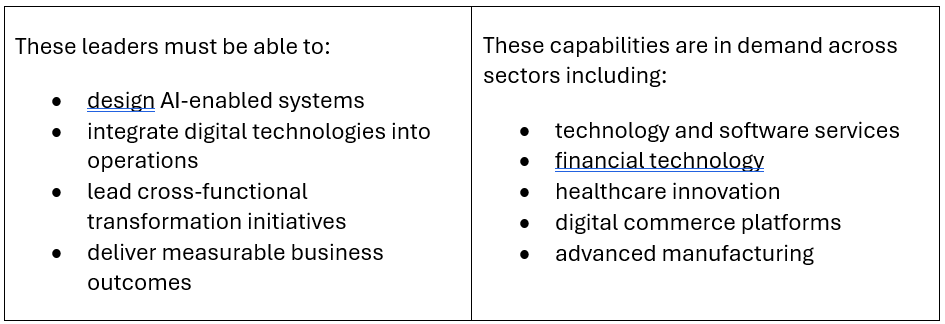
Professionals who develop expertise in software application development, management information technology, and digital leadership will have a significant advantage in the future workforce.
Course

Conclusion
Digital transformation is redefining how organizations operate and compete.
Success in this environment requires more than understanding technology. It requires the ability to design, deploy, and scale digital solutions that deliver real business outcomes.
By developing expertise in software application development, management information technology, and digital leadership, professionals can position themselves at the forefront of innovation.
Programs that integrate learning with real execution provide one of the most effective pathways for building these capabilities.
The Digital Innovation Leadership pathway offers a structured journey for professionals who want to lead transformation rather than simply adapt to it.
Become a Digital Innovation Leader capable of designing and scaling AI-enabled solutions.