
Driving Change: The Roadmap to Digital Transformation and Innovation

SHARE THIS:

Organizations today operate rapidly evolving digital environment. Advances in cloud computing, artificial intelligence, automation, and data analytics are transforming how businesses compete and create value.
In this environment, innovation and digital transformation have become essential priorities for organizations seeking long-term growth and competitiveness.
However, many companies still struggle to translate digital ambition into real business outcomes. Despite major investments in technology, transformation initiatives often stall or fail to deliver expected results.
The reason is simple. Digital transformation is not purely a technology initiative. It is fundamentally a leadership challenge.
Successful transformation requires leaders who can align technology with business strategy, guide teams through organizational change, and implement scalable digital solutions. Organizations that invest in developing these leadership capabilities are significantly more likely to succeed in transformation efforts.

Why Leadership Is Critical for Innovation and Digital Transformation

Many organizations approach transformation by focusing primarily on new technologies. While technology is an important enabler, it does not automatically transform businesses.
Digital transformation requires coordinated change across multiple dimensions, including strategy, operations, workforce skills, and organizational culture.
Leaders play a central role in ensuring these elements align.
Effective digital innovation leaders go beyond coordination—they translate strategy into deployable systems and measurable business outcomes:
  • Translating digital strategy into practical initiatives
  • Aligning teams across departments
  • Encouraging innovation and experimentation
  • Managing organizational change
  • Ensuring technology investments support business outcomes
Without leadership alignment, digital initiatives often become isolated projects rather than drivers of long-term transformation.

The Leaderhsip Capability Gap

Despite the growing importance of digital transformation, many organizations face a significant leadership capability gap.
Leaders may recognize the importance of transformation but lack the frameworks or expertise needed to guide complex digital initiatives.
Common challenges include:
  • difficulty integrating digital strategy with business operations
  • limited understanding of emerging technologies
  • uncertainty about managing cross-functional innovation initiatives
  • challenges scaling digital solutions across the organization
Organizations with strong digital leadership capabilities are far more likely to successfully transform their operations and business models.
These findings highlight the importance of structured leadership development in digital transformation efforts.
Organizations must develop leaders who understand both innovation strategy and technology implementation.
To address this leadership capability gap, organizations are increasingly exploring integrated models that combine leadership development, strategic guidance, and digital technology implementation. One such model is the CLaaS2SaaS approach, which connects capability building with scalable digital solutions that leaders can deploy across their organizations.

A Framework for Leaders Driving Digital Transformation

To address this leadership capability gap, many organizations are adopting integrated transformation frameworks that combine learning, strategic guidance, and technology implementation.
One emerging approach is the CLaaS2SaaS model, which integrates capability development with scalable digital platforms. Rather than treating learning, consulting, and technology adoption as separate initiatives, the CLaaS2SaaS model connects them into a cohesive transformation journey.
The framework focuses on three key components.
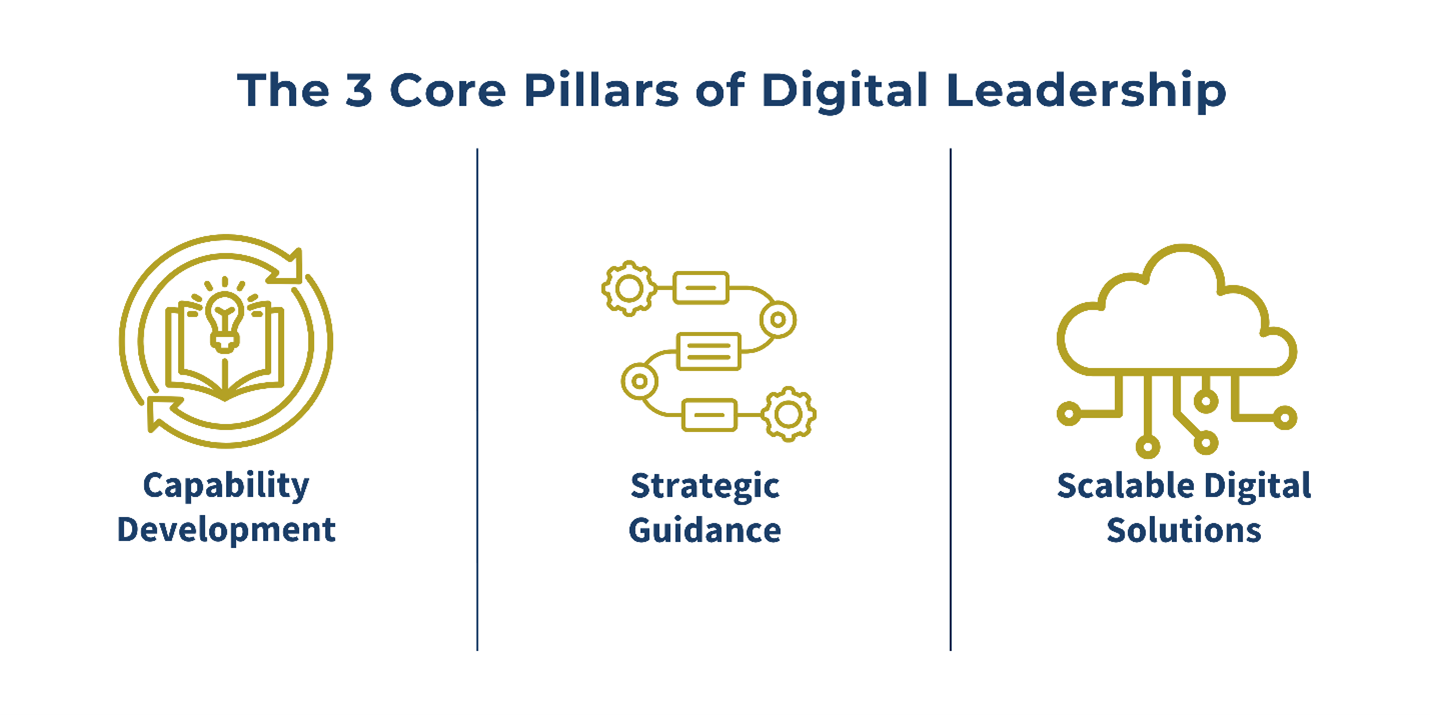
The first step in enabling leaders to drive transformation is building their digital capabilities.
Capability development focuses on helping leaders understand how digital technologies influence business strategy and innovation.
This includes knowledge areas such as:
  • digital business strategy
  • innovation management
  • data-driven decision making
  • emerging technology trends
When leaders develop these capabilities, they are better equipped to interpret digital opportunities and guide transformation initiatives.
Capability development ensures that digital transformation becomes a strategic leadership capability rather than simply a technical project.
Knowledge alone is not enough. Leaders must also understand how to structure and implement transformation initiatives effectively.
Strategic guidance provides leaders with frameworks and tools for managing digital transformation within complex organizations.
This includes:
  • designing digital transformation roadmaps
  • prioritizing innovation initiatives
  • aligning stakeholders across departments
  • managing organizational change
Structured guidance helps leaders translate strategic vision into practical execution.
Organizations often complement this process with digital transformation consulting, which provides specialized expertise and industry best practices.
The final component of the framework focuses on implementing digital platforms that enable scalable innovation.
Leaders must understand how to evaluate and deploy technologies that support long-term operational efficiency.
Examples of scalable digital solutions include:
  • cloud-based infrastructure
  • enterprise SaaS platforms
  • AI-powered analytics systems
  • digital workflow automation tools
These technologies enable organizations to scale transformation initiatives across departments while maintaining operational efficiency.
By integrating capability development, strategic guidance, and scalable digital solutions, the CLaaS2SaaS framework empowers leaders to move from strategic planning to real implementation.

Managing Digital Transformation in Practice

Leaders guiding digital transformation initiatives typically follow a structured approach, execution-driven approaches that connect strategy with implementation. These are applied through real transformation projects, enabling leaders to test, refine, and scale solutions in live environments.
Transformation begins with understanding the organization’s current capabilities.
Leaders must evaluate technology infrastructure, workforce digital skills, and operational processes to identify areas that require improvement.
Leaders must clearly communicate the purpose and goals of digital transformation initiatives.
A well-defined vision helps align teams and ensures transformation efforts remain connected to broader business objectives.
Digital transformation often requires cooperation between departments such as IT, operations, marketing, and leadership teams.
Effective leaders encourage collaboration and break down organizational silos.
Once strategy and capability development are in place, organizations can implement digital platforms that support operational improvements and innovation.
Transformation is not a one-time initiative. Organizations must continuously adapt to new technologies, market trends, and customer expectations.
Leaders play a key role in building cultures that support experimentation and continuous improvement.

The Role of Digital Transformation Consulting

Because transformation initiatives are complex, many organizations work with digital transformation consulting partners.
Consultants provide expertise that helps organizations accelerate transformation initiatives while minimizing risks.
Consulting support typically includes:
  • digital maturity assessments
  • transformation strategy development
  • technology implementation guidance
  • change management frameworks
By combining consulting expertise with leadership capability development models like CLaaS2SaaS, organizations can significantly improve the success rate of transformation initiatives.

Benefits of Innovation and Digital Transformation

When organizations successfully implement digital transformation strategies, they unlock several key advantages.

Better Customer Experiences

Digital platforms enable personalized services and seamless interactions across channels.

Faster Innovation Cycles

Organizations can test and launch new products or services more quickly.

Data-Driven Decision Making

Advanced analytics allow leaders to make informed decisions based on real-time data.

Stronger Competitive Advantage

Companies that successfully innovate are better positioned to respond to market changes and emerging technologies.

Leadership Pathways for Driving Digital Innovation

Developing leaders who can guide digital transformation requires more than theoretical knowledge—it requires structured capability pathways that combine learning, real-world application, and technology implementation.
Through the Digital Innovation Leadership Pathway, business professionals can progressively develop the capability to build, lead, and scale digital transformation initiatives in real business environments. Rather than focusing only on knowledge acquisition, the pathway is designed to develop execution capability—the ability to design, deploy, and operationalize digital solutions that deliver measurable outcomes.
Participants build hands-on expertise in areas such as data-driven decision-making, workflow automation, AI-enabled solutions, and low-code application development using platforms like Microsoft Power BI, Power Automate, and generative AI tools. These capabilities are developed through work-integrated learning, where participants work on real or simulated enterprise projects to design and implement end-to-end digital solutions.
The pathway follows a stackable progression from foundational digital solution building, to transformation implementation, and ultimately to enterprise-level leadership through an International MBA in Digital Innovation & Entrepreneurship. This final stage enables professionals to integrate strategic leadership, financial decision-making, and digital transformation governance, preparing them to lead organization-wide innovation initiatives.
This ensures that participants not only understand digital strategy, but can also execute transformation initiatives, lead cross-functional teams, and scale digital innovation across the organization.
Unlike traditional technology training programs, this pathway is specifically designed for non-technical leaders and business professionals. It enables them to translate digital opportunities into real business solutions while building a portfolio of applied work that demonstrates their ability to drive transformation in practice.

Course

Conclusion

Digital transformation is not simply about implementing new technologies. It is about empowering leaders who can guide organizations through innovation, change, and strategic growth.
Successful innovation and digital transformation initiatives require leaders who can connect business strategy with emerging technologies and scalable digital platforms.
The CLaaS2SaaS framework provides a practical approach to achieving this goal. By combining capability development, strategic guidance, and scalable digital solutions, the framework enables leaders to translate digital opportunities into measurable business outcomes.
As organizations continue navigating rapid technological change, the ability to lead transformation will become one of the most valuable leadership capabilities.
Businesses that invest in developing digital leaders, supported by structured frameworks and digital transformation consulting, will be better positioned to innovate, scale, and remain competitive in the digital economy.