Home Blog Work Study Degree Flexible Pathways in SG and PH
Work Study Degree

Associate and Alternative Degree: Flexible Pathways in SG and PH

Associate and Alternative Degree: Flexible Pathways in SG and PH

Header banner: CLaaS2SaaS Associate Degrees: Flexible, Affordable, Recognized in SG & PH

Not everyone can afford to pause life for a traditional 4-year (or longer) bachelor’s degree—and for many learners today, that’s no longer the only option. 

Across the Philippines and other growing economies, students and working adults are actively searching for faster, more flexible ways to gain recognized qualifications without sacrificing career momentum. They are trying to avoid spending years on bachelor’s degree programs that still leave them without real-world skills. For those with a high school diploma, an associate pathway is the fastest bridge to higher education. 

 Whether it’s due to financial priorities, family responsibilities, or the need to start working sooner, the demand for alternative education pathways continues to rise. 

An associate degree is a recognized academic credential that is often completed as a 2 years course. It sits between a high school diploma and a bachelor’s degree, allowing you to enter the workforce faster. It is designed to help learners build practical skills, earn transferable credits, and access career opportunities sooner, without committing immediately to a full bachelor’s program. 

In the Philippines, where affordability and employability are critical factors, this pathway offers a strategic advantage: 

  • It reduces upfront education costs compared to full degree programs 
  • It allows learners to enter the workforce earlier while continuing their studies
  • It provides a clear route toward a bachelor’s degree through credit transfer

At the same time, education models are evolving. Beyond traditional associate degrees, newer pathways are beginning to combine structured learning with real-world work experience, industry exposure, and guided career progression—offering learners not just credentials, but clearer employment outcomes.

While countries like Singapore have established structured progression systems that support these pathways, similar approaches are becoming increasingly relevant across Southeast Asia—including the Philippines—where flexible, career-aligned education is no longer optional, but essential.

Choosing an associate degree or a modern alternative pathway doesn’t mean settling for less. It means choosing a smarter, staged approach to education: one that allows you to learn, work, and progress at your own pace, while keeping long-term degree opportunities open.

Get an Bachelor’s Degree and Digital Career in just 2 years Download the PDF guide

What Is an Associate Degree

An associate degree is a post-secondary academic qualification. Depending on the years to complete, this degree allows students to enter high-growth fields faster. According to the 2026 Bureau of Labor Statistics data, associate-level roles in tech and healthcare are growing faster than the average. 

At its core, an associate degree combines two key components: 

  • General education such as communication, mathematics, and critical thinking  
  • Field-specific training in areas like business, information technology, healthcare, or applied sciences  

This structure allows learners to develop a well-rounded foundation while also gaining skills that can be applied directly in the workplace. 

For learners in the Philippines, this pathway is becoming increasingly relevant as education shifts toward skills-based and outcome-driven models. Associate degrees are recognized as legitimate stepping stones, especially when aligned with institutions or programs that support credit transfer into bachelor’s degrees under CHED-recognized frameworks. 

In practical terms, an associate degree allows you to: 

  • Earn a recognized qualification in a shorter timeframe compared to a full degree  
  • Start working earlier in entry-level or specialized roles  
  • Continue your education later by transferring credits into a bachelor’s program  

Types of Associate Degrees
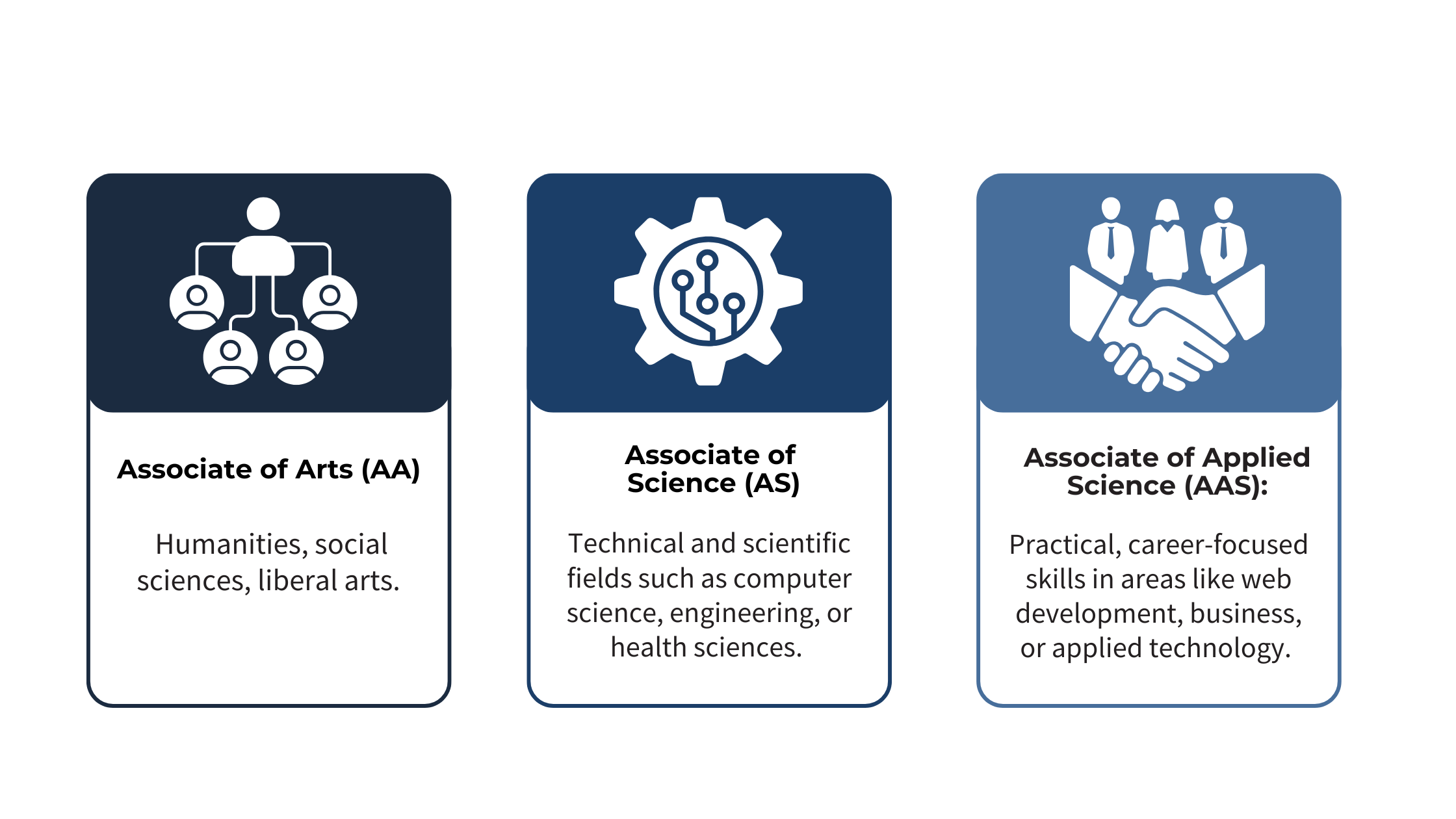
Visual comparison of Associate of Arts (humanities and liberal arts), Associate of Science (technical and scientific fields), and Associate of Applied Science (career-focused skills like business and web development).

In the Philippines, these distinctions are becoming more relevant as institutions align programs with career outcomes and credit transfer opportunities under CHED-recognized systems. 

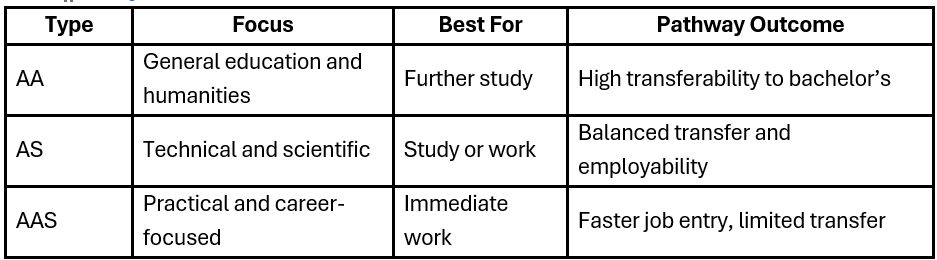
  • AA and AS degrees are often used as pathways into bachelor’s programs, especially for students who want flexibility or need to manage costs  
  • AAS degrees appeal to working adults or career shifters who prioritize immediate job readiness  

In practice, the right choice depends on your goal: 

  • If you want to continue to a bachelor’s degree, AA or AS is usually the better path  
  • If you want to start working quickly, AAS provides more direct, hands-on preparation 

An associate degree typically takes 2 to 3 years to complete. 

  • Full-time students usually finish in about 2 years, making it a fast way to gain a recognized qualification and enter the workforce.  
  • Part-time or flexible learners may take up to 3 years, especially when balancing work or family responsibilities. 

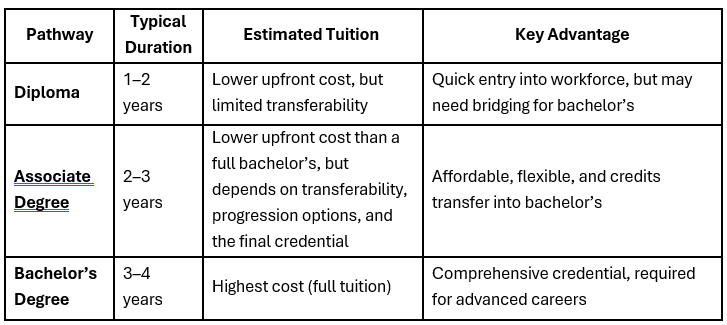
Associate Degree vs Bachelor’s Degree 

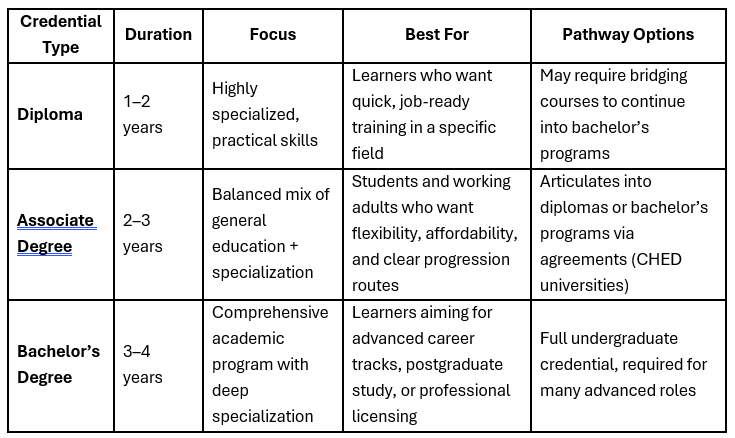
When deciding between an associate degree and a bachelor’s degree, the differences go beyond just the number of years in school. 

  • Associate Degree: Takes about 2–3 years, is more affordable, and helps you enter the workforce sooner while keeping the option to continue into a bachelor’s later.   
  • Bachelor’s Degree: Takes 3–4 years, offers deeper specialization, and is often required for advanced roles or professional paths. 

The key takeaway: an associate degree is not “less than” a bachelor’s—it’s a different pathway that can lead to the same destination. Many students the Philippines choose the associate route first, then transfer credits into bachelor’s programs at institutions like CHED-recognized universities, saving both time and money. 

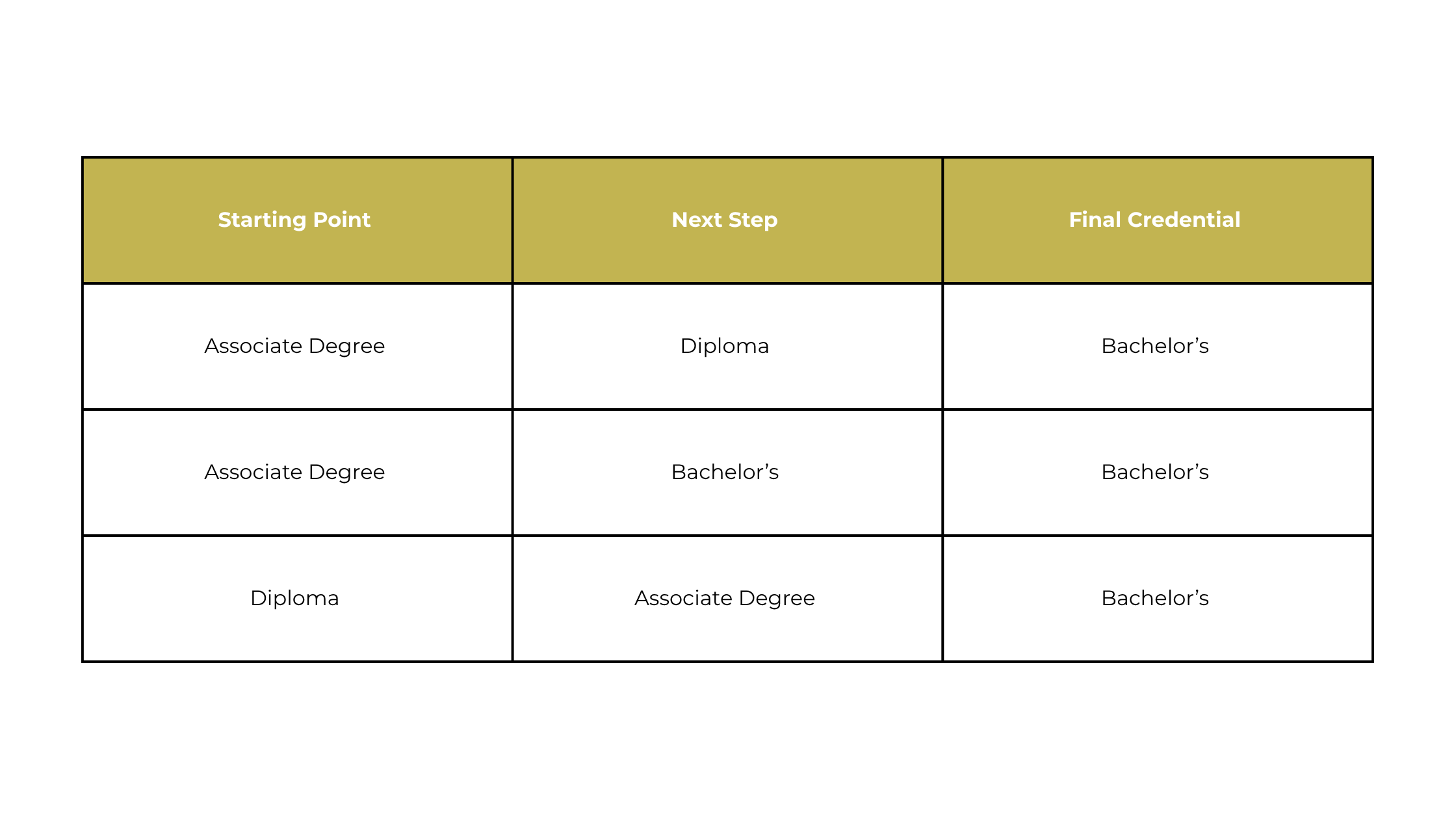
Associate Degree vs Diploma vs Bachelor’s: Which Path Is Right?

Pathway from Associate to Full DegreeTable showing education pathways: Associate Degree leading to Diploma then Bachelor’s, Associate Degree leading directly to Bachelor’s, and Diploma leading to Associate Degree then Bachelor’s.
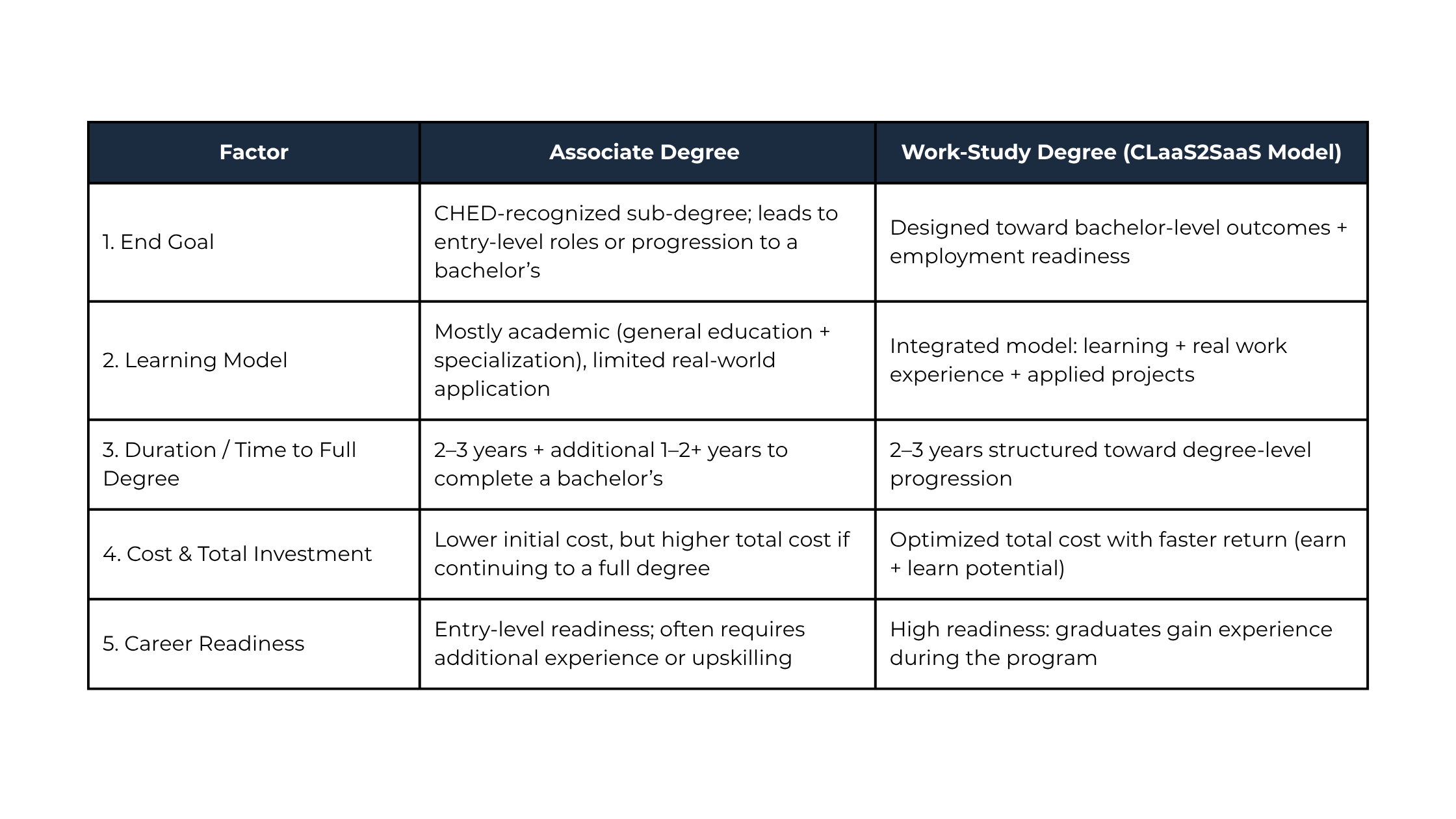
Beyond Stepping Stones: Why CLaaS2SaaS is the Smarter Choice

While traditional associate degrees are valuable “stepping stones,” they often require an additional 1–2 years of study to “top up” to a full degree. CLaaS2SaaS offers a more direct alternative pathway for learners who want a full degree outcome that delivers more value in the same amount of time.  Comparison table of Associate Degree vs Work-Study Degree CLaaS2SaaS model highlighting end goals, learning model, duration, cost efficiency, and career readiness.
A Full Bachelor’s Degree in 2–3 Years

The most significant advantage of CLaaS2SaaS is the final credential. While a generic associate program takes 2–3 years to complete a mid-level qualification, our programs allow you to earn a full Bachelor’s degree in that exact same 2–3 year timeframe.  

You reach the final destination without needing further bridging courses or separate “top-up” programs: 

Foundation Diploma* (6 months) → Advanced/Higher Diploma (12 months) → Top-up Bachelor’s Degree (12 months, with industry project/apprenticeship). 

*for some countries only 

The Work-Integrated (Work-Study) Advantage 

  • Unlike traditional academic programs that focus purely on theory, CLaaS2SaaS utilizes a work-study model. 
  • Job-Ready Skills: You build a professional portfolio and gain job-ready skills while earning your degree, making you more employable upon graduation. 
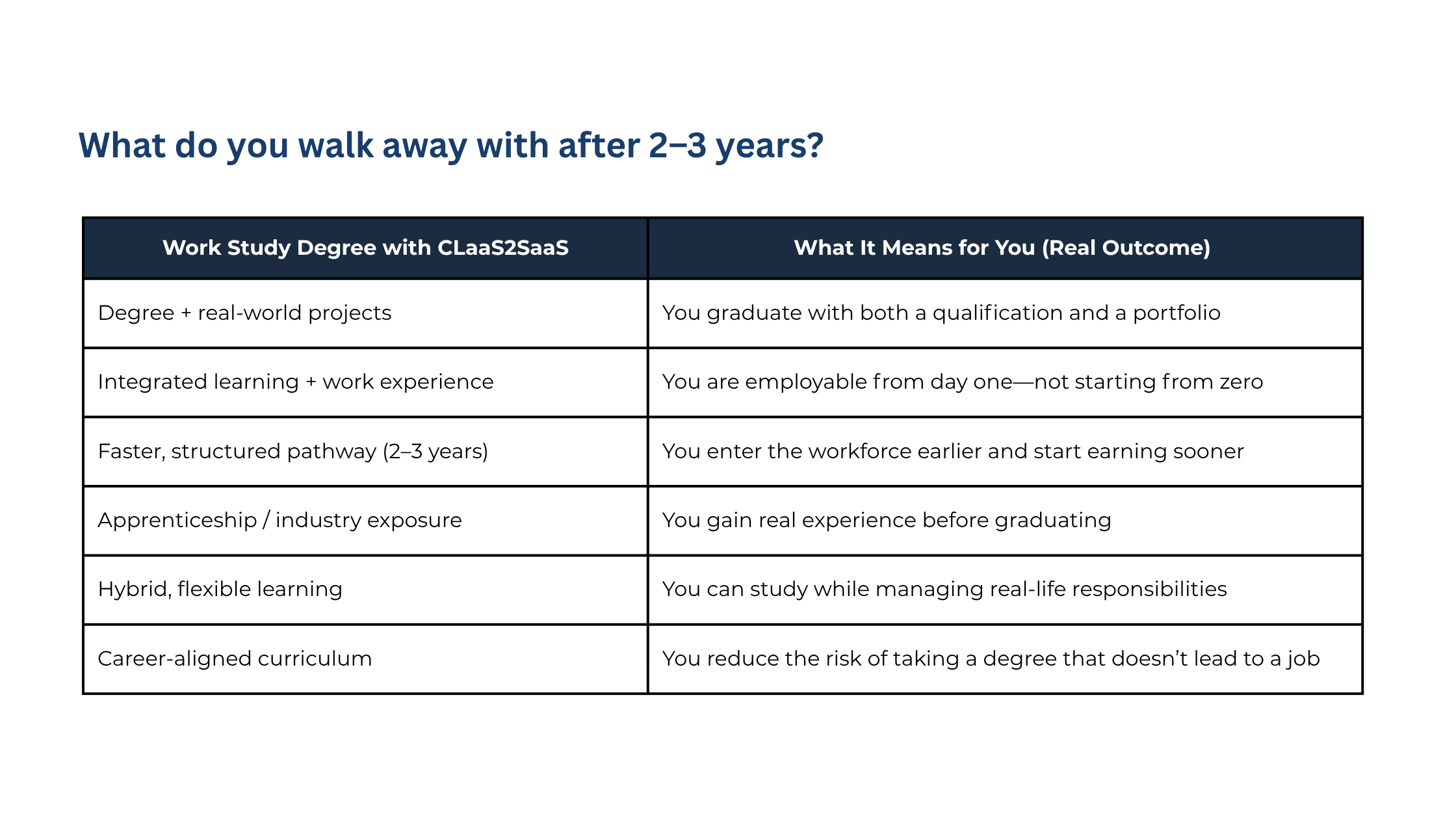
Work Study Degree CLaaS2SaaS benefits table showing outcomes like employability, faster graduation, industry exposure, flexible learning, and career-aligned curriculum.

Work-Study Degrees That Combine Learning and Employment 

Work-Study Degree models, widely implemented in structured systems like Singapore and increasingly relevant in the Philippines, represent a shift from traditional education by combining academic learning with real work experience within the same 2–3 year timeframe.  

While an associate degree typically serves as a stepping stone toward further study, a work-study degree is designed as a direct pathway to both a qualification and a career, addressing common concerns around employability, time to income, and limited university access by aligning education more closely with real job outcomes. 

Why this matters: 

  • Faster transition from study to earning  
  • Built-in real-world experience before graduation  
  • More predictable and career-aligned outcomes  
  • Practical alternative for those seeking flexible, job-focused pathways 
Still wondering if this path fits you? Consult with our experts

Frequently Asked Questions 

An associate degree is a post-secondary academic credential that typically takes 2 to 3 years to complete. It serves as a flexible pathway between a high school diploma and a bachelor’s degree, combining general education with field-specific training.
No, it is simply a different pathway that can lead to the same destination. While a bachelor’s degree offers a broader academic scope, an associate degree is a strategic, affordable option that allows learners to enter the workforce earlier or keep their options open while earning transferable credits.
While a traditional associate degree is a mid-level qualification that often requires an additional 1–2 years to “top up” to a full degree, work-study models like CLaaS2SaaS are designed to deliver a full bachelor’s degree within the same 2–3 year timeframe. Additionally, work-study models integrate real-world industry projects directly into the curriculum.

Next Steps: Take Charge of Your Pathway


You’ve explored how associate degrees work in the Philippines, how they compare to bachelor’s programs, and how newer models like work-study pathways offer a different approach to achieving degree-level outcomes. 

The next step is yours. Whether you’re: 

  • A student looking for a more affordable and flexible starting point  
  • A working adult aiming to upskill without pausing your career  
  • Or someone seeking a faster, more practical route to employment  

What matters most is choosing a pathway that aligns with your timeline, budget, and career goals. 

Traditional associate degrees provide a structured academic progression. But if your priority is to gain real-world experience earlier while working toward a full qualification, work-study degree models offer a more integrated alternative. 

Programs like CLaaS2SaaS are designed around this approach—combining skills training, applied learning, and career support within a 2–3 year pathway aligned to bachelor-level outcomes. 

Don’t let uncertainty delay your progress. The right pathway should give you clarity, flexibility, and a clear direction toward employment and growth. 

Explore Your Options — Compare pathways, understand your progression, and choose the route that moves you forward with confidence. 

Next Steps: Take Charge of Your Pathway 

You’ve explored how associate degrees work in the Philippines, how they compare to bachelor’s programs, and how newer models like work-study pathways offer a different approach to achieving degree-level outcomes. 

The next step is yours. Whether you’re: 

  • A student looking for a more affordable and flexible starting point  
  • A working adult aiming to upskill without pausing your career  
  • Or someone seeking a faster, more practical route to employment  

What matters most is choosing a pathway that aligns with your timeline, budget, and career goals. 

Traditional associate degrees provide a structured academic progression. But if your priority is to gain real-world experience earlier while working toward a full qualification, work-study degree models offer a more integrated alternative. 

Programs like CLaaS2SaaS are designed around this approach—combining skills training, applied learning, and career support within a 2–3 year pathway aligned to bachelor-level outcomes. 

Don’t let uncertainty delay your progress. The right pathway should give you clarity, flexibility, and a clear direction toward employment and growth. 

Explore Your Options — Compare pathways, understand your progression, and choose the route that moves you forward with confidence.

Want to check if this career is for you?