Home Blog Lifelong Learning CET Build In-Demand Skills with Local Salary Context
Lifelong Learning CET

Data Analyst Course: Build In-Demand Skills with Local Salary Context

Data Analyst Course: Build In-Demand Skills with Local Salary Context
Demand for data professionals is accelerating faster than the talent pipeline can fill it. Companies in banking, e-commerce, logistics, and tech are growing their analytics teams.
They struggle to find candidates with strong technical skills and clear business communication. The gap is real, and it is creating meaningful career opportunities for professionals willing to invest in the right skills now.
Singapore, the region’s leading digital economy, has already mapped out what this transition looks like at scale. Its National AI Strategy 2.0, SkillsFuture funding ecosystem, and employer-driven demand for data talent serve as a practical benchmark for where the rest of the region is heading. Understanding how Singapore built its data workforce helps professionals across Southeast Asia see what is coming in their own markets and position ahead of it.
CLaaS2SaaS Data Science & AI Program is built for exactly this moment. Whether you are in the Philippines, Indonesia, Malaysia, or Myanmar, this guide covers regional pay for data skills. It also explains what you will learn and your career path after graduation. You can also explore the full Lifelong Learning Tech track for the complete range of programs available.

Data Analyst Market in 2026

Southeast Asia’s demand for data analysts is accelerating as digital payments, e-commerce, and enterprise digitization expand. In the Philippines, BPOs, fintech, and retail firms are driving more than 10,000 listings on JobStreet Philippines, with salaries ranging from PHP 25,000–80,000 monthly. Indonesia’s fast-growing digital economy, led by Gojek, Tokopedia, and Traveloka, offers IDR 6–22 million monthly.
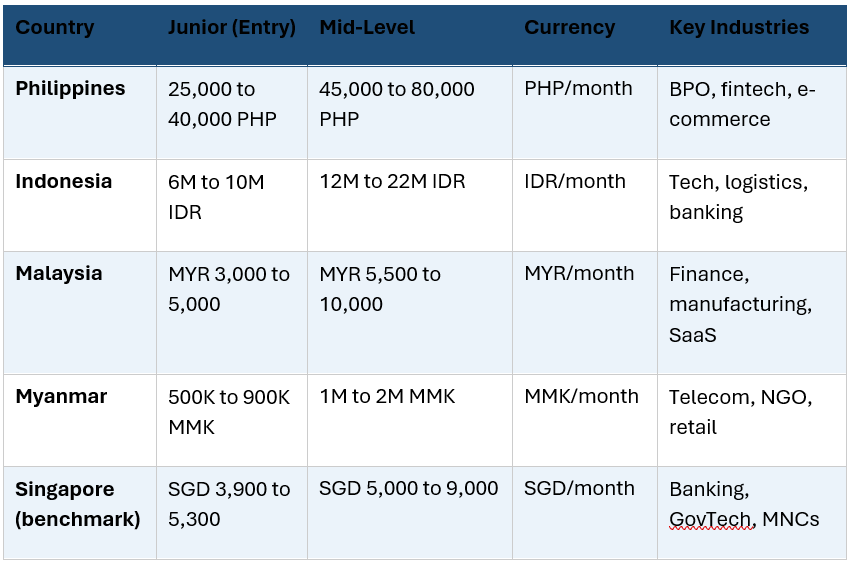
Malaysia’s mature analytics ecosystem pays MYR 3,000–10,000, while Myanmar’s emerging market, driven by telecoms and NGOs, offers MMK 500,000–2,000,000+ as digital adoption rises. Demand across all four markets is strongest for professionals skilled in SQL, Python, business intelligence tools, forecasting, fraud detection, and operational analytics.
A second layer of demand is now being driven by AI adoption. As organisations across the region deploy AI tools, from automated reporting platforms to predictive inventory systems to AI-assisted customer service, they are discovering that these tools require human oversight to function effectively. Someone needs to validate what the AI is producing, identify where it is wrong, and communicate its outputs to teams who do not have a technical background.
That role, sitting at the intersection of AI-assisted work, data interpretation, and cross-functional communication, is increasingly filled by data analysts. It is widening the definition of the role while simultaneously widening the pool of organisations that need to hire for it.
What varies by country is the stage of market development, the industries leading hiring, and the salary benchmarks. Here is where each market stands heading into the second half of 2026.
*Disclaimer: All figures are indicative ranges based on publicly available market data as of 2025 to 2026. Actual compensation varies by employer, industry sector, years of experience, specific tools held, and city or region within each country.
Regional Data Analyst Salary ReferenceSources: JobStreet Philippines, JobStreet Malaysia, JobStreet Indonesia, LinkedIn Salary data, Morgan McKinley SG Salary Guide 2025, MOM Labour Market data.

How Singapore Sets the Benchmark
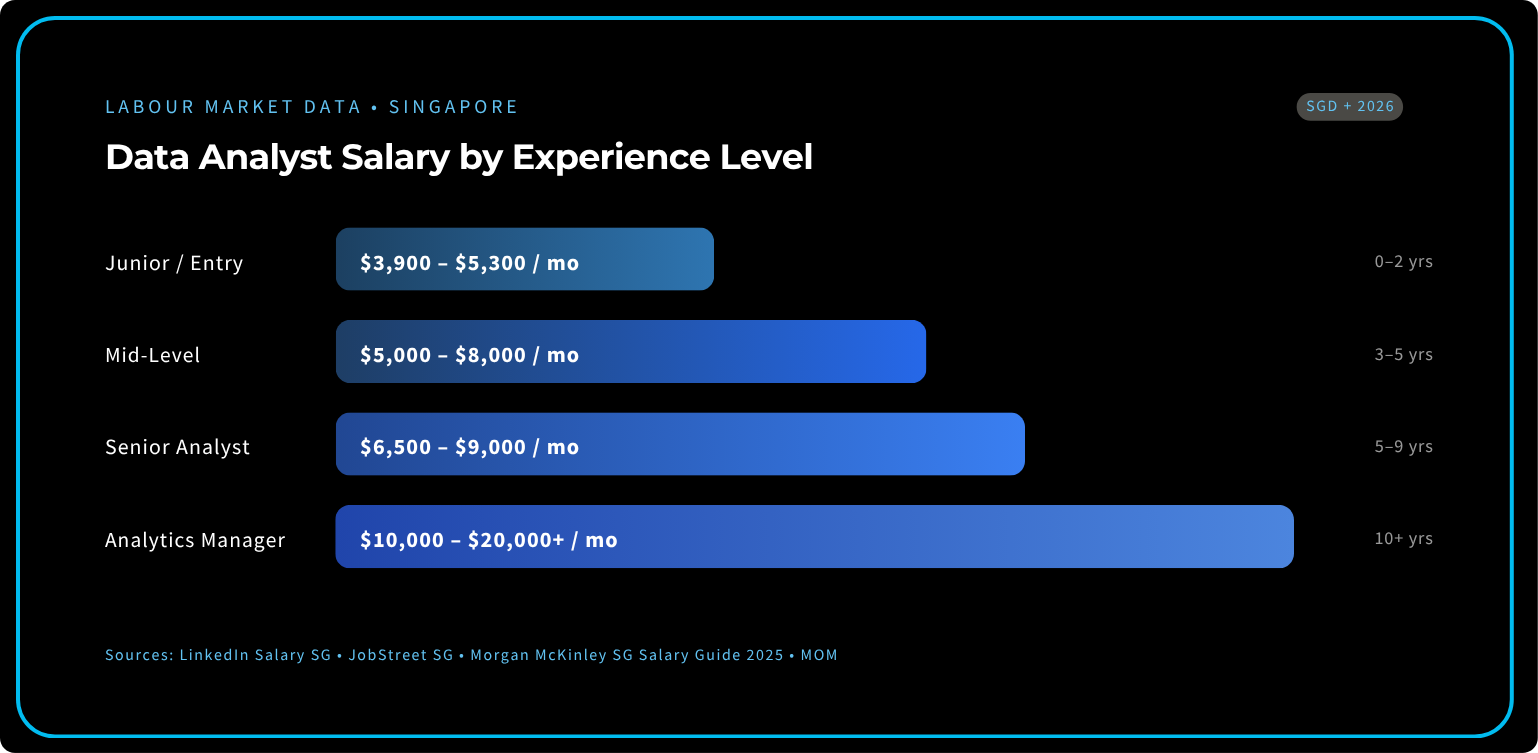
Data analyst salary comparison table for Singapore, showing monthly pay ranges by experience level in 2026 Singapore’s National AI Strategy 2.0 has put data analytics at the centre of the country’s digital economy roadmap. Every sector, from the public sector’s Smart Nation initiative to MAS-regulated financial institutions to the fast-scaling logistics and e-commerce platforms, needs professionals who can extract insight from data and turn it into decisions. The demand is structural, not cyclical.
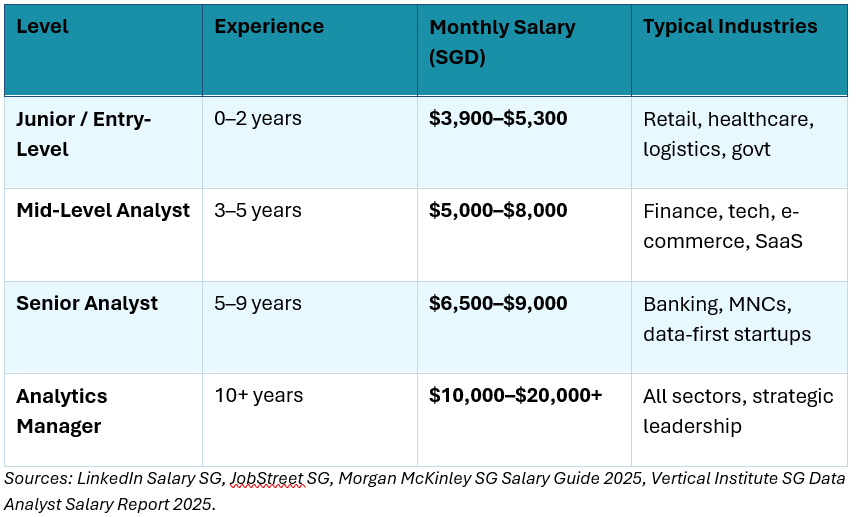
Across Singapore’s job market, data analyst roles consistently rank among the most in-demand tech positions on LinkedIn SG and JobStreet, with over 7,000 active data analyst jobs Singapore listings on LinkedIn Singapore alone at any given time. Unlike software engineering, where the supply of candidates has grown rapidly, the supply of data-capable candidates with both technical skills and business communication ability remains thin, which is why salaries have held up even during global tech cooling periods.
Data Analyst Salary Singapore & SG Benchmarks by Experience Level
The figures below are drawn from LinkedIn Salary Insights SG, JobStreet SG, and the Morgan McKinley Singapore Salary Guide 2025, cross-referenced with MOM Labour Market data for SG residents in full-time employment.
Certifications boost salaries by up to 25% when paired with real project experience, particularly in finance, tech, and e-commerce. Analysts who specialise in predictive analytics, business intelligence, or Python-based automation reach the mid-level bracket faster than generalists. The industries with the highest ceilings are banking and financial services, MNC technology firms, and data-first platforms, all of which maintain a strong hiring presence in Singapore.

What You Will Learn in the CLaaS2SaaS Data Science & AI Program
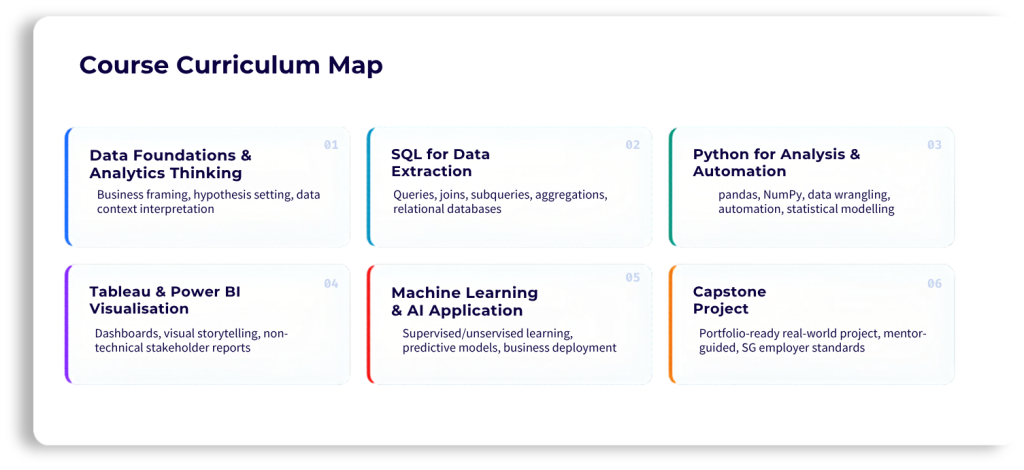
Data analyst course curriculum roadmap covering SQL, Python, Tableau, and Power BI for professionals
CLaaS2SaaS Data Science & AI Program is a work-integrated curriculum built around the competencies that Singapore employers actually screen for in interviews and technical assessments. The program is structured as a stackable pathway, from a Professional Certificate through to a Master’s degree, so you can enter at the level that matches your background and progress as far as your ambitions take you.
The program is delivered through the Adaptive CLaaS® model, which combines competency-led learning, AI-enabled guidance, applied projects, mentoring, and stackable progression pathways designed for working professionals.
The curriculum covers:
  • Data foundations and business analytics thinking: translating business questions into data queries, framing hypotheses, interpreting results in context
  • SQL for data extraction and manipulation: writing queries, joins, subqueries, aggregations, and working with relational databases
  • Python for data analysis and automation: pandas, NumPy, data wrangling, automation scripts, and introductory statistical modelling
  • Data visualisation with Tableau and Power BI: building dashboards, designing visual stories from raw data, and presenting insights to non-technical stakeholders
  • Machine learning fundamentals and AI application: supervised and unsupervised learning, predictive models, and how to deploy ML outputs in business contexts
  • Data cleaning and pipeline management: ETL processes, handling missing data, data quality checks, and structuring datasets for analysis
  • Capstone project: a portfolio-ready real-world data project completed under mentor guidance and assessed against Singapore employer standards

Skills and Tools Covered, SQL, Python, Tableau, Power BI
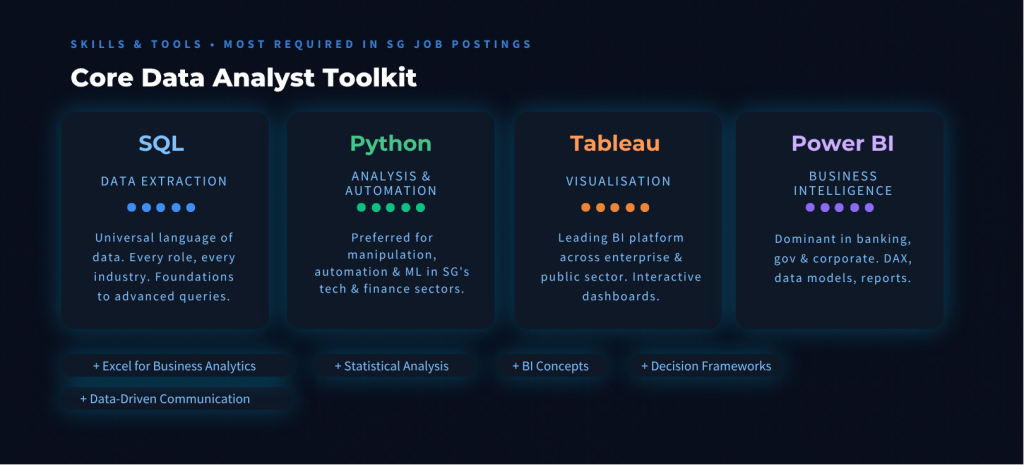
SQL, Python, Tableau, and Power BI tools taught in the CLaaS2SaaS data analyst course for professionals
These four tools are the most consistently required in data analyst job postings across all seniority levels:
  • SQL: the universal language of data extraction. Every data role in every industry uses SQL. Covered from foundations to advanced query writing.
  • Python: the preferred language for data manipulation, automation, and machine learning in Singapore’s tech and financial services sectors.
  • Tableau: the leading visualisation platform across Singapore’s enterprise and public sector organisations. Dashboard building and interactive data stories.
  • Power BI: Microsoft’s BI platform, dominant in banking, government, and large corporates. Report building, DAX measures, and data model design.
The program also covers Excel for business analytics, business intelligence (BI) concepts, statistical analysis, and data-driven decision frameworks, rounding out the skill set expected at the junior and mid-level analyst tier. Critically, the curriculum also addresses how AI tools are changing the analyst’s daily workflow: where tools like ChatGPT, Copilot for Power BI, and Tableau AI can accelerate output, and where the analyst’s judgement, domain knowledge, and communication ability remain irreplaceable. Human and AI collaboration is not a future concept in this curriculum. It is embedded throughout.

Why Local Context Matters More Than a Certificate

Global certifications like Google and Coursera provide strong foundational exposure. However, successful workforce transition depends not only on certification, but also on applied project capability, local hiring expectations, and employer-recognised competency pathways.
CLaaS2SaaS is built around the Singapore Skills Framework for ICT, the competency framework widely referenced by Singapore employers and HR teams when evaluating candidates. The programme is aligned with Singapore’s National AI Strategy 2.0 and delivered through Lithan Academy, an SSG-approved training organisation with more than a decade of experience placing tech talent into Singapore companies.
This relevance extends beyond Singaporean jobseekers. For international professionals seeking opportunities across Singapore and the wider Asia-Pacific region, employers increasingly prioritise candidates who understand regional business environments, compliance expectations, and operational workflows. A credential aligned with Singapore’s industry frameworks signals practical readiness for multinational teams and cross-border digital operations.
The practical differences are significant. When you complete the CLaaS2SaaS programme, you are not just holding a certificate, you are holding a credential recognised by Singapore hiring managers, a portfolio of projects built on real-world datasets, and access to a placement network of more than 2,000 active hiring companies across Singapore and the Asia-Pacific region.

At this stage, professionals help maintain cloud environments under guidance. They assist with resource provisioning, monitoring, documentation, and basic troubleshooting.

  • Estimated salary range: $5,000 to $6,000, based on entry-level salary data from Indeed.

At this level, professionals take ownership of day-to-day cloud operations. They deploy services, manage cloud resources, troubleshoot incidents, and support system reliability.

  • Estimated salary range: 6,000 to $10,000, based on mid-level salary insights from JobStreet.

At this stage, professionals shape how cloud systems are built and improved. Their work includes architecture planning, cost optimization, reliability, security, and governance.

  • Estimated salary range: $12,000 and above, according to QuickSalaries senior roles salary data.

Career Path After the Data Analyst Course

The data analyst career path across Southeast Asia is not a single linear track. It is, by design, a resilient and adaptive career foundation. Unlike roles that are tightly tied to one tool, one industry, or one type of task, data analysts operate at the intersection of business and technology, which means their skills travel.
Across the Philippines, Indonesia, Malaysia, and Myanmar, the same analytical capabilities that make you valuable in fintech are transferable to logistics, healthcare, retail, and government. That cross-sector career mobility is one of the most practically important features of building data as your core capability.
This matters even more in the context of AI. As automation reshapes routine tasks across every industry, professionals who can work alongside AI systems, interpret their outputs, and apply human judgement to the results are more employable, not less.
Data analysts sit at exactly this intersection. They are not being replaced by AI tools. They are the people who make AI outputs usable for the rest of the organisation. That positioning makes data capability one of the most future-resilient professional investments available to workers across Southeast Asia right now.
The data analyst career path is not a single linear track, it branches early based on the industries you work in and the tools you specialise in. But the entry point is consistent: most graduates move into their first entry level data role within four to six months of completing the Professional Certificate, typically as a Junior Data Analyst, Data Analyst, or Business Analyst at SGD $3,900 to $5,300 per month.
From there, the path can go in several directions depending on where your interests develop:
  • Business Intelligence Analyst: specialising in dashboard development, reporting infrastructure, and executive insights using Tableau or Power BI
  • Data Engineer: moving into pipeline management, data warehousing, and infrastructure; typically higher salary ceiling and strong demand in tech
  • Data Scientist: advancing into machine learning, predictive modelling, and statistical analysis; salaries range from SGD $7,000–$12,000/month at mid-level
  • Analytics Manager / Head of Data: managing analytics teams, setting data strategy, stakeholder management; SGD $10,000–$20,000+/month at senior level

The Career Transition Timeline, From Admin or Finance to Data Analyst

The majority of our data program graduates come from non-technical backgrounds, finance, operations, admin, marketing, and customer service. The program is designed for this. You do not need prior IT experience. You need the ability to think analytically, communicate clearly, and commit to the learning process.
Ready to see your data career path? Get a Free Career Proposal from CLaaS2SaaS →

Duration, Schedule, and Prerequisites

CLaaS2SaaS Data Science & AI Program is structured for working adults. Part-time sessions run on weekday evenings (7pm–10pm) and weekends, with two to three sessions per week. You do not need to resign from your current job to participate, the schedule is designed around your existing commitments.

Program duration by stage:
  • Professional Certificate, 4 months: Intensive Digital Skilling Bootcamp. SQL, Python, Tableau, Power BI, data foundations, and capstone project. No prior IT experience required.
  • Professional Diploma, 4 months: Industry Project Implementation. Advanced analytics, ML fundamentals, mentored real-world projects, and skill accreditation.
  • Master’s Degree (Top-Up), 6–12 months: Part-time study and project thesis. Internationally accredited degree from UniMarconi, Italy.
Prerequisites for the Professional Certificate:
  • Able to communicate in English at a professional level
  • Basic computer literacy, no programming or IT experience required
  • Access to a laptop meeting minimum spec: Intel i5 or equivalent, 8GB RAM, Windows 7 or above
All training is delivered virtually, sessions, group projects, and mentoring all take place online. If you prefer campus-based learning, speak to a CLaaS2SaaS career consultant who can refer you to a learning partner with a physical campus and a matching intake.

Frequently Asked Questions

A data analyst collects, cleans, and interprets data to help organisations make better decisions. In practice, this means writing SQL queries to extract data from databases, using Python or Excel to manipulate and analyse it, building Tableau or Power BI dashboards that make the findings visible to stakeholders, and presenting recommendations that inform business strategy. In Singapore, data analysts work across every sector, from DBS and OCBC in banking to Shopee and Lazada in e-commerce to MOH and GovTech in the public sector.
Yes, and the SG-specific data backs that up. Entry salaries start at $3,900–$5,300 per month and senior analysts can earn $6,500–$9,000 per month, with analytics managers reaching $10,000–$20,000+ at strategic levels. The role is also highly portable, data skills transfer across every industry, giving you more career flexibility than most tech specialisations.
Most candidates without prior experience can complete the CLaaS2SaaS Professional Certificate in four months and be ready to apply for junior data analyst roles immediately after. Building a competitive mid-level profile, with a portfolio and additional tool depth, typically takes eight to twelve months of structured learning and real project experience.
Yes. Eligible Singapore citizen can use their SkillsFuture Credit to offset course fees for eligible data analyst programs. Check more details here.
Based on LinkedIn SG, JobStreet, and the Morgan McKinley Singapore Salary Guide 2025: junior data analysts earn SGD $3,900–$5,300 per month; mid-level analysts with three to five years earn $5,000–$8,000 per month; senior analysts with five to nine years earn $6,500–$9,000; and analytics managers at ten or more years earn $10,000–$20,000+. Salaries are highest in banking, fintech, MNC tech, and e-commerce. Certifications paired with real project portfolios can accelerate progression and salary increases by up to 25%.
No. CLaaS2SaaS program is designed for professionals without a technical background, including those transitioning from finance, admin, operations, and marketing. What matters to employers when hiring for an entry level role is demonstrated competency, not your prior degree. A portfolio of SQL queries, Python scripts, and Tableau dashboards carries far more weight in a Singapore data interview than a theoretical qualification in an unrelated field.
The highest hiring volumes for data analysts in Singapore are currently in: banking and financial services (DBS, OCBC, Standard Chartered, Citi, JPMorgan); technology and SaaS platforms (Grab, Sea, Shopee, ByteDance, global MNCs); government and public sector (GovTech, MOH, MAS, various statutory boards); e-commerce and logistics (Lazada, Ninja Van, DHL, FairPrice Group); and healthcare and life sciences (Integrated Health Information Systems, hospital networks, pharmaceutical companies).

Enrol in the Data Analyst Course

Data skills gap is real, and it is creating genuine opportunities for professionals who move now. A junior data analyst role today is a stepping stone to senior analyst, data scientist, and analytics manager positions, in industries that are expanding, in a market where the credential you hold actually matches what employers are screening for.

Explore the full program details and current intake dates on the Data Science & AI Program page, or browse related tech programs, including Software & Web Development, Cloud & Infrastructure, and the full Non-Tech Digital Skills track, on the Lifelong Learning hub.
Ready to build your data career?
Enrol in the Data Analyst Course →

Want to check if this career is for you?
Â