Agent-Based Enterprise Software Platforms Are Redefining Business Systems
SHARE THIS:


Enterprise software is at a turning point. For decades, organizations have relied on traditional SaaS platforms to digitize operations, standardize processes, and manage data at scale. While these systems have improved efficiency, they were never designed for an AI-first operating model.
Today’s enterprises operate in environments that change faster than static systems can adapt. Skills obsolescence, fragmented processes, and rising complexity have become execution risks, not training gaps. Organizations rely on a few experienced operators to interpret data and coordinate decisions across disconnected systems, making operations increasingly fragile. Automation stalls at pilots, AI remains detached from workflows, and productivity plateaus as decision-making turns reactive.
This is where agent-based enterprise software platforms enable AI-first adaptive enterprise transformation.
Instead of software that only records transactions, agent-based platforms embed intelligence directly into workflows. They introduce AI agents that can observe, reason, and act across enterprise systems in real time. Built on Agentic CLaaS2SaaS and Adaptive CLaaS®, this model moves enterprises from passive systems to adaptive, intelligence-driven operations.
This article explains what agent-based enterprise software is, why traditional SaaS is no longer sufficient, how agentic platforms work, and why they represent the inevitable evolution of enterprise systems.
Why Traditional Enterprise SaaS Is Reaching Its Limits
Traditional SaaS platforms were built for stability and scale. They excel at managing structured data, enforcing predefined workflows, and supporting standardized business processes. However, modern enterprises now face challenges that these systems were not designed to solve.
Static Workflows in a Dynamic Environment
Traditional SaaS workflows are rule-based and predefined. When business conditions change, workflows must be redesigned manually. This makes enterprises slow to adapt and overly dependent on IT teams or vendors.
Fragmented Systems and Siloed Intelligence
Most enterprises operate dozens of SaaS platforms across ERP, CRM, HR, finance, and operations. While these systems capture transactions, they rarely share intelligence in real time. This fragmentation prevents a unified view of operations and limits AI effectiveness.
Automation Without Adaptation
Robotic process automation and workflow tools automate tasks but do not learn or improve. When exceptions occur, humans intervene. Over time, automation becomes brittle and difficult to maintain.
AI Pilots That Do Not Scale
Many enterprises experiment with AI tools such as chatbots or analytics models. Without being embedded into workflows, these initiatives struggle to deliver sustained business impact, as reported in McKinsey’s research on how AI adoption advances but foundational barriers remain.
These limitations explain why organizations are now questioning the long-term viability of traditional SaaS as the foundation for AI-driven operations.
What Are Agent-Based Enterprise Software Platforms
Agent-based enterprise software platforms represent a new architectural model. Instead of software acting as a passive system of record, the platform becomes an intelligent operating layer powered by AI agents.
AI agents are software entities that can:
- Sense data across multiple systems
- Reason using context, policies, and business logic
- Recommend or execute actions within workflows
- Learn continuously through feedback
Within agent-based enterprise software platforms, these agents operate as digital coworkers embedded into daily operations rather than standalone tools.
This is not automation layered on top of SaaS. It is not a chatbot layer, RPA, or analytics dashboards. It is a rethinking of enterprise software itself, a distributed decision intelligence architecture embedded into live workflows.
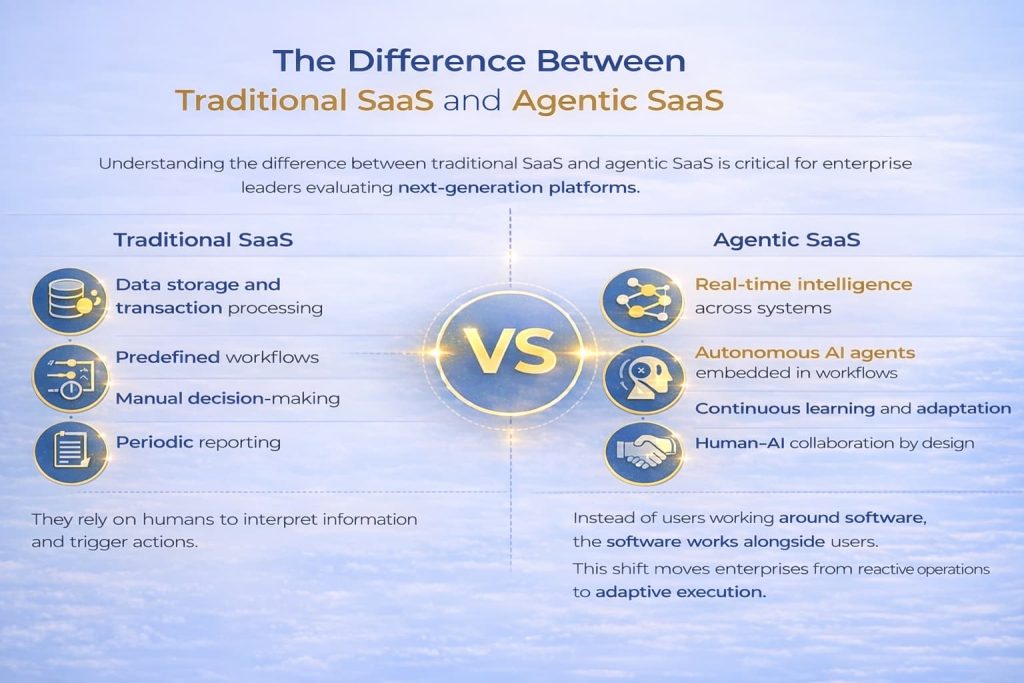
The Difference Between Traditional SaaS and Agentic SaaS
Understanding the difference between traditional SaaS and agentic SaaS is critical for enterprise leaders evaluating next-generation platforms.
Traditional SaaS
Traditional SaaS systems focus on:
- Data storage and transaction processing
- Predefined workflows
- Manual decision-making
- Periodic reporting
They rely on humans to interpret information and trigger actions.
Agentic SaaS
Agentic SaaS platforms, such as Agentic CLaaS2SaaS, introduce:
- Real-time intelligence across systems
- Autonomous AI agents embedded in workflows
- Continuous learning and adaptation
- Human–AI collaboration by design
Instead of users working around software, the software works alongside users.
This shift moves enterprises from reactive operations to adaptive execution.
How Agent-Based Platforms Work in Practice
Agent-based enterprise software platforms operate through a layered architecture designed for intelligence, governance, and scale.
A Unified Intelligence Layer
Built on Adaptive CLaaS®, the platform connects enterprise systems into a shared enterprise intelligence layer that coordinates decisions across systems.
AI agents access data securely without duplicating or fragmenting information.
Embedded AI Agents
AI agents operate within workflows rather than outside them. They monitor events, assess conditions, and take action according to enterprise policies.
Orchestrated Workflows
Agents coordinate across systems. For example, a single workflow may span procurement, finance, and operations without manual handoffs.
Governance by Design
Security, auditability, and compliance are embedded into the platform. Every AI action is traceable and policy-controlled.
This architecture enables intelligence without compromising control.
What Is Agentic SaaS Enterprise Use Cases
Understanding what is agentic SaaS enterprise use cases helps clarify its real-world value.
Finance and Shared Services
AI agents monitor transactions, validate compliance, manage approvals, and flag anomalies in real time. This reduces cycle times while improving accuracy and governance.
Operations and Supply Chain
Agents track inventory levels, supplier performance, and disruptions across ERP and operations systems, triggering actions proactively. They trigger actions proactively rather than waiting for manual intervention.
Human Resources and Workforce Operations
AI agents support onboarding, skills tracking, workforce planning, and internal mobility by coordinating data across HR systems.
Customer Operations
Agents unify CRM, service, and billing systems to resolve issues faster and improve customer experience consistency.
Across these use cases, the value lies not in automation alone, but in intelligence embedded directly into operations.
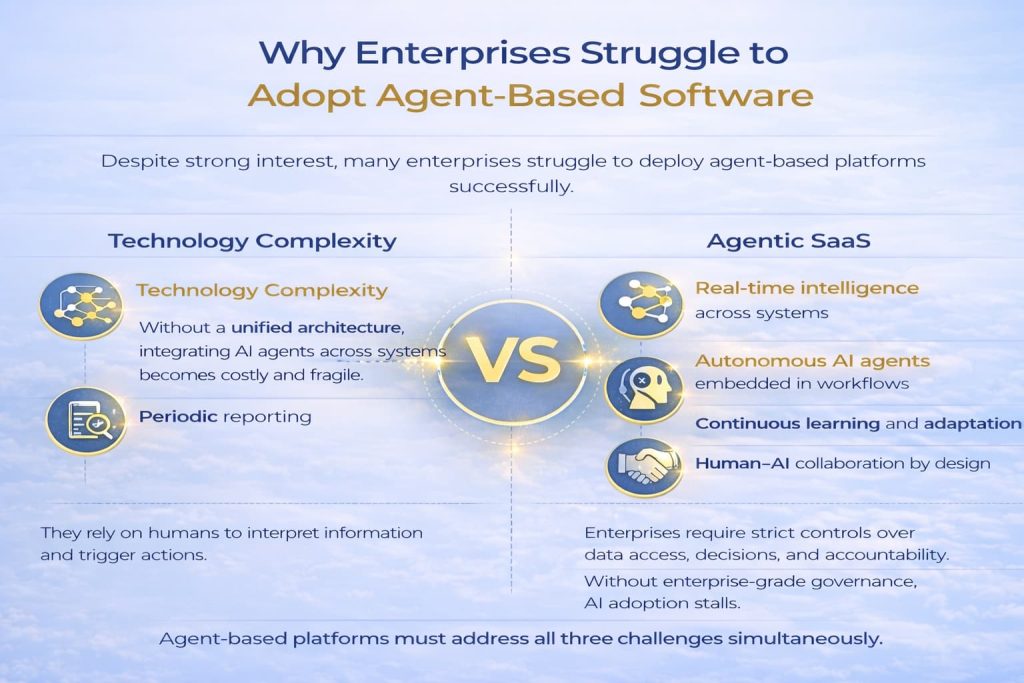
Why Enterprises Struggle to Adopt Agent-Based Software
Despite strong interest, many enterprises struggle to deploy agent-based platforms successfully.
Technology Complexity
Without a unified architecture, integrating AI agents across systems becomes costly and fragile. Point solutions increase risk rather than reduce it.
Workforce Readiness
Employees need AI fluency to supervise and collaborate with AI agents effectively. Technology alone does not deliver transformation.
Governance and Compliance Concerns
Enterprises require strict controls over data access, decisions, and accountability. Without enterprise-grade governance, AI adoption stalls.
Agent-based platforms must address all three challenges simultaneously.
How Agentic CLaaS2SaaS Enables Enterprise-Grade Adoption
Agentic CLaaS2SaaS provides the architectural control layer required for enterprise-scale agent deployment as part of a unified enterprise AI platform.
Unified Enterprise AI Platform
The platform unifies people, data, and workflows into a single intelligent operating core. AI agents operate across systems without creating silos.
Self-Service Intelligent Innovation
Business teams can configure and extend AI agents using low-code tools, while IT maintains oversight. This reduces dependency on external vendors.
Workforce Enablement
Agentic CLaaS2SaaS integrates workforce upskilling, ensuring employees understand how to work with AI agents as part of daily operations.
Enterprise-Grade Governance
Security, compliance, and auditability are embedded by design. Enterprises can deploy AI agents with confidence. This combination enables AI adoption that scales beyond pilots.
Operating Model Redesign
Enterprise AI governance is not a feature layer added on top of existing processes. It requires operating model redesign: clear ownership for agent-enabled workflows, defined decision rights, updated process controls, and accountable roles across business, IT, security, and risk. Without this redesign, AI agents remain isolated experiments that cannot be trusted to run core operations.
Enterprise AI Governance Framework
A scalable enterprise AI governance framework sets the rules for how AI agents access data, make decisions, and interact with systems. This includes identity and access management, policy enforcement, audit trails, risk classification by workflow criticality, and continuous monitoring of outcomes. The goal is consistent control across functions and systems, not governance that varies by team or use case.
Human Override and Escalation Design
Agent-based execution must include explicit human override and escalation pathways. High-impact decisions should require approval gates, exception routing, and clear thresholds for when agents pause, escalate, or revert to human control. This design prevents silent failure, reduces operational risk, and ensures accountability remains intact even as execution becomes more autonomous.
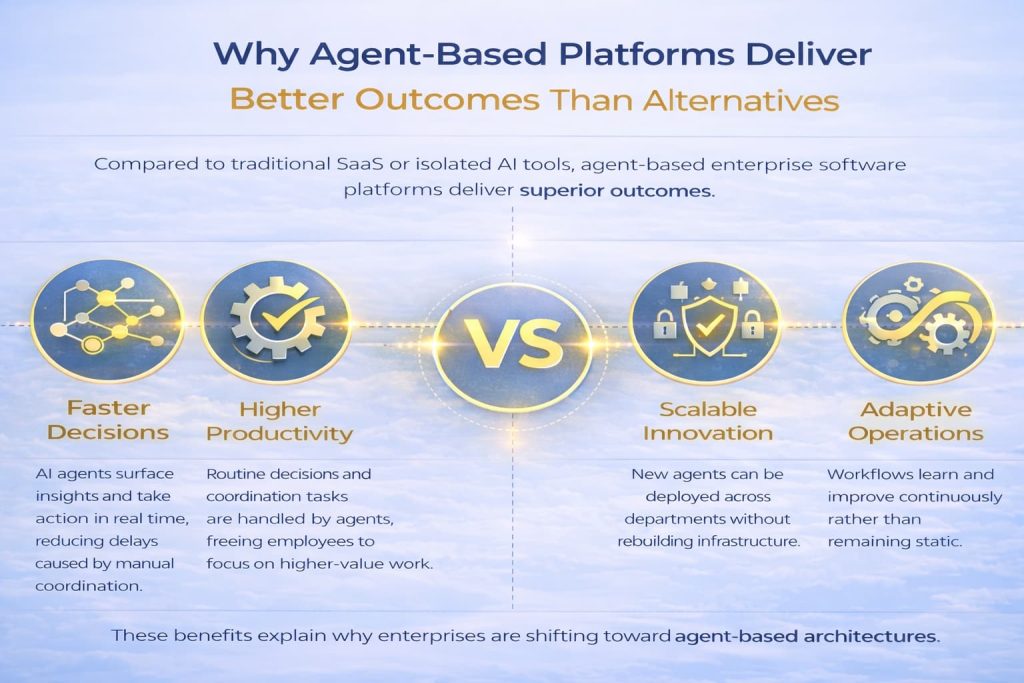
Why Agent-Based Platforms Deliver Better Outcomes Than Alternatives
Compared to traditional SaaS or isolated AI tools, agent-based enterprise software platforms deliver superior outcomes. At enterprise scale, this translates into measurable operational and governance advantages:
Faster Decisions
AI agents surface insights and take action in real time, reducing delays caused by manual coordination.
Higher Productivity
Routine decisions and coordination tasks are handled by agents, freeing employees to focus on higher-value work.
Stronger Governance
Centralized control improves trust in AI-driven processes.
Scalable Innovation
New agents can be deployed across departments without rebuilding infrastructure.
Adaptive Operations
Workflows learn and improve continuously rather than remaining static.
These benefits explain why enterprises are shifting toward agent-based architectures.
Who Should Adopt Agent-Based Enterprise Software Platforms
Agent-based platforms are particularly valuable for:- Large enterprises with complex, cross-functional workflows
- Organizations struggling to scale AI beyond pilots
- Shared services teams seeking efficiency and governance
- Leaders prioritizing compliance and decision quality
Getting Started With Agent-Based Enterprise Software
Successful adoption follows a structured approach:- Identify high-friction workflows
- Establish governance and data readiness
- Deploy AI agents through a unified platform
- Upskill teams through always-on adaptive learning, enabling continuous workforce capability development
- Measure outcomes and iterate continuously
Course

Conclusion
Traditional SaaS platforms are no longer sufficient for AI-first enterprises. Static systems cannot keep pace with dynamic environments, fragmented data, and rising expectations for intelligence and speed.
Agent-based enterprise software platforms represent the future. By embedding AI agents directly into workflows, enterprises move from passive systems to adaptive operations.
The future of enterprise performance will depend on embedded decision intelligence, not static system digitization. Learn how Agentic CLaaS2SaaS, built on Adaptive CLaaS®, enables governed agent-based enterprise software platforms for adaptive, AI-first operations.