IBM Data Science Professional Certificate: Launch Your Data Career
SHARE THIS:


Data is everywhere. Businesses collect information from websites, apps, customer interactions, and internal systems every second. The challenge today is not gathering data. The real challenge is turning that data into insights that help organizations make smarter decisions.
This is why data science has become one of the most in-demand career paths in the digital economy. Companies need professionals who can analyze data, build models, and explain what the numbers mean for the business.
If you are exploring this field, you have probably come across the IBM Data Science Professional Certificate. It is widely known as a beginner-friendly entry point that provides structured data science training and a recognized data science certification.
But as the demand for data professionals continues to grow, many learners are also looking for programs that go beyond foundational knowledge. This is where applied programs such as the CLaaS2SaaS Data Science & AI Program come into the picture. Designed to help learners become Data & AI Analysts in four months, this program focuses on practical analytics skills, AI-driven insights, and real-world business problem-solving.
But what exactly does the IBM certification teach? And how can you move from learning the basics to building real data expertise that employers value?
Let’s explore how this certification fits into a modern data career journey.
What Is the IBM Data Science Professional Certificate?
The IBM Data Science Professional Certificate is an online learning program designed to introduce learners to the fundamentals of data science. It is widely known as a beginner-friendly data science certification that helps people develop the core technical skills needed for entry-level roles.
The program typically covers a range of foundational topics, including:
- Python programming for data science
- Data analysis and manipulation
- Data visualization techniques
- SQL and database querying
- Basic machine learning concepts
- Tools used in modern data science workflows
Many people choose this certification because it provides a structured pathway into the field without requiring a prior background in programming or statistics. It is often recommended for:
- Beginners exploring data science
- Career switchers moving into tech
- Analysts who want to strengthen their technical skills
- Professionals who want to understand data-driven decision-making
Through a combination of lectures, exercises, and projects, the program introduces learners to the workflow used by data professionals.
However, understanding the content is only part of the journey. To succeed in a data career, you also need to apply these skills to real-world problems.
What Skills Will You Gain?
One of the main advantages of completing a structured data science training program is that it exposes you to several important tools and methods used in modern analytics.
Here are some of the core skills learners develop during the program.
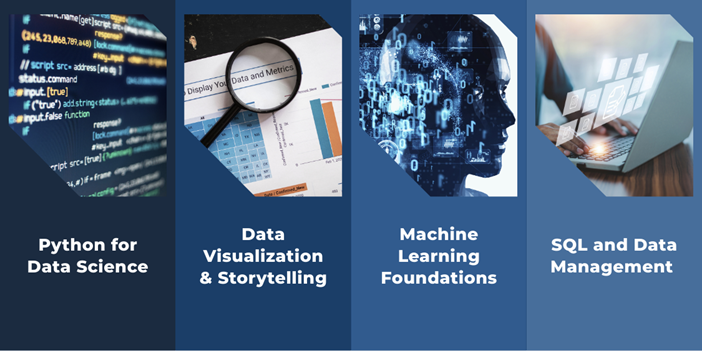
1. Python for Data Science
Python has become one of the most widely used programming languages in data science.
During the program, learners typically work with tools such as:
- Pandas for data manipulation
- NumPy for numerical computation
- Jupyter Notebooks for coding and analysis
These tools help you clean datasets, perform calculations, and prepare information for further analysis.
Learning Python also opens the door to many other data science tools used in machine learning and AI development.
2. Data Visualization and Storytelling
Data is only valuable when people understand it.
This is why visualization is a critical skill in any data science certification program. Learners explore how to present data in ways that highlight trends, patterns, and insights.
Common topics include:
- Creating charts and graphs
- Visualizing large datasets
- Communicating insights to non-technical audiences
Good data visualization helps decision-makers understand what the numbers are saying and what actions they should take next.
3. Machine Learning Foundations
Machine learning is another important component of modern data science.
The IBM Data Science Professional Certificate introduces the basic concepts behind machine learning models, including:
- Supervised learning
- Unsupervised learning
- Model evaluation techniques
These concepts help learners understand how predictive models are built and how they can be used to forecast trends or identify patterns in data.
While this level of training is introductory, it provides the foundation needed to explore more advanced machine learning topics later.
4. SQL and Data Management
Data scientists rarely work with data stored in spreadsheets alone. Most business data lives inside databases.
SQL (Structured Query Language) allows professionals to retrieve, filter, and analyze data stored in these systems.
In a typical data science training pathway, learners practice:
- Writing SQL queries
- Filtering datasets
- Joining multiple tables
- Extracting meaningful insights from structured data
SQL remains one of the most essential skills for any analytics professional.
Apply these data science skills in real business scenarios, Explore the Data Science & AI Program →
Career Outcomes After Completing the Certification
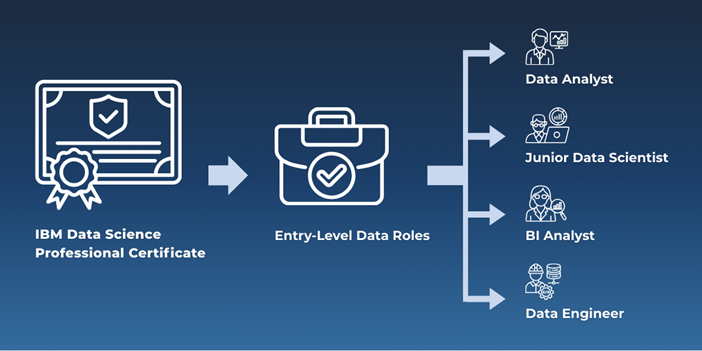
Completing a data science certification can help learners pursue entry-level roles such as Data Analyst, Junior Data Scientist, Business Intelligence Analyst, or AI/ML Associate. If your goal is to transition into analytics, you may also find it helpful to explore a step-by-step guide on how to become a data analyst online and the skills employers expect in these roles.
Some of the most common career paths include:
- Data Analyst
- Junior Data Scientist
- Business Intelligence Analyst
- AI or Machine Learning Associate
These roles exist across many industries, including finance, healthcare, marketing, e-commerce, and logistics. Nearly every organization today relies on data to guide decisions.
However, many organizations still struggle to fill these roles. A report from Business.com highlights that companies across industries continue to face a shortage of skilled data and analytics professionals who can turn large datasets into meaningful business insights.
Salaries in the data field can also grow quickly as professionals gain experience. As your ability to analyze data and build predictive models improves, so do your career opportunities.
While certification programs introduce essential technical concepts, many professionals discover that employers increasingly expect applied analytics capability beyond theoretical knowledge. Understanding concepts is helpful, but employers are usually looking for more than that. They want professionals who can solve real business problems with data.
Thinking about starting a career in data analytics? Learn about the career path
The Real Challenge: Why Certification Alone Isn’t Always Enough
Completing the IBM Data Science Professional Certificate is a strong first step. It introduces the tools and concepts used in data science.
But many people still face challenges when entering the job market.
Some common gaps include:
- Applying analytics to real business scenarios
- Integrating AI tools into workflows
- Designing dashboards for decision-makers
- Communicating insights to stakeholders
In other words, there is often a gap between learning concepts and applying them in real-world environments.
According to a report by McKinsey, many organizations struggle to find professionals with the right combination of analytics expertise and business understanding needed to drive data transformation initiatives.
These organizations are not only looking for people who understand tools. They need analysts who can interpret data and connect it to real business challenges.
This is where applied learning becomes critical.
Building Real-World Data Expertise Beyond Certification
To truly become a professional data analyst, you will need opportunities to apply their skills in real-world contexts.
This means working with real datasets, building dashboards, experimenting with machine learning models, and solving problems that businesses actually face.
The Data Science & AI Program at CLaaS2SaaS is designed to address exactly this challenge.
The program focuses on helping learners become Data & AI Analysts in four months, with an emphasis on practical, applied analytics skills that organizations need today.
Instead of focusing only on theory, the program follows a skills-first analytics pathway that includes:
- Data preparation and management
- AI-driven insights and analytics
- Dashboard development and visualization
- Decision intelligence frameworks
- Real-world problem-solving projects
Learners build portfolio-ready projects using data, AI tools, and visualization platforms. These projects demonstrate their ability to translate raw data into meaningful business insights.
This kind of applied experience can make a major difference when transitioning into a data career.
IBM Data Science Professional Certificate vs. Structured Data Science Training
Many people combine certifications with applied programs to build a complete skill set.
Here is how the two approaches typically complement each other.
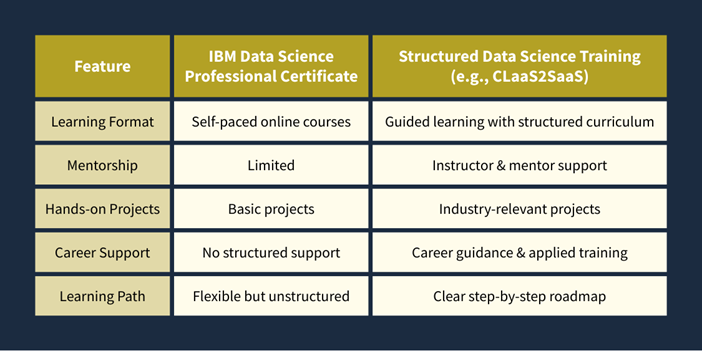
IBM Data Science Professional Certificate:
- Focuses on foundational concepts
- Introduces Python, SQL, and machine learning
- Provides guided labs and exercises
- Offers a globally recognized credential
CLaaS2SaaS Data Science & AI Program:
- Focuses on applied analytics and AI integration
- Emphasizes solving real business problems
- Develops dashboards and decision intelligence skills
- Produces portfolio-ready outcomes
Instead of replacing certification programs, applied training often builds on them. Applied analytics training bridges the gap between technical knowledge and business impact by enabling learners to work with real datasets, build decision dashboards, and interpret analytics results in business contexts. Together, they create a stronger learning pathway for aspiring data professionals.
Who Should Take the IBM Data Science Professional Certificate?
The IBM Data Science Professional Certificate is a great starting point for several types of learners. However, if you are still comparing different learning pathways, it can also be helpful to explore other top-tier data science certifications available today and understand how they align with your career goals.
If you are new to programming and analytics, this certification provides a structured introduction to the field.
-
Career Switchers
Professionals in fields such as marketing, finance, or operations often transition into data roles by building analytics skills. -
Working Professionals
Many professionals want to understand data better so they can make more informed decisions in their current roles. -
Tech Enthusiasts
Some learners simply want to explore AI, machine learning, and data technologies because they see how these skills are shaping the future of work.
How to Maximize Your Learning from the Certification
If you decide to pursue the IBM Data Science Professional Certificate, there are several ways to make the most of the experience.
- Practice coding consistently: Working with Python and SQL regularly helps reinforce what you learn.
- Build personal projects: Analyze datasets that interest you and document your findings.
- Create a portfolio: Showcase your projects through GitHub or online portfolios.
- Work with real datasets: Real-world data can help you understand the challenges professionals face.
- Combine certification with applied programs: Programs such as the CLaaS2SaaS Data Science & AI Program provide opportunities to work on real business challenges using data and AI tools.
By taking these steps, you turn theoretical knowledge into practical capabilities that employers value.
CLaaS2SaaS Data Science & AI Program: Become a Data & AI Analyst
If your goal is to move beyond theory and build job-ready analytics capabilities, the CLaaS2SaaS’ Data Science & AI Program offers a structured pathway designed for real industry needs.
The program is built around a clear mission: empowering businesses with AI-driven analytics by training professionals who can turn data into actionable insights that support business decision making.
The CLaaS2SaaS program addresses the skills and experience gap through a skills-first approach to data science education.
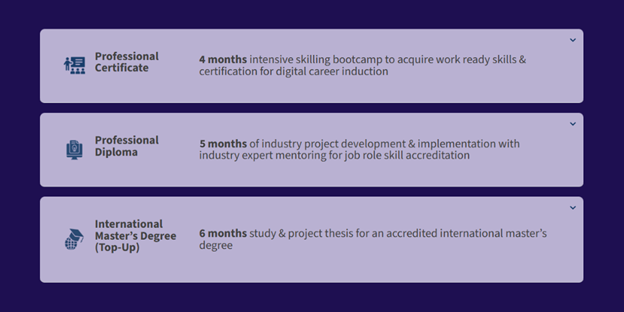
- Professional Certificate in Digital Innovation (4 months): Modules include Low-Code Application Development, AI Model Development, Data Analytics & Management, Capstone Project – Intelligent Application
- Professional Diploma in Data Science & AI (5 months): Modules include Data Science Essentials, Applied Machine Learning, Deep Learning, Capstone Project – Data Science & AI
- Top-Up Master in Computer Science (6 months): Modules include Security, Final Thesis
What makes this Data Science & AI program unique is its focus on portfolio-based outcomes. Instead of only completing assignments, learners work on projects that demonstrate their ability to apply analytics to real scenarios: analyze data, build predictive insights, and communicate results that support real business decisions.
By the end of the program, learners are equipped with practical experience that helps them pursue roles such as Data Analyst, AI Analyst, or Business Intelligence professional.
Course

Take the Next Step in Your Data Career
Data science is one of the most exciting and rapidly growing career paths today. Organizations across industries are searching for professionals who can transform data into insights that drive strategy and innovation.
The IBM Data Science Professional Certificate can certainly help you begin your journey by building essential technical foundations.
From there, programs like the CLaaS2SaaS Data Science & AI Program help you move from theory to real-world expertise. By focusing on applied analytics, AI-driven insights, and portfolio-based outcomes, learners gain the skills needed to empower businesses with data.
If you are ready to start building the capabilities needed in today’s data-driven economy, the next step is exploring the certifications that align with your career goals.