Home Blog Lifelong Learning CET AI-First Future of Work
Lifelong Learning CET

AI-First Future of Work

AI-First Future of Work

Overview of the AI-driven workforce transformation, which will highlight the shift toward innovation, intelligent systems, and future-ready talent

Artificial intelligence is fundamentally transforming how organizations operate, how professionals perform knowledge work, and how value is created in the modern economy. The rapid evolution of AI technologies is not simply another phase of digital transformation. Instead, it represents a structural shift toward an AI-first future of work, where intelligent systems augment human capabilities and reshape traditional job roles.

In this new landscape, routine tasks are increasingly automated by AI systems while human talent focuses on higher-value activities such as innovation, decision-making, and problem solving. Organizations are beginning to deploy AI agents, intelligent automation, and advanced analytics to optimize operations and unlock new forms of productivity. As a result, professionals are expected to work in close collaboration with AI systems that enhance their cognitive capacity and extend their ability to analyze complex information.

Research across industries confirms that the nature of work is changing rapidly. According to the World Economic Forum’s Future of Jobs Report, nearly 44 percent of workers’ core skills will change by 2027 as technological disruption accelerates. At the same time, McKinsey estimates that generative AI could automate up to 30 percent of current work activities by 2030, dramatically reshaping how knowledge work is performed.

However, automation alone does not eliminate the need for human expertise. Instead, it elevates the importance of human capabilities that drive innovation and strategic thinking. Organizations increasingly recognize that the greatest constraint to digital transformation is not technology but talent readiness. Many enterprises struggle with process inefficiencies, fragmented workflows, data limitations, and workforce capability gaps that slow their ability to adopt advanced technologies effectively.

This shift places a new emphasis on future-ready skills for the AI era. Professionals who can combine digital expertise with analytical thinking and leadership capability will become essential drivers of innovation. Rather than replacing human talent, AI amplifies the impact of individuals who possess the right skills to leverage intelligent technologies effectively.

For decision makers and professionals alike, the central challenge is no longer whether AI will influence the workplace. The real question is how organizations can develop talent that is capable of thriving in an AI-first environment.

To address this challenge, companies must rethink how skills are developed, how careers evolve, and how digital capabilities are integrated into everyday work.

Explore the Digital Skilling Programs and Career Pathways Guide to understand how structured capability frameworks can prepare professionals for the AI-driven workforce.

Agile Innovation Talent for the AI Era

The emergence of the AI-first workplace requires a new generation of professionals who can operate effectively in digitally enabled environments. In this context, future-ready talent is best understood as agile innovation talent, defined not by isolated technical expertise but by the ability to integrate multidisciplinary skills to continuously adapt, innovate, and solve complex problems in a fast-evolving digital workplace.

Traditional roles that relied primarily on manual processes or repetitive analysis are gradually evolving into positions that require strategic thinking, digital fluency, and cross-functional collaboration. Professionals must now understand how to integrate AI tools into their workflows, automate processes, and translate data-driven insights into meaningful business outcomes.

This shift is not about creating a new category of professionals, but rather about evolving existing talent into agile innovators. As AI systems increasingly automate routine activities such as data processing, content generation, and workflow execution, the role of human talent shifts toward higher-order capabilities. These include problem solving, innovation design, decision-making, and the ability to orchestrate intelligent systems.

Agile innovation talent is therefore defined by its ability to learn continuously, adapt quickly, and collaborate across disciplines. These professionals operate effectively in environments where change is constant and where innovation cycles are significantly shorter than in traditional organizational models.

For organizations, developing agile innovation talent is essential to unlocking the full value of AI investments. Enterprises that deploy advanced technologies without building workforce capability often struggle to realize measurable outcomes. In contrast, organizations that invest in integrated digital skills development create teams that are capable of driving continuous innovation and transformation.

The development of agile innovation talent is not dependent on a single skill domain. Instead, it emerges from the integration of five core future-ready skills, which collectively enable individuals to operate as innovators within the AI-first workplace.

These five core skills form the foundation that allows professionals to collaborate effectively with AI systems, design intelligent solutions, and drive transformation across the organization.

The Five Core Future-Ready Skills

The development of agile innovation talent in the AI-first workplace is not driven by isolated technical capabilities, but by the integration of several interconnected skill domains.

These five core future-ready skills collectively enable professionals to operate as agile innovators, capable of adapting quickly, solving complex problems, and continuously driving innovation in a fast-evolving digital environment.

Rather than focusing solely on the adoption of technology, these skills equip individuals with the ability to design solutions, orchestrate intelligent systems, and translate digital capabilities into meaningful business outcomes. When developed together, they form the foundation that allows professionals to move beyond execution toward innovation.
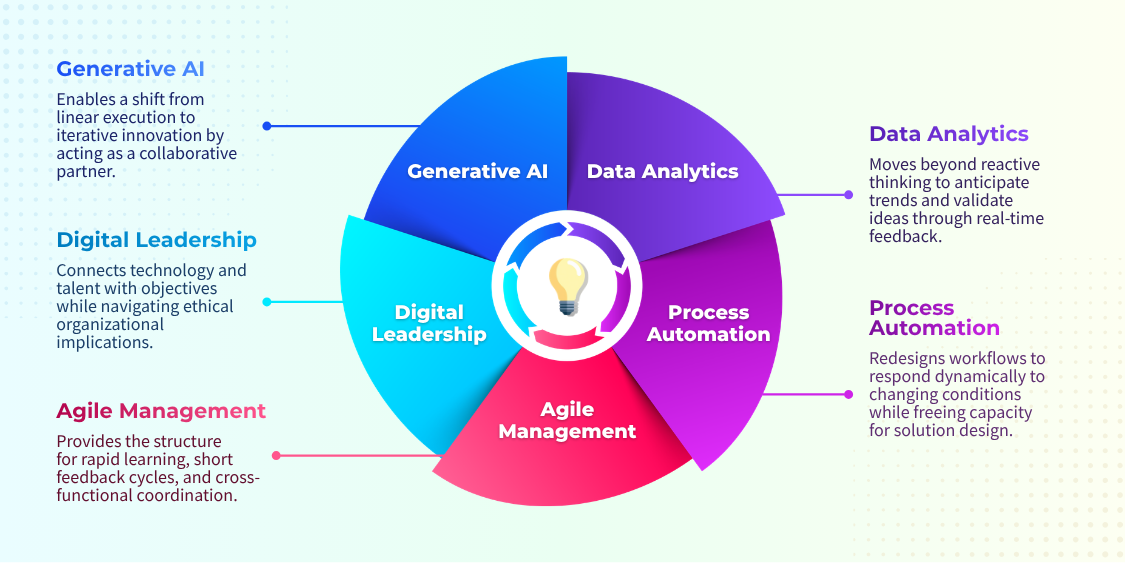
Five core future-ready skills—generative AI, data analytics, process automation, agile management, and digital leadership—enabling professionals to drive innovation in the AI-first workplace

Generative AI has emerged as a foundational capability that enables professionals to engage directly with intelligent systems in the creation and design of solutions. While it is often associated with faster content generation or automation of tasks, its true value lies in how it enhances the ability to ideate, experiment, and innovate.

Professionals who understand generative AI can design workflows that integrate AI into problem-solving processes. They are able to rapidly prototype ideas, simulate scenarios, and generate multiple solution pathways that accelerate innovation cycles. This allows individuals to explore possibilities that would previously have required significant time and resources.

More importantly, generative AI enables a shift from linear execution to iterative innovation. By leveraging AI as a collaborative partner, professionals can continuously refine ideas, test assumptions, and develop solutions in a dynamic and adaptive manner. In this way, generative AI becomes a core enabler of agile innovation capability rather than simply a productivity tool.

Data analytics provides the foundation for informed decision-making in the AI-first workplace. As organizations generate increasing volumes of data, the ability to interpret, contextualize, and act on insights becomes critical to innovation.

Agile innovation talent relies on data analytics not just to understand what has happened, but to anticipate what could happen next. By identifying patterns, trends, and relationships within data, professionals are able to make evidence-based decisions that guide strategy and innovation initiatives.

This capability allows individuals to move beyond reactive thinking toward predictive and scenario-based planning. It enables teams to validate ideas quickly, measure outcomes effectively, and refine solutions based on real-time feedback. In this context, data analytics becomes a key driver of adaptive decision-making, supporting continuous improvement and innovation across the organization.

Process automation enables professionals to redesign how work is executed by integrating intelligent systems into operational workflows. While automation has traditionally focused on efficiency, its role in the AI era extends to enabling innovation by freeing up capacity and enabling more sophisticated system orchestration.

Agile innovation talent uses process automation to build and optimize workflows that integrate data, AI, and business logic. This includes designing systems that can respond dynamically to changing conditions, automate decision pathways, and support real-time execution.

By understanding how to automate processes intelligently, professionals are able to shift focus from manual execution to solution design. This capability supports the development of scalable systems that continuously improve over time, enabling organizations to operate with greater agility and responsiveness.

Agile management serves as the operational backbone that enables innovation to occur continuously within teams and organizations. In an AI-driven environment where change is constant, the ability to iterate quickly and adapt to new information becomes essential.

Agile management provides the structure for collaboration, experimentation, and rapid learning. It allows teams to test ideas in short cycles, gather feedback, and refine solutions in an ongoing process. This iterative approach reduces risk while accelerating innovation.

Professionals with agile management capability are able to coordinate cross-functional efforts, align diverse skill sets, and integrate insights from multiple domains. They create environments where innovation is not a one-time initiative but a continuous process embedded within daily work.

In this way, agile management enables individuals and teams to operate with the flexibility and speed required in the AI-first workplace.

Digital leadership brings together all the core skills by providing direction, alignment, and purpose within the transformation journey. As organizations adopt AI and digital technologies, leaders must ensure that these capabilities are applied in ways that drive meaningful outcomes.

Digital leadership involves guiding teams through complexity, fostering a culture of innovation, and aligning digital initiatives with strategic objectives. Leaders must be able to connect technology, talent, and business priorities while navigating the ethical and organizational implications of AI adoption.

Agile innovation talent requires leaders who can empower teams to experiment, make decisions, and continuously improve. These leaders create the conditions for innovation by encouraging collaboration, supporting learning, and enabling individuals to apply their skills effectively.

Ultimately, digital leadership ensures that the integration of generative AI, data analytics, process automation, and agile management translates into sustained innovation and organizational impact.

Together, these five core skills do not operate independently. They function as an integrated capability framework that enables professionals to become agile innovation talent in the AI-first workplace.

When developed collectively, they empower individuals to design solutions, adapt to change, and continuously innovate in response to evolving business and technological environments.

Discover how Digital Skilling Programs combine these capabilities with work-integrated learning and real-world applications to develop agile innovation talent for the AI era.

In-Demand Future-Ready Careers for the AI Era

As digital transformation accelerates, new career pathways are emerging that reflect the evolving relationship between technology and human expertise. These future-ready careers can be broadly categorized into two groups: tech-lite digital careers and deep-technology careers.
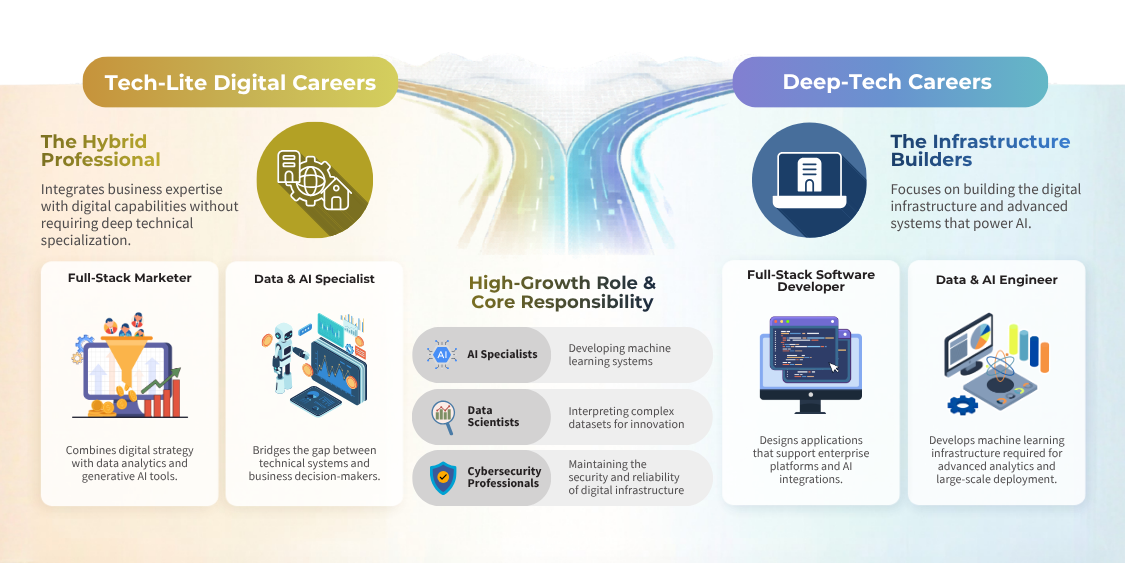
Key future-ready career pathways, including tech-lite digital roles and deep technology careers that support AI-driven organizations

Tech-lite digital careers integrate business expertise with digital capabilities. These roles allow professionals from diverse backgrounds to contribute to AI-driven organizations without requiring deep technical specialization.

One prominent example is the full-stack marketer, a role that combines digital marketing strategy with data analytics and generative AI tools. Full-stack marketers design personalized customer journeys, analyze campaign performance using advanced analytics, and leverage AI technologies to create highly targeted marketing content. Their ability to integrate marketing strategy with digital platforms makes them critical contributors to modern customer experience initiatives.

Another emerging role is the data and AI specialist, who bridges the gap between technical systems and business decision-makers. These professionals interpret complex datasets, develop analytics dashboards, and translate AI-generated insights into actionable strategies. Their work ensures that organizations can use data effectively to guide innovation and operational improvements.

The third key role in this category is the digital innovation leader. These individuals oversee digital transformation initiatives, coordinate cross-functional innovation teams, and align technology investments with organizational strategy. They play a crucial role in ensuring that digital initiatives deliver measurable business value.

Deep technology careers focus on building the digital infrastructure that powers AI-driven organizations. These roles typically require specialized technical knowledge and play a critical role in developing advanced systems.

The full-stack software developer remains one of the most in-demand roles globally. Developers design and build applications that support enterprise platforms, automation workflows, and AI integrations. Their work enables organizations to translate innovative ideas into functional digital products.

Another critical role is the cyber and cloud system administrator, responsible for maintaining the security and reliability of digital infrastructure. As organizations increasingly rely on cloud computing and AI platforms, the importance of cybersecurity and system resilience continues to grow.

The third deep-tech career pathway is the AI and data engineer, who develops the data pipelines and machine learning infrastructure required for advanced analytics and AI deployment. These professionals design systems that allow organizations to process large volumes of data efficiently and deploy AI models at scale.

According to the World Economic Forum, roles such as AI specialists, data scientists, and cybersecurity professionals are among the fastest-growing jobs globally.

Skills-First Work-Integrated Project-Based Learning with Outcome

Becoming agile innovation talent in the AI era requires more than acquiring technical knowledge—it demands a structured, outcome-driven approach to continuous learning and real-world application.

This is grounded in the 70:20:10 learning model, where 70% of learning comes from on-the-job experience, 20% from coaching and collaboration, and 10% from formal training—ensuring that skills are developed through practical application and continuous feedback.

To address this need, CLaaS2SaaS offers a solution through a Skills-First Competency-Based Framework—placing outcomes before content and skills before theory. This approach ensures that learning is not only continuous and applied, but also directly translates into real-world performance and measurable business impact, enabling the development of truly agile innovation talent.
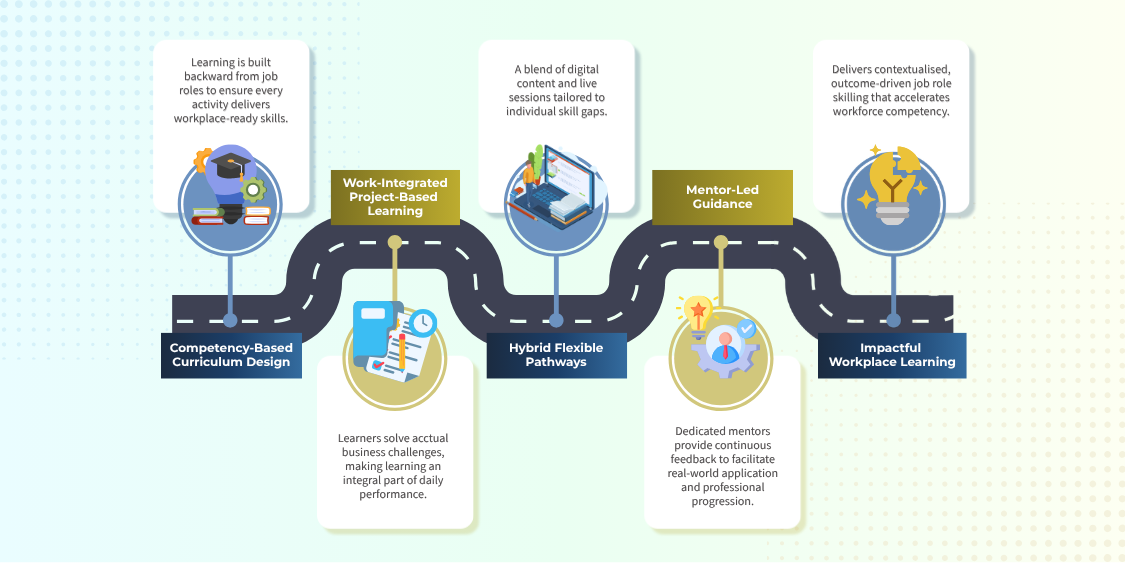
Three pillars of skills-first learning—competency-based curriculum, work-integrated project-based learning, and personalized mentor-led journeys—designed to deliver real-world performance and business impact

Learning pathways are designed in reverse, starting with clearly defined competency outcomes aligned to job roles and industry standards such as Bloom’s Taxonomy and ESCO. Each module, activity, and assessment is intentionally curated to deliver measurable knowledge, skills, and abilities required for workplace performance.

This ensures that learning remains purposeful and outcome-driven; content is delivered in a just-enough manner rather than being excessive, and progress is measured based on demonstrated capability instead of simple completion.

At the core of the model is project-based learning embedded within real work contexts. Learners engage in structured, outcome-oriented projects that address actual business challenges, require the application of targeted competencies, and produce measurable outputs aligned with organisational goals.

This enables immediate application of skills in the workplace, accelerates time-to-competency, and allows learners to contribute directly to business performance. Learning is no longer separate from work—it becomes an integral part of how work is performed.

The framework is delivered through a hybrid, flexible learning journey tailored to each learner’s pace, role, and professional goals. Personalised pathways are built based on individual skill gaps and job requirements, supported by mentor-led guidance to facilitate real-world application and progression.

The experience blends digital content, live sessions, and workplace activities, allowing learners to balance work, life, and study. With continuous diagnostics and feedback, the learning journey dynamically adapts to ensure ongoing relevance and effectiveness.

Together, this approach delivers contextualised, outcome-driven job role skilling—accelerating workforce performance, reducing time-to-competency, improving engagement, and enabling organisations to achieve faster, measurable business impact.

Conclusion

As the AI era reshapes industries and job roles, the definition of talent is rapidly evolving from static expertise to dynamic, skills-based capability. Organisations can no longer rely solely on traditional education or one-time training; instead, they must cultivate agile innovation talent that can continuously learn, adapt, and apply skills in real-world contexts.

By aligning emerging career pathways with a Skills-First, competency-based approach and embedding learning directly into work through models like 70:20:10, organisations can bridge the gap between knowledge and performance. This not only accelerates time-to-competency but also ensures that workforce development is tightly linked to measurable business outcomes.

Ultimately, the future belongs to individuals and organisations that can integrate technology, human insight, and continuous learning into a unified capability. Those who embrace this transformation will be best positioned to drive innovation, sustain competitiveness, and thrive in the AI-powered economy.

To explore how these frameworks support both workforce development and enterprise innovation, download the Digital Skilling Programs and Future-Ready Career Pathways guide.
Want to check if this career is for you?