Lifelong Learning CET
How to Productize Digital Marketing Services for SME Clients
How to Productize Digital Marketing Services for SME Clients

Content
Content
Custom marketing proposals can take time, especially when every SME has different requirements. Productized marketing services simplify this process by turning recurring tasks into packages with defined deliverables, timelines, and prices. This helps marketers set clear expectations, manage their workload, and build repeatable service offerings.
What Does It Mean to Productize a Marketing Service?
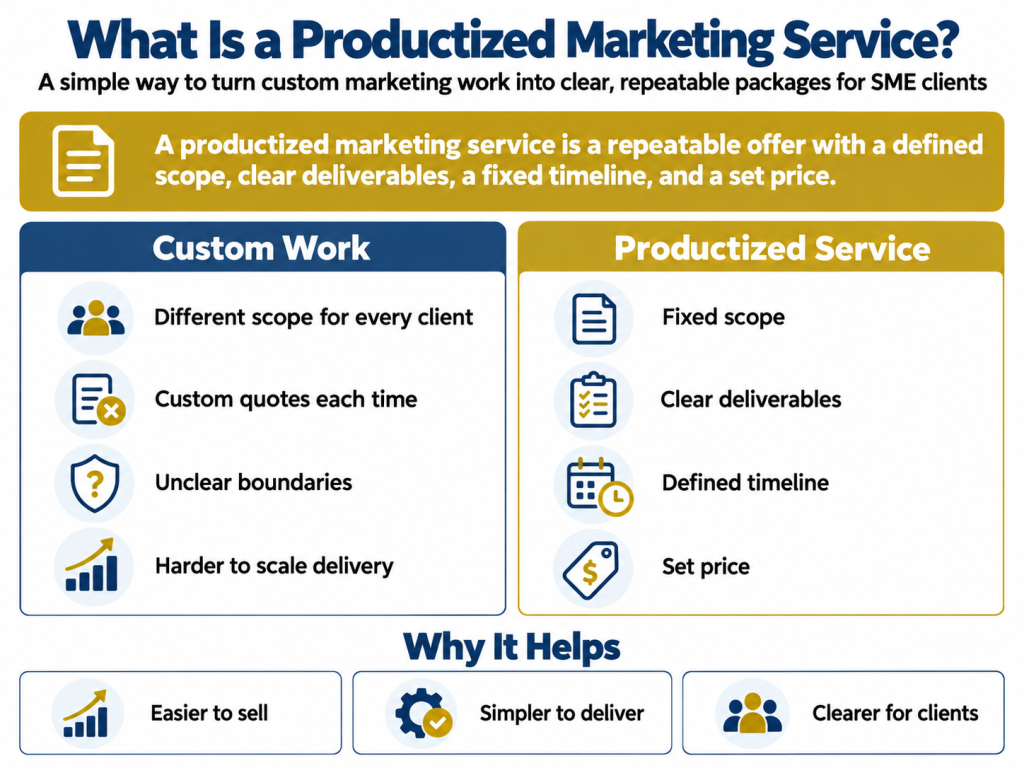
A productized marketing service is a repeatable offering with a defined scope, deliverables, timeline, and price. Instead of preparing individual quotations, marketers offer packages that explain what clients receive and how the service is delivered.- Fixed scope: The specific tasks included in the service.
- Defined outcome: The intended result or completed deliverable.
- Fixed price: An agreed fee for the defined work.
- Clear timeline: When the client can expect delivery.
Standardizing delivery does not mean treating every client identically. Content and recommendations should still reflect their business needs.
Which Services Package Well for SMEs?
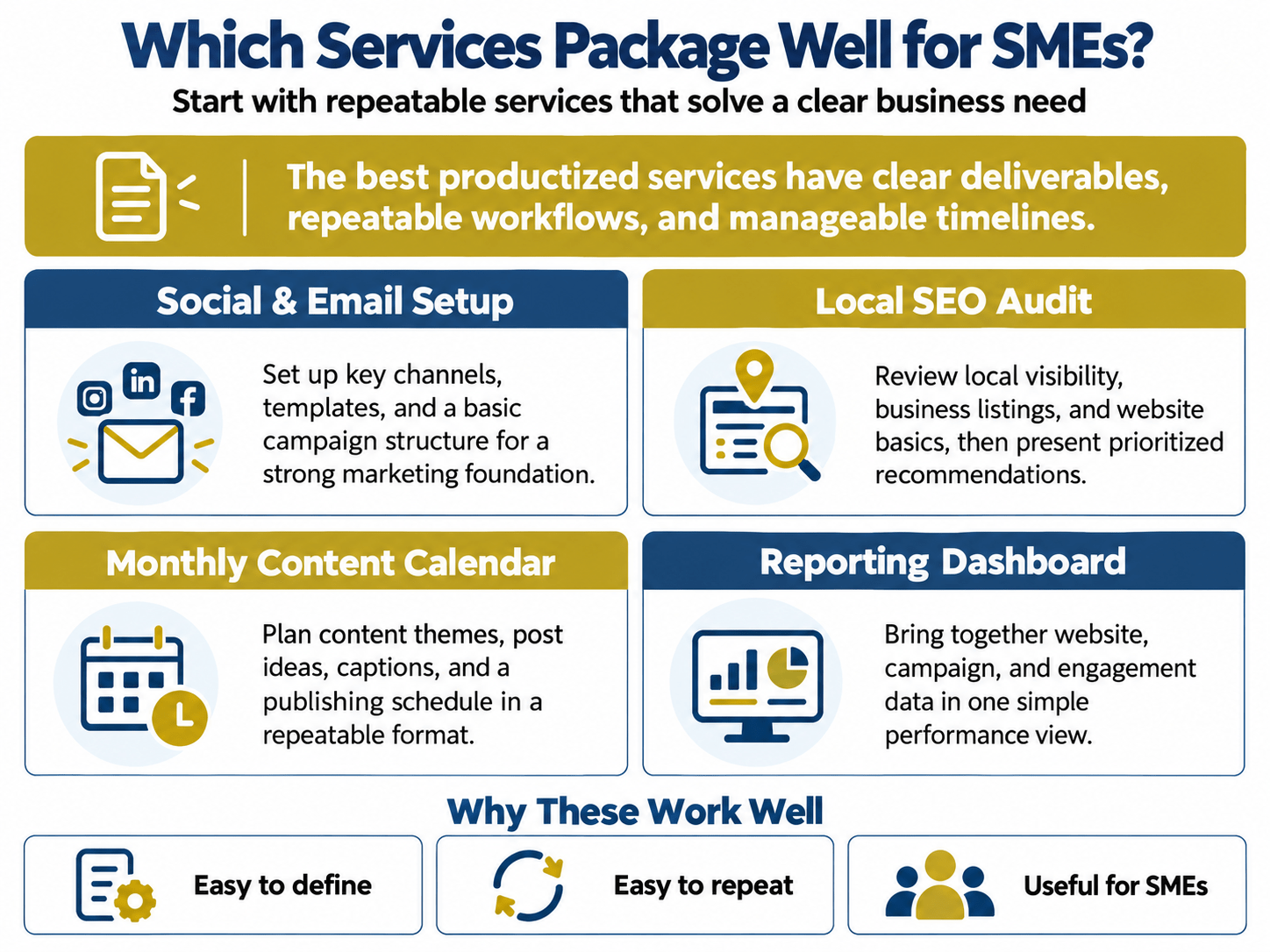
The easiest services to productize are those with clear deliverables, repeatable workflows, and manageable timelines. When building marketing service packages for SMEs, start with services that address a specific business need.
Social Media and Email Marketing Setup
A starter package might include social media profile optimization, a content calendar, email templates, and basic campaign setup. It gives SMEs a structured marketing foundation.
Local SEO Audit
A local SEO audit can review a client’s Google Business Profile, local keywords, website visibility, and business listings. The deliverable is a report with prioritized recommendations.
Monthly Content Calendar
This package provides content themes, post ideas, captions, and a publishing schedule. Marketers can reuse planning workflows while tailoring content to each client.
Marketing Reporting Dashboard
A reporting package could bring together website traffic, campaign performance, and engagement metrics in one dashboard. Clients receive a clearer view of their marketing activities without commissioning a new report each time.
Choose one service you can confidently deliver before combining several into larger packages
How Do You Define Scope, Deliverables and Boundaries?
Once you have selected a service, the next step is defining exactly what the client is purchasing. Without clear boundaries, even fixed-price marketing packages can become difficult to manage.
Specify What Is Included
Describe deliverables in measurable terms. Instead of promising ongoing content support, specify eight social posts, eight captions, and one monthly performance report. Also explain the formats, platforms, and delivery schedule.
Clarify What Is Excluded
List tasks that require separate quotations, such as paid advertising management, video production, additional platforms, or website development. This prevents clients from assuming every marketing request belongs within the package.
Set Revision Limits and Timelines
Explain how many revision rounds are included and how quickly feedback must be provided. For example, a package might include two revision rounds, with additional changes quoted separately.
Define Client Responsibilities
Identify what the client must provide, including brand guidelines, account access, product information, and timely approvals. Agree on these requirements before starting, since missing information can delay delivery.
Documenting these boundaries in a simple service agreement helps both parties understand the work and how changes will be handled.
How Do You Price and Tier the Packages?
Pricing a productized service requires balancing delivery effort, operating costs, and the value the client expects. Start by estimating the hours required for planning, production, revisions, communication, and reporting. Then account for software subscriptions, administrative time, and your desired margin.
Value also matters. A specialized service that solves an important business problem may justify a higher price than a basic task-based offering. However, the price still needs to reflect what prospective clients are willing to pay.
Build Good-Better-Best Packages
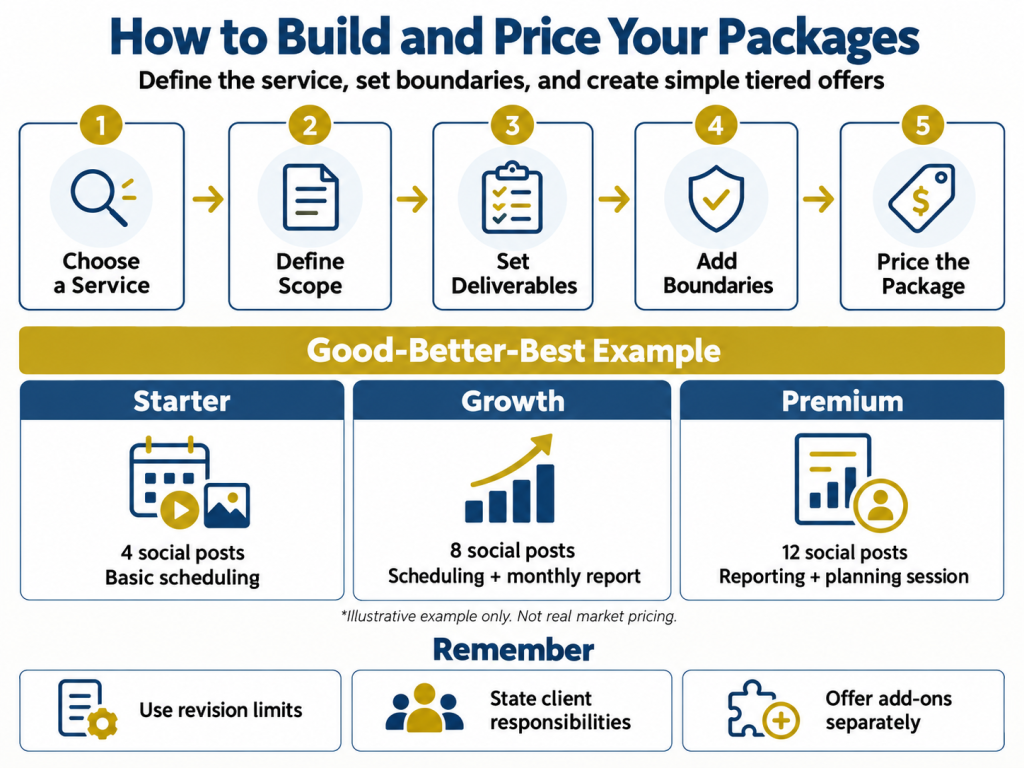
A three-tier structure gives clients choices without requiring a completely customized proposal. The following is a hypothetical example for illustration only, not actual CLaaS2SaaS pricing or recommended market rates.
A three-tier structure gives clients choices without requiring a completely customized proposal. The following is a hypothetical example for illustration only, not actual CLaaS2SaaS pricing or recommended market rates.
| Package | Illustrative price | Included deliverables |
|---|---|---|
| Starter | SGD 300/month | 4 social posts, captions, basic scheduling |
| Growth | SGD 600/month | 8 social posts, captions, scheduling, monthly report |
| Premium | SGD 950/month | 12 social posts, captions, scheduling, monthly report, quarterly planning session |
Before publishing your packages, test them against your estimated workload and discuss them with potential clients. The goal is to create a structure that clients can understand and that you can deliver sustainably.
How Do You Onboard Clients and Grow the Ladder?
Clear packages are only useful when the delivery experience is equally organized. Start with an intake form covering business goals, target audiences, brand guidelines, existing platforms, and required account access.
Next, use a shared project management tool to track tasks, approvals, deadlines, and completed deliverables. Templates for briefs, content calendars, and reports can reduce repetitive administrative work. Marketing automation and AI-assisted tools may also support preparation and reporting, provided outputs are reviewed for accuracy and brand suitability.
For additional context, explore how small businesses can select AI tools by business function.
AI tools can also support repeatable tasks such as generating first-draft content, organizing campaign insights and preparing performance summaries. Define where these tools fit into the workflow and include human review for accuracy, brand voice and client suitability. The service package should specify the deliverables and quality standards—not just the tools used to produce them.
Establish a reporting rhythm from the beginning. For recurring packages, this might include a monthly performance summary and a discussion of recommended improvements. As client requirements evolve, introduce an upsell ladder. A client purchasing a content calendar might later add content production, campaign management, or reporting services.
Offer upgrades when a genuine business need emerges, rather than adding services simply to increase the package price.
Frequently Asked Questions
1. What is a productized marketing service?
A productized marketing service combines defined deliverables, a clear timeline, and a set price into a repeatable offering. Unlike a custom retainer, it establishes the scope upfront so clients know what to expect.
2. Does productizing mean lower quality?
No. Productizing standardizes the delivery process, not the quality or relevance of the work. Each client’s content and recommendations should still reflect their business requirements.
3. How do I handle clients who want changes?
Set revision limits in the service agreement. Changes within the agreed scope can follow the normal revision process, while additional requests can be offered as paid add-ons.
4. How many packages should I offer?
Start with two or three tiers. This gives clients meaningful choices while keeping pricing, delivery, and package comparisons manageable.
5. Is this only for freelancers?
No. Agencies and independent marketers can both productize their services. The approach is useful whenever recurring work can be delivered through a clearly defined process.
Build a Repeatable Service Offering
Productizing digital marketing services starts with a focused offer, clearly defined boundaries, practical pricing, and consistent delivery. As you gain experience, you can refine packages around actual client needs.
For further reading, explore how to start a digital marketing agency in Singapore or learn what running a one-person marketing agency involves.
You can also explore the CLaaS2SaaS Digital Marketing Intelligent Business Process Outsourcing (iBPO) pathway to learn more about building agency capabilities, developing repeatable service offerings and using AI-enabled workflows in marketing delivery.
Share


Want to check if this career is for you?