Intelligent Orchestration
for the AI-First Enterprise

The Enterprise Challenges We Solve

AI projects stall when intelligence is fragmented across tools, teams, and workflows. These are the three constraints Intelligence OS is designed to remove.
Siloed Systems
ERP, CRM, LMS, spreadsheets, and business apps do not share context. Teams work from partial views, duplicate effort, and slow down decisions.
Broken Workflow Continuity
Work still depends on handoffs, workarounds, manual checking, and people bridging system gaps. Execution remains hard to scale.
Fragmented Intelligence
Knowledge, governance, reasoning, and decision history are inconsistent across teams. Every solution starts from scratch instead of compounding.

Why Enterprises Need an Intelligent OS

Point solutions can automate individual tasks, but they do not create enterprise intelligence. Intelligence OS provides the shared foundation that lets people, systems, data, and agents operate from the same source of truth.
Unify intelligence across the enterprise
Every team builds on common data, knowledge, policy, and workflow state.
Coordinate agents, data, and workflows
Agents can act across functions because context and execution paths are connected.
Ensure governance and trust at scale
Access, policy, approvals, audit trail, and exception handling are built into the operating layer.
Accelerate outcomes across the business
New use cases can be launched faster because they reuse the same intelligence foundation.

The Foundation That Makes AI-First Transformation Sustainable

Intelligence OS gives enterprise teams a shared intelligence layer that can be reused across strategic and operational AI solutions, instead of rebuilding data access, workflow logic, and governance for every new use case.
Consolidated data for citizen developers
Intelligence OS brings trusted data, workflow context, and enterprise knowledge into governed services that citizen developers can access when building apps, copilots, dashboards, and automations.
Reduces repeated integration work across use cases
Lets teams build from a shared data and knowledge foundation
Makes AI-first transformation easier to scale beyond isolated pilots
One intelligence layer for strategic and operational AI
Strategic AI helps leaders plan, prioritise, and decide. Operational AI improves daily execution, workflows, and frontline productivity. Intelligence OS connects both by giving them access to the same governed intelligence foundation.
Links business priorities to real operational data and workflow state
Supports both planning decisions and day-to-day execution
Ensures intelligence is reusable, governed, and aligned to company needs
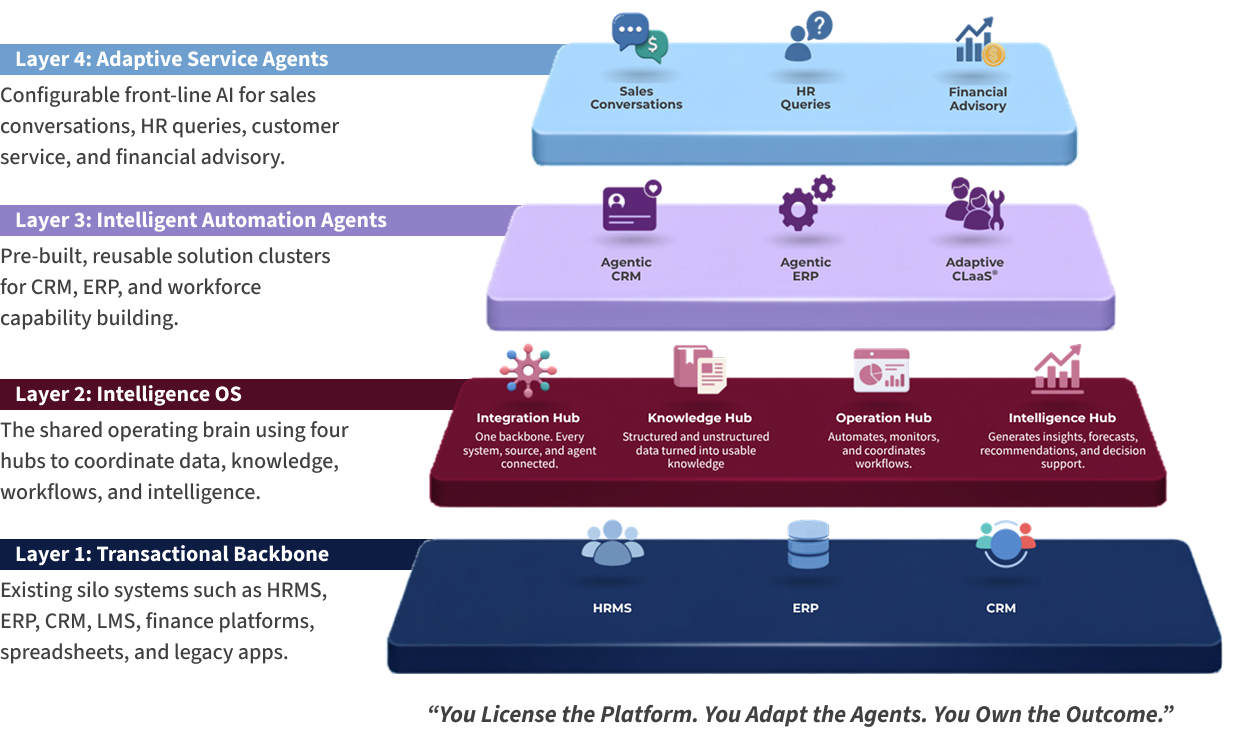
Built On A Four-Layer Enterprise Architecture
Intelligence OS is not another app sitting beside ERP, CRM, HRMS, or LMS. It is the operating brain that connects the transactional backbone below, powers reusable automation agents above, and enables front-line service agents to act with shared context.
CLaaS2SaaS Adaptive Intelligence Automation Platform
Four layers working as one enterprise operating model

Core Capabilities of Intelligence OS

Intelligence OS is built around four core hubs. Each hub explains the business capability, while the service chips show the reusable building blocks that teams can use to assemble new agents and workflows faster.
01 · Human bottlenecks → agent-augmented execution
Integration Hub
Connect approved systems and data into one governed environment.
ERP, CRM, LMS, spreadsheets, inventory records, pricing sources and third-party platforms are connected into a single enterprise foundation. Agents downstream can reason from approved data sources instead of relying on manual system checks, duplicated extracts or disconnected point-to-point integrations.
WHAT THIS MEANS IN PRACTICE
Citizen developers and solution teams can build on approved data services instead of requesting a new connector for every agent or workflow. This reduces integration bottlenecks and keeps agents aligned to the same version of business data.
Reusable integration services
Customer Data Service
ERP Connector
Inventory / Availability Service

Pricing Data Service

Core Capabilities of Intelligence OS

Intelligence OS is built around four core hubs. Each hub explains the business capability, while the service chips show the reusable building blocks that teams can use to assemble new agents and workflows faster.
Integration Hub
Knowledge Hub

Operation Hub

Intelligence Hub

01 · Human bottlenecks → agent-augmented execution
Integration Hub
Connect approved systems and data into one governed environment.
ERP, CRM, LMS, spreadsheets, inventory records, pricing sources and third-party platforms are connected into a single enterprise foundation. Agents downstream can reason from approved data sources instead of relying on manual system checks, duplicated extracts or disconnected point-to-point integrations.
Reusable integration services
Customer Data Service
ERP Connector
Inventory / Availability Service

Pricing Data Service
Governance services
Keep reuse controlled, auditable and safe
ERP, CRM, LMS, spreadsheets, inventory records, pricing sources and third-party platforms are connected into a single enterprise foundation. Agents downstream can reason from approved data sources instead of relying on manual system checks, duplicated extracts or disconnected point-to-point integrations.
Role-Based Access Control
Audit Trail
Data Validation
Human Review Gate
Confidence Thresholds and Escalation

From Vendor Dependency to In-House Agent Assembly

Without IOS, each new agent often depends on external build cycles or repeated IT effort. With IOS, internal teams can assemble agents from approved capabilities that already connect data, knowledge, workflows, intelligence and governance.

Every new agent becomes a custom project

The business asks for a customer portal sales agent, but delivery depends on external or IT-led build work around the use case.

1

Scope requirements

Clarify the portal journey, sales rules and data sources.

2

Build connectors

Connect CRM, ERP, inventory, pricing and document sources again.

3

Create logic

Define data mapping, retrieval logic, workflow routing and approvals.

4

Retest controls

Check access, audit logs, human review gates and exception handling.

Internal teams assemble agents from reusable capabilities

A citizen developer or solution team selects the use case, composes approved services and configures the rules for access, approval and escalation.

USE CASE

Customer Portal Sales Agent

Guide customers, recommend packages and start quote requests.

Select reusable IOS capabilities

Integration

Customer Data

Integration

Inventory

Knowledge

Product Docs

Operation

Workflow Routing

Intelligence

Pricing Rule Evaluation

Governance

Human Review

Configure rules

Access

Approval

Escalation

Audit

Agent deployed into customer portal

The customer sees one simple sales agent. IOS handles the reusable data, knowledge, workflow, intelligence and governance services behind the scenes.

See Intelligence OS in Action

Watch how Intelligence OS unifies systems, data, workflows, and intelligence into one governed foundation — so agents can reason, act, and compound outcomes across the enterprise.

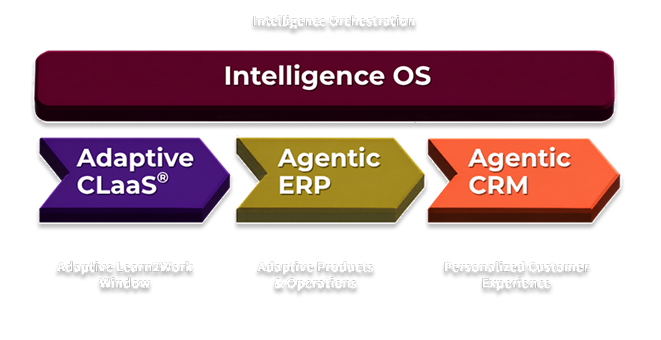
How Intelligence OS enables Adaptive CLaaS®, Agentic CRM, and Agentic ERP

The three solution clusters are not isolated products. They are powered by the same intelligence foundation, so workforce transformation, operational intelligence, and customer experience can compound together.

Adaptive CLaaS®

AI-native workforce incubation

Transforms the workforce into citizen developers who can configure, extend, and operate intelligent systems in the flow of work.

Agentic ERP

Adaptive products and operations

Embeds intelligent agents across procurement, finance, supply chain, facilities, compliance, and operational decision-making.

Agentic CRM

Personalized customer experience

Gives sales and service teams AI agents that understand customer context, anticipate needs, and respond across touchpoints.

Outcomes That Compound

When every solution builds on the same foundation, outcomes improve across productivity, speed, customer experience, governance, and performance.

Higher productivity

Automate more work and reduce manual coordination.

Faster decisions

Put real-time intelligence into the flow of action.

Better customer experiences

Serve customers personally and consistently at scale.

Lower risk

Improve governance, traceability, access control, and auditability.

Stronger performance

Improve margins, throughput, and quality without adding complexity.

Ready to build

One foundation. Three solution clusters. Limitless impact.

Build the AI-first enterprise with Intelligence OS, the shared platform for systems, data, workflows, intelligence, and agent-enabled execution.