Digital Workforce Transformation for a Converged Future of Learning and Work
Redesign work, build adaptive talent, and embed human-AI collaboration through a continuous Digital Workforce Transformation system that connects workforce, skills, learning, work, and performance.
Move beyond traditional training to develop AI-bilingual talents who can continuously learn, adapt, and transform how work gets done.
More Training Isn’t Solving the Problem
The problem is not a shortage of training resources. Conventional enterprise learning remains inefficient, ineffective, and increasingly difficult to justify against business outcomes.
Inefficient One-Size-Fits-All Learning
Generic learning increases development cycles, R&D costs, and maintenance workloads.
Ineffective Learning Without Outcome
Learning separated from actual work does not necessarily translate into measurable business outcomes.
High Opportunity Cost With Low ROI
Organizations struggle to connect learning investment with workplace application, performance, and business KPIs.
From:
Course → Learn → Hope They Apply It
To:
Work → Learn → Apply → Measure → Improve
Digital Workforce Transformation shifts workforce development from job-centric to skills-first, one-size-fits-all to Batch-of-One, course-based to work-integrated, and human-only work to human + AI work.
Build AI-Native Adaptive Talent
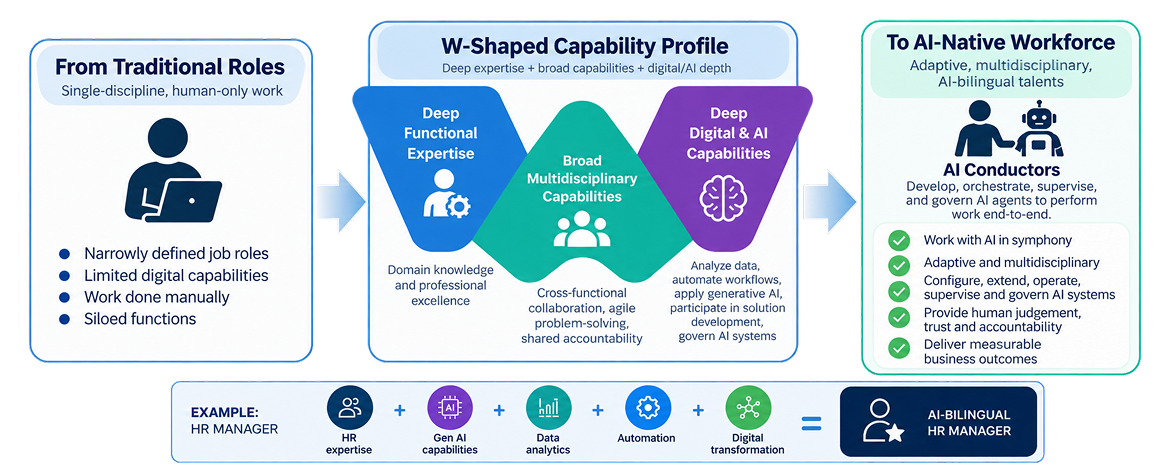
As AI changes tasks, workflows, and responsibilities, employees need more than job-specific expertise. The future workforce requires adaptive, multidisciplinary, AI-bilingual talents who combine professional expertise with the ability to work with intelligent systems.
The result is AI-Bilingual Talent: fluent in their professional domain and fluent in working with intelligent systems.
Digital Workforce Transformation Engine
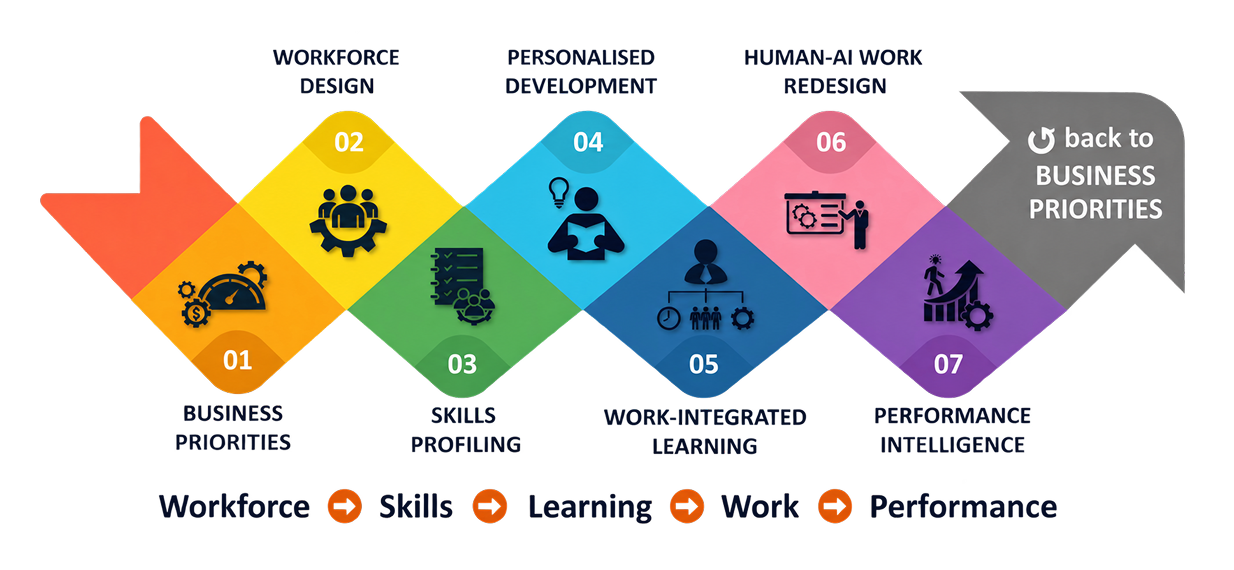
A continuous transformation engine that aligns business priorities with workforce design, skills, learning, work redesign, and performance intelligence. It enables organizations to continuously develop and optimize their workforce around evolving business priorities.
Every stage produces an asset that feeds the next stage, creating a continuous transformation system.
Skills-First Workforce Transformation
Digital Workforce Transformation begins by understanding what the organization needs its workforce to do.
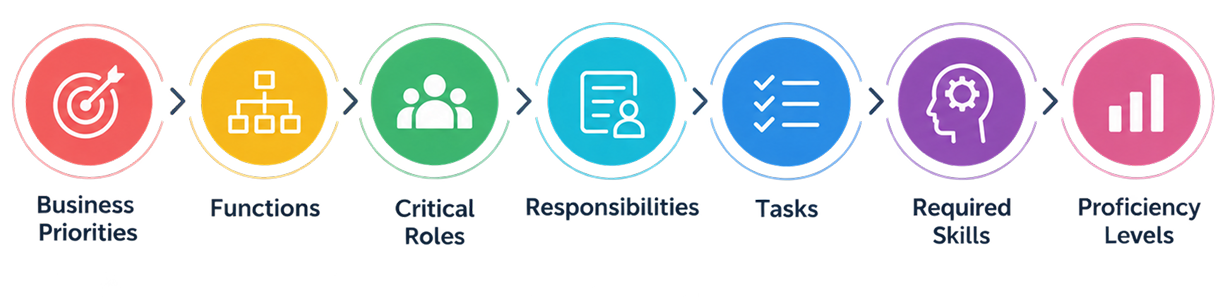
Skills-First Workforce Design creates an Adaptive Workforce Blueprint that defines the role-specific skills and proficiency levels required for the future workforce.
Digital Career Skills Profiling then compares:
Required Capability − Current Capability = Skill Gap
This creates clear visibility into each employee’s capabilities, proficiency levels, and specific skill gaps, providing the foundation for personalized capability development.
Batch-of-One Capability Development
Every employee has a different role, capability level, skill gap, and development need. Batch-of-One Adaptive CLaaS® replaces one-size-fits-all learning with personalized capability development aligned to each individual’s job role and workplace requirements.
Each identified skill gap moves through a structured development journey:
Prioritize → Match → Sequence → Practice → Apply → Validate
Contextualized Job-Role Curricula then connect the employee’s existing capability, identified skill gaps, job-role requirements, and changing business priorities with the learning and workplace application required to close those gaps.

Work-Integrated Adaptive Learning
Learning moves into the flow of work through a Work-Integrated 70:20:10 Hybrid Flexible Learning Journey.
10%
Structured Learning
Digital modules, content, assessment, and knowledge.
20%
Structured Learning
Coaching, feedback, guidance, and intervention.
70%
Work Experience
Projects, problem-solving, automation, data analysis, and workplace application.
Employees do not simply learn and return to work. They develop capabilities while applying them directly to real workplace challenges.
Learn2Work: Build capability while doing real work.
From Learning to Human-AI Work Redesign
Capability development becomes meaningful when employees can apply new skills to transform real work.
Digital Workforce Transformation moves from learning into Human-AI Work Redesign through three connected steps:
Step 1:
Deconstruct Work
Break work into tasks, decisions, and handoffs.
Step 2:
Identify AI Application
Determine where AI can support thinking, coordinating, and interacting through activities such as search, generation, analysis, communication, connection, and monitoring.
Step 3:
Redesign Human-AI Collaboration
Humans provide context, judgment, interaction, and accountability, while AI supports search, generation, analysis, and monitoring.
This creates a human-AI system where people and intelligent systems work together to improve how work is performed.
Adaptive CLaaS® Platform
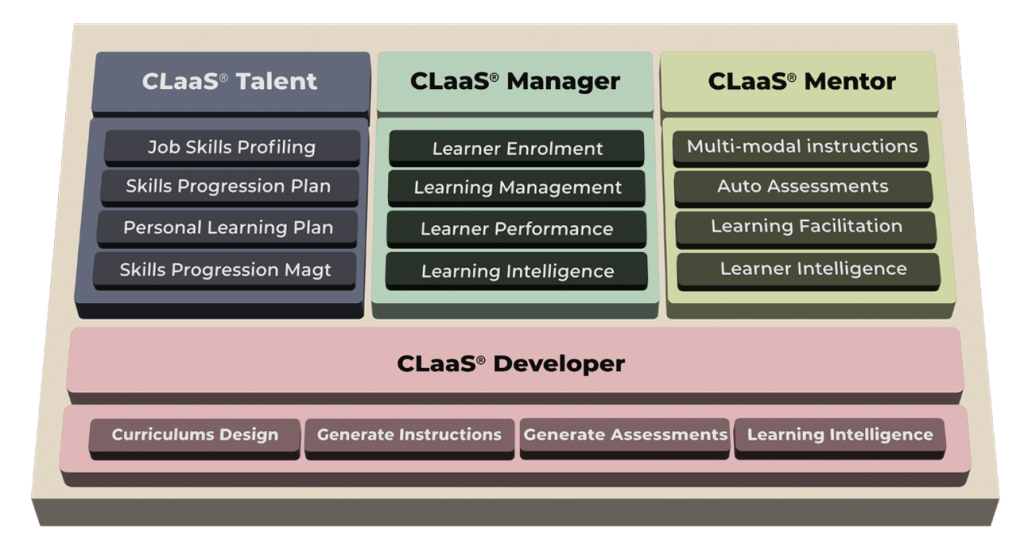
The Adaptive CLaaS® ecosystem connects people, skills, learning, work, and performance through a Unified Learn2Work Window.
CLaaS® Talent
Job Skills Profiling, Skills Gap Analysis, Workforce Planning, and Talent Development.
CLaaS® Developer
Curriculum Design, Learning Content, Assessments, and Learning Intelligence.
CLaaS® Mentor
Learner Enrollment, Learning Management, Learner Performance, and Learning Intelligence.
CLaaS® Manager
Multi-modal Instructions, AI Coaching & Feedback, Learning Facilitation, and Learner Intelligence.
CLaaS® Intelligence
Workforce Analytics, Skills & Learning Insights, Predictive Intelligence, and Strategic Recommendations.
Together, these intelligence layers create one continuous adaptive workforce capability system.
Develop Digital Capabilities at Scale
Adaptive CLaaS® Academy provides 100+ modular and stackable digital skilling programs that organizations can align to job roles, skill gaps, and workplace application.
Tech-Lite
Job Skills Profiling, Skills Gap Analysis, Workforce Planning, and Talent Development.
Deep-Tech Skills
Advanced technology capabilities
Role → Skills → Gap → Modules → Learning Pathway → Workplace Application
This enables organizations to scale targeted capability development while keeping learning connected to workforce requirements and real work.
From Learning Metrics to Workforce Performance
Move beyond attendance, completion, and certification to understand whether workforce capability is actually improving.
Through Learn2Performance Intelligence, organizations can connect skills, learning, application, performance, intelligence, and continuous development in one measurable capability journey.
Move From Strategy to AI-Native Workforce in 6 months
Months 1–2
DESIGN & PROFILE
Define critical roles, required skills, proficiency levels, and workforce gaps.
Output: Workforce Skills Blueprint + Digital Skills Profiles
Months 3–4
PLAN & DEVELOP
Build personalized pathways, job-role curricula, and 70:20:10 learning journeys.
Output: Adaptive Talent Development
Months 5–6
APPLY & IMPROVE
Transform human-AI workflows, identify intelligent automation opportunities, and connect capability progression with performance intelligence.
Output: Workplace application + measurable capability progression.
Build a Workforce That Continuously Adapts
Digital Workforce Transformation enables organizations to:
ALIGN
Workforce capability with business priorities.
IDENTIFY
Critical skills and capability gaps.
DEVELOP
Personalized capability development at scale.
TRANSFORM
Human-AI work around real workflows.
MEASURE
Skills progression against workplace performance.
The goal is not simply to train more people. It is to build a workforce that can continuously learn, adapt, and transform the way work gets done.
Start Your Workforce Transformation
Start with one workforce, one function, and one transformation.
Identify a priority business function, select critical roles, build the skills blueprint, profile the workforce, and launch a structured 6-month Digital Workforce Transformation journey.