From Manager to Digital Transformation Leader: 5 Skills Non-Tech Professionals Need in the AI Era
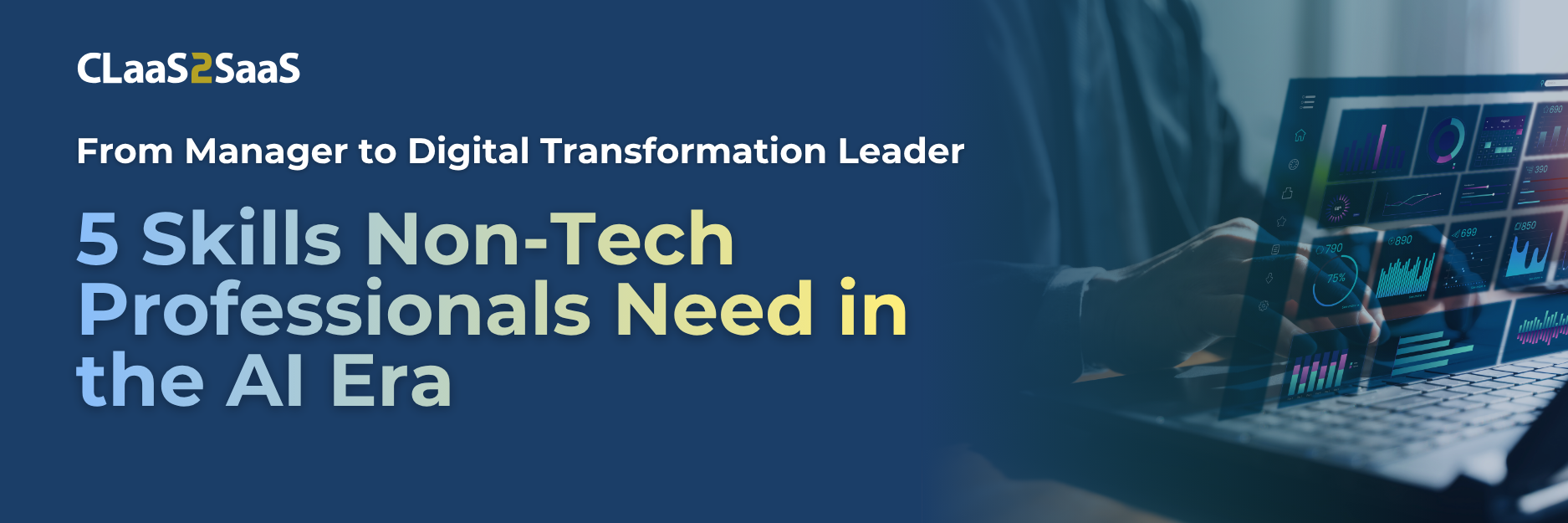
From Manager to Digital Transformation Leader: 5 Skills Non-Tech Professionals Need in the AI Era
Isi kandungan
Isi kandungan
Capable managers often understand the business problem better than anyone, yet technical teams may still make the key digital decisions. Building the right digital transformation skills for managers helps non-technical professionals shape AI, data, automation, and change initiatives without becoming software engineers.
How Non-Technical Managers Can Lead Digital Transformation Without Coding
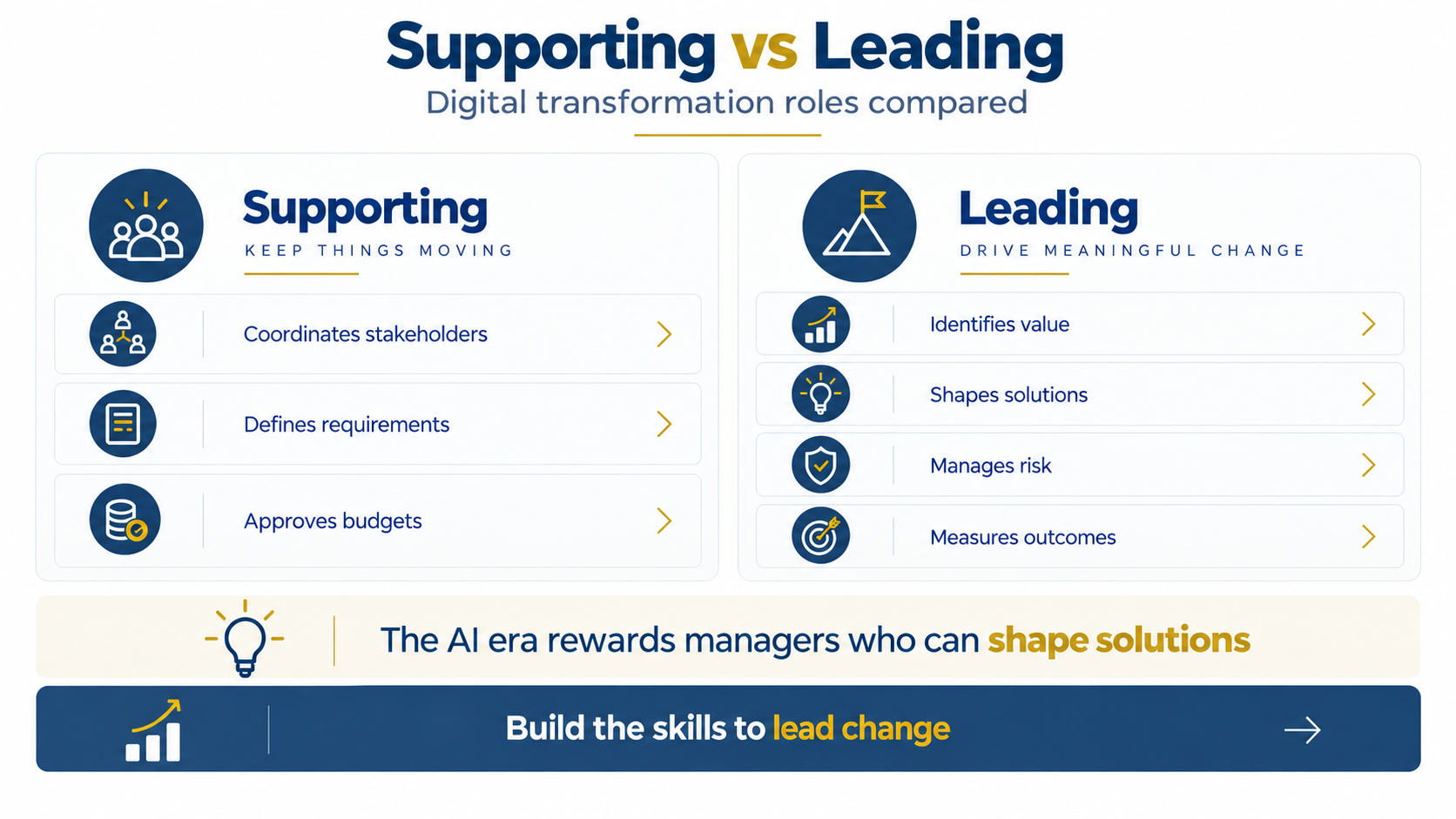
Supporting and leading digital transformation require different capabilities. A manager may coordinate stakeholders, approve budgets, or define requirements. A transformation leader also identifies where technology creates value, shapes solutions, manages risk, and measures business outcomes.
As AI becomes part of everyday work, this distinction matters more. The World Economic Forum’s Future of Jobs Report 2025 highlights AI and big data, technological literacy, analytical thinking, agility, and social influence among skills expected to grow in importance. You can lead digital transformation without coding, but you still need enough technical literacy to understand capabilities and risks, ask informed questions, and set direction.
For professionals in Singapore and across ASEAN, these digital transformation leadership skills can help move them from supporting digital projects to leading them.
5 Digital Transformation Leadership Skills for Non-Technical Managers
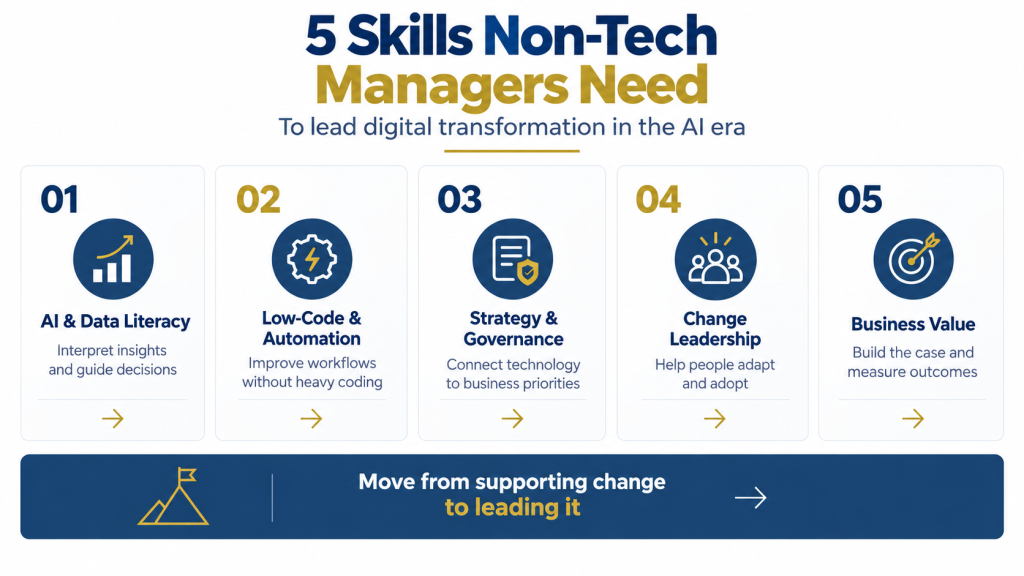
1. Build AI and Data Literacy
AI and data literacy means understanding how AI uses information, what its outputs can tell you, and where human judgment is needed. Managers do not need to build AI systems, but they should be able to judge whether insights are reliable, relevant, and useful.
What this looks like on the job: Interpret a performance dashboard, question an AI-generated recommendation, spot data gaps, and decide what action should follow.
2. Use Low-Code and Automation to Improve Workflows
Low-code and automation help managers improve inefficient processes without traditional programming for every change. Platforms such as Microsoft Power Apps can support simple applications, workflow redesign, and repetitive-task automation. Low-code is most useful when it connects process knowledge with measurable improvement.
What this looks like on the job: Redesign an approval process, automate handoffs or notifications, and measure whether the new workflow saves time or reduces errors.
You can also explore how low-code app development and RPA support practical process improvement.
3. Develop Digital Strategy and Governance
Digital strategy connects technology decisions with business priorities. Governance creates accountability around data, privacy, security, responsible AI, and human oversight. Managers need to choose problems worth solving, define acceptable risk, and decide how success will be measured.
The NIST AI Risk Management Framework organizes AI risk management around Govern, Map, Measure, and Manage.
What this looks like on the job: Define the objective, stakeholders, risks, accountability, and review process before an AI-enabled solution is implemented.
4. Lead People Through Change
Technology can be deployed quickly; changing how people work is often harder.
Managers need to explain why change is happening, address resistance, support changing responsibilities, and adapt when implementation does not go as planned. This calls for adaptability, communication, and emotional intelligence.
What this looks like on the job: Introduce an AI-assisted workflow, clarify new responsibilities, gather feedback, and help the team adjust.
5. Build a Business Case and Measure Value
Digital transformation should improve business performance.
Managers need to define the problem, estimate benefits, understand costs and risks, set KPIs, and measure results after implementation. The focus should be whether the initiative creates value, not simply whether it was launched.
What this looks like on the job: Measure whether automation reduced processing time, lowered costs, improved accuracy, or created capacity.
Build These Skills Through Work-Integrated Learning
For working managers, AI upskilling is most useful when new capabilities can be applied to real business challenges. The CLaaS2SaaS Digital Innovation Consultant pathway brings the five skills together through work-integrated learning for non-technical professionals.
AI model development and data analytics build AI and data literacy, while application development strengthens low-code capability. Leadership, entrepreneurship, and business strategy develop strategic decision-making.
The 3Qs framework of AQ, IQ, and EQ supports change leadership, while finance, applied projects, and capstones reinforce business-case development and value measurement.
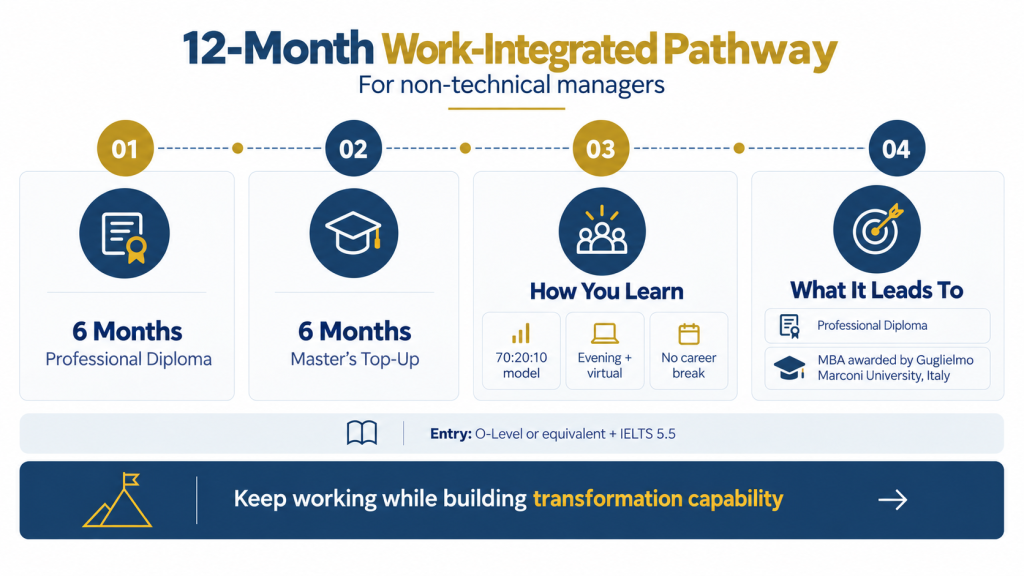
The 12-month pathway combines a six-month Professional Diploma with a six-month International Master’s Degree top-up. Its 70:20:10 approach blends structured learning, mentoring, self-paced activities, assessment, and hands-on projects, with part-time and virtual options.
Entry requirements differ by stage. The initial professional credential may accept a minimum O-Level or equivalent plus IELTS 5.5 or equivalent, subject to applicable requirements.
Admission to the MBA top-up is assessed separately and requires meeting the MBA stage’s academic, English-language, and other criteria. Completing the professional stage does not guarantee MBA admission.
Eligible learners who meet those requirements may progress to an MBA awarded by Guglielmo Marconi University, Italy. CLaaS2SaaS and Lithan deliver the pathway, while the university awards the MBA. For eligible learners, this creates a work-integrated MBA pathway.
For professionals wondering whether an IT background is necessary, the guide to pursuing a digital transformation course with no tech background provides additional guidance.
Career Progression: Digital Innovation Lead to Consultant
For a non-technical digital transformation leader, these skills can support roles that connect business strategy, technology, and organizational change.
A Digital Innovation Lead typically drives transformation within an organization. A Digital Innovation Consultant may take on broader diagnostic, advisory, stakeholder-management, and transformation-strategy responsibilities.
The current CLaaS2SaaS pathway page presents these indicative career-progression stages:
- Digital Innovation Lead: positioned at the 2 to 3 year stage.
- Digital Innovation Consultant: positioned at the 5 to 7 year stage.
These are indicative progression stages, not program durations. Actual progression varies by experience, market conditions, role scope, and individual circumstances.
For a deeper comparison, see the Digital Innovation Lead vs. Digital Innovation Consultant guide.
If you are considering this career direction, talk to a program advisor about the pathway that best matches your experience and goals.
Pertanyaan umum
What skills do non-technical managers need to lead digital transformation?
AI and data literacy, low-code and automation, digital strategy and governance, change leadership, and value measurement.
Can you lead digital transformation without a technical background?
Yes. You need enough technology literacy to evaluate opportunities, guide technical teams, manage risks, and connect solutions with business goals, not programming expertise.
Do I have to stop working to do this program?
No. Part-time and virtual options let working adults continue working while studying.
What qualification do I get?
The professional stage can lead to a Professional Diploma. MBA top-up admission is separate and requires meeting its academic, English-language, and other requirements. Eligible learners who are admitted and complete the top-up can earn an MBA from Guglielmo Marconi University, Italy. Completing the professional stage does not guarantee MBA admission.
What is the difference between a Digital Innovation Lead and a Digital Innovation Consultant?
A Digital Innovation Lead typically drives transformation within one organization. A Digital Innovation Consultant works across broader diagnostic, advisory, stakeholder, and strategy challenges.
Move From Supporting Digital Change to Leading It
Build practical AI, data, low-code, strategy, and change-leadership capabilities while continuing to work through the Digital Innovation Consultant pathway.
Talk to a program advisor to find the route that fits your experience and goals.
Bagikan


Ingin tahu apakah karier ini cocok untuk Anda?