Beranda Blog Transformasi HigherEd Bagaimana Agen AI Dapat Merampingkan Pengadaan dan Manajemen Pemasok di Universitas
Transformasi HigherEd
Bagaimana Agen AI Dapat Merampingkan Pengadaan dan Manajemen Pemasok di Universitas
Bagaimana Agen AI Dapat Merampingkan Pengadaan dan Manajemen Pemasok di Universitas
Isi kandungan
Isi kandungan
Many departments and research teams at a university buy independently, often on restricted grant funds and under public-spending rules. University procurement automation that uses AI agents can help route, check and track those purchases without removing people from the decisions that need them.
Why Is University Procurement Different From Corporate Procurement?
University procurement often involves additional complexity, particularly in research-intensive and publicly funded institutions:- Decentralized buyers: departments, labs and individual researchers raise requests, so buying habits and data quality vary
- Restricted funds: grant and research money often carries conditions on what it can buy and when
- Research equipment: specialized, low-volume items that standard catalogs may not cover
- Public rules: many institutions follow public-spending requirements on quotes and tenders
- Many small vendors: each supplier needs onboarding and checks
Thresholds and rules differ by country and funder, so none are stated here. Each institution should work from its own jurisdiction’s primary source.
Where Do Delays and Compliance Risks Appear?
Delay and risk tend to cluster at five points, usually where information is missing or arrives late:- Requisition quality: incomplete requests, wrong categories and missing quotes send work back to the requester
- Approvals: unclear routing leaves requests waiting for budget holders or principal investigators
- Restricted-fund checks: allowability confirmed after the purchase, not before
- Vendor onboarding: incomplete documents and duplicate vendor records
- Off-contract spend: purchases made outside agreed contracts or preferred suppliers
When these steps are connected, agents can help move a request through the procurement workflow, surface exceptions to the right team and track outstanding actions across handoffs.
What Can AI Agents Handle Along the Purchase-to-Pay Path?
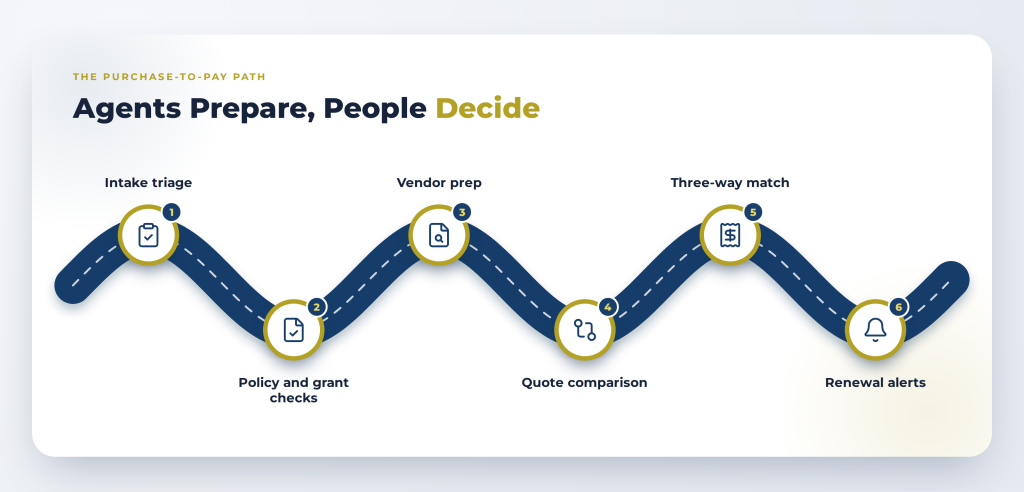
AI in university purchasing works best as preparation and flagging along the purchase-to-pay path, with people deciding. Here, an agent is software that reads a request, applies the institution’s rules and prepares a recommendation for a person. Three-way match means comparing the purchase order, the goods receipt and the invoice.
| Segment | What they may value | Example signals |
|---|---|---|
| Recent graduates | Career launch support, peer networks | Career-service use, event sign-ups, first-role updates |
| Mid-career alumni | Mentoring, skill refreshers | Role changes they share, topic interests, mentoring sign-ups |
| Alumni interested in giving back | Mentoring, volunteering, community involvement, philanthropy opportunities | Volunteer registrations, mentoring participation, stated interests in supporting the university |
| Returning learners | Short upskilling matched to career stage | Course-page visits, learning interests, program history |
For example, a lab consumables request arrives without a quote. The agent returns it to the requester with the gap named. Once the quote is added, the agent routes the request to the appropriate budget holder and flags potential conflicts between the fund code, the grant’s stated conditions and institutional policy for review before approval.
‘Vendor management relies on due-diligence preparation and renewal alerts, which rest on records and dates an agent can check. Agents prepare and flag. People with delegated authority approve exceptions and high-value purchases.
What Guardrails Do Public and Grant-Funded Institutions Need?
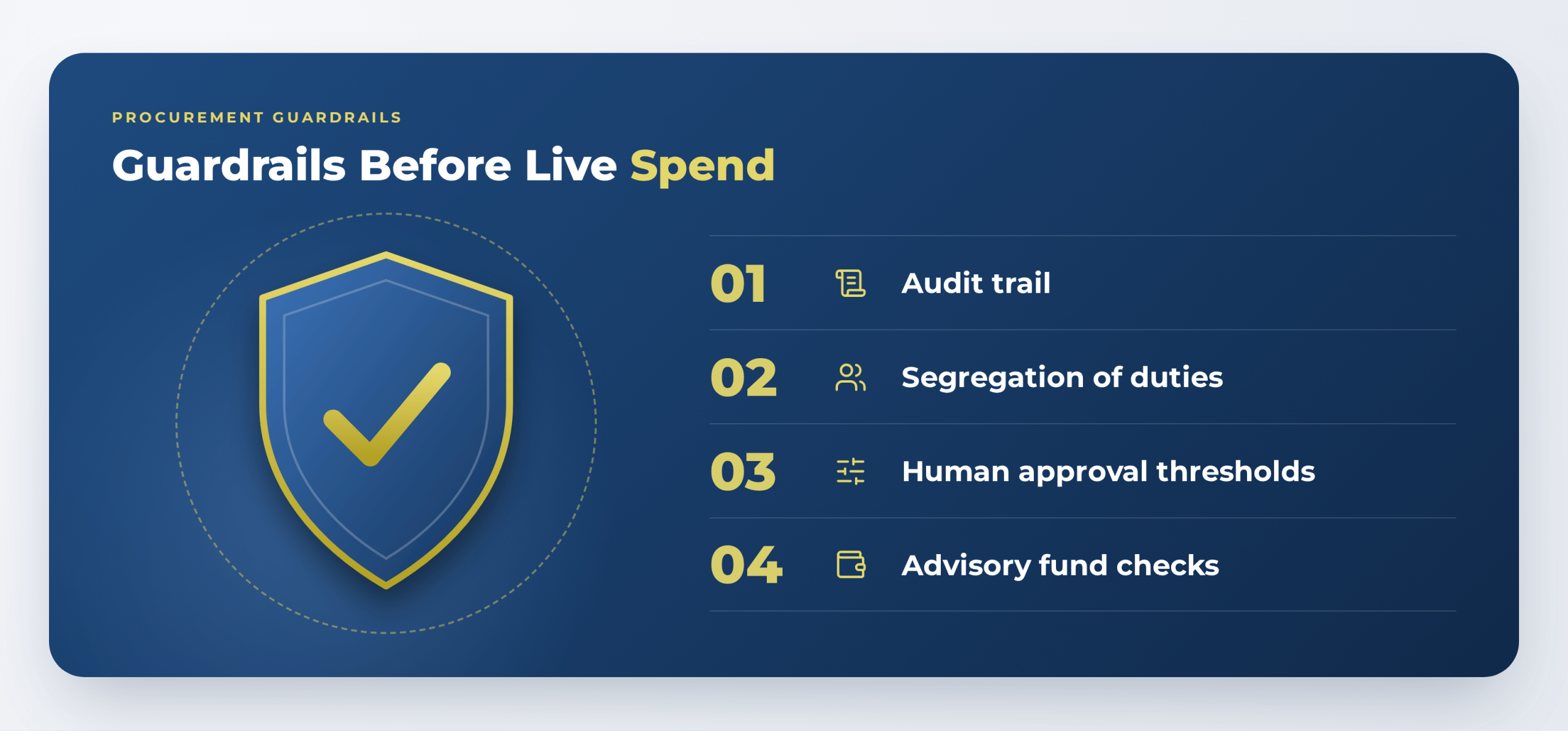
Public and grant-funded institutions need guardrails written down before agents touch live spend. Define approval limits and decision rights under institutional policy. Agents should prepare recommendations and route requests to authorized approvers; any automated approval must be explicitly permitted by the institution’s control framework.
- Audit trail: record what an agent checked, what it flagged and who decided, so a funder or auditor can follow each purchase
- Segregation of duties: the agent that prepares a request does not approve it, and requesting, approving and paying stay with different people
- Human approval thresholds: set by the institution under its own rules, with agents not approving spend above delegated limits
- Advisory fund checks: for grant purchasing compliance, an agent’s check is a pre-check, and the funder’s terms decide allowability
How Should a University Start?
Start with one category, such as lab consumables, that is high in volume and low in risk:- Record cycle time and policy exceptions before starting, to have a baseline
- Let agents triage and check requests while people approve
- Compare cycle time, policy exceptions and the proportion of agent flags confirmed by staff against the baseline. Review errors and missed issues.
- Extend to another category only after that review
Pertanyaan umum
Can AI agents approve purchases on their own?
They should not make final approvals on regulated or high-value spend. Agents are better used to triage requests, check them against policy and grant rules and prepare vendor information, while people with delegated authority approve exceptions and high-value purchases.
How does this help grant-funded purchasing?
It pre-checks funds and allowability against the grant’s stated conditions before approval, so problems surface early. The funder’s terms and research administration still decide what is allowable.
Does this replace procurement staff?
No. It shifts time from routine checking toward exceptions, vendor strategy and working with departments and researchers.
What data is needed first?
A clean vendor master and consistent category data, plus current policy and grant conditions in a usable form. Duplicate or incomplete vendor records are worth fixing first.
Which spend category should be piloted?
A high-volume, low-risk category, such as lab consumables, where outcomes are easy to measure and errors are easy to correct.
Further reading: University procurement is one example of how connected workflows can help institutions coordinate complex operations, surface exceptions earlier and maintain oversight across multiple teams.
Explore how CLaaS2SaaS Agentic ERP supports connected intelligent operations workflows across university operations.
Bagikan


Ingin tahu apakah karier ini cocok untuk Anda?