Beranda Blog Transformasi HigherEd Build vs. Buy: How Universities Can Choose the Right Digital Skills Curriculum Strategy
Transformasi HigherEd
Build vs. Buy: How Universities Can Choose the Right Digital Skills Curriculum Strategy
Build vs. Buy: How Universities Can Choose the Right Digital Skills Curriculum Strategy
Isi kandungan
Isi kandungan
Build vs buy curriculum decisions start from a real tension: academic control points toward building, while keeping content current and spreading cost over time point toward buying. There is no universally cheaper option; the right choice depends on six criteria. A hybrid route, licensing a core and adding local work, sits between the two.
What Do ‘Build’, ‘Buy’ and ‘Hybrid’ Actually Mean for a Digital Skills Curriculum?
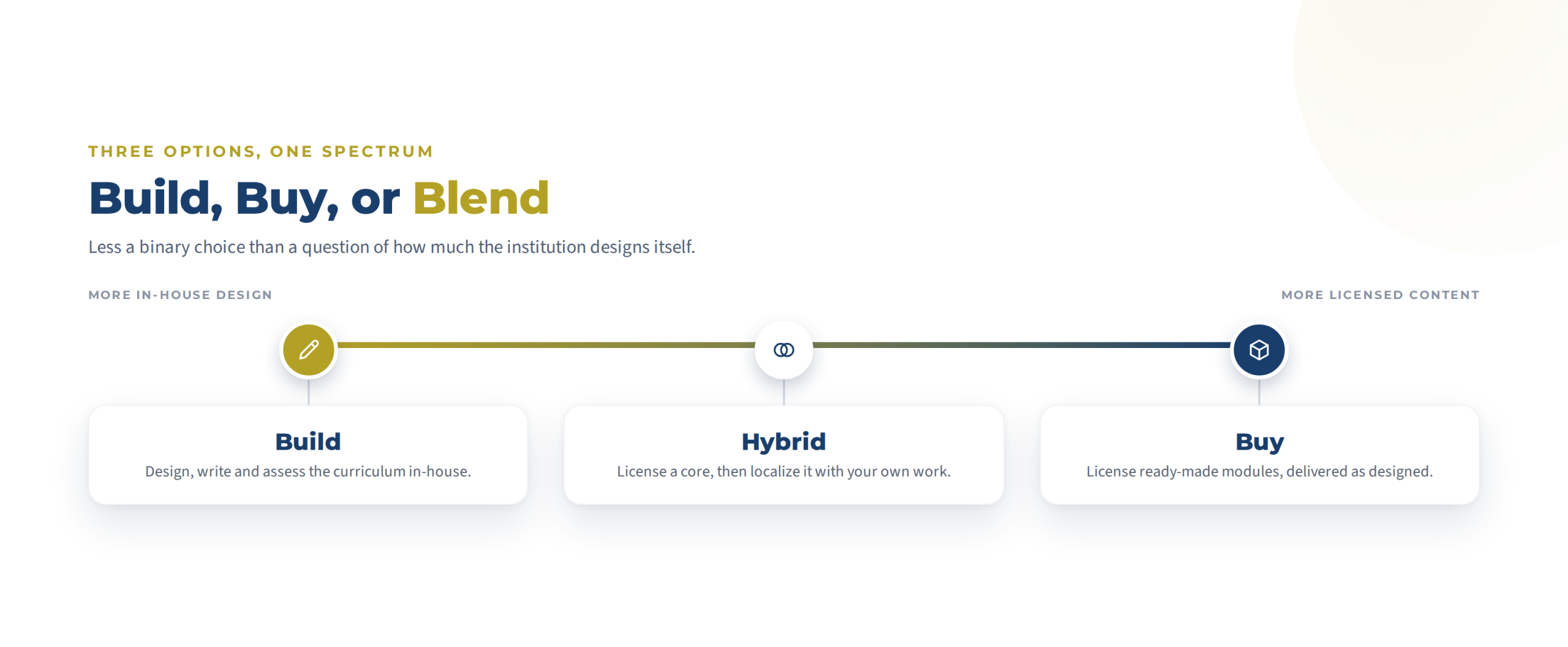
Universities can choose from three digital skills curriculum models: build, buy or hybrid. Bangun means designing, writing and assessing the curriculum in-house. For example, a computing faculty creates its own data analytics sequence around local industry relationships. Buy means licensing ready-made modules and delivering them as designed, for example licensing a cybersecurity module library and scheduling them into existing programs.
Hibrida means licensing a core and localizing it, for example taking licensed data modules and adding a locally designed capstone project and assessment. The licensed vs in-house curriculum choice is therefore less a binary than a spectrum of how much the institution designs for itself.
What Criteria Should a University Use to Compare Them?
Six criteria support a fair buy vs build curriculum comparison. Cost should be judged as total cost of ownership over a multi-year horizon that matches the institution’s planning cycle, not as a first-year figure.| Criterion | Bangun | Buy | Hibrida |
|---|---|---|---|
| Total cost of ownership | Cost concentrated up front, plus recurring refresh as technology changes | Recurring license plus local delivery cost | License for the core, plus the cost of local additions |
| Keeping content current | Institution is responsible for updates | Depends on the provider’s update cadence, so confirm it | Provider maintains the core; institution maintains the local layer |
| Quality and assessment control | Design and assessment rest with the institution | Limited to what the license permits | Institution controls local projects and assessment |
| Accreditation and awarding route | Follow the institution’s applicable internal and external approval route | Confirm the awarding or credit route with the awarding body and review the license terms | Confirm the licensed core’s route and approve local additions under applicable institutional and awarding-body requirements |
| Faculty capacity | Faculty time needed for design, build and upkeep | Faculty time still needed for delivery and contextualization | Faculty time needed for the local layer and delivery |
| Differentiation | Scope to reflect the institution’s own strengths | Content may be shared with other licensees; differentiation comes from delivery | Differentiation through local projects and assessment |
The table shows directional tendencies, not measurements. Test each cell against real quotes, faculty workloads, and the awarding body’s requirements.
When Does Building Make Sense, and When Does Buying?
Building tends to suit institutions with distinctive research or industry strengths they want to teach, in fields that change slowly enough for faculty to keep content current. Buying tends to suit fast-moving technology skills, where tools change quickly, or areas where the faculty capacity is stretched.
A hybrid suits institutions that want a ready foundation but need the course to reflect local industry and their own standards, licensing the core and adding local projects, assessment and context. These signals are not decisive alone: a fast-changing field with a strong in-house team may still point toward building or a hybrid. The decision can also be made program by program rather than once for the whole institution.
What Hidden Costs Can Institutions Overlook?
Beyond the initial development or license fee, universities should account for five ongoing or supporting costs:- Refresh cycles: content must be kept current, through the institution’s own updates or a provider’s cadence, and that effort can recur as tools change
- Faculty time: design, review, delivery, mentoring and contextualization draw on faculty hours
- Assessment design: licensed and in-house content can both need local assessment work and moderation
- Tooling and licenses: platforms, software and lab environments the modules depend on
- Quality assurance: internal review, awarding body requirements and ongoing monitoring of learner outcomes
What Questions Should You Ask Before Deciding?
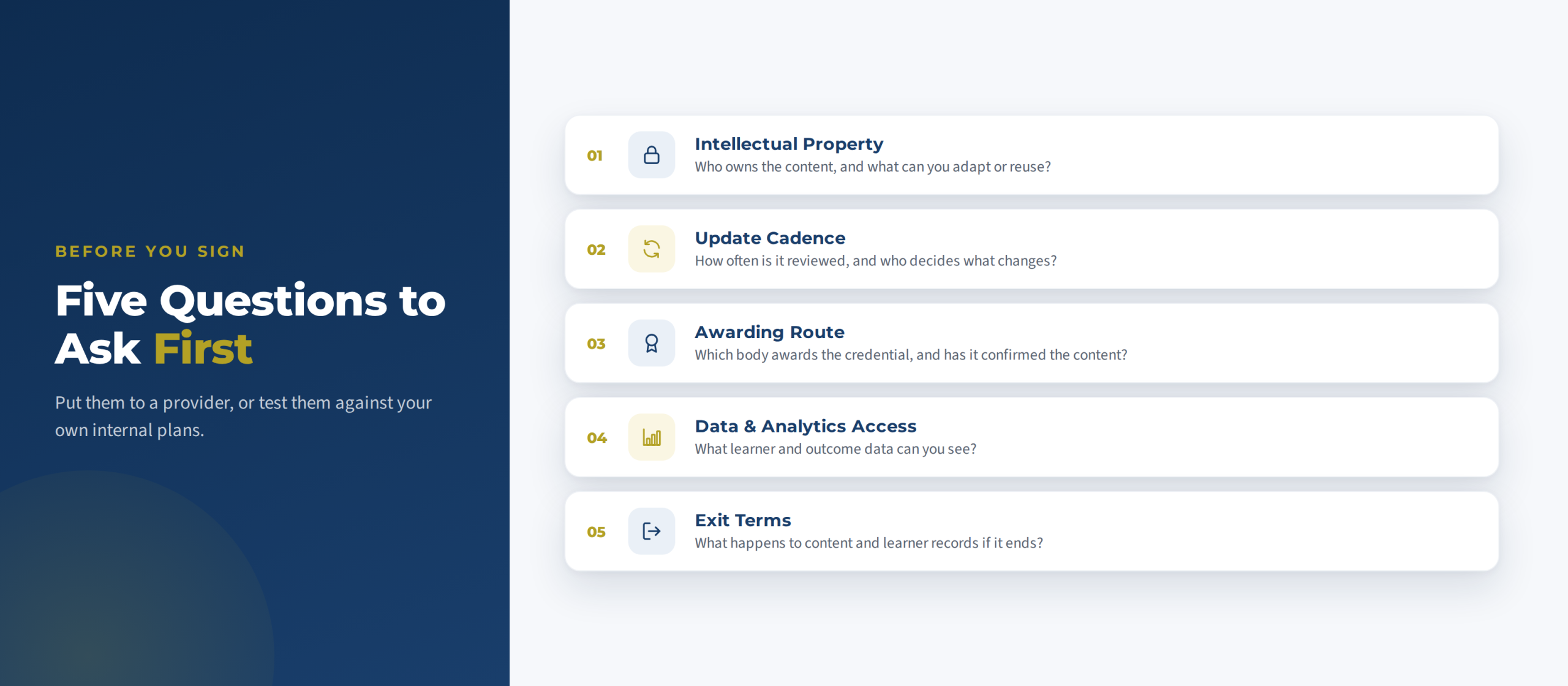
Whichever route is under consideration, these questions can be put to a provider or tested against internal plans:
- Intellectual property: who owns the content, and what can the institution adapt or reuse?
- Update cadence: how often is content reviewed, and who decides what changes?
- Awarding route: which body awards the credential, and has it confirmed how this content counts?
- Data and analytics access: what learner and outcome data can the institution see?
- Exit terms: what happens to content access, learner records and delivery if the arrangement ends?
Pertanyaan umum
Is it cheaper to build or buy a digital skills curriculum?
Neither is universally cheaper. Building front-loads spending and adds a recurring refresh expense as technology changes, while buying shifts it toward a recurring license fee plus local delivery.[BS3.1] The fair comparison is total cost of ownership over a multi-year period matching the institution’s planning horizon, including faculty time, assessment design and keeping content current.
Can a university mix both approaches?
Yes. A hybrid route licenses a core and adds local projects, assessment and context, and the mix can be set program by program.
Who owns the intellectual property when you buy?
It depends on the license, so read the terms before signing. Ownership, adaptation and reuse rights can differ between providers.
How does accreditation work with bought content?
The awarding or credit route must be confirmed with the awarding body for the specific content and program. Licensing content does not by itself settle how it counts toward a qualification.
How often should digital skills content be refreshed?
There is no verified standard interval. Frequency should follow how quickly the underlying tools change, with responsibility for each update agreed up front.
Further reading: For universities exploring the buy or hybrid approach, CLaaS2SaaS offers CLaaS® Academy, a ready-made modular digital skilling library that can provide a foundation for digital skills curriculum delivery and local adaptation.
Bagikan


Ingin tahu apakah karier ini cocok untuk Anda?