Why Digital Economy Transformation Requires Collaboration Between Government, Education, and Industry
Why Digital Economy Transformation Requires Collaboration Between Government, Education, and Industry
အကြောင်းအရာ
အကြောင်းအရာ
A digital economy transformation strategy works best when policy, skills development, and business needs move in the same direction. Government can provide policies, funding, infrastructure, and clear rules. Education providers prepare people for changing jobs. Employers show which roles, technologies, and skills are becoming more important.
Problems emerge when these efforts are disconnected. Governments may fund training that does not match workforce demand. Universities and technical and vocational education and training (TVET) providers may update courses without enough industry input. Businesses may invest in technology but struggle to find people with the skills to use it.
Collaboration connects these efforts so workforce development and technology investment contribute to shared economic goals.
What Do Government, Education, and Industry Each Bring to a Digital Economy Strategy?
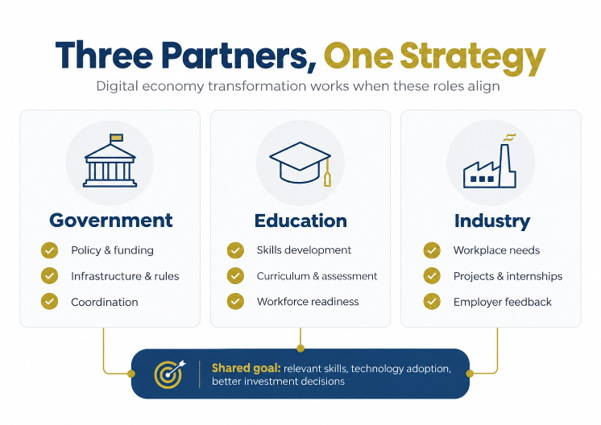
Government sets direction. Public agencies shape digital policy, invest in infrastructure, coordinate institutions, fund priority programs, and establish rules for areas such as data, cybersecurity, and artificial intelligence.
Education providers develop skills. Universities, polytechnics, TVET institutions, and training providers translate workforce needs into learning, assessment, and practical application while maintaining academic standards.
Industry provides current workplace insight. Employers understand how technology is changing jobs, tools, and processes. They can contribute projects, workplace experience, skills requirements, and feedback.
For institutions strengthening this connection, CLaaS2SaaS’s AI-First Higher Education Transformation focuses on skills-first learning, adaptive delivery, and stronger alignment with changing workforce needs.
What Happens When These Three Actors Move in Isolation?
The challenge is often not a lack of activity, but a lack of alignment. Government can introduce a national digital economy strategy and fund new initiatives, but those programs may have limited impact when workforce demand is unclear.
Education providers may introduce digital subjects, but curriculum cycles can move more slowly than technology. Employers understand immediate skills gaps, but individual companies cannot build national infrastructure or workforce systems alone.
At the organizational level, CLaaS2SaaS’s AI-First Adaptive Enterprise Transformation connects workforce capability, AI adoption, automation, and operational transformation. Public-private digital transformation therefore depends on defined roles and ongoing coordination rather than separate initiatives moving in different directions.
What Does a Coordinated Digital Economy Transformation Strategy Look Like?
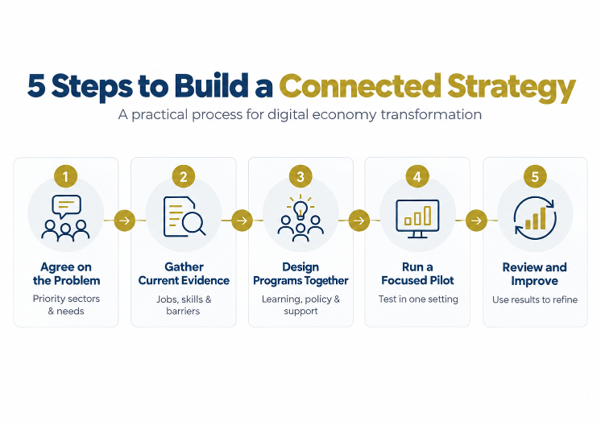
A coordinated strategy can begin with five practical steps:- Define the challenge. Identify the workforce, industry, community, or technology problem to solve.
- Use current evidence. Review skills demand, employment trends, training capacity, and barriers to technology adoption.
- Design together. Translate evidence into relevant learning, policy actions, employer participation, and support.
- Pilot the approach. Test with a defined sector, institution, region, or learner group.
- Review and improve. Measure results and adjust before expanding.
How Indonesia Is Moving From Digital Adoption to Impact
Indonesia illustrates why digital transformation must connect systems, skills, and economic needs. The Ministry of Communication and Digital Affairs reports approximately 27,000 applications across central and regional government agencies that need greater integration. The government is pursuing a more connected digital-government architecture to reduce duplication and improve how systems and data work together.
Workforce capability is another major challenge. Komdigi projects that Indonesia will require 12 million digital talents by 2030, with a gap of about 3 million. These priorities show that digital transformation involves more than building additional technology. It requires integrated systems and enough skilled people to develop, manage, and apply that technology effectively.
For government, education providers, and employers, the shared challenge is ensuring that digital infrastructure, workforce development, and industry adoption advance together.
How Do You Measure Success Across Three Different Stakeholders?
Partners should determine success measures before major programs begin. The measures should match the initiative rather than relying on activity counts alone, so it could show whether priority skills gaps are closing and whether programs improve based on evidence.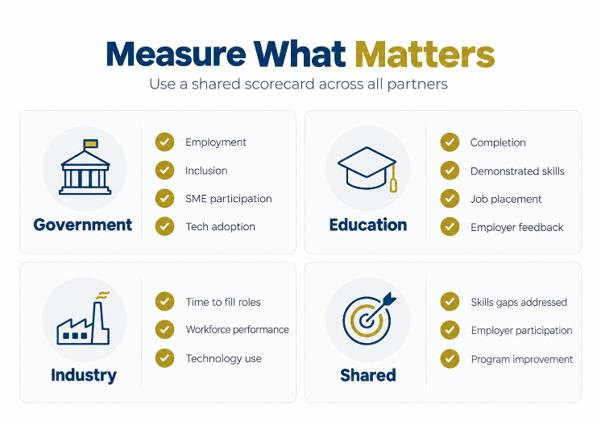
For example, CLaaS2SaaS SME Upskilling for Self-Service Transformation focuses on practical AI, data, and automation skills employees can apply to workplace challenges. Using several relevant measures helps partners assess whether an initiative is producing meaningful outcomes rather than activity alone.
What Is the Path Forward for Regions Starting This Collaboration?
Regions can begin by identifying a priority economic or workforce challenge and bringing the organizations responsible for policy, learning, and employment into the same conversation. This creates a practical starting point without repeating separate discussions about data, ownership, and employer input across every stage.
CLaaS2SaaS supports this connected approach through its Digital Economy Transformation ecosystem, linking workforce transformation, innovation acceleration, SME growth, AI adoption, and broader digital-economy participation.
In February 2026, CLaaS2SaaS joined a regional forum in Laguna, Philippines, where more than 200 participants from 70 private schools convened alongside institutional leaders and government representatives. The forum focused on skills-first, workforce-aligned education and preparing learners for an AI-enabled economy.
Build a More Connected Digital Economy Strategy
A successful digital economy strategy is more than a policy document, training program, or technology investment. When government, education, and industry work toward connected goals, regions can better align workforce skills with economic needs, strengthen technology adoption, and make more informed investments. This alignment also makes it easier to identify gaps early, adapt programs as workforce needs change, and focus public and private resources on initiatives that can deliver practical value.
Planning a regional workforce or digital-economy initiative? Book a 1:1 Consultation to explore how government, education, and industry partners can build a more connected approach.
မျှဝေပါ


ဒီအလုပ်ကသင့်အတွက်လားဆိုတာ စစ်ဆေးချင်ပါသလား?