How AI-Powered CRM Helps Enterprises Create More Personalized Customer Experiences
How AI-Powered CRM Helps Enterprises Create More Personalized Customer Experiences
Nội dung
Nội dung
AI-powered CRM helps enterprises create more personalized customer experiences by augmenting static, manually segmented customer records with dynamic, behavior-based insights that update continuously as a customer’s activity changes.
For enterprises managing large customer bases, manually personalizing every interaction is difficult to sustain. Static segments and periodic reviews may not keep pace with changing customer behavior across channels and touchpoints.
The Limits of Traditional CRM for Personalization
Many traditional CRM or lightly configured CRM deployments depend heavily on static fields and periodically updated customer segments. These records may become outdated as customer behavior and needs change between review cycles.
Manual segmentation compounds this problem, since a human analyst updating segments periodically can’t realistically process real-time behavioral signals across an enterprise-scale customer base, leaving segments perpetually a step behind actual customer behavior.
An enterprise with tens of thousands of accounts might realistically re-segment its customer base periodically through manual review, meaning behavioral shifts between review cycles can go unnoticed until the next scheduled update.
The problem isn’t that the representative made a poor judgment call; it’s that the system feeding them information was never built to reflect a customer base whose behavior shifts continuously rather than on a quarterly cycle.
What Changes When AI Is Layered Into CRM?
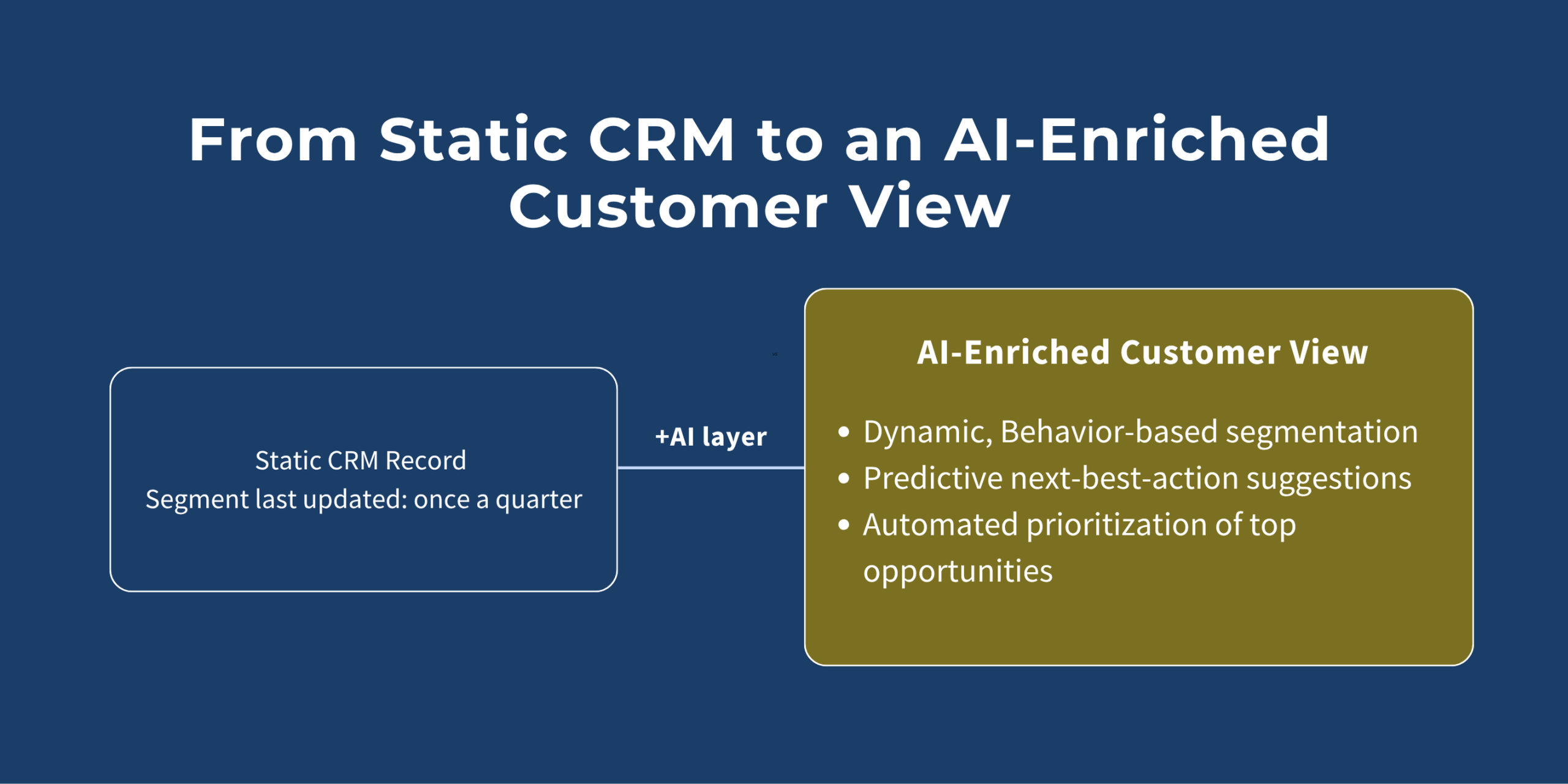
Layering AI into CRM changes this dynamic directly.- Dynamic, behavior-based segmentation replaces static fields, continuously updating a customer’s segment based on their actual, current activity rather than a snapshot taken months earlier.
- Predictive next-best-action suggestions give a sales or service representative a specific, data-driven recommendation for what to do next with a given customer, rather than leaving that representative to guess based on incomplete information.
- Automated prioritization surfaces the highest-value opportunities across the customer base automatically, rather than requiring a representative to manually sort through accounts looking for which ones deserve attention first.
- Governed agent workflows across sales, service, and marketing: AI agents can act on customer signals by initiating follow-ups, coordinating tasks, or triggering the appropriate workflow across sales and service, rather than leaving representatives to manually execute every recommended action.
What Does More Personalized Customer Experience Actually Look Like?
More personalized customer experience, once AI is layered into CRM, looks like several concrete changes in how an enterprise actually interacts with customers. Communication timing and content adjust based on each customer’s individual behavior pattern, rather than every customer in a segment receiving the same message on the same schedule regardless of their individual engagement pattern.
Proactive outreach happens before a churn signal worsens, since the CRM surfaces an early warning sign, such as declining engagement, in time for a representative to intervene rather than only noticing the problem after the customer has already largely disengaged.
Experience stays consistent across sales, service, and marketing touchpoints, since all three functions draw from the same AI-enriched customer view rather than each function working from its own separate, potentially conflicting picture of the same customer.
A concrete scenario shows this shift in practice. A customer whose product usage has quietly declined over the past month, a pattern invisible in a static CRM field showing only their original purchase date and tier, gets flagged automatically by an AI-enriched CRM based on that declining usage pattern.
A customer-success representative receives the alert with supporting context and a recommended next action, allowing the team to investigate and respond before declining engagement develops into an explicit cancellation request.
Where permissions and governance controls allow, an AI agent may prepare a follow-up, route the account to the appropriate team, or initiate a workflow for representative approval.
What Should Enterprises Evaluate Before Adopting AI CRM?
Enterprises evaluating AI CRM should assess several factors before adopting it. Data quality prerequisites matter first, since an AI layer built on top of incomplete or inconsistent CRM data will produce recommendations no more reliable than that underlying data allows.
Integration with existing systems matters second, since an AI CRM capability that requires replacing systems already in use across sales, service, and marketing introduces far more disruption than one designed to enhance an existing CRM investment.
Human oversight of AI-suggested actions matters third, since a representative should retain the judgment to override an AI recommendation that doesn’t fit a specific customer’s actual situation, rather than treating every AI suggestion as an instruction to follow automatically without question.
You should also evaluate whether AI agents can translate customer signals and recommendations into governed workflows across sales, service, and marketing, rather than simply displaying insights for employees to act on manually.
An enterprise that skips the data-quality assessment and moves straight to evaluating AI features often discovers only after implementation that the AI layer’s recommendations are unreliable, not because the AI itself is flawed, but because it was built on top of the same incomplete data that made manual personalization difficult in the first place.
A vendor should be able to walk through exactly how its AI handles that kind of conflict, including which signals it considers, how the recommendation is generated, and what level of human oversight applies to the resulting action. Ask them to demonstrate how the system handles conflicting signals, which data influences its recommendation, and when human approval is required.
The Bigger Picture: Personalization as a Retention Strategy
Personalization becomes more valuable when it can operate consistently across a large customer base and multiple touchpoints. By continuously interpreting customer signals and surfacing or executing relevant actions, AI-powered CRM can help sales, service, and marketing teams respond to changing customer needs without relying entirely on manual segmentation and review cycles.
Within an AI-First Adaptive Enterprise, Agentic CRM becomes part of a broader intelligence foundation where customer context can move across systems, teams, and workflows rather than remaining trapped in a static CRM record.
Chia sẻ


Bạn muốn kiểm tra xem nghề nghiệp này có phù hợp với mình không?