Master Python for AI: Build Intelligent Applications
Master Python for AI: Build Intelligent Applications
Content
Content
Python has become one of the most practical entry points into Asia’s digital economy because it is no longer just a programming language but has become the foundation for building AI-powered applications and data-driven systems. Across industries such as fintech, e-commerce, and enterprise technology, Python skills are consistently linked to roles in data science, software development, and automation. Professionals who can apply Python to develop AI solutions or generate business insights are moving into some of the fastest-growing and highest-value roles.”
As demand for Python skills grows across Asia, platforms like CLaaS2SaaS are increasingly structuring learning pathways around real career outcomes, combining technical training with applied projects and AI-driven capabilities. This reflects a broader shift from traditional learning models toward skills-based, employment-focused education.
While these figures are specific to Singapore, they serve as a useful reference point for the rest of Asia. Markets such as Indonesia, India, and Malaysia may have different salary ranges, but the structure of career progression and the demand for Python skills remain largely consistent. This makes choosing the right python course singapore not just relevant locally, but also valuable as a benchmark for building a career across the region.
Python Career Tracks: Data Science vs Web Development vs Automation
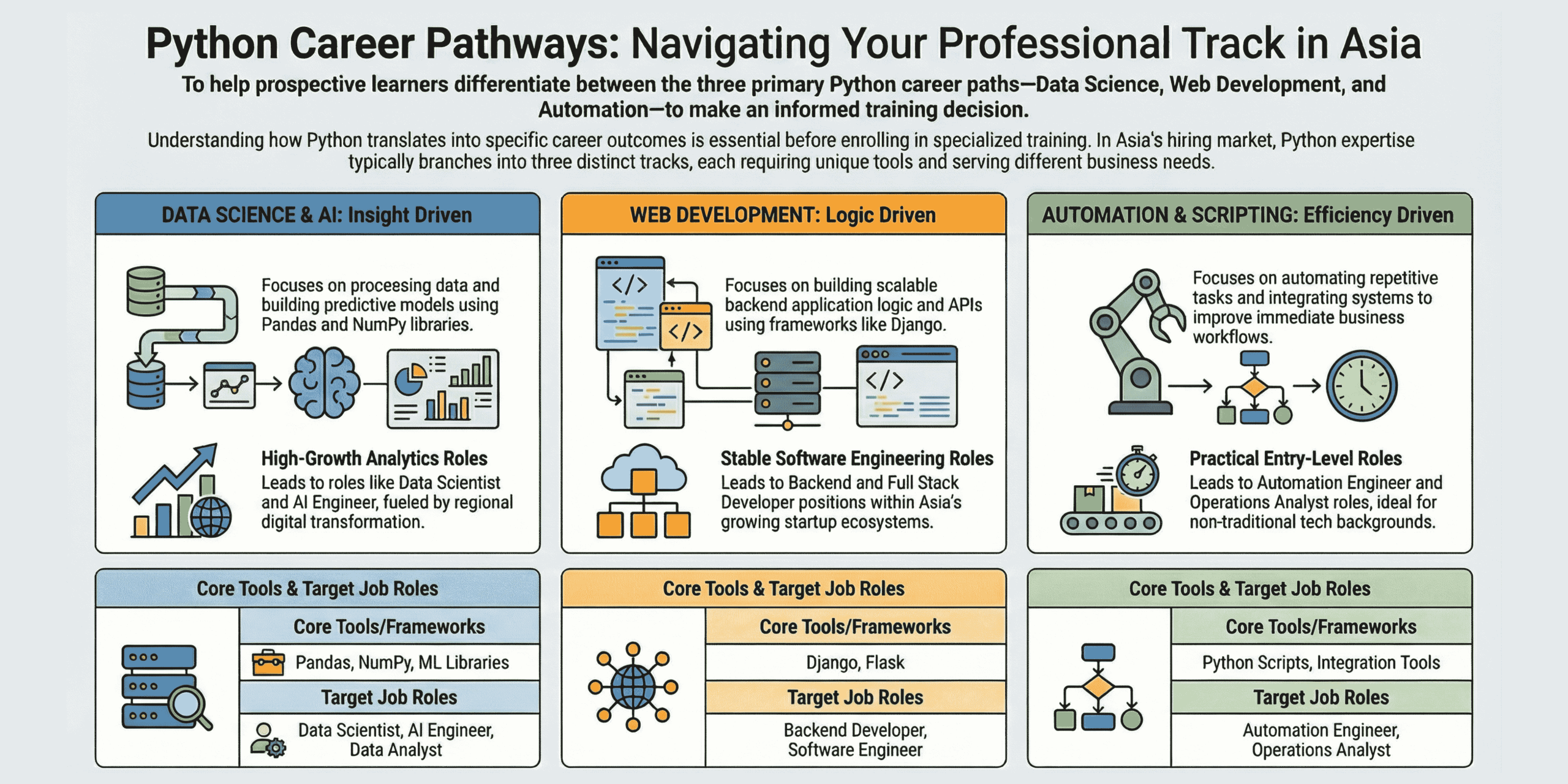
Before enrolling in a python programming course singapore, it is important to understand how Python translates into actual career paths. Across Asia, three primary tracks dominate hiring demand, each requiring a different set of applied skills and leading to distinct job roles.
Data Science and AI
Web Development
Python also plays a significant role in backend web development, where it is used to build scalable applications and systems. Instead of focusing on data, this track emphasizes application logic, APIs, and database integration. While web development remains relevant, its primary value in this context is enabling AI-powered applications, such as dashboards, APIs, and intelligent systems.
Career outcomes include Backend Developer, Full Stack Developer, and Software Engineer. These roles align closely with the broader demand for software engineer positions and are equally relevant across Asia’s growing startup and tech ecosystems. As more companies build digital platforms, backend development continues to be a stable and high-demand career path.
Automation and Scripting
Automation is often the most immediately applicable Python skill, especially for professionals who are not from a traditional tech background. Instead of building full applications, this track focuses on using Python to automate workflows and integrating systems, for learners to begin building intelligent applications that can scale decision-making and execution.
Roles on this track include Automation Engineer and Operations Analyst. Across Asia, this pathway is particularly valuable in industries that are undergoing rapid digitalization, where efficiency improvements can deliver immediate business impact. It is also a practical starting point for professionals looking to transition into more technical roles over time.
SG Python Developer Salary by Experience Level
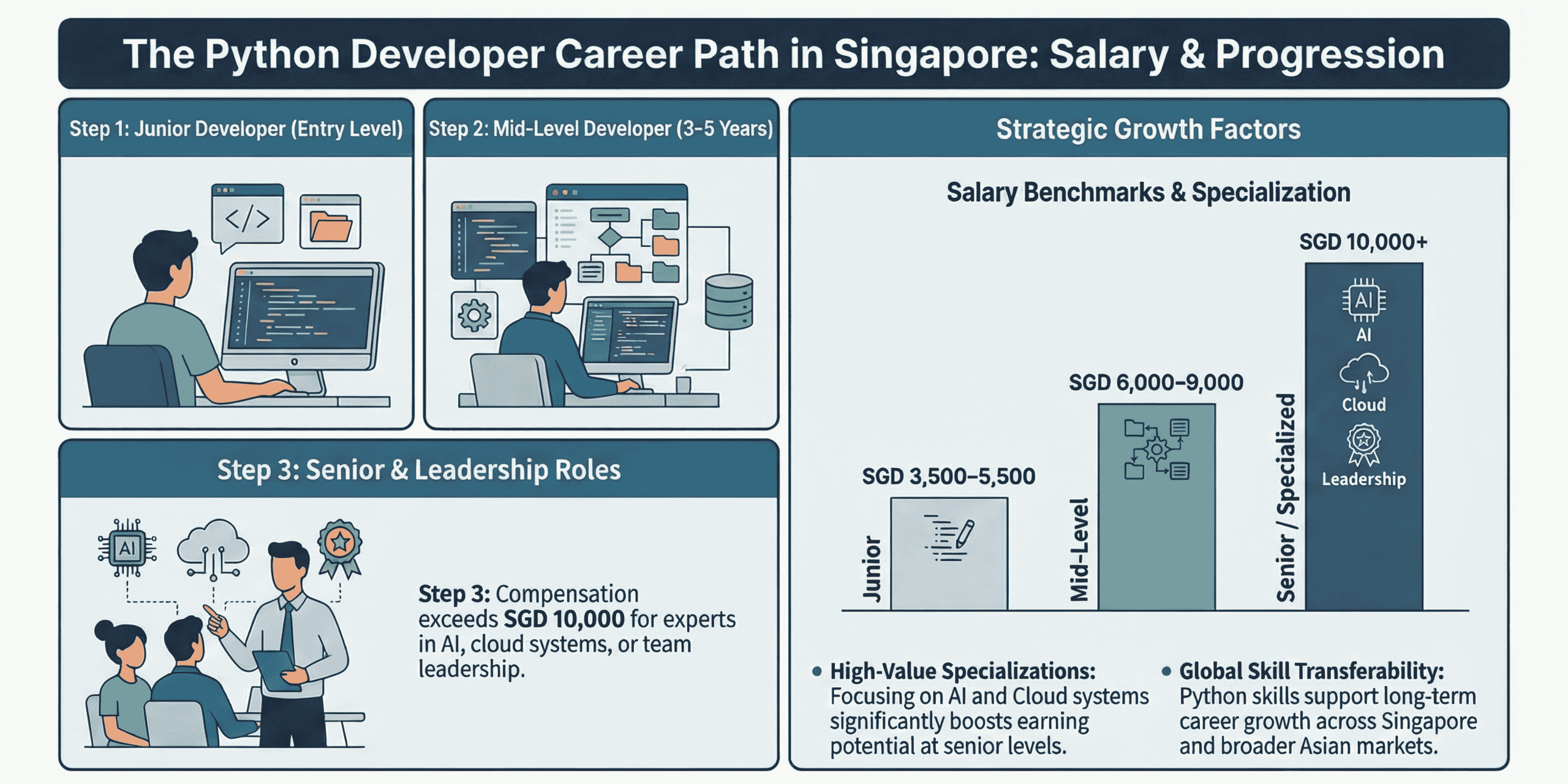
Salary benchmarks are one of the key reasons learners consider coding courses as a starting point. Data from JobStreet, supported by broader workforce insights linked to Ministry of Manpower, provides a reliable view of how Python roles progress over time.
At the junior level, professionals typically earn between SGD 3,500 and 5,500 per month while focusing on foundational coding and basic project work. Mid-level professionals, with three to five years of experience, can expect salaries ranging from SGD 6,000 to 9,000 as they take on more complex systems and specialization. At the senior level, salaries often exceed SGD 10,000, especially for those working in AI, cloud systems, or leadership roles.
Disclaimer: Salary ranges may vary depending on factors such as location, industry, company size, and individual experience level.
While salary levels differ across Asia, the progression model remains consistent. This reinforces the idea that Python is a transferable skill that supports long-term career growth across multiple markets.
Who Should Attend
A python course for beginners is designed for a broad range of learners, particularly those looking to enter or transition within the tech industry. One of Python’s key advantages is its accessibility. It allows individuals with no prior programming experience to start building practical skills that can quickly translate into real-world applications.
For career switchers, Python offers a structured pathway into roles such as data analysis, software development, or automation without requiring a formal background in computer science. This is especially relevant across Asia, where many professionals are transitioning into digital roles as industries evolve.
Fresh graduates also benefit from Python training, as it helps bridge the gap between academic knowledge and industry expectations. By working on hands-on projects, they can build a portfolio that demonstrates their capabilities to employers. Meanwhile, working professionals can use Python to automate repetitive tasks, analyze business data, and improve efficiency in their current roles.
Across the region, Python is widely adopted as a first programming language because it balances ease of learning with strong career outcomes, making it suitable for both beginners and those looking to upskill.
Program Overview
Modern programming courses singapore are increasingly focused on employability rather than theoretical learning. The goal is to ensure that learners can apply their knowledge in real job scenarios rather than just understand concepts in isolation.
With CLaaS2SaaS, the program is structured around competency-based learning, in an applied AI pathway, where learners progress from Python fundamentals to building intelligent applications and data-driven systems. Through work-integrated projects, learners apply their skills to real business scenarios.
Another key feature is the integration of AI-powered learning tools, which provide personalized feedback and adaptive learning paths. This helps learners progress more efficiently, regardless of their starting level. In addition, work-study pathways allow learners to gain practical experience while learning, making the transition into employment smoother.
The program also incorporates stackable credential pathways, allowing learners to build their qualifications progressively. Instead of committing to a single long-term program, learners can accumulate certifications over time, moving from foundational Python skills into more advanced areas such as data science, software development, or AI. This flexible structure supports continuous upskilling and aligns with the evolving demands of the digital economy.
Learning Objectives
By completing a structured Python course, learners develop practical capabilities that go beyond basic coding. The focus is on using Python as a tool to solve real problems across different domains.
Learners begin by mastering the fundamentals of writing clean, efficient code. As they progress, they gain the ability to build applications, work with real-world datasets, and integrate systems through APIs. These are essential skills for roles in software development, data analysis, and automation.
For those pursuing more advanced pathways, the program introduces machine learning concepts, enabling learners to understand how Python is used in AI applications. This progression ensures that learners are not only job-ready but also prepared for future developments in technology.
Curriculum by Module
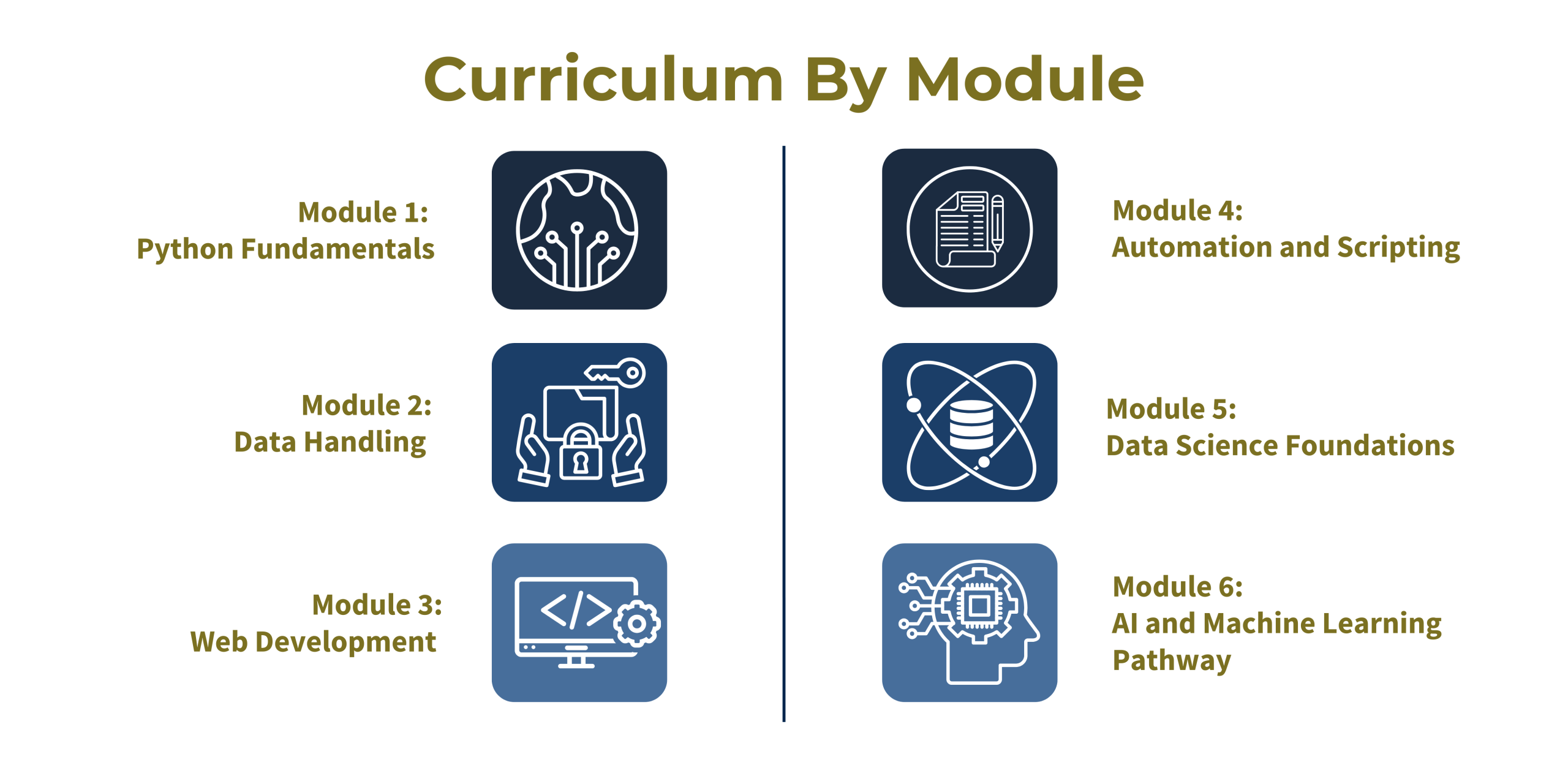
A strong curriculum ensures both breadth and depth with AI capabilities introduced progressively across modules, not treated as a standalone topic, ensuring learners continuously build toward real-world AI applications.
Module 1: Python Fundamentals
- Variables, data types, operators
- Control flow and loops
- Functions and modular programming
Module 2: Data Handling
- File input and output
- Data structures (lists, dictionaries)
- Data cleaning and preprocessing
Module 3: Web Development
- Flask or Django frameworks
- REST API development
- Database connectivity
Next Steps: Take Charge of Your Pathway
You’ve explored how associate degrees work in the Philippines, how they compare to bachelor’s programs, and how newer models like work-study pathways offer a different approach to achieving degree-level outcomes.
The next step is yours. Whether you’re:
- A student looking for a more affordable and flexible starting point
- A working adult aiming to upskill without pausing your career
- Or someone seeking a faster, more practical route to employment
What matters most is choosing a pathway that aligns with your timeline, budget, and career goals.
Traditional associate degrees provide a structured academic progression. But if your priority is to gain real-world experience earlier while working toward a full qualification, work-study degree models offer a more integrated alternative.
Programs like CLaaS2SaaS are designed around this approach—combining skills training, applied learning, and career support within a 2–3 year pathway aligned to bachelor-level outcomes.
Don’t let uncertainty delay your progress. The right pathway should give you clarity, flexibility, and a clear direction toward employment and growth.
Module 4: Automation and Scripting
- Task automation
- Web scraping
- Scheduling and system scripts
Next Steps: Take Charge of Your Pathway
You’ve explored how associate degrees work in the Philippines, how they compare to bachelor’s programs, and how newer models like work-study pathways offer a different approach to achieving degree-level outcomes.
The next step is yours. Whether you’re:
- A student looking for a more affordable and flexible starting point
- A working adult aiming to upskill without pausing your career
- Or someone seeking a faster, more practical route to employment
What matters most is choosing a pathway that aligns with your timeline, budget, and career goals.
Traditional associate degrees provide a structured academic progression. But if your priority is to gain real-world experience earlier while working toward a full qualification, work-study degree models offer a more integrated alternative.
Programs like CLaaS2SaaS are designed around this approach—combining skills training, applied learning, and career support within a 2–3 year pathway aligned to bachelor-level outcomes.
Don’t let uncertainty delay your progress. The right pathway should give you clarity, flexibility, and a clear direction toward employment and growth.
Module 5: Data Science Foundations
- Pandas and NumPy
- Data visualization tools
- Introductory machine learning
Next Steps: Take Charge of Your Pathway
You’ve explored how associate degrees work in the Philippines, how they compare to bachelor’s programs, and how newer models like work-study pathways offer a different approach to achieving degree-level outcomes.
The next step is yours. Whether you’re:
- A student looking for a more affordable and flexible starting point
- A working adult aiming to upskill without pausing your career
- Or someone seeking a faster, more practical route to employment
What matters most is choosing a pathway that aligns with your timeline, budget, and career goals.
Traditional associate degrees provide a structured academic progression. But if your priority is to gain real-world experience earlier while working toward a full qualification, work-study degree models offer a more integrated alternative.
Programs like CLaaS2SaaS are designed around this approach—combining skills training, applied learning, and career support within a 2–3 year pathway aligned to bachelor-level outcomes.
Don’t let uncertainty delay your progress. The right pathway should give you clarity, flexibility, and a clear direction toward employment and growth.
Module 6: AI and Machine Learning Pathway
This is where Python becomes a gateway into high-value careers.
Real Project Examples from Curriculum
Hands-on projects are a critical component of effective Python training, as they allow learners to apply their knowledge in realistic scenarios. Employers increasingly value candidates who can demonstrate practical experience, making project work an essential part of any program.
At CLaaS2SaaS, learners work on projects that reflect real business use cases. These projects simulate real business scenarios, such as predicting customer churn or building AI-driven automation tools, enabling learners to develop deployable solutions rather than theoretical models.
Other projects include developing web-based systems, creating automation tools for reporting, and building AI chatbot prototypes. These experiences help learners develop not only technical skills but also problem-solving and analytical thinking, which are highly valued by employers.
Assessment Details
Assessment in modern Python courses is designed to evaluate practical skills rather than theoretical knowledge. Instead of traditional exams, learners are assessed through coding assignments, project submissions, and a capstone project.
The capstone project is particularly important, as it requires learners to integrate everything they have learned into a single solution. This often involves solving a real-world problem and serves as a key portfolio piece that can be presented to potential employers.
In many programs, learners also receive feedback from instructors or peers, helping them refine their work and improve their approach. This mirrors real workplace environments, where collaboration and iteration are essential.
Fee Table & Funding Options
Singapore provides a strong benchmark for funding support through SkillsFuture Singapore, which enables learners to access high-quality training at reduced costs. Depending on eligibility, subsidies can cover up to 70 percent of course fees, or up to 90 percent for mid-career individuals.
While this funding model is specific to Singapore, it reflects a broader trend across Asia, where governments and institutions are investing in upskilling initiatives. Countries such as Indonesia, India, and Malaysia are also introducing programs to support digital skills development, making Python training increasingly accessible across the region.
Trainer Profiles
The quality of a Python course is closely tied to the expertise of its instructors. Strong programs are led by trainers with industry experience in areas such as software engineering, data science, or AI. This ensures that learners gain insights into real-world practices, tools, and expectations.
At CLaaS2SaaS, trainers combine technical expertise with teaching experience, helping learners understand not just how to code, but how to apply their skills in professional contexts.
Testimonials
Learners from different backgrounds consistently highlight the practical and career-transforming value of Python training. Beyond technical skills, structured programs provide the confidence, support, and real-world exposure needed to transition into the tech industry.
One example is Siti Nurazillah, who joined CLaaS2SaaS after facing nearly a year of job uncertainty following retrenchment. Despite having some informal exposure to the tech environment, she lacked structured learning and struggled with self-doubt about entering a technical field.
Through the program, she gained access to guided instruction, hands-on learning, and continuous support from lecturers and program managers. This structured approach helped her overcome the fear of coding and build confidence step by step. A key turning point came during her job preparation, where personalized coaching and a mock interview session helped her successfully secure a role at D Life Pro.
Her journey reflects a broader pattern seen across many learners. With the right support system, even those without a technical background can transition into data or IT roles. Today, Siti not only enjoys her work but also feels confident in her abilities, highlighting how Python training can lead to both professional and personal growth.
Similar outcomes are seen across Asia, where career switchers move into tech roles, graduates strengthen their employability through project portfolios, and working professionals improve productivity through automation. These experiences reinforce that Python is not just a technical skill, but a powerful tool for career transformation in a rapidly evolving job market.
Frequently Asked Questions (FAQs)
Which Python course is best in Singapore?
Can I use SkillsFuture for Python training?
How long does it take to learn Python?
Next Steps: Take Charge of Your Pathway
You’ve explored how associate degrees work in the Philippines, how they compare to bachelor’s programs, and how newer models like work-study pathways offer a different approach to achieving degree-level outcomes.
The next step is yours. Whether you’re:
- A student looking for a more affordable and flexible starting point
- A working adult aiming to upskill without pausing your career
- Or someone seeking a faster, more practical route to employment
What matters most is choosing a pathway that aligns with your timeline, budget, and career goals.
Traditional associate degrees provide a structured academic progression. But if your priority is to gain real-world experience earlier while working toward a full qualification, work-study degree models offer a more integrated alternative.
Programs like CLaaS2SaaS are designed around this approach—combining skills training, applied learning, and career support within a 2–3 year pathway aligned to bachelor-level outcomes.
Don’t let uncertainty delay your progress. The right pathway should give you clarity, flexibility, and a clear direction toward employment and growth.
What jobs can I get after a Python course?
Next Steps: Take Charge of Your Pathway
You’ve explored how associate degrees work in the Philippines, how they compare to bachelor’s programs, and how newer models like work-study pathways offer a different approach to achieving degree-level outcomes.
The next step is yours. Whether you’re:
- A student looking for a more affordable and flexible starting point
- A working adult aiming to upskill without pausing your career
- Or someone seeking a faster, more practical route to employment
What matters most is choosing a pathway that aligns with your timeline, budget, and career goals.
Traditional associate degrees provide a structured academic progression. But if your priority is to gain real-world experience earlier while working toward a full qualification, work-study degree models offer a more integrated alternative.
Programs like CLaaS2SaaS are designed around this approach—combining skills training, applied learning, and career support within a 2–3 year pathway aligned to bachelor-level outcomes.
Don’t let uncertainty delay your progress. The right pathway should give you clarity, flexibility, and a clear direction toward employment and growth.
What is the difference: Python for data science vs web development?
Conclusion
Python has established itself as a foundational skill across Asia’s digital economy, offering clear pathways into high-demand roles in data, software, and automation. While Singapore serves as a benchmark market with structured salaries and funding support, the underlying career opportunities extend across the region.
A strong python course Singapore should therefore be evaluated not just based on location, but on its ability to deliver real outcomes, including hands-on projects, AI-focused learning, and career progression. With CLaaS2SaaS, learners gain a structured pathway into roles that are relevant across multiple markets.
For anyone looking to transition into tech, increase earning potential, or future-proof their career, Python remains one of the most practical and impactful investments available today.