Data Analyst vs Data Scientist: Roles, Skills & Which to Choose
Data Analyst vs Data Scientist: Roles, Skills & Which to Choose

Content
Content
Should I become a data analyst or a data scientist? If you are researching a move into the data industry, this is usually the first real fork in the road, and the answer shapes everything from which skills you build to which roles you apply for. The difference between data analyst and data scientist roles comes down to scope: analysts explain existing data, while scientists build models to predict what comes next. But the comparison is actually more nuanced than it first appears: the roles share a foundation but diverge in tools, responsibilities, and seniority. This guide breaks both down clearly, so you can choose the path that fits your goals.
What a Data Analyst Does
Digital marketing is structured around a clear progression path. Each tier demands a broader skill set, greater strategic ownership, and crucially higher pay. Here is how the ladder breaks down.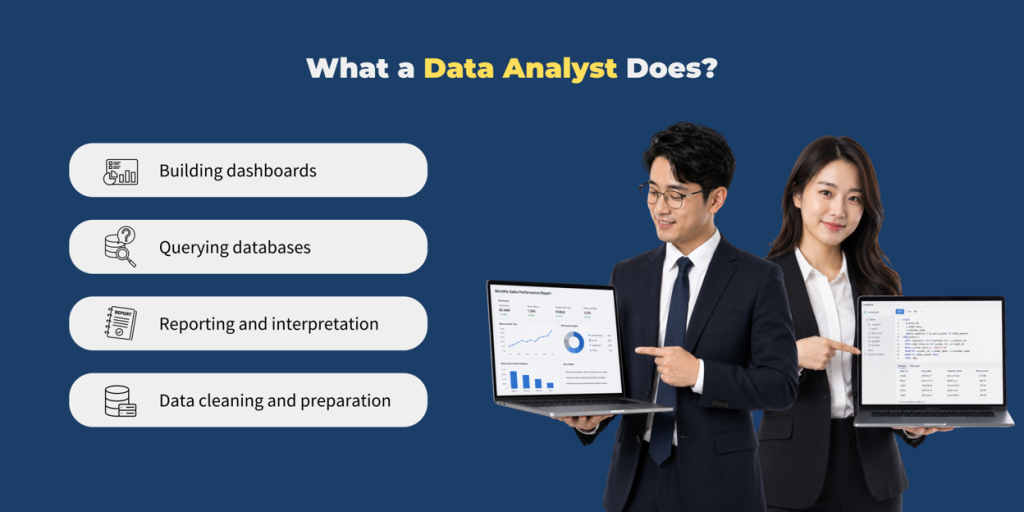
A data analyst’s core job is to answer business questions with existing data. They connect to databases, clean and query data, build dashboards and reports, and surface insights that help teams make faster, better-informed decisions.
Day-to-day work typically includes:
- Querying databases: Writing SQL to extract and filter data from structured sources, sales records, customer data, operational logs.
- Building dashboards: Visualising findings in Power BI or similar tools so stakeholders can track KPIs at a glance without needing a data background.
- Reporting and interpretation: Turning query results into clear narratives, what happened, why it happened, and what it means for the business.
- Data cleaning and preparation: Identifying gaps, errors, and inconsistencies in datasets before analysis begins.
Analysts answer the question ‘what happened and why?’ Their output is insight that supports decisions already being made by others. The role is highly collaborative, you work closely with marketing, finance, operations, and product teams and the value you create is immediate and visible. It is also one of the most accessible entry points into the data field, requiring strong logical thinking and tool fluency more than advanced mathematics.
Tier 1: Digital Marketing Executive
The entry point. You execute campaigns across channels, paid ads, content, social, email, using tools like Google Ads, Meta Ads, WordPress, HubSpot, and generative AI tools such as ChatGPT. Pay rises with every skill you can demonstrate in practice.
Tier 2: Digital Marketing Manager
Stepping into a management position brings one of the most significant increases in earning potential. A typical digital marketing manager salary reflects a major shift from execution to strategy—owning campaigns, managing budgets, mentoring junior marketers, and reporting on ROI. Proficiency in marketing automation, CRM, and data analysis is essential. Managers who show measurable results command the strongest packages.
Tier 3: Digital Marketing Head / Director
Marketing becomes a board-level function. You set strategy, lead a team of managers, and tie every campaign to business revenue. Many senior marketing leaders also pursue postgraduate qualifications to deepen their strategic and leadership capabilities. Pay varies most widely here, reflecting direct commercial impact.
What a Data Scientist Does
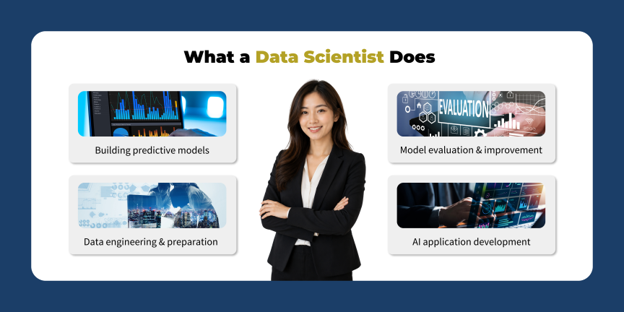
A data scientist goes a step beyond analysis into prediction and automation. Where an analyst interprets what has already happened, a data scientist builds models that forecast what is likely to happen next and creates systems that learn and improve over time.
Day-to-day work typically includes:
- Building predictive models: Using Python and machine learning algorithms, regression, classification, clustering to build models that forecast outcomes such as customer churn, demand, or risk.
- Data engineering and preparation: Working with larger, messier datasets that need significant processing before they are usable, often using cloud platforms such as AWS or Azure.
- Model evaluation and improvement: Testing models for accuracy, reducing bias, and iterating until performance meets the business requirement.
- AI application development: Applying techniques such as computer vision, NLP, and deep learning to build intelligent tools that automate real business tasks.
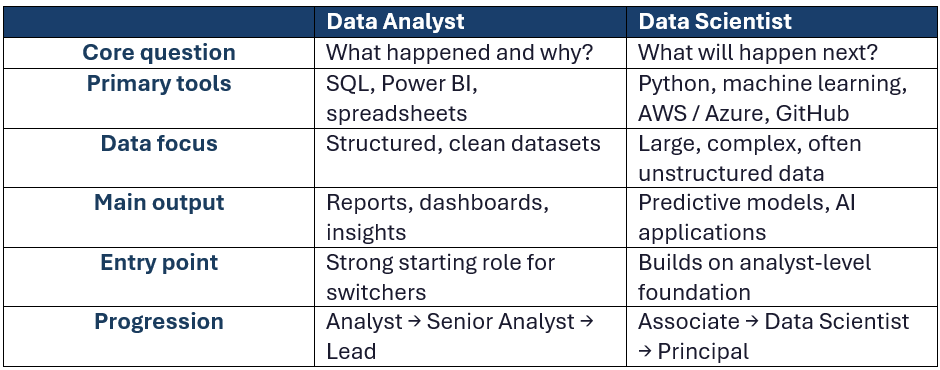
Analyst vs Scientist: A Side-by-Side Comparison
How to Choose and How to Get Started
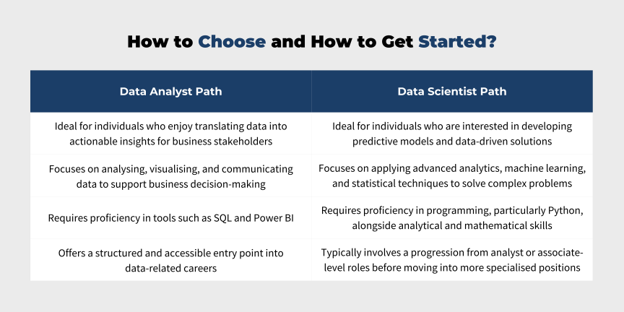
The right starting point depends on where your interests and background currently sit.
Choose the analyst path if: you are drawn to making data understandable for non-technical stakeholders, enjoy logical problem-solving, and want a clear, fast entry into data work. SQL and Power BI are learnable without a programming background, and the business impact of the role is immediate.
Choose the scientist path if: you are comfortable with (or excited to learn) programming in Python, interested in building systems that predict and automate, and want to work on larger, more technically complex problems. Expect to build up through an associate or analyst-level role first.
The good news is that these paths are not separate tracks, they are stages on the same ladder. Rather than preparing learners for only one role, the CLaaS2SaaS Data Science & AI Lifelong Learning Programme pathway develops progressively deeper capabilities, enabling career switchers to begin with data analytics and continue growing toward AI-driven data science roles.
Through work-integrated learning and industry-relevant projects, learners apply SQL, Power BI, Python, machine learning and cloud technologies to solve practical business problems while building a portfolio. The pathway supports progression from Data Science Associate to Data Scientist and Principal Data Scientist, so learners can start with analytics foundations and grow toward AI-driven data science roles.
Frequently Asked Questions
What is the difference between a data analyst and a data scientist?
A data analyst focuses on interpreting existing data to answer business questions, querying databases with SQL, building dashboards in Power BI, and turning numbers into clear insights and reports. A data scientist goes further, using Python, statistics, and machine learning to build predictive models and work with larger, messier datasets on cloud platforms. Analysts answer ‘what happened and why,’ while scientists also predict ‘what will happen.’ The CLaaS2SaaS Data Science & AI programme teaches the full toolkit, Python, SQL, Power BI, machine learning, and cloud, so you can start in an analyst-style role and progress toward data scientist.
Which pays more, data analyst or data scientist?
Data scientist roles are typically more senior and command higher pay, reflecting the deeper technical complexity of the work, particularly proficiency in Python, machine learning, and cloud platforms. That said, experienced analysts with strong domain expertise and tool mastery can progress quickly and earn competitively. Pay at both levels varies by country, industry, and the commercial impact of the role.
Do I need a degree to become a data scientist?
No. Many employers value demonstrated skills and a portfolio of real work alongside academic credentials. If you are wondering how to become a data scientist without a traditional degree, focus on Python, machine learning, SQL, Power BI and project work.
What skills does a data scientist need that an analyst doesn't?
The key differentiators are Python programming, machine learning (regression, classification, clustering, deep learning), statistical modelling, and experience working on cloud platforms such as AWS or Azure and using version control via GitHub. Analysts primarily work with SQL and visualisation tools; scientists need all of that plus the programming and modelling layer on top.
Can a data analyst become a data scientist?
Yes, and it is one of the most common progression paths in the data field. The analytical foundation (SQL, data interpretation, stakeholder communication) transfers directly. The step up involves adding Python proficiency, machine learning skills, and cloud platform experience. The CLaaS2SaaS programme’s Associate → Data Scientist → Principal Data Scientist ladder is designed specifically for this kind of structured progression. See the full pathway on the Data Science & AI programme page.
Ready to Start Your Data Career?
Whether you begin as a Data Analyst or aspire to become a Data Scientist, long-term success depends on continuously building new capabilities as technologies, business needs, and AI continue to evolve. Professionals who combine analytical thinking, applied experience, and lifelong learning are best positioned to grow throughout the modern data economy.
The CLaaS2SaaS Data Science & AI Lifelong Learning Programme is built for career switchers with zero IT experience, backed by job placement support and 2,000+ hiring company relationships.
Share


Want to check if this career is for you?