Digital Innovation Lead vs Consultant: Roles, Skills & Career Path
Digital Innovation Lead vs Consultant: Roles, Skills & Career Path
Content
Content
Should you aim to become an internal agent of change or an external advisor? For experienced professionals planning a move into senior digital transformation leadership roles, evaluating a digital innovation lead vs consultant path is a critical first step. While both tracks draw on a similar foundation of cutting-edge tech expertise, they require completely different operational mindsets.
Here’s how the two roles compare, and the leadership pathway that prepares you for either one.
What a Digital Innovation Lead Does
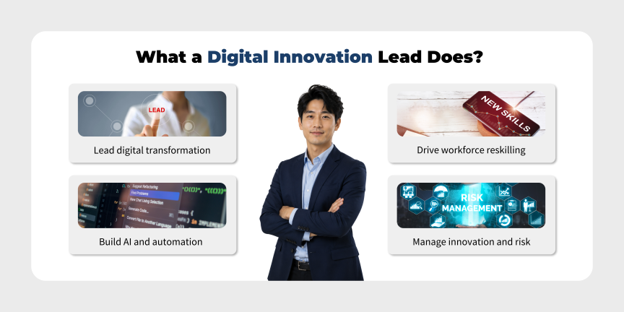
A Digital Innovation Lead is an internal driver of transformation, accountable for building and executing digital innovation initiatives from within a single organisation.
Where others advise, the Digital Innovation Lead acts. They own the agenda: setting direction, building AI-enabled systems, leading cross-functional teams, and carrying direct accountability for outcomes.
In practice, a Digital Innovation Lead is typically responsible for:
- Designing and executing an organisation-wide digital transformation roadmap
- Building AI and automation capabilities, using tools like Power Automate, M365 Copilot, and Power Virtual Agents
- Leading workforce transformation: closing skills gaps, redesigning processes, reskilling teams
- Governing innovation portfolios, managing risk, and reporting outcomes to senior leadership
- Translating data insights via Power BI into strategic decisions that move the business forward
What a Digital Innovation Consultant Does
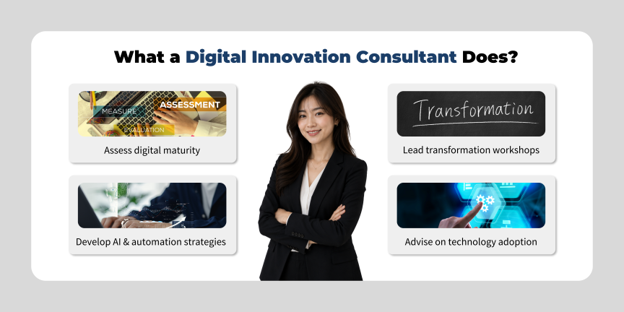
A Digital Innovation Consultant operates in an advisory or cross-organisational capacity, diagnosing, designing, and recommending transformation across multiple clients or functions, then equipping others to execute.
The role demands the same AI and transformation depth as the Lead, but pairs it with strong client communication and the ability to deliver strategic clarity across different organisational contexts.
In practice, a Digital Innovation Consultant is typically responsible for:
- Assessing digital maturity and identifying the highest-value transformation opportunities
- Designing AI adoption strategies, automation frameworks, and innovation roadmaps for each client
- Facilitating leadership workshops that build internal transformation capability
- Advising on governance, change management, and technology selection, from low-code platforms to AI-integrated data systems
- Translating data and AI insights into clear executive recommendations that drive investment decisions
Lead vs Consultant: Skills, Focus & Path
Both roles require the same foundational capability set. The difference lies in how those skills are applied.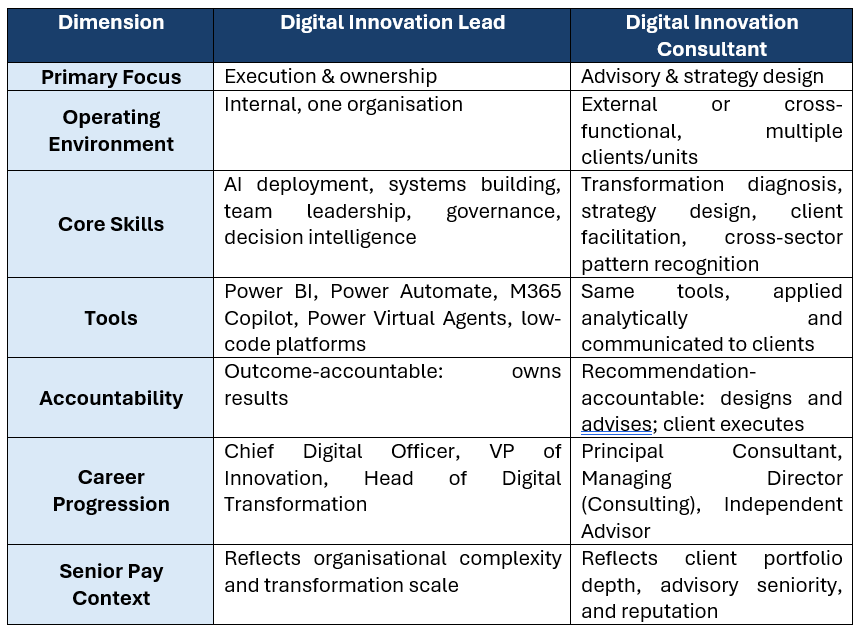
Neither role is inherently more senior than the other. In large corporates, a Digital Innovation Lead may carry significant P&L responsibility and lead transformation at enterprise scale. In consulting, a senior Digital Innovation Consultant may advise C-suite leaders across multiple sectors simultaneously. Context determines seniority, but both demand genuine AI leadership capability.
The critical point: capability alone is not enough.. Both roles require the ability to lead under uncertainty, govern transformation initiatives, and deliver measurable outcomes, the judgement and execution confidence that only comes from building real capability in real environments.
The Leadership Pathway to Both Roles
Whether you’re targeting a Lead or Consultant trajectory, the capability requirements converge on the same foundation: AI fluency, digital transformation depth, leadership and governance, and the credibility that a structured, internationally recognised credential provides.
The CLaaS2SaaS Digital Leadership pathway is designed precisely for experienced professionals making this move. Through a 4-month work-integrated learning journey, the programme develops hands-on capability across AI, automation, data analytics, low-code development, transformation leadership, decision intelligence, and governance, using tools like Power BI, Power Automate, M365 Copilot, and Power Virtual Agents.
Stackable professional certificates allow you to build and evidence capability at each stage, with the pathway laddering to an International Master of Business Administration, Digital Innovation & Entrepreneurship, awarded by Guglielmo Marconi University, Italy.
That combination, practical AI and transformation skills, built through work-integrated learning and validated by an international MBA, positions you for senior roles on either the Lead or Consultant path with both the capability and the credential to back it.
Frequently Asked Questions
What is the difference between a digital innovation lead and a digital innovation consultant?
A Digital Innovation Lead is typically an internal leader who owns and drives transformation inside an organisation, setting direction, building systems, leading teams, and being accountable for execution and outcomes. A Digital Innovation Consultant usually works in an advisory capacity, often across multiple clients or functions, diagnosing problems, designing transformation strategies, and recommending solutions for others to execute. The CLaaS2SaaS Digital Leadership pathway develops these capabilities through work-integrated learning and ladders up to an International MBA awarded by Guglielmo Marconi University, Italy, preparing you for either path.
How do I become a digital innovation leader?
Becoming a digital innovation leader requires building a combination of AI fluency, leadership capability, and hands-on transformation experience. Structured pathways, such as the CLaaS2SaaS digital leadership programme, develop these competencies through work-integrated learning, covering AI, automation, data analytics, low-code development, leadership, decision intelligence, and governance. Stackable credentials that ladder to an International MBA further strengthen your readiness for senior roles.
Does a digital innovation consultant need an MBA?
An MBA is not a mandatory requirement for every digital innovation consulting role, but it significantly strengthens credibility, especially at senior or cross-organisational levels where strategic advisory work demands both business acumen and transformation expertise. An International MBA grounded in digital innovation, like the one offered through the CLaaS2SaaS pathway (awarded by Guglielmo Marconi University, Italy), is particularly relevant because it ties academic rigour directly to AI, leadership, and transformation skills.
Which role is more senior — digital innovation lead or consultant?
There is no fixed hierarchy between the two roles — seniority depends on context, organisation size, and scope of responsibility. In corporate environments, a Digital Innovation Lead may carry P&L accountability and lead large transformation teams, making it a highly senior role. In consulting, a senior Digital Innovation Consultant may advise C-suite leaders across multiple organisations simultaneously. Both are high-impact, high-responsibility positions that require strategic thinking, AI capability, and leadership depth.
What skills do digital innovation roles require?
Senior digital innovation roles, whether Lead or Consultant typically require: AI and automation fluency (tools like Power Automate, M365 Copilot, Power Virtual Agents), data analytics and visualisation (Power BI), low-code application development, digital transformation leadership and governance, decision intelligence and strategic execution, and the ability to lead, influence, and mobilise cross-functional teams. The CLaaS2SaaS digital leadership pathway is built to develop these competencies.
Ready to Take the Lead or Build the Practice?
Whether you aim to drive transformation from within an organisation or advise on it across many, a leadership pathway that ladders to an international MBA gives you both the credibility and the capability to get there. The CLaaS2SaaS Digital Leadership pathway is designed for professionals ready to make that move.
Share


Want to check if this career is for you?