How to Start a Digital Marketing Agency in Singapore
How to Start a Digital Marketing Agency in Singapore

Content
Content
Can you start a digital marketing agency in Singapore without major capital or years of agency experience? Yes, but a viable launch requires more than registration. You need a focused offer, proof that you can deliver it, a realistic financial runway, and a repeatable plan for reaching your first clients.
What It Actually Takes to Start (Beyond Registration)
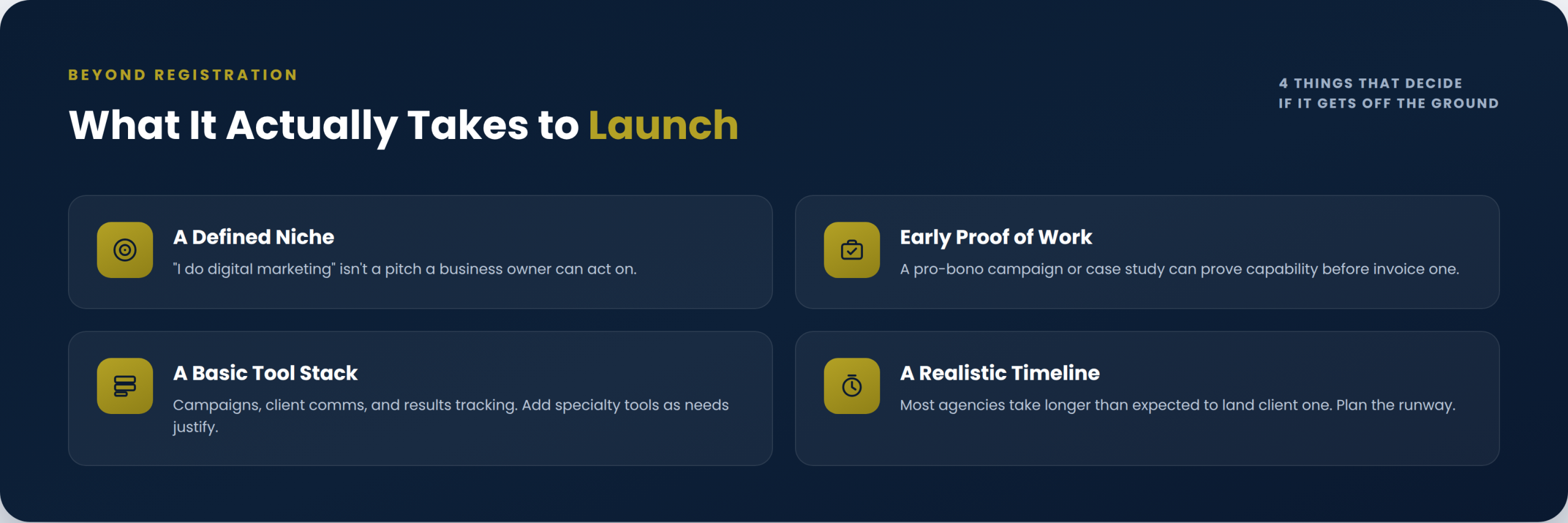
Registering a business in Singapore is the easy part, and it’s already well covered by legal and company-registration sites. The harder, less discussed side of starting a digital marketing agency is what actually makes one operational: a defined niche, early proof of work, a workable tool stack, and a realistic timeline for when revenue might start.
A defined niche matters more than many new agency owners expect, because “I do digital marketing” isn’t a pitch a business owner can act on. Early proof of work matters just as much. A portfolio doesn’t require paid clients to start: a project-based approach built around a pro bono campaign, a case study on your own business, or a detailed breakdown of a campaign you’d run for a hypothetical client can all demonstrate capability before your first invoice.
The skills needed to start an agency are narrower than a full marketing degree implies: campaign planning, content creation, and enough comfort with automation and CRM tools to run client work without a team behind you. If you’re starting from scratch, structured, mentor-led skills training can help you build these skills faster than piecing them together from scattered tutorials, though the pace still depends on the time and effort you put in. A basic tool stack, something to manage campaigns, something to manage client communication, and something to track results, is enough to start; add specialized software as specific client needs justify the cost.
Finally, set a realistic timeline. Most new agencies take longer than expected to land a first paying client and longer still to reach consistent revenue. Planning for that runway, rather than assuming month one will look like month six, is what tends to separate founders who stay in business from those who burn out chasing an unrealistic pace.
Choosing Your Niche and Service Offering
New agencies in Singapore rarely win by trying to be a full-service shop from day one. Agencies that gain traction tend to pick a lane, an industry, a business size, or a single marketing discipline, and get visibly good at it before expanding.
SME-focused positioning is one common lane: smaller businesses often can’t afford a full in-house marketing team and are looking for someone who understands their budget constraints and can move quickly. E-commerce is another, since online sellers have specific, recurring needs around paid ads, product content, and conversion optimization that a specialist can speak to more credibly than a generalist. A social-first offering, built around content and community for brands that live primarily on social platforms, is a third route that suits agencies built around a smaller, nimble team.
Before committing to a lane, test it against a few real conversations: ask a handful of prospects in that niche what they’re currently struggling with, and see whether your intended service actually addresses it. Pay attention to more than polite interest — ask what they currently spend on marketing and whether solving this problem is a budget priority right now, since interest without a budget or a real timeline isn’t validation. A niche that sounds credible on paper but doesn’t match what prospects are willing to pay for won’t hold up once you start pitching.
Whatever lane you choose, it belongs in a proper digital marketing agency business plan rather than staying a loose idea in your head. That plan doesn’t need to be long, but it should name your niche, your target client profile, your core service, and roughly how you intend to reach your first prospects. A one-page plan you actually follow will outperform a polished document that never gets tested against real conversations with real prospects.
What It Costs to Get Started
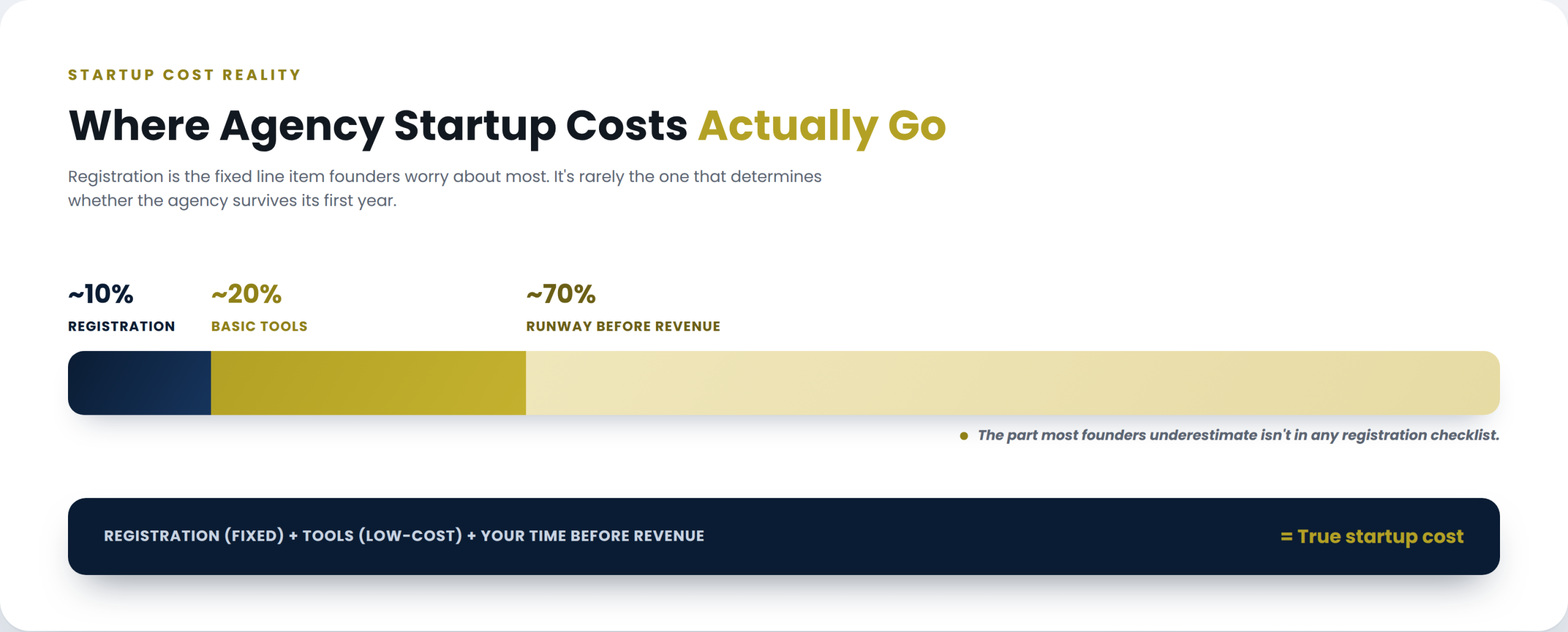
Cost is one of the biggest reasons people delay starting, often based on assumptions that don’t hold up once you break the expenses into categories. Digital marketing agency startup costs generally fall into three buckets: business registration, basic tools, and your own time investment before revenue arrives.
Registration is one cost category, but the amount depends on the business structure and registration period you choose. Confirm current name-application, registration, and incorporation fees directly with ACRA. For many founders, the larger early investment is the time and financial runway required before client revenue becomes consistent. Basic tools come next: a simple website, a way to manage client projects, and whatever campaign or content tools your chosen niche requires. Many of these have free or low-cost starting tiers, so the real cost early on is usually your time rather than software spend.
The least visible cost is the runway you need before the business supports itself: months of limited or no agency income while you build a portfolio and land that first client. Underestimating this runway is a common reason new agencies stall. Budgeting honestly for that gap, rather than assuming client revenue by month two, is what makes the early months survivable.
Getting Your First Clients
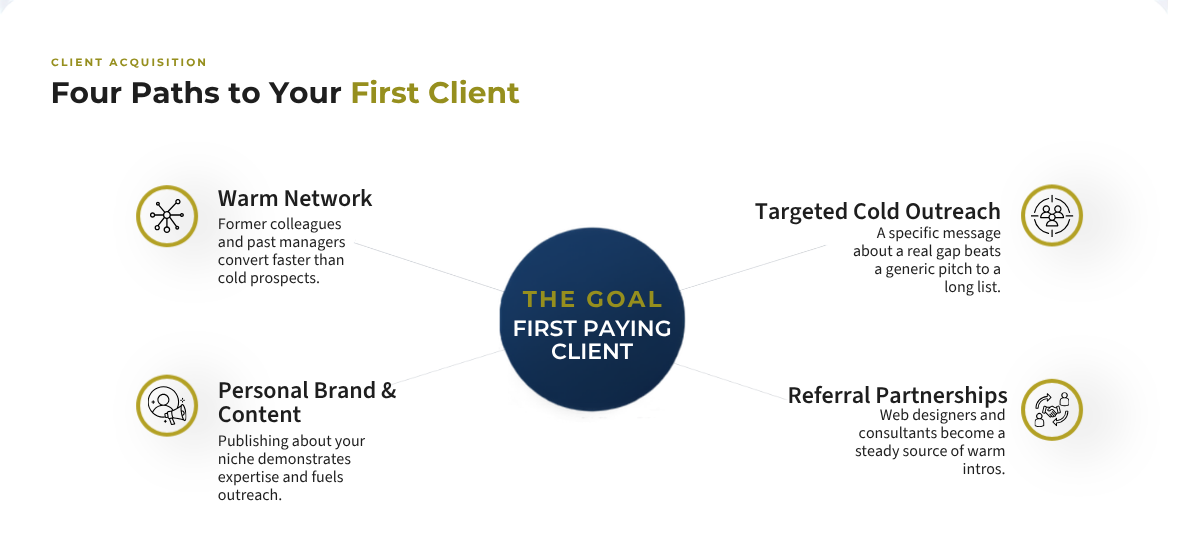
This is usually the hardest part of learning how to get clients for a new agency, and it’s the part legal and registration guides don’t cover at all, because it has nothing to do with paperwork.
Your warm network is often a strong starting point: former colleagues, past managers, and people who already trust your work are more likely to become a first client, or refer one, than a cold prospect. Cold outreach still works when it’s specific: a short, personalized message about a real gap you noticed in a business’s marketing tends to outperform a generic pitch sent to a long list. Building a personal brand and publishing content about your niche does double duty, since it demonstrates expertise to prospects while giving you material to point to in outreach conversations. Referral partnerships, with web designers, business consultants, or other non-competing service providers who serve your target clients, can become a steady source of warm introductions once the relationship is established.
Not every early conversation is worth chasing. A prospect who fits your niche, has a real budget, and is ready to move within a reasonable timeframe is worth prioritizing over one who’s simply curious or comparing quotes with no real intent to hire. Qualifying prospects early, by asking about budget, timeline, and decision-making authority before you invest hours in a proposal, saves runway you can’t get back. A simple rule of thumb: if a prospect can’t tell you roughly when they’d start or who else needs to sign off, treat the conversation as exploratory rather than a live opportunity, and keep your energy on leads that are further along.
None of these paths produce guaranteed results, and most new agency owners underestimate how much sustained outreach it takes before the first yes arrives. What tends to separate agencies that land a first client in a reasonable window from ones that stall isn’t a secret channel, it’s consistency across more than one of these paths at once, rather than betting everything on a single tactic.
Where a Guided Program Helps
Everything above is achievable on your own, and plenty of agency owners have done exactly that. The trade-off is time: figuring out positioning, pricing, and outreach by trial and error usually takes longer than doing it with structured guidance, and early mistakes are the ones most likely to drain your runway before you’ve landed a client. If you’re weighing whether to go fully solo, [Can You Really Run a One-Person Marketing Agency?] is a useful companion read before you decide.
A guided program can combine skills training with support for positioning, pricing, pitching, follow-ups, and project delivery. Typically, this means structured lessons paired with regular check-ins where you bring real prospects and real proposals for feedback, rather than generic case studies. Digital Marketing AI-Powered Business Process Outsourcing offers this kind of mentorship: skills training paired with support for positioning, pricing, pitching, follow-ups, and project delivery. Client acquisition isn’t guaranteed; securing projects depends on your capability, professionalism, commitment, offer, and market.
If you’d rather not figure this out entirely alone, the consultation below is a good next step.
Frequently Asked Questions
How do I start a digital marketing agency in Singapore with no experience?
Start by defining a narrow service niche you can prove results in, build a small portfolio through pro bono or discounted early projects, and register your business only once you have a validated offer. Most new agency owners struggle less with paperwork and more with landing that first client, which is where a structured, mentor-guided program can shorten the learning curve. Book a free career consultation to map out your starting point.
How much does it cost to start a digital marketing agency in Singapore?
Costs generally fall into business registration, basic tools, and the time investment before revenue arrives, rather than one fixed figure. The amount also depends on the business structure and registration period you choose, so confirm current registration fees directly with ACRA, since they change periodically.
Do I need a marketing degree or certification to start an agency?
No. Early clients usually care more about whether you can demonstrate relevant skills and credible work than whether you hold a marketing degree, and it’s entirely possible to switch into digital marketing without a marketing degree. A focused portfolio can provide that proof. Structured training or certification may help you build skills and credibility faster, but it does not replace practical evidence or client communication.
How long does it take to get a digital marketing agency profitable?
It varies widely by niche, effort, and market conditions, and there’s no guaranteed timeline. Planning for a longer runway than you expect is safer than assuming early income.
What's the fastest way to land my first client?
There’s no guaranteed shortcut, but combining your warm network, targeted outreach, and visible content tends to work faster than relying on one channel alone. Prioritizing prospects who are genuinely ready to move, rather than chasing every lead equally, also speeds things up. A guided program can help structure that early outreach so it doesn’t stall.
Starting an agency does not mean figuring out positioning, pricing, and client acquisition entirely alone. A guided path can give you structure, feedback, and support while you build your offer and test it in the market. Book a Free Career Consultation, or launch your own agency with guided support.
Share


Want to check if this career is for you?