Why Industry-Aligned Curriculum Is Now a Survival Issue for Universities
Why Industry-Aligned Curriculum Is Now a Survival Issue for Universities
Content
Content
Why does industry-aligned curriculum matters enough to reshape a programme you’ve spent years building. The honest answer: employer trust and enrollment numbers depend on it, and that puts your programme’s reputation on the line. Students are already weighing this when they choose a programme, and employers are weighing it when they decide where to keep recruiting.
The Shift That Makes Industry-Aligned Curriculum Urgent Now
For most of the last century, you could design curriculum on a multi-year cycle and still stay relevant. That cushion is largely gone.
Skills are changing faster than academic review cycles can keep pace with. Employers expect 39% of core workplace skills to shift by 2030, according to the World Economic Forum’s Future of Jobs Report 2025, and 63% now name skills gaps as the single biggest barrier to their organization’s transformation plans, ahead of budget constraints or outdated regulation. If you design a curriculum in isolation and leave it untouched for five or six years, it risks being out of date before the first cohort graduates. That makes curriculum development a more continuous process rather than something confined to periodic academic reviews.
Artificial intelligence is compressing that timeline even more. Tasks that defined entire job categories a few years ago are now partially automated, and employers are rewriting role requirements faster than you can rewrite syllabi. You’ll need to revisit the underlying competencies your programme teaches more often than once every accreditation cycle.
You’re also no longer the only credential in the room. Certificate and bootcamp enrollment has grown for four straight years and now sits well above pre-pandemic levels, as students look for shorter, more direct paths into a job. Some of these programmes now partner directly with employers on hiring pipelines, which puts pressure on your own placement numbers even when your degree still carries more academic weight. Your curriculum can’t assume it has years to catch up.
What “Industry-Aligned Curriculum” Actually Means
The term gets used loosely, so it’s worth being precise.
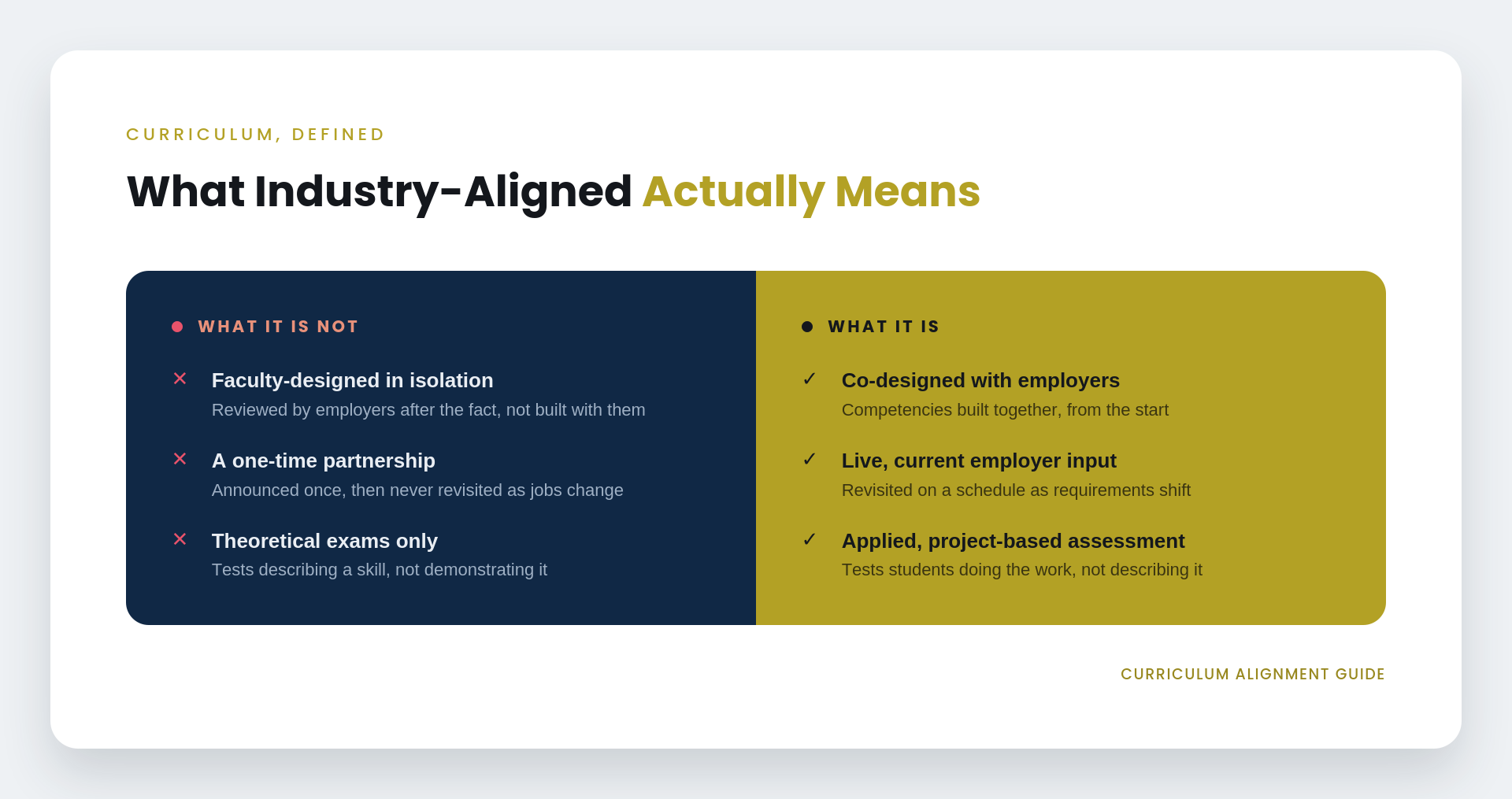
For higher education institutions, industry-aligned curriculum describes a specific way of building and maintaining a programme, and it goes well beyond a single conversation with employers at launch. Here’s what it actually involves:
- You co-design competencies with industry input.
- You build assessment around applied work: projects and deliverables that mirror what the role actually requires, alongside your theoretical coursework. This creates a more relevant learning experience, with each student developing evidence of capability through real-world tasks.
- You keep employer input ongoing, through advisory boards or structured feedback loops.
Curriculum built without this input usually follows a familiar pattern. A faculty committee defines learning outcomes based on disciplinary tradition. Industry gets consulted informally, if at all. The programme comes up for review again in five years, often after the market has already moved.
Academic rigor still matters here. Industry-aligned curriculum builds on that foundation. Your goal is a programme where graduates can show both the grounding a degree is meant to provide and the applied practical skills employers are asking for, including the technical skill requirements relevant to their target roles.
The Cost of Standing Still: The Curriculum-Industry Skills Gap
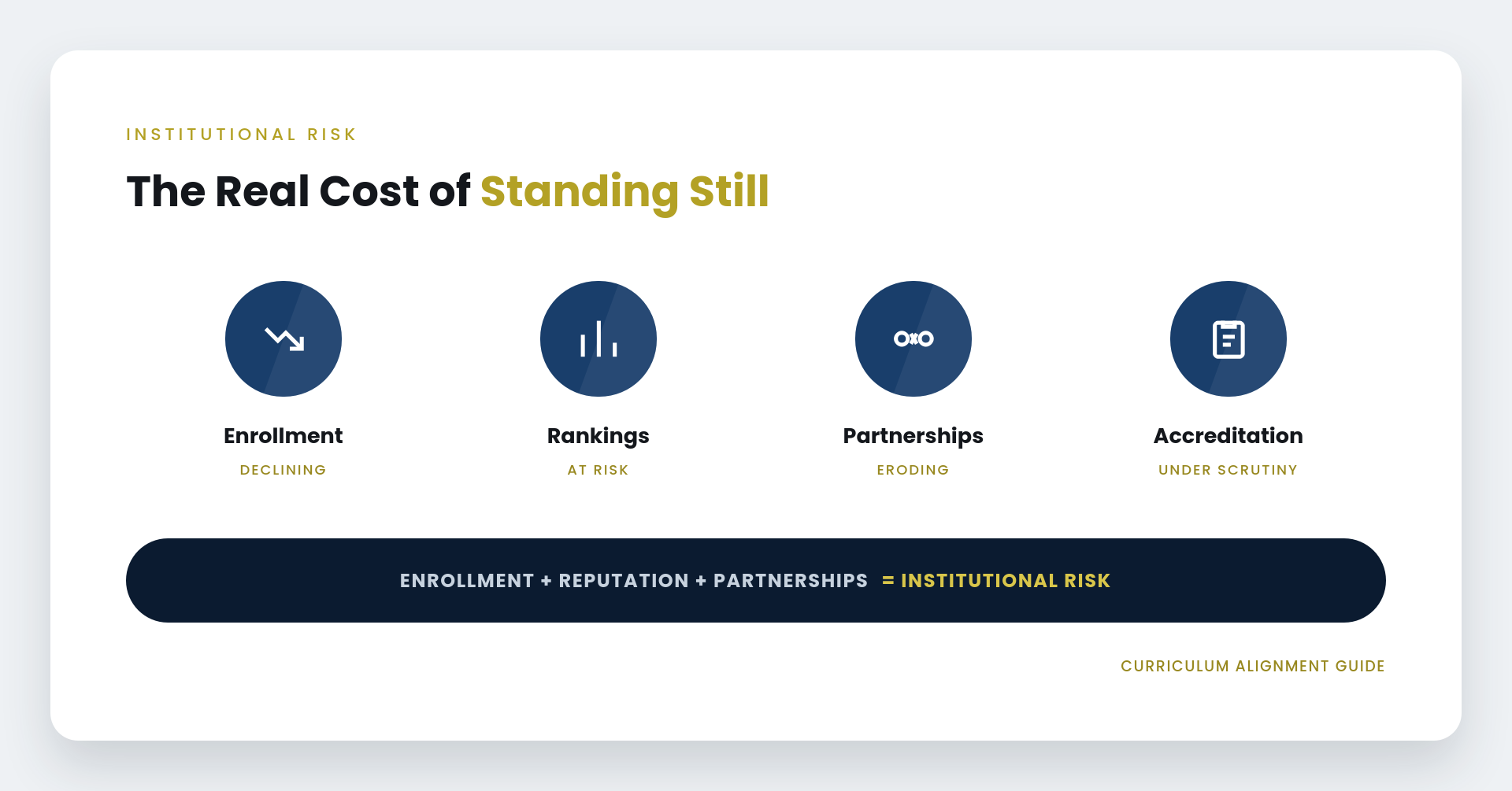
The risk of doing nothing shows up in real numbers, ones your institution may already track or will soon start to.
Start with employer sentiment. In a 2025 survey by Workplace Intelligence and Hult International Business School, 96% of employers said colleges should take greater responsibility for preparing students to be workforce-ready. That’s close to consensus among the organizations your graduates depend on for jobs.
Then there’s the labor market itself. Cengage Group’s 2025 Graduate Employability Report found employers hiring the same number or fewer entry-level workers than the year before, with skills mismatches cited as a compounding factor, and roughly three in ten 2025 graduates landing full-time roles related to their degree. When your graduates struggle to find relevant work, that outcome eventually reaches your prospective students and the rankings bodies that track employment data.
Reputational costs tend to move more quietly. When employer partners don’t see your graduates arriving job-ready, they often step back from recruiting on campus and from co-op placements. Those partnerships take years to rebuild once you lose them.
Accreditors and funders are also asking sharper questions about graduate outcomes these days. If you don’t have a clear story connecting your curriculum to employability, those conversations get harder every year.
A modest, sustained gap between what your programme teaches and what employers need compounds year over year. By the time it shows up clearly in your enrollment numbers, it’s usually been building for several admissions cycles.
What Leading Institutions Are Doing Differently to Build Workforce-Ready Graduates
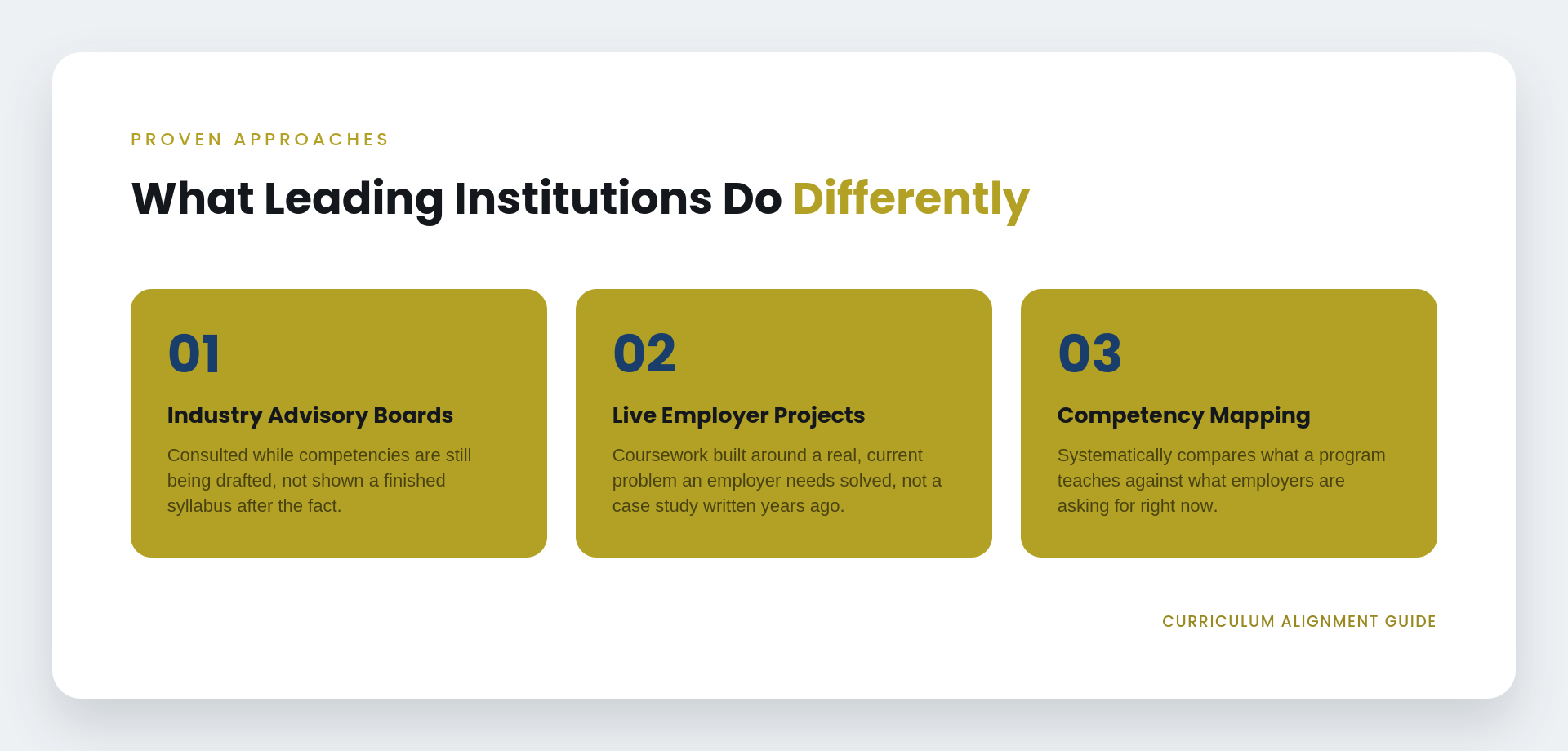
Institutions holding their ground on employability outcomes tend to share a few practices. None of them require you to rebuild a programme from scratch.
Industry advisory boards. You bring in a standing group of industry practitioners who review your programme’s competencies every year and flag where the curriculum drifts from what the role actually demands.
Live employer projects. You embed real employer briefs directly into your coursework, in capstones and applied labs built around an actual business problem, with the employer involved in evaluating the work. This gives students exposure to real-world challenges rather than relying only on hypothetical case studies.
Competency mapping. You run a structured audit comparing your programme’s stated learning outcomes against current job postings and employer-defined skill frameworks, then flag where the gaps are largest.
These approaches all treat industry input as an ongoing part of curriculum design. They also tend to start small, focusing on one programme or one advisory board at a time.
None of these approaches require an institution to become something it isn’t. If you want a deeper look at how platforms are helping institutions operationalize this kind of alignment work at scale, [What Is a Digital Skilling Platform?] is a useful next read.
Where to Start: Future-Proofing Your Curriculum
Start small. Pick one programme and map its current competencies against the skills employers are actually asking for in job postings and industry frameworks. You don’t need to redesign every programme at once to see where the distance is.
That exercise alone usually surfaces two things: a short list of gaps worth addressing quickly, and a clearer sense of which employer relationships are worth formalizing into an advisory board or project pipeline. You can run it with a small team over a few weeks, and you’ll have something concrete to bring to a programme committee or a dean’s cabinet meeting.
Doing this well at scale, across multiple programmes, with a repeatable process, is usually where institutions reach for outside support, whether that’s a non-technical reskilling pathway built for individual career switchers or an enterprise digital upskilling model built for organization-wide rollout. Building and maintaining employer-informed competency maps and advisory structures takes dedicated capacity most academic departments don’t have on top of everything else they run.
That’s where bridging the gap becomes an operational priority. CLaaS® Academy is built to help close it. CLaaS® Academy works alongside your institution to align curriculum with real, current industry requirements, without asking you to start from zero. If you’re not sure where your own programme stands, a short consultation is a low-commitment way to find out.
Frequently Asked Questions
Why does industry-aligned curriculum matter for universities today?
Because employers increasingly reject graduates who lack deployable, job-ready skills, and that gap now shows up directly in enrollment, employer partnerships, and institutional reputation. Aligning curriculum with real industry requirements, through employer-informed competencies and applied assessment, helps close that gap before it costs the institution its standing.
What is the difference between industry-aligned curriculum and a traditional academic curriculum?
Traditional academic curriculum is typically designed by faculty alone and assessed mostly through exams and papers. Industry-aligned curriculum builds in employer input from the start and leans on applied, project-based assessment that mirrors real work.
How does curriculum alignment affect graduate employability?
Graduates from aligned programmes tend to have deployable skills employers recognize immediately, rather than theoretical knowledge that still needs translating on the job. That usually shows up as a faster time-to-job after graduation.
Does industry-aligned curriculum require replacing an entire programme?
No. Most institutions start by mapping one programme’s competencies against current employer requirements rather than overhauling everything at once. It’s a bounded first step, not an all-or-nothing commitment.
How can a university start aligning its curriculum with industry needs?
The most practical starting point is a tailored assessment of where a specific programme’s competencies diverge from current employer requirements. A 1:1 consultation can help work through what that would look like for your institution.
Closing the curriculum-industry skills gap doesn’t require a full programme overhaul. It starts with an honest assessment of where one programme’s competencies stand today.
Share


Want to check if this career is for you?