How to Switch Careers to Tech With No Experience
How to Switch Careers to Tech With No Experience
Content
Content
If you are wondering how to switch to a tech career with no experience, remember that having no IT background does not mean you have no useful experience. A successful career change is about building on the skills you already have, developing the right digital capabilities, gaining practical experience, and showing employers what you can do.
Can You Really Switch to a Tech Career With No Experience?
Yes, moving into a technology or digital career without previous IT experience can be possible.
The important distinction is between having no tech experience and having no relevant experience.
If you have worked in sales, marketing, finance, operations, customer service, administration, education, or another field, you may already have skills that transfer into digital roles.
Communication can support marketing and project work. Analytical thinking can help in data-related roles. Customer knowledge can be useful in digital product and marketing careers. Project coordination, business knowledge, and problem-solving also apply across many technology roles.
However, transferable experience needs to be combined with the skills required for your target job.
A non-tech to tech career transition is therefore less about starting again and more about connecting your existing strengths with new digital capabilities and practical evidence.
Step 1: Choose the Right Tech Career Path
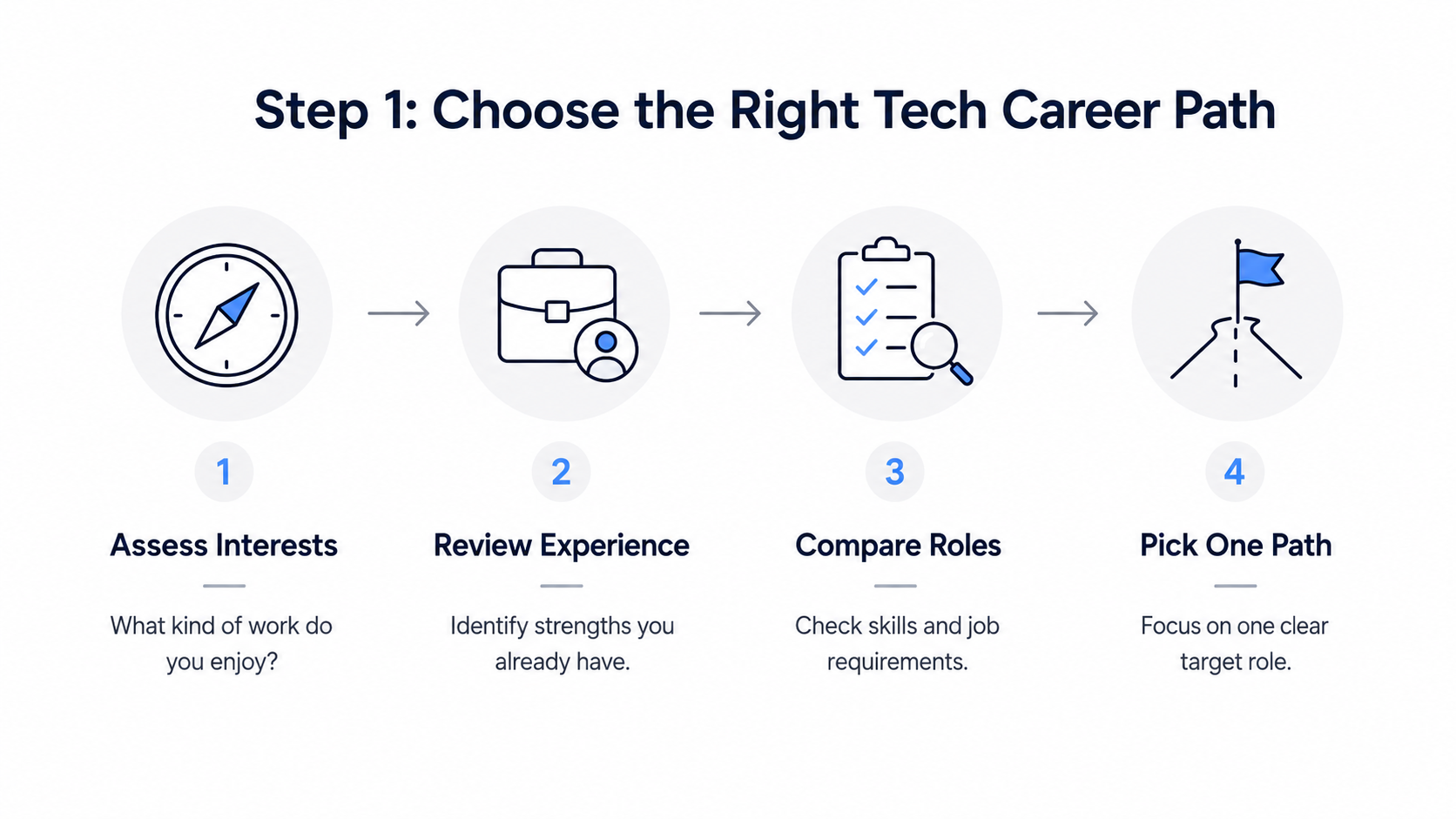
Do not begin by trying to learn everything about technology.
Start with one career direction.
Technology and digital careers cover many areas, including data and AI, software development, digital marketing, business innovation, cloud computing, and cybersecurity.
The right option depends on:
- What type of work interests you
- What experience you already have
- What skills you enjoy using
- What employers expect in the role
- Where you want your career to go
For example, someone who enjoys numbers and solving analytical problems may be drawn to data. Someone who enjoys customer behavior, campaigns, and communication may prefer digital marketing. A person who likes building solutions may explore software-related careers.
Review job descriptions before committing to a path. Look at the work involved, the skills employers request, and how closely the role connects with your current strengths.
Choosing one direction gives your career change a clear focus.
Step 2: Identify the Skills You Already Have
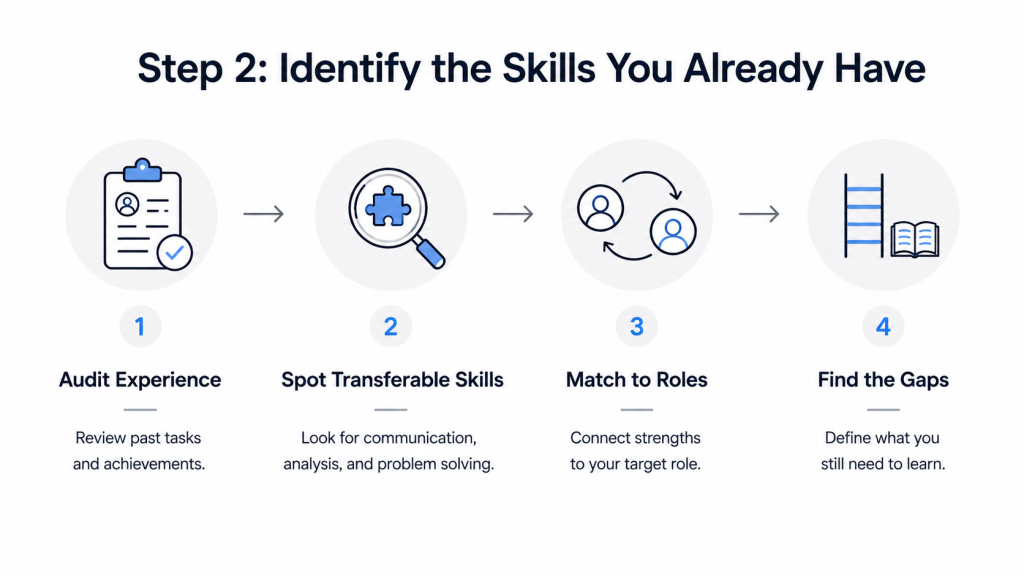
Before deciding what you need to learn, identify what you already bring to the table.
Ask yourself:
What problems have I solved? What responsibilities have I handled? What results have I helped produce?
An operations professional may already know how to improve processes and manage projects.
Someone in customer service may understand customer needs and communication.
A salesperson may have strong relationship-building and business skills.
A finance professional may already be comfortable analyzing information and spotting patterns.
These are transferable skills.
Your goal is to match them with your target tech role and identify the gaps you need to fill.
For example, someone moving from sales into digital marketing may already understand customers and buying behavior. Rather than starting from zero, they can build on that knowledge by learning digital campaigns, analytics, content, and marketing technology.
Step 3: Learn the Core Skills for Your Chosen Role
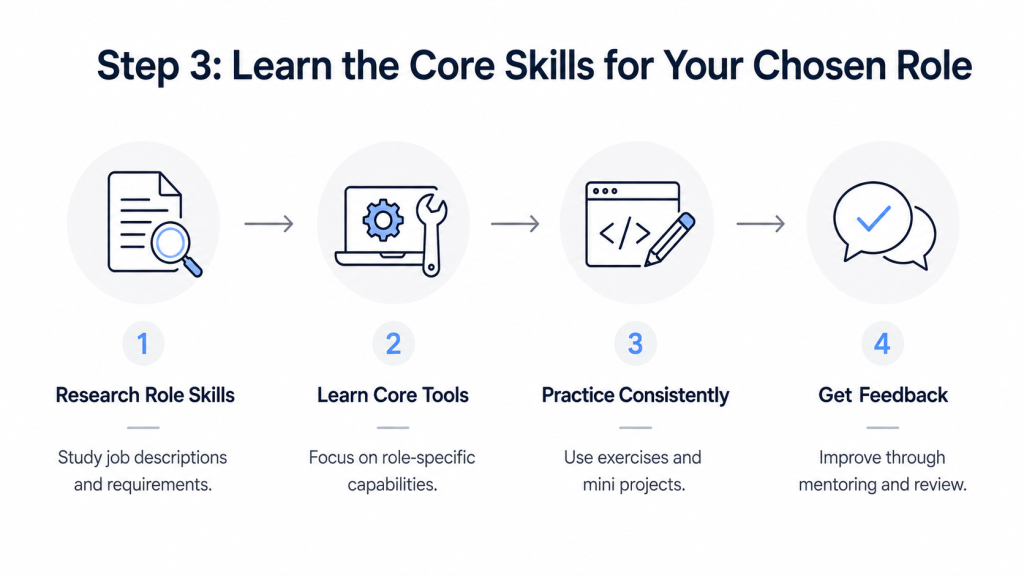
Once you have a target role, build your learning plan around it.
General digital knowledge is useful, but employers usually need role-specific capabilities.
Someone moving into data, for example, may need skills in data preparation, analysis, visualization, and relevant tools.
Someone moving into digital marketing may need to understand campaigns, content, analytics, customer journeys, and marketing technology.
Use job descriptions as a guide. Compare common requirements with the skills you already have. The difference shows you what to learn next.
Look for learning that gives you opportunities to practice, receive feedback, and improve rather than simply consuming information.
Most importantly, stay focused. Learning a smaller set of relevant skills deeply is usually more useful than trying to study every new technology you come across.
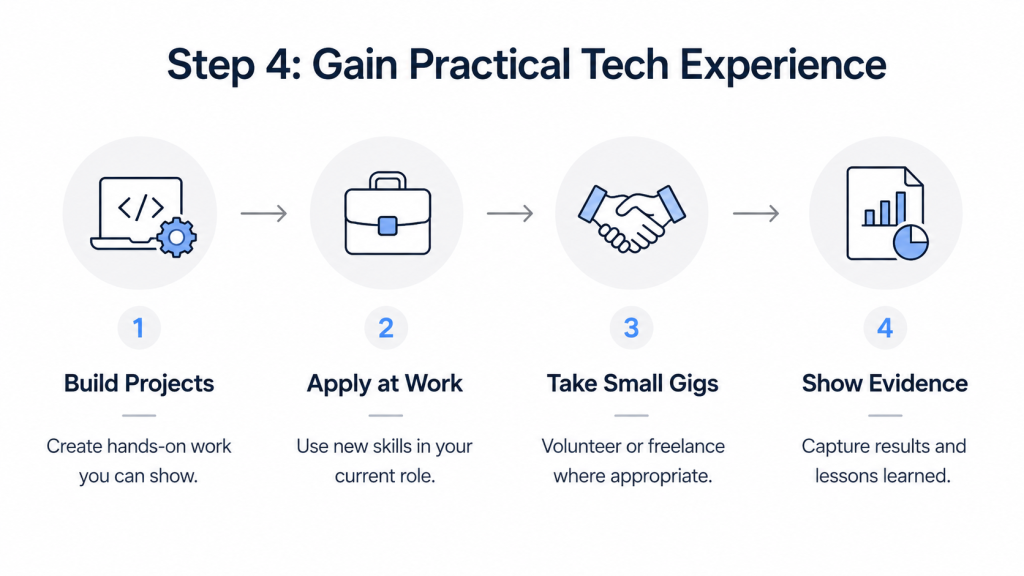
Step 4: Gain Practical Tech Experience Before You Get a Tech Job
One of the biggest challenges for career changers is:
How do I get experience when jobs already ask for experience?
You can start by creating opportunities to use your new skills before landing your first tech role.
Depending on your target career, this could include:
- Completing practical projects
- Solving a real business problem
- Applying new digital skills in your current workplace
- Taking suitable freelance assignments
- Volunteering your skills where appropriate
- Working on industry-related projects
An aspiring data professional might analyze a public dataset and build a dashboard.
Someone moving into digital marketing could create a sample campaign and explain how they would measure its performance.
An aspiring software professional could build an application that solves a clear problem.
The purpose is to move beyond simply saying that you learned a skill.
You want to be able to show how you used it.
Step 5: Build a Portfolio That Proves Your Skills
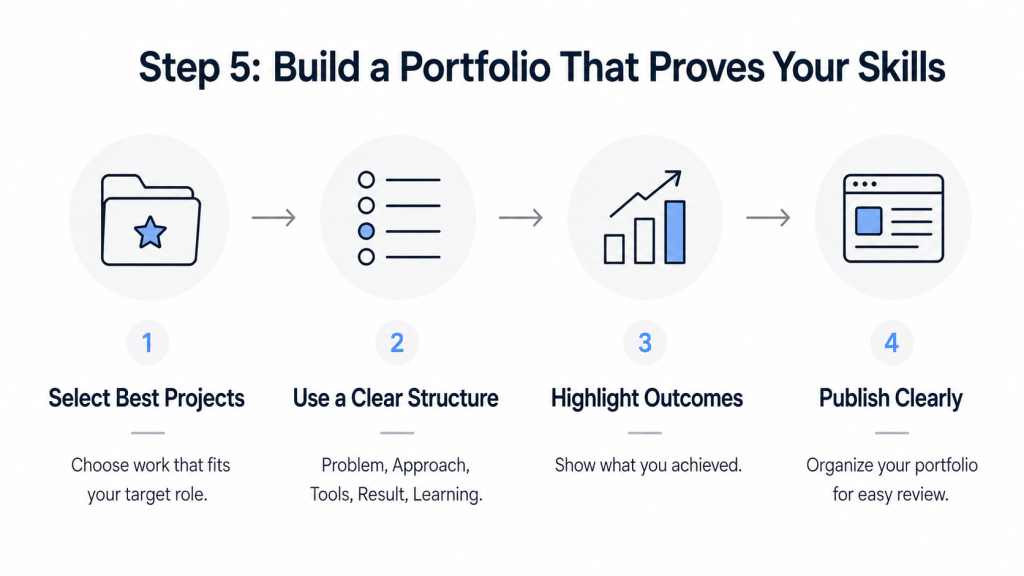
Once you have completed practical work, organize your strongest projects into a portfolio.
Your portfolio should help an employer answer one question:
What can this person actually do?
You do not need dozens of projects. A few relevant, well-explained examples are often more useful than a large collection of unfinished work.
Depending on your target career, you might include:
- A data dashboard
- A software application
- A digital marketing campaign
- A digital transformation proposal
- A business process improvement project
- A cloud or cybersecurity exercise
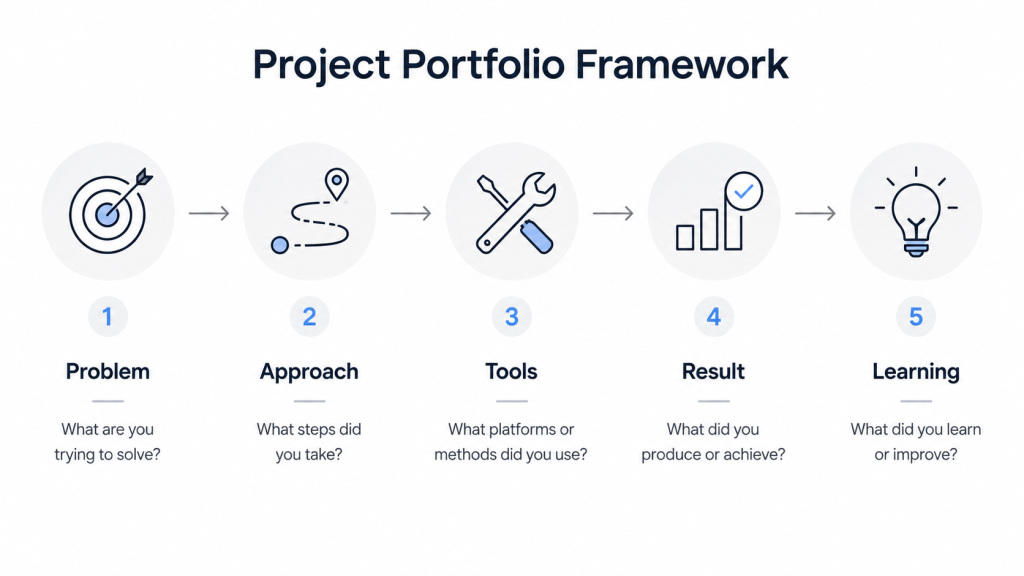
Problem → Approach → Tools → Result → Learning
Problem: What were you trying to solve?
Approach: What steps did you take?
Tools: Which platforms, technologies, or methods did you use?
Result: What did you produce or discover?
Learning: What did you learn, and what would you improve next time?
This structure makes your portfolio easier to understand and shows how you approach real problems.
Step 6: Rewrite Your Resume for a Tech Career Change
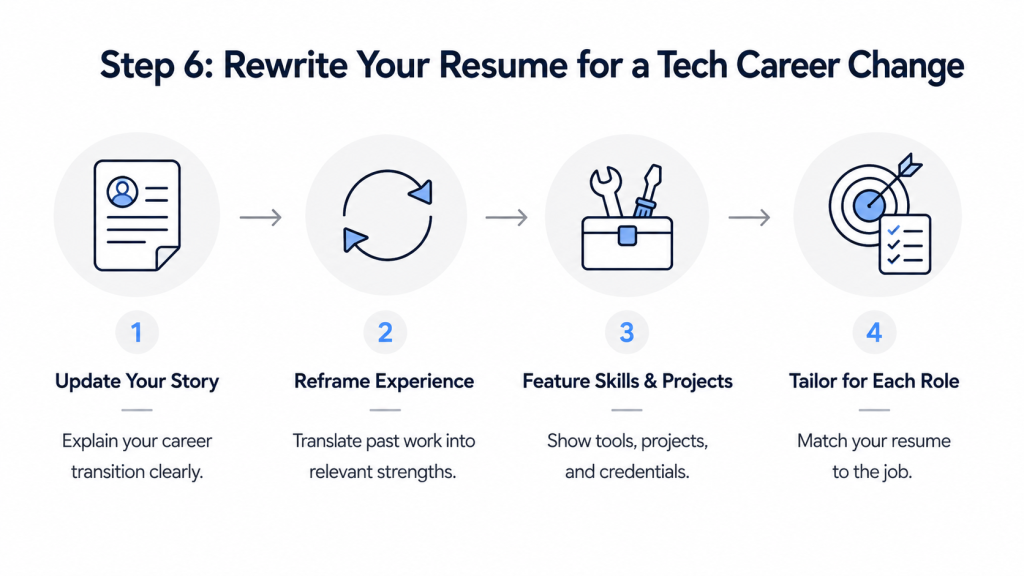
Your resume should connect your previous experience with the career you are moving toward.
Instead of removing your old experience, reframe the parts that are most relevant.
For example:
Before:
“Prepared weekly sales reports for management.”
After:
“Analyzed weekly sales performance data and prepared reports that helped management identify customer and revenue trends.”
The responsibility is similar, but the second version makes the analytical value clearer.
Your updated resume should highlight:
- Relevant transferable skills
- Digital and technical capabilities
- Practical projects
- Measurable achievements
- Relevant credentials
- Tools you can use
Step 7: Prepare for Your First Tech Interview
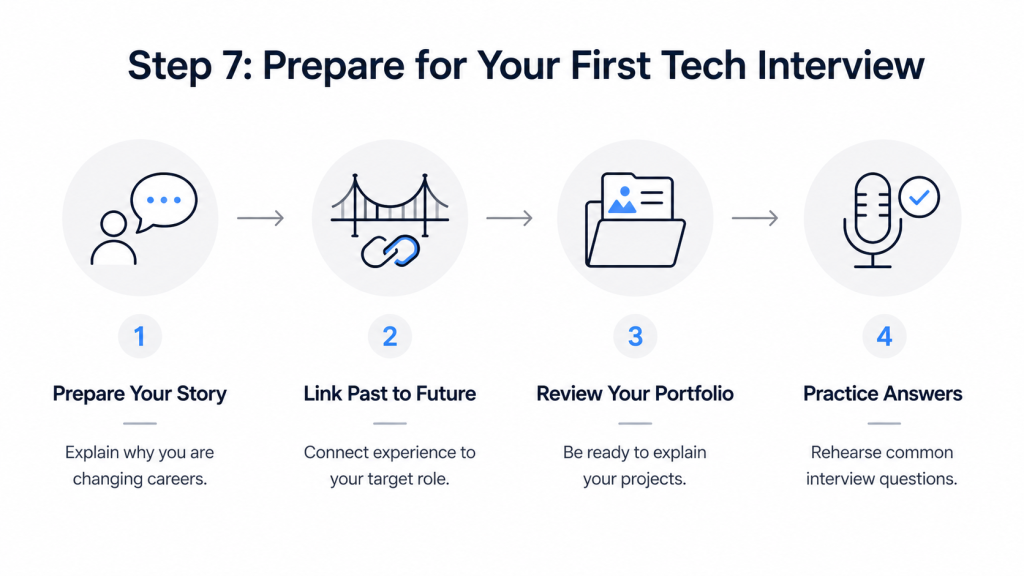
Career changers are often asked:
Why are you changing careers?
Why are you interested in this role?
What relevant experience do you have?
Prepare a clear answer using this structure:
Previous experience → Reason for transition → New skills → Practical evidence → Target role
For example, you might explain that working with business reports increased your interest in data. You then developed relevant analytical skills and completed practical projects to build experience.
Be prepared to discuss those projects as well.
An interviewer may ask why you chose a particular project, what tools you used, what challenges you faced, and what you learned.
Your ability to explain your thinking helps show that you understand the work rather than simply following instructions.
Step 8: Apply Strategically Instead of Applying Everywhere
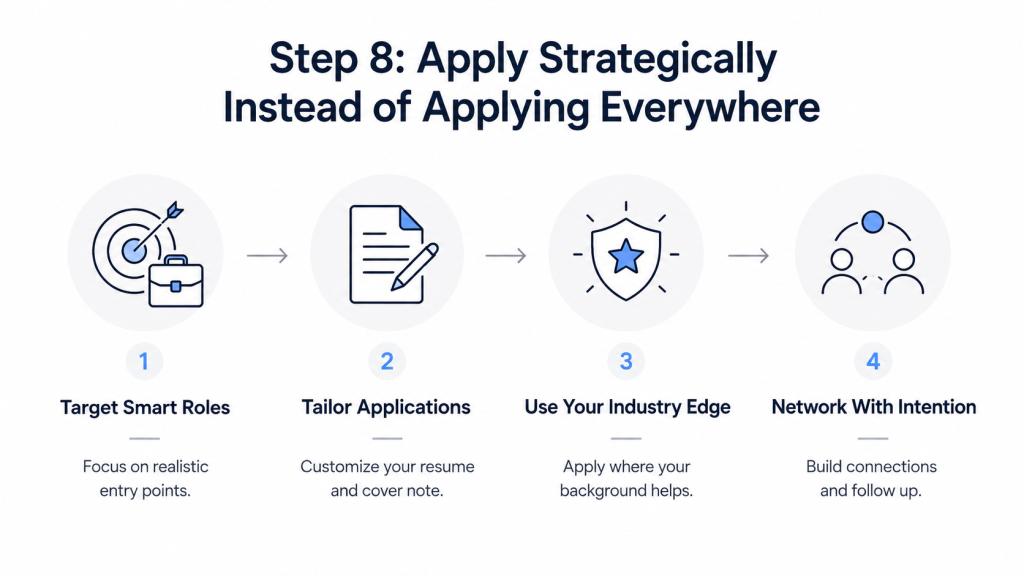
A successful job search is not necessarily about sending the largest possible number of applications.
Start with realistic entry points and roles where your combination of industry experience and new digital skills can be useful.
Someone with banking experience who develops data skills, for example, may have an advantage when exploring data roles in financial services.
Someone from sales may be able to combine customer knowledge with newly developed digital marketing capabilities.
For each opportunity:
- Read the job requirements carefully
- Tailor your resume
- Highlight relevant projects
- Use examples that match the role
- Connect with professionals in the field
- Research the company and its industry
Your first technology role does not have to be your final destination. It can be the next step in your career transition.
How Long Does It Take to Switch to a Tech Career?
There is no universal timeline for a career change to tech.
How long the transition takes depends on factors such as:
- Your target role
- Your current skill level
- Your transferable experience
- How much time you can spend learning
- The technical depth of the role
- Your practical experience
- Job-market conditions
Someone moving into a role related to their existing profession may follow a different path from someone entering a highly technical field for the first time.
Do not treat the length of a training program as a guaranteed timeline for changing careers.
Learning is only part of the process. Building experience, preparing a portfolio, networking, interviewing, and finding the right opportunity also take time.
Focus on steady progress rather than trying to meet an arbitrary deadline.
A 90-Day Tech Career-Switch Roadmap
A 90-day plan can give your career change structure, but it should be treated as a starting framework rather than a promise that you will find a job within 90 days.
Stage 1: Choose
Select a realistic target role, review job descriptions, and identify the skills you already have and the ones you need to develop.
Stage 2: Learn
Build the core skills required for your target role and practice them through hands-on exercises.
Stage 3: Apply
Complete practical projects, ask for feedback, improve your work, and begin organizing your strongest examples into a portfolio.
Stage 4: Prepare
Update your resume and LinkedIn profile, practice interviews, build professional connections, research employers, and begin targeted applications when you are ready.
Your pace will depend on your background and chosen career.
The goal is consistent movement from:
Learning → Applying → Demonstrating capability
Common Mistakes Career Changers Should Avoid
A focused career transition can save you time and frustration.
Try to avoid:
- Learning too many technologies at once
- Collecting certificates without practical application
- Ignoring transferable skills from your previous career
- Choosing a career only because of salary
- Applying before you have relevant evidence
- Assuming every technology role requires coding
- Expecting a course or certification to guarantee employment
- Expecting your career change to happen overnight
How Work-Integrated Learning Can Support a Career Switch
Some people can successfully reskill through self-study. Others may prefer a more structured approach that combines learning with practical application.
This is where work-integrated learning can support a career transition.
Instead of learning first and looking for ways to practice later, a work-integrated approach brings several parts of the career-switch process together.
Learners can move through a cycle of:
Learn → Apply → Receive Feedback → Improve → Demonstrate
CLaaS2SaaS Lifelong Learning programs uses a personalized, work-integrated, and outcome-based CLaaS® approach built around a 70:20:10 learning model. Current program pages describe self-paced e-learning, flipped classes, project mentoring, summative assessment, and expert-led or hands-on projects.
Mentoring and guided feedback support learners as they apply skills through projects, while career support can include resume preparation, interview coaching, 1-to-1 career coaching, and recruitment activities. Job placement is supported, but not guaranteed.
For career changers, this can help connect skills development with practical experience and evidence of capability.
The objective is not simply to know more. It is to become better able to show how you can use what you know.
Which CLaaS2SaaS Lifelong Learning Path Could Suit You?
The right learning path depends on your strengths, interests, experience, and target career.
If You Enjoy Marketing, Customers, and Communication
A Digital Marketing career may suit people interested in audiences, campaigns, content, and customer engagement.
Explore the Digital Marketing pathway to learn more.
If You Enjoy Data and Analytical Problem-Solving
If you enjoy working with information, identifying patterns, and solving problems using evidence, consider Data Science & AI.
Explore the Data Science & AI pathway to understand this career direction.
If You Want to Build AI-Powered Applications
If you are interested in applications, technology, and developing digital solutions, consider AI Application Development.
Explore the AI Application Development pathway to learn more.
If You Enjoy Improving Businesses Through Technology
If you prefer solving business problems, improving processes, and helping organizations use technology effectively, consider Digital Innovation.
Explore the Digital Innovation pathway to learn more.
Still comparing your options? Explore the broader career pathways for non-tech professionals before deciding which direction best fits your goals.
There is no universally best pathway. Look for the option that creates the strongest connection between your existing strengths and the career you want to build.
Frequently Asked Questions
Can I switch to a tech career with no experience?
Yes. A career switch can be possible without previous IT experience. Choose a specific target role, develop the required skills, gain practical experience, and use your existing professional experience as a transferable advantage.
Do I need a computer science degree to get into tech?
Not necessarily. Requirements vary by role and employer. Some technical positions require deeper technical education, while other digital roles may be accessible through targeted learning, practical experience, credentials, and transferable skills.
What is the easiest tech career to start with no experience?
There is no single easiest tech career. The best starting point depends on your interests, existing skills, career goals, and the requirements of the role you want.
How can I get tech experience before getting a tech job?
Complete practical projects, apply digital skills in your current workplace, build portfolio work, and consider suitable freelance, volunteer, industry-project, or work-integrated learning opportunities.
How long does it take to switch careers to tech?
There is no fixed timeline. It depends on your target role, existing experience, learning pace, practical experience, and job-market conditions.
Can I switch to tech while working full-time?
It can be possible if the learning format fits around your responsibilities. Review the schedule, workload, delivery format, project requirements, and expected study time before choosing a pathway.
Take the Next Step Toward Your Tech Career
You do not need to start your professional life over to move into tech.
You need a clear target, relevant digital skills, practical experience, and a realistic transition plan.
Explore CLaaS2SaaS Lifelong Learning pathways for career changers and find a work-integrated pathway that can help you build new capabilities through applied learning.
Share


Want to check if this career is for you?