From AI Pilots to Enterprise Intelligence: A CIO's Guide to Unifying University Systems
From AI Pilots to Enterprise Intelligence: A CIO's Guide to Unifying University Systems
![[BS1.1]Higher-education AI operating layer unifying LMS, ERP and CRM systems under one governance framework](https://claas2saas.com/wp-content/uploads/2026/09/CIO_Guide.png)
Content
Content
Most university Chief Information Officers (CIOs) and Chief Data Officers (CDOs) working across higher education institutions don’t have an AI problem. They have a fragmentation problem: a dozen AI pilots running in isolation, none of them talking to the LMS, ERP, or CRM underneath. Scaling AI in higher education starts with fixing that foundation, not running another proof of concept.
Why University AI Pilots Stall
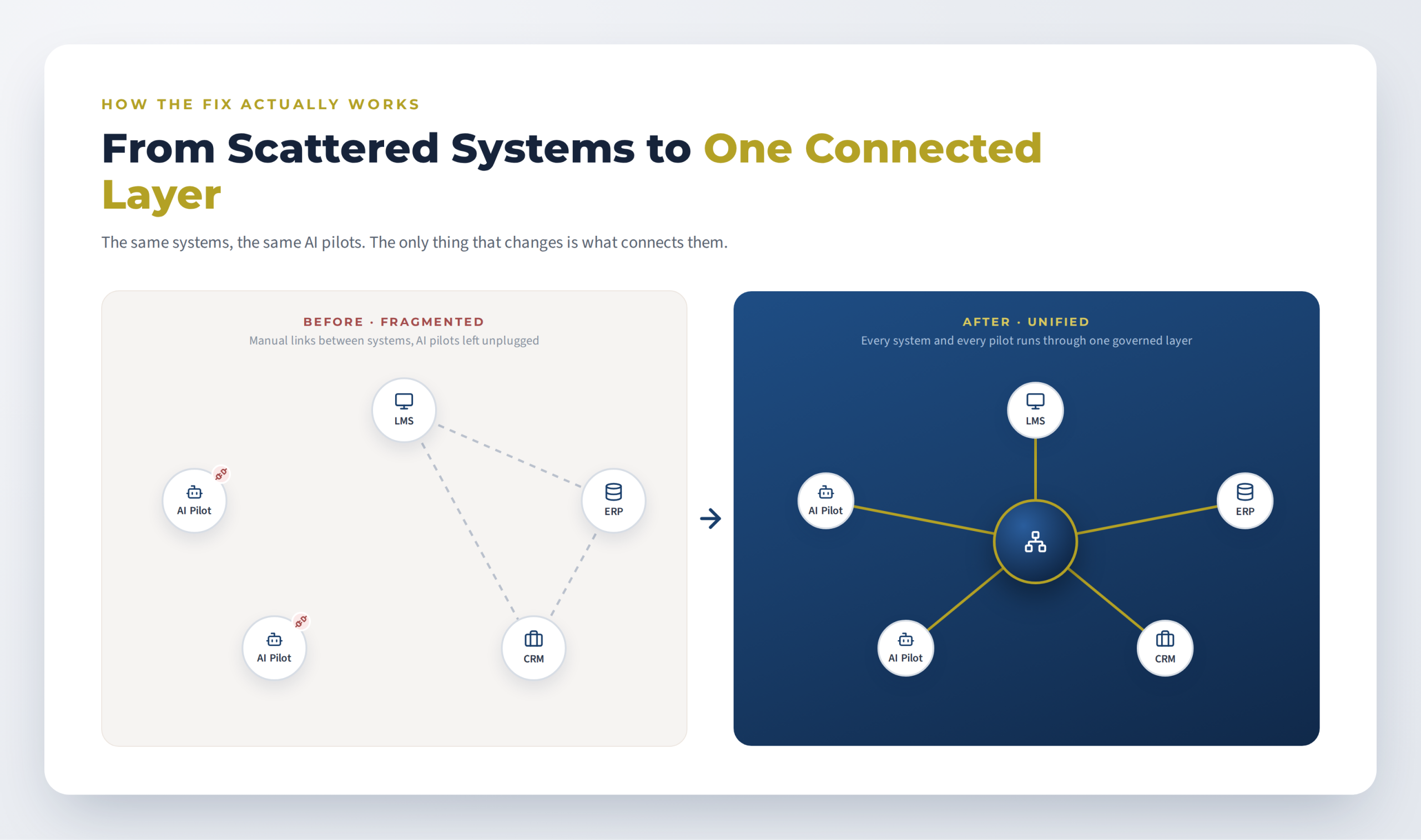
The pilot trap (every project rebuilds foundations)
A promising AI pilot, a chatbot for admissions or a dropout-risk model, works well in a demo, then stalls once it needs real student records or an existing workflow. That is a university system integration failure, not a model failure. Most legacy IT stacks were never built to let separate systems reason over the same data, so each new pilot rebuilds work the last one already did. The path from AI pilots to enterprise AI runs through infrastructure, and not just another demo.
Three constraints show up in almost every stalled program: siloed systems that each hold a partial view of the same student; workflows that break down between departments, so approvals get re-entered at each handoff; and fragmented intelligence, since no shared layer lets scattered AI tools inform each other. Breaking down data silos in universities is less about ripping out old systems than giving them a shared layer to talk through. This is the higher education CIO AI strategy problem in miniature, promising pilots that never connect into one system.
The Shift from Point Solutions to an AI Operating Layer
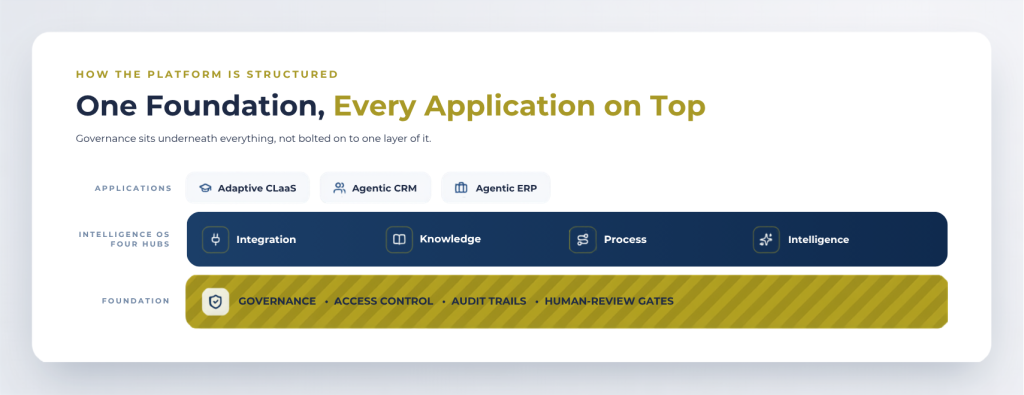
The fix is not a better pilot. Point solutions, one AI tool per department, produced the fragmentation in the first place, especially when they sit above disconnected enterprise systems. What replaces them is a shared operating layer built around four connected hubs.
Integration Hub: connecting the systems you already have
An Integration Hub connects systems such as the LMS, ERP and CRM so data moves between them without a custom build each time. This shared data integration foundation also makes it easier to integrate AI across existing university technology rather than creating another isolated application.
Knowledge Hub: turning policies into reusable services
A Knowledge Hub turns institutional policies and eligibility rules into context-aware services any workflow can call, so teams reference one governed source of truth instead of re-encoding the same policy each time.
Process Hub: workflows that don't get rebuilt every time
A Process Hub makes workflows such as approval routing, data retrieval and risk scoring reusable rather than bespoke. As explored in AI Agents for Enterprise Workflow Automation, this is often where the practical time saving in agentic systems comes from: the workflow, not the model.
Intelligence Hub: reasoning across systems, not just within one
An Intelligence Hub is where AI agents’ reason over the data the other hubs make available, drawing on more than one system at a time.
Governance runs across all four hubs, not on top of them, so access rules, audit trails, and human review apply consistently everywhere. CLaaS2SaaS builds this through Intelligence OS, making it function as one agentic enterprise platform rather than four tools bolted together.
A CIO’s Roadmap: Governance, Integration, Scale
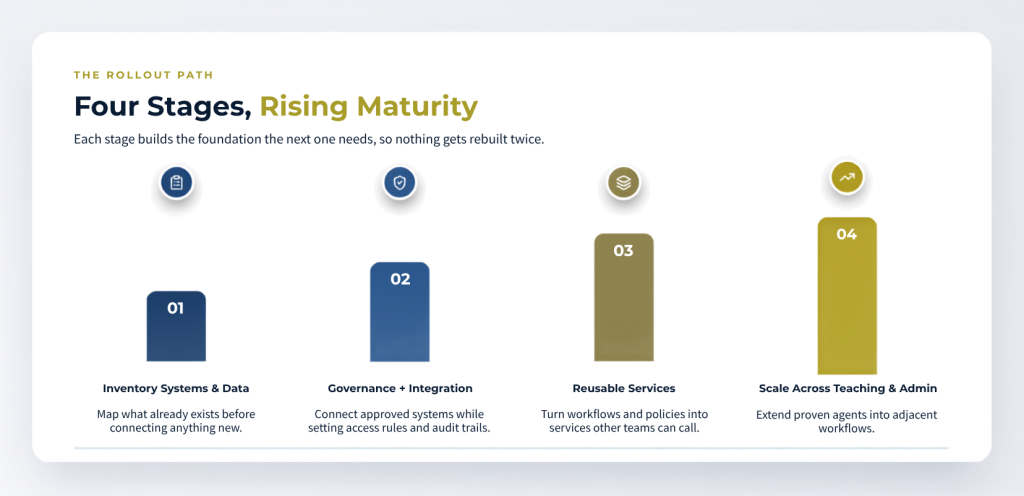
Moving from isolated pilots to an operating layer follows a fairly consistent maturity path, whatever stage a university is at.
- Inventory systems and data: map what exists, including overlapping data.
- Stand up integration and governance together: connect systems while setting access rules from day one.
- Build reusable governed services: turn workflows into services teams and agents can call on demand.
- Scale agents across teaching and admin: extend proven agents into adjacent workflows.
Governance & compliance (audit trails, human gates)
Trustworthy AI governance doesn’t come from a policy document. It comes from access control, audit trails and human-review gates before anything consequential goes ahead unsupervised.
Enabling citizen developers safely
Citizen developers, staff who extend workflows without deep coding experience, are how an operating layer scales past the IT department, working within governed templates rather than around them.
Institutions that treat this as an infrastructure roadmap, not one-off approvals, tend to move through these stages with less rework at each one.
What ‘Enterprise Intelligence’ Looks Like in Practice
Enterprise intelligence is not another dashboard. It’s what happens when the same AI operating layer supports multiple applications at once, so an improvement made for one application reaches the others too, instead of being rebuilt inside each one. Adaptive CLaaS can personalize a student’s learning path using the same Knowledge and Intelligence Hubs that Agentic CRM draws on for enrolment communications, and that Agentic ERP & Operations uses to route a finance approval, so a change to a student’s record in one system is visible to the others automatically. For students, that can mean fewer separate logins and less repeated paperwork across admissions, learning and support touchpoints, rather than a guarantee of a single sign-on. For the institution, it can mean faster decisions and a lower operational-risk profile, since the same governance rules apply everywhere rather than varying tool by tool. None of this requires replacing the systems a university already has. Worth seeing how this would look across your own systems? Talk to us.Frequently Asked Questions
How do universities move from isolated AI pilots to enterprise-wide AI?
The blocker is rarely the models — it’s fragmentation. Universities move from pilots to enterprise AI by putting a shared operating layer beneath their existing systems so data, workflows and decision logic are reused instead of rebuilt for every project. With CLaaS2SaaS Intelligence OS, an Integration Hub connects approved systems, a Knowledge Hub turns policies into context-aware services, a Process Hub makes workflows reusable, and an Intelligence Hub supplies reasoning — all under one governance framework with audit trails and human-review gates.
What is an AI operating layer for higher education?
An AI operating layer is a governed foundation beneath a university’s existing systems, unifying data, workflows and reasoning across the LMS, ERP and CRM so new capabilities can compound instead of working in isolation.
How do you govern AI agents across a university safely?
Governance sits across every hub, not bolted on afterward: access control over which agents see which data, audit logs of what they did, and human-review gates before consequential decisions go ahead.
What are 'citizen developers' and why do CIOs care?
Citizen developers are trained staff who configure or extend workflows without deep coding experience, working inside governed guardrails. For CIOs, that means scaling AI across departments without a small central engineering team as the bottleneck.
Does an AI operating layer replace our existing LMS/ERP/CRM?
No. An AI operating layer connects and orchestrates the systems a university already runs, reducing rip-and-replace projects rather than adding another one.
For most CIOs, the real decision isn’t which AI pilot to fund next. It’s whether AI sits on infrastructure built to last, or on another set of disconnected tools. If that sounds familiar, our platform team is a good place to start.
Share


Want to check if this career is for you?