How AI Integration Connects Siloed University Systems (SIS, LMS, CRM & ERP)
How AI Integration Connects Siloed University Systems (SIS, LMS, CRM & ERP)
Content
Content
University systems integration with AI combines conventional connectivity with intelligence applied to connected data. APIs, integration platforms, and master data controls can connect SIS, LMS, CRM, and ERP environments, while AI can help identify cross-system patterns, prioritize exceptions, and surface information for staff review.
AI integration connects siloed university systems, the student information system (SIS), learning management system (LMS), customer relationship management (CRM) platform, and enterprise resource planning (ERP) system, through a shared data and intelligence layer rather than requiring each to be replaced. A student’s information is often spread across them: learning activity in the LMS, advising interactions in the CRM, enrollment records in the SIS, and financial data in the ERP, so without a shared layer, staff reconcile those records manually.
Why Do SIS, LMS, CRM and ERP End Up Siloed in the First Place?
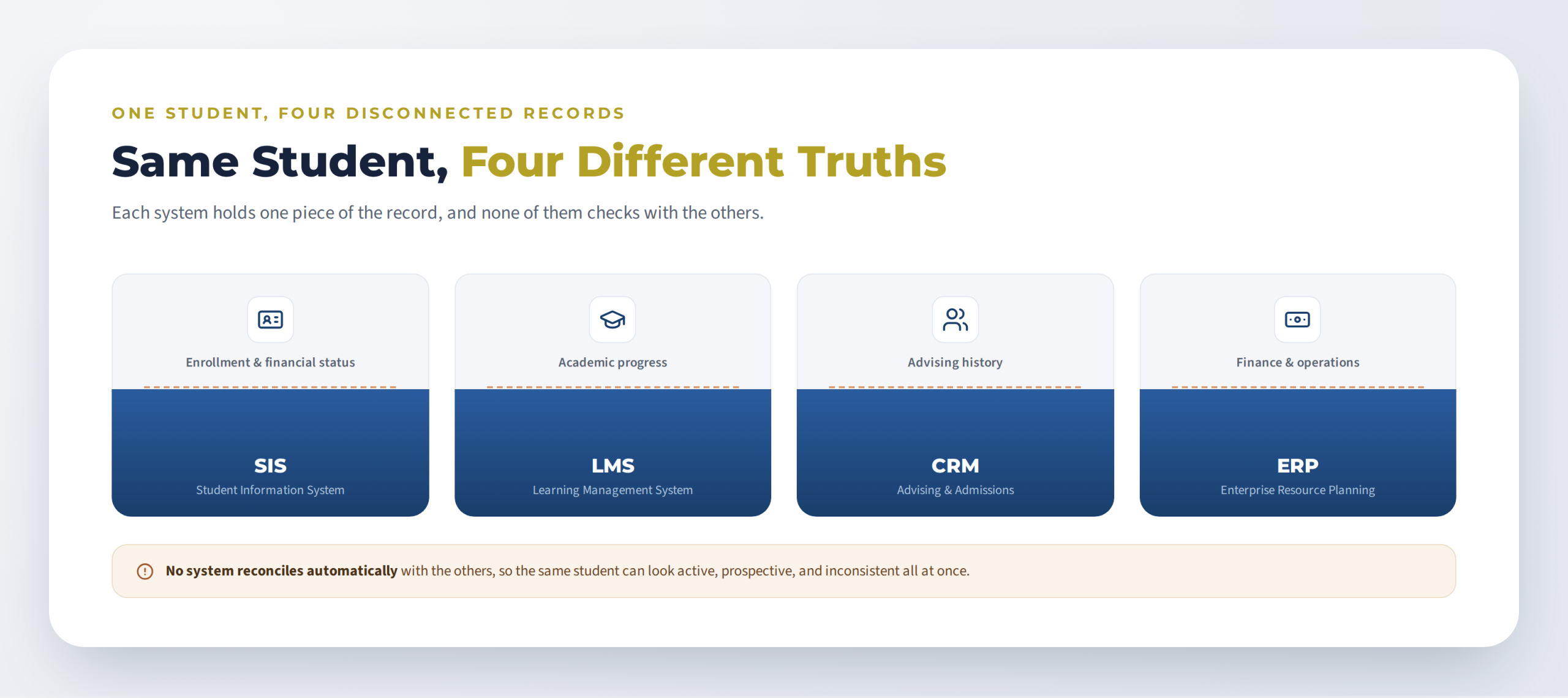
SIS, LMS, CRM and ERP systems often end up siloed because universities acquire them at different points in institutional history, from different vendors, for different departments solving different problems. Registrars adopt an SIS for enrollment and records, academic departments an LMS for course delivery, admissions offices a CRM for student relationships, and finance and HR an ERP for operations. Each purchase optimizes for one department’s need at the time, not cross-system consistency years later, and the systems are not always built around a common institutional data model, particularly when implemented independently.
What Does Fragmentation Actually Cost an Institution?
Fragmented systems can create costs through three recurring symptoms: duplicated data entry, delayed reporting, and inconsistent student records. Duplicated entry happens when staff re-enter a student’s contact details into the CRM after they change in the SIS. Delayed reporting happens when a research team manually exports and reconciles spreadsheets from all four platforms for a single report. Inconsistent records happen when a student shows as actively enrolled in the SIS but still as a prospective applicant in the CRM.
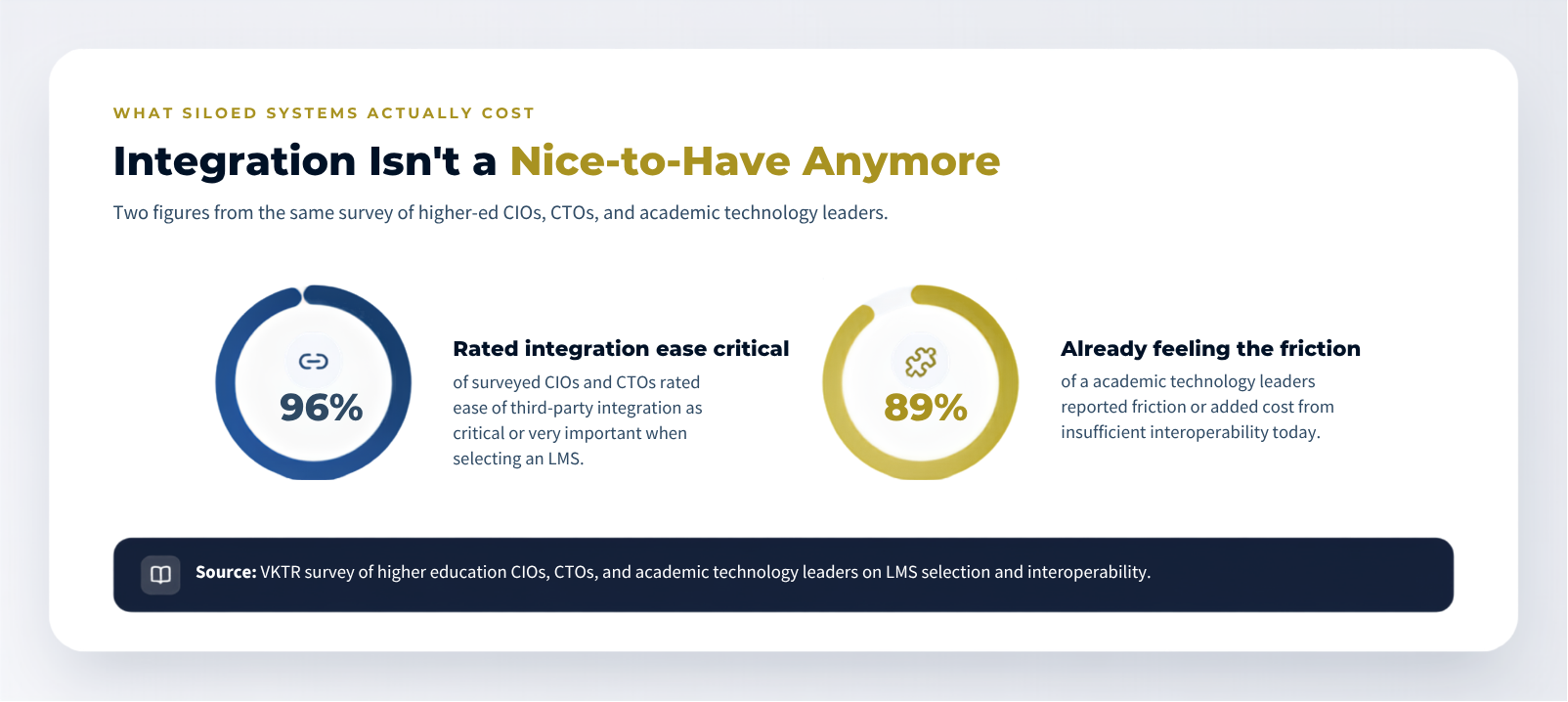
A VKTR survey conducted for its LMS comparison found that 96 percent of CIOs and CTOs rated ease of third-party integration as critical or very important in LMS selection, and 89 percent of academic technology leaders reported friction or added cost from insufficient interoperability between their LMS and systems such as the SIS, library systems, or assessment tools.
What Does ‘AI Integration’ Actually Mean in This Context?
Integrating SIS, LMS, CRM, and ERP data is fundamentally a connectivity problem, and traditional integration architectures and rule-based pipelines can already handle much of it well.
What AI adds is analytical capability on top of connected, governed data, surfacing patterns that predefined rules may miss. That is the practical difference between basic connectivity and genuine higher education system integration.
What Does a Practical Model for Connecting These Systems Look Like?
Connecting university systems is only the first step. CLaaS2SaaS’s Intelligence OS describes a practical model built on three connected components: an Integration Hub, a Knowledge Hub, and an Agents Hub. The Integration Hub connects approved institutional systems and data so every system works from the same version of student data. The Knowledge Hub organizes institutional policies, procedures, and context into a reusable form, so connected data carries institutional meaning. The Agents Hub is where AI agents work from that shared data and knowledge, interpreting context and supporting staff action.
For example, declining LMS engagement might be associated with later support requests in the CRM. The Integration Hub brings both signals together, the Knowledge Hub supplies the institution’s own definition of meaningful engagement, and an agent can flag the pattern for an advisor to review. Staff should weigh that signal alongside other evidence rather than treat it as proof that a student is at risk.
That three-part structure is what direct, pairwise connections can struggle to replicate as a fifth or sixth system is added, and it is the foundation of a unified student data platform. Once data, knowledge, and agents work together, a university can respond to student and operational signals with more context and less manual coordination.
What Governance Considerations Apply When Unifying Student Data?
Unifying student data across four systems raises three governance considerations an institution must resolve before deployment: data privacy compliance, access control policy, and audit-trail requirements.- Data privacy compliance under the relevant regional framework, such as FERPA in the US or an equivalent law elsewhere.
- Access control policy defining which staff roles can view which unified fields.
- Audit-trail requirements documenting who accessed or modified a record and when.
What Does a Connected System Enable Once It’s in Place?
Once SIS, LMS, CRM, and ERP data can work together, universities can move beyond simply accessing more data. They can identify issues earlier, coordinate action across teams, and decide with a more complete picture of each student and the institution.
Those benefits depend on adoption and trust: staff must use the shared view in their day-to-day workflows, so institutions that track adoption alongside the technical rollout tend to see value sooner than those that assume behavior will change on its own.
CLaaS2SaaS Intelligence OS applies this model to higher education, connecting existing SIS, LMS, CRM, and ERP environments through shared integration, knowledge, and agent capabilities. It gives universities moving toward an AI-First Adaptive University a foundation to build on without replacing their existing systems.
Share


Want to check if this career is for you?