From Student Data to Student Engagement: How AI Turns CRM Insights Into Action
From Student Data to Student Engagement: How AI Turns CRM Insights Into Action
Content
Content
Universities turn CRM data into student engagement by layering an AI scoring and prioritization capability on top of the CRM for higher education, translating raw contact records into a ranked list of students who need outreach today. Many universities already collect useful engagement signals across CRM, LMS, SIS, and advising systems, but those signals often remain fragmented or underused until a staff member notices a problem manually.
The sections below explain why CRM data alone fails to improve engagement, define what an AI student engagement platform adds on top of the CRM, walk through what the resulting workflow looks like for an advising team, and name the metrics that confirm engagement efforts are actually working.
Why Doesn’t CRM Data Alone Improve Engagement?
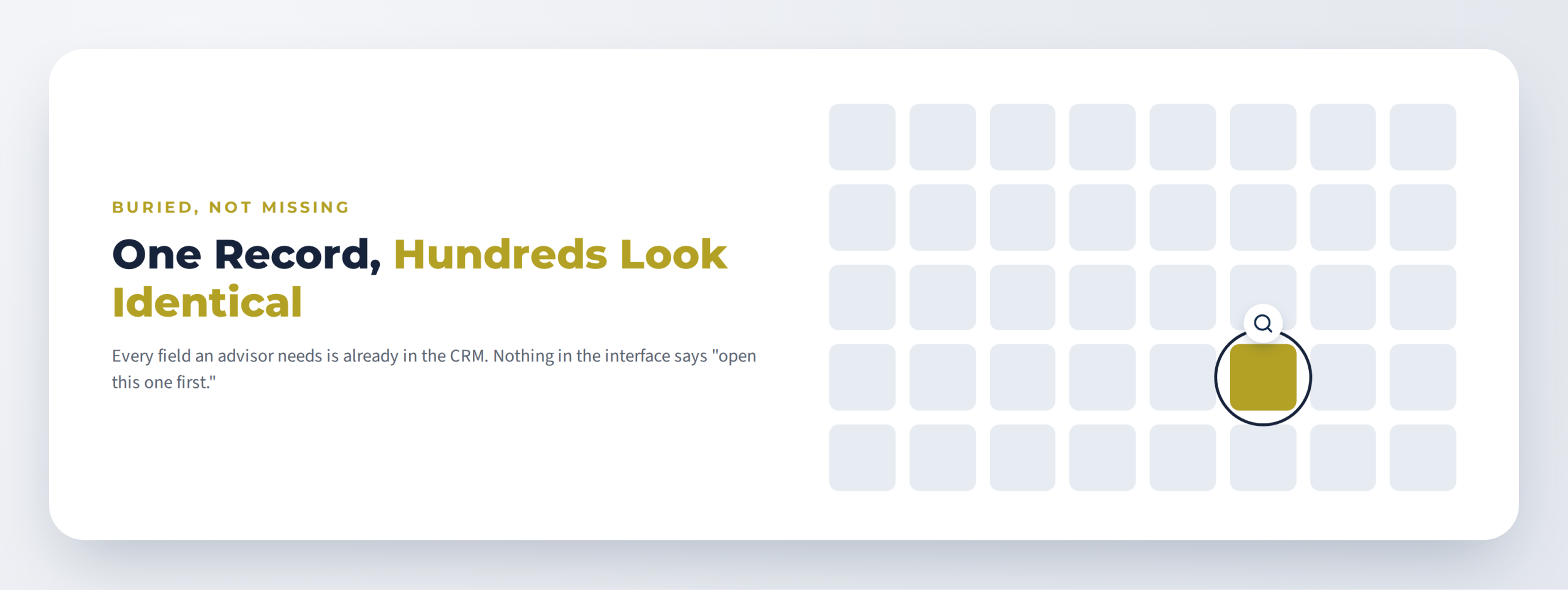
CRM data can describe student interactions and engagement history, but without an intelligence and prioritization layer, staff still need to interpret those signals manually and decide who requires attention first. A CRM record shows a student’s contact history, application status, and communication log accurately, but none of these three fields tells a staff member which currently enrolled student is at risk of disengaging this week, the data is descriptive, not predictive.
An advisor managing a large caseload cannot manually review every student’s engagement history regularly, so outreach tends to become reactive, responding after a student initiates contact or misses several deadlines, by which point the intervention window has narrowed. A student’s record might show three advising appointments last term and one this term, with no email replies in six weeks, data already sitting in the CRM, fully visible to any advisor who opens that record, but without a configured prioritization or alerting capability, nothing surfaces that student ahead of the hundreds of other records an advisor could just as easily open instead.
What Does an AI Student Engagement Platform Add on Top of CRM?
An AI student engagement platform adds a scoring layer that converts raw CRM and system data into a ranked, prioritized list of students needing outreach, the core mechanism behind student engagement analytics. Depending on the implementation, the platform can combine signals such as reduced LMS activity, missed appointments, and declining response rates to help prioritize students who may need support.
EAB’s Navigate360 illustrates a related connected-data model. Its AI Smart Network connects signals across SIS, LMS, CRM, and engagement data to help teams spot friction, prioritize outreach, and coordinate support before challenges become barriers, though exact scoring and prioritization methods vary by platform and configuration.
An AI student engagement platform differs from a CRM dashboard in one respect: a dashboard helps staff view and interpret information, while an AI-assisted platform prioritizes signals and recommends where attention may be needed first, with advisors retaining judgment over the actual response.
What Does Turning Insight Into Action Look Like for Advising Teams?
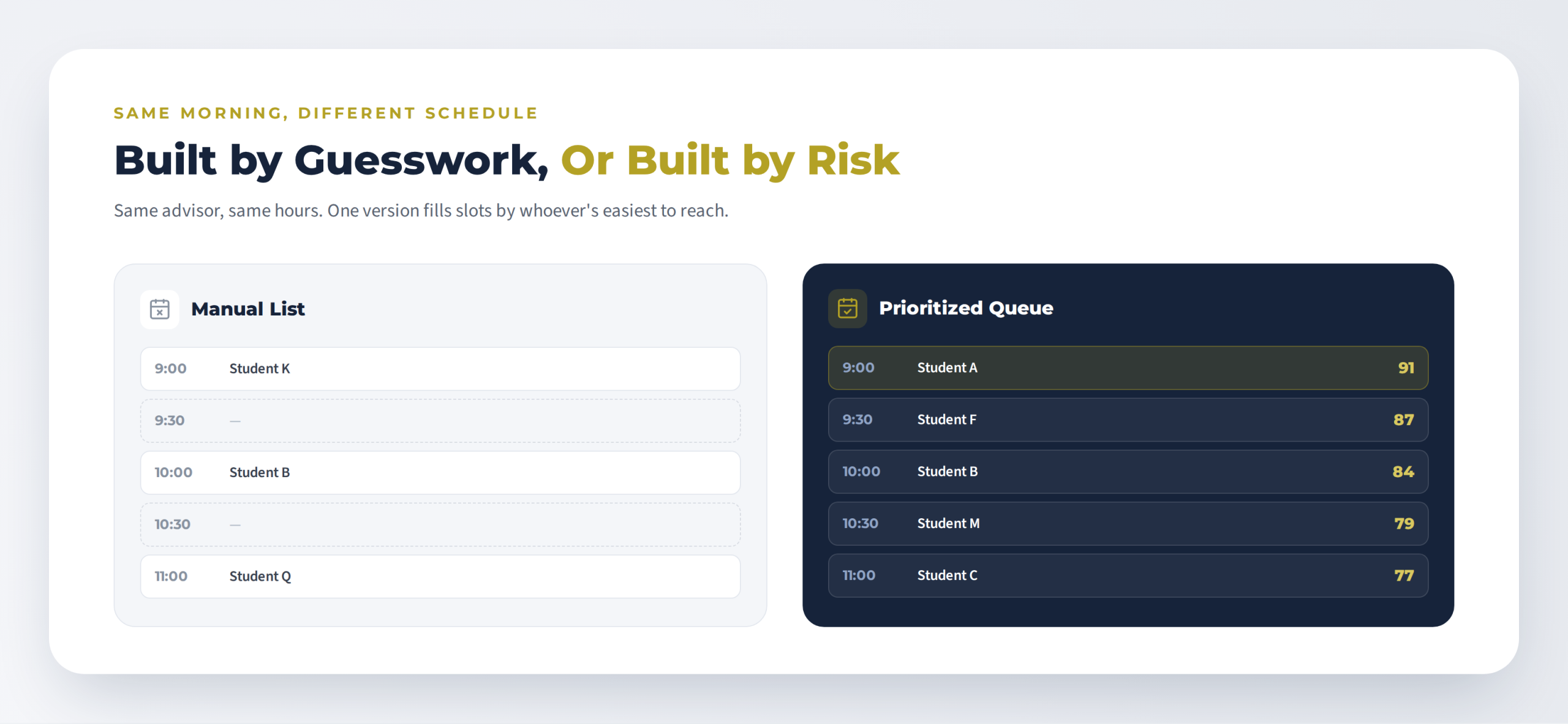
Turning insight into action replaces manual list-building with an automatically generated, prioritized outreach queue. In a manual workflow, an advisor filters CRM records against predefined criteria, such as students who haven’t logged a contact in 30 days. With an AI student engagement platform, an advisor instead opens a queue already ranked by risk score, surfacing students with the strongest indicators of disengagement first.
This shift changes what a team measures: not how many calls it completed, but whether it reached the students with the strongest indicators of support need, a workflow that supports earlier intervention rather than a guaranteed reduction in institutional risk. The queue also updates automatically as new data arrives, a missed assignment recorded in the LMS may change a student’s priority and prompt the team to review whether outreach is appropriate.
How Do Institutions Measure Whether Engagement Efforts Are Working?
Institutions measure engagement effectiveness using three metrics tracked over different time horizons, the backbone of AI-driven student retention strategy. Response rate, measured within days, shows whether contacted students reply. Re-engagement rate, measured within weeks, shows whether a previously disengaging student’s activity recovers after contact. Retention rate change, measured across a full term or year, shows whether outcomes improved alongside the intervention.
Response rate and re-engagement rate function as leading indicators, giving a team confidence within days or weeks that the approach is working. Retention rate change functions as the lagging indicator, best compared against a pre-adoption baseline from at least one prior term rather than a national average reflecting a different student population.
How Should Institutions Build an Engagement Strategy Around Data, Not Guesswork?
Institutions build an effective strategy by treating the risk score as a starting point for outreach, not a replacement for an advisor’s judgment. A high score tells a team where to look first, not what to say once contact happens. That judgment, and training advisors to act on the signal consistently, is what determines whether the workflow actually gets used.
Because this workflow runs on sensitive student data, institutions should treat governance as part of the rollout, not an afterthought: limiting access to risk scores and underlying records to staff roles that genuinely need them, giving advisors enough visibility into how a score was generated to interpret it rather than treating it as a black box, keeping a human in the loop for any decision affecting a student’s standing, and checking regularly for uneven results across student groups. Applicable education-record and data-protection requirements, such as FERPA in the US or an equivalent framework elsewhere, should shape retention and access, and a score should guide review, not determine an intervention automatically.
Institutions exploring how a connected, AI-assisted engagement workflow might fit their own systems are welcome to talk to the CLaaS2SaaS team about what that could look like on their campus.
Share


Want to check if this career is for you?